Every comic collector has a mental list of purchases they regret. The overpriced issue bought on impulse, the duplicate pile discovered while organizing, the poor-condition comic you "forgot to check" before buying.
Every comic collector has a mental list of purchases they regret. The overpriced issue bought on impulse, the duplicate pile discovered while organizing, the poor-condition comic you "forgot to check" before buying. These mistakes are universal: they're part of learning to collect.
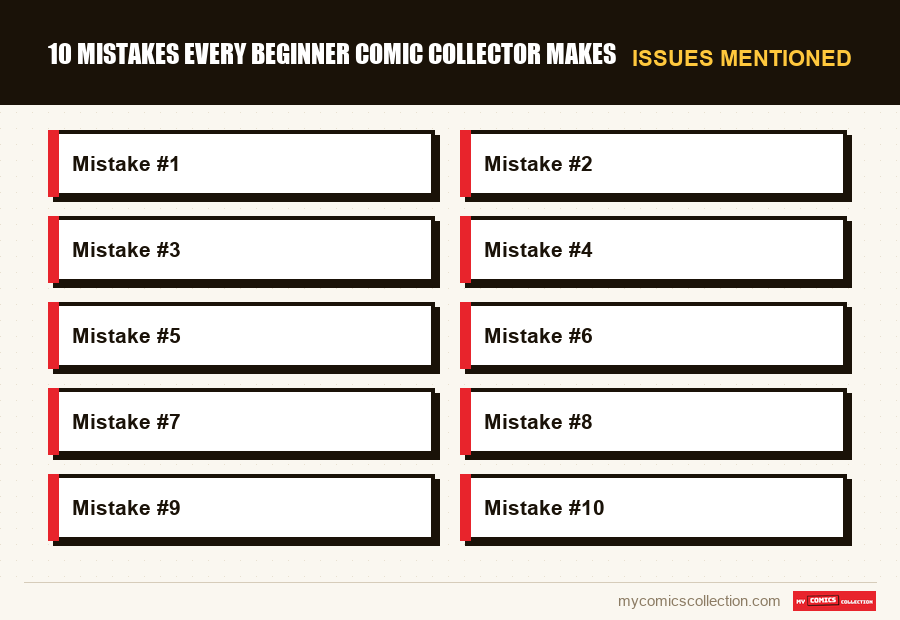
But they're not inevitable. With the right habits from the start, you can avoid most of these mistakes and save several hundred dollars in your collection's early years. Here are the 10 most common mistakes, why they happen, their real consequences, and most importantly, how to avoid them.
Mistake #1, Buying duplicates unknowingly
Your collection grows. Runs get longer. You buy on eBay, at conventions, at shops, sometimes in lots. It becomes impossible to remember every issue you own by heart, especially on 200+ issue runs. The duplicate slips into your collection without you seeing it.
Collectors estimate that between 10 and 20% of their initial budget goes to unidentified duplicates. On a $550 first-year budget, that's $55 to $110 wasted. These duplicates pile up, take space, and end up either in the trash or resold at a loss.
The solution: Catalog every comic you buy in a collection app before putting it away. My Comics Collection automatically alerts you if you try to add an issue already in your collection. No more duplicates, ever.
Mistake #1, duplicates, permanently eliminated
My Comics Collection detects duplicates in real time. Before buying at a convention or on eBay, check in 2 seconds whether you already have the issue. Never pay for the same comic twice again.
Eliminate my duplicates now7-day trial
Mistake #2, Poorly preserving your comics from the start
At the start, you pile comics in cardboard boxes, lay them flat in stacks, store them in the basement or attic "temporarily." You say "I'll organize them properly later." That "later" often arrives too late: after humidity, light or temperature variations have caused irreversible damage.
A comic in Near Mint (9.4) condition can lose 60 to 80% of its value in a few years of poor preservation. Foxing, page yellowing, warped covers, moisture stains: all of this is permanent and irreversible. It's literally money evaporating.
The solution: Buy proper bags and backing boards from your first comic. Store in longboxes in vertical position, in a dry place (humidity < 50%), away from direct light and temperature variations. Basements and attics are to be absolutely avoided.
Mistake #3, Buying without checking market values
You see a comic you want. The seller announces a price. You buy, because you want it and haven't taken time to verify. Or you buy at a convention on impulse, without your smartphone at hand to verify. It's understandable, but avoidable.
Paying $33 for a comic that usually sells for $13 on eBay is a $20 net loss. Multiply by 20-30 purchases over a year and you've easily spent $330-440 too much. Not to mention the psychological effect of feeling "ripped off" when you discover real market value.
The solution: Before any purchase, check completed sales on eBay (not listed prices, actually sold prices). Keep your smartphone with you at conventions. Set yourself a rule: you never pay more than 110-120% of observed market value.
Mistake #4, Neglecting cover variants
Cover variants: direct market vs. newsstand editions, convention variants, ratio variants (1:10, 1:25, 1:50): are a complex aspect of comic collecting. Beginners often don't know they exist, and miss issues worth 5 to 10 times more than the standard edition.
Having bought the standard edition instead of the newsstand variant (often rarer and better valued), or having resold a comic without realizing it was a valuable ratio variant. These mistakes sometimes cost several hundred dollars through simple ignorance.
The solution: Learn to identify the main types of variants: the barcode at bottom right (direct market without full UPC barcode, newsstand with), explicitly mentioned cover variants (cover A, B, C), ratio variants. For post-1990 comics, systematically check if a variant exists before buying.
Mistake #5, Not specializing and buying in all directions
Comics are vast. Marvel, DC, Image, independents, manga, European comics... An enthusiastic beginner buys everything they like without a guiding thread. Result: a scattered collection, hard to manage, impossible to complete, losing coherence and value.
Without specialization, the collection has no direction. You buy 3 issues of one series, 5 of another, never building something coherent. Incomplete runs are worth less than complete runs. And the satisfaction of "finishing something" never arrives.
The solution: Choose a main angle from the start: a character, an author, a period, a publisher. Focus 80% of your budget on that angle. The rest can go to impulse buys. You'll build something coherent and far more satisfying.
Mistake #6, Underestimating condition's importance
A beginner often buys "to read" and figures condition doesn't matter. Then their collection gains value, they start caring about it financially, and realize their "Good" condition comics are worth 5 times less than the same ones in "Very Fine." Too late to recover.
The value gap between a G (2.0) and a VF (8.0) is often 5 to 10 times on important issues. A collection of 100 moderately preserved comics can be worth 5 times less than a similar collection well maintained from the start.
The solution: Always buy the best condition possible in your budget. For issues you want to read, buy a second cheaper copy "for reading" and keep the nice copy bagged. Or read digital versions via Marvel Unlimited or DC Universe.
Mistake #7, Trusting seller self-assessments
"Near Mint," "Excellent condition," "Like new": sellers, especially private ones, tend to overestimate their comics' condition. Not necessarily through dishonesty, but because they don't know precise grading criteria and see their comics through the lens of affective memory.
Receiving a comic described as "Very good condition" that's actually a VG (4.0) when you expected a VF (8.0) is a disappointment and often a financial loss. Especially on eBay where returns aren't always simple.
The solution: Learn official grading criteria (CGC Universal Grade descriptions). Systematically ask for additional photos (spine, corners, interior pages) before buying a valuable comic. And understand that "excellent condition for its age" means nothing in professional grading.
Mistake #8, Ignoring key issues in your own series
You've been collecting Amazing Spider-Man for months. You have issues 200-350. But you don't know that #238 is Hobgoblin's first appearance, that #252 is Black Suit Spider-Man's first appearance, or that #300 is one of the series' most important key issues. You resell them in a lot at a cut-rate price.
Selling a key issue without knowing is one of the most painful mistakes, especially when you realize weeks later what you let go. Once resold, these issues are often impossible to buy back at the same price.
The solution: For each series you collect, do thorough research on key issues. Resources like ComicBookRealm, Key Collector Comics, or My Comics Collection tell you the important issues to watch and never sell lightly.
Mistake #9, Disorganized storage that makes the collection unmanageable
You start with one longbox, then two, then five. Comics pile up without a coherent storage system. You no longer know what you have, you re-buy issues out of fear of missing them, and finding a specific comic takes 20 minutes in the best case.
Chaotic storage leads directly to duplicates (mistake #1), inability to evaluate your collection's actual condition, and growing frustration that can discourage the passion itself. Entire collections have been abandoned for this reason.
The solution: Establish a storage system from the start: by publisher, by character, in alphabetical and numerical order. Label your longboxes. And double this physical storage with digital cataloging that gives you an overview without having to open every box.
Mistake #10, Not documenting purchases and collection value
Nobody wants to do bookkeeping when it's a passion. But not noting what you paid, not tracking your collection's value, not having a global view of your comics portfolio: that's depriving yourself of crucial information for making good decisions.
Without tracking, you don't know whether your collection is gaining or losing value, whether you've spent more than you thought, or whether certain issues are now valuable enough to deserve CGC grading. It's managing your collection in total fog.
The solution: Note the purchase price of each comic at purchase time. Use an app that tracks your collection's estimated value over time. Do a quarterly review: what's my collection worth? What did I spend? What are my most valuable issues?
Collecting this series?
Track what you own, what you are missing and what your collection is worth. 7 day trial.
Start my trial →The common thread across these mistakes
If you read this list carefully, you realize most of these mistakes share a common cause: the absence of a centralized information system about your own collection. Not knowing what you have (duplicates), not knowing what it's worth (values), not knowing how it's stored (organization), not knowing what's important (key issues).
A well-organized collector from the start naturally avoids 8 of the 10 mistakes on this list. Good physical storage is part of the solution, digital cataloging is the other essential half.
What a good collector does from their first comic
- They buy a bag and backing board before putting the comic in their longbox
- They catalog the issue in their app (title, number, condition, purchase price)
- They check if it's a key issue before storing it
- They never resell an issue without verifying its current value
- They consult their catalog before any purchase to avoid duplicates
Frequently asked questions
Avoid the 10 mistakes from your first login
My Comics Collection was designed precisely to eliminate these mistakes: real-time duplicate detection, market value tracking, easy cataloging, key issues flagged. Start right, start now.
Start without mistakes7-day trial