To find the total value of your collection, inventory every issue (title, number, publisher, variant), give it a realistic condition, then look up its current market value from recent sales, never from your purchase price. Then add those values up: the manual method is reliable but slow, while a dedicated app keeps the total up to date automatically.
⚠️ For reference only: This information is provided for educational purposes only. My Comics Collection is not an investment advisor. Prices vary with condition, scarcity, and market trends. Always check recent sales before any sell or insurance decision.
You've got longboxes in your basement, TPBs on your shelves, a few CGC slabs stored in their boxes, and you don't really know what it's all worth. Many collectors never ask this question, either for lack of time or because they assume the answer is "not much." Both reasons are bad reasons to ignore your collection's value.
This guide explains why calculating your collection's total value matters, how to do it correctly, and why the manual method is often inefficient compared to modern tools.
Why know your collection's total value?
The most obvious reason is insurance. If your collection is stored at home and water damage, a fire, or a theft occurs, your insurer will only reimburse what you can prove and justify. Without a valued inventory, you risk ending up with a meager settlement for a collection that was worth thousands of dollars. Even standard homeowners insurance can cover collections if they're declared, but you need a document listing each issue with its estimated value.
The second reason is transmission and estate. If you own valuable comics and something happens to you, your loved ones won't know what to do with them, who to sell them to, or at what price. A well-documented collection with values is a gift to your heirs, who will avoid giving away rare issues at bargain prices for lack of information.
The third reason is simply informed decision-making. Knowing exactly what your collection is worth helps you decide whether to sell certain issues to buy others, whether to grade copies whose value justifies it, or whether to reallocate your comics budget differently.
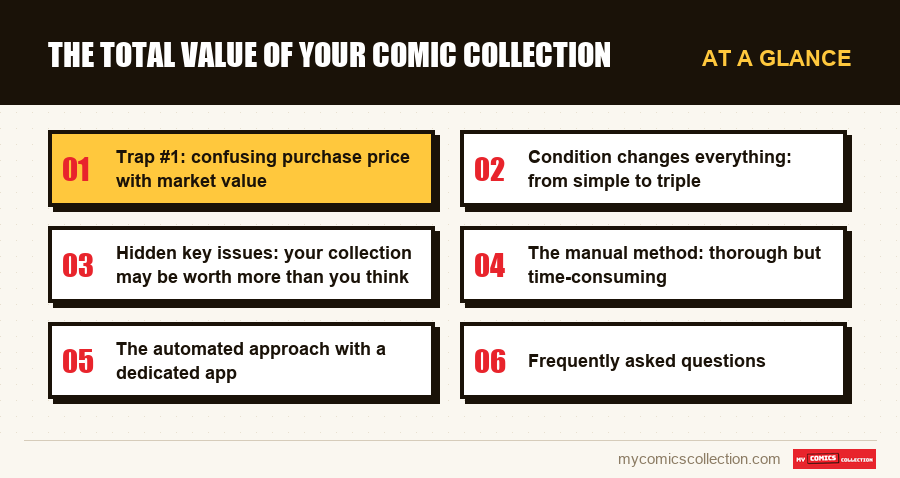
Trap #1: confusing purchase price with market value
Most collectors who try to value their collection make the same mistake: they add up what they paid for their comics. This is a fundamental error. A comic's purchase price has no relation to its current market value.
An Amazing Spider-Man #300 you bought for $88 in 2015 might be worth $330 today, or $50 if the market corrected on that title. A lot of 1990s comics you paid $220 for at a convention might only be worth $44 today, because most comics from that decade were overproduced and have no speculative value. Conversely, a comic bought for $5 in a flea-market bin can turn out to be a $165 key issue.
Market value is what a buyer would pay today for your copy in its current condition. And that value changes constantly, sometimes in days, after a Marvel or DC announcement.
Condition changes everything: from simple to triple
The second classic mistake is ignoring condition's effect on value. Two copies of the same issue in your collection can have very different values depending on their preservation.
An X-Men #94 (first new X-Men team appearance) is worth about $440 in Good (GD), but more than $1,650 in Fine (FN) and can exceed $4,400 in Near Mint (NM). When calculating your collection's total value, treating all your comics as NM will give you a completely fantastical number, and you'll be bitterly disappointed the day you try to sell.
For an honest estimate, you must assign a realistic condition to each copy. Be critical: the vast majority of comics read and stored in boxes without protection for years are Very Good (VG) to Fine (FN), rarely Near Mint. Truly NM comics are those that were never read and went immediately into bags with backing boards.
Collecting this series?
Track what you own, what you are missing and what your collection is worth. 7 day trial.
Start my trial →Hidden key issues: your collection may be worth more than you think
A "modest"-looking collection can hold surprises. Key issues (issues with first appearances, origins, major deaths, or character transformations) can have values far above surrounding issues in the same series.
Some orders of magnitude for context: a common issue from a popular 2000s series generally runs $2-$9. But if one of your comics is the first appearance of a character since added to the MCU, its value can jump to $55, $220, even $550 for the most sought-after first appearances.
Collectors regularly have the pleasant surprise of discovering that a comic bought in a bulk lot for a few dollars is actually a key issue worth dozens or hundreds of dollars. That's one reason a detailed inventory coupled with a pricing database can reveal hidden treasures in your own collection.
The manual method: thorough but time-consuming
If you want to calculate your collection's total value manually, here's the rigorous method:
For each comic, note the exact title, issue number, year, publisher, and if applicable the cover variant. Assign an honest condition on the standard scale (GD, VG, FN, VF, NM). Then search eBay sold listings for that copy in that condition, and record the median of the last 5-10 sales.
For a 50-issue collection, this work represents 3-5 hours. For 300 issues, it's a full day. And the result is already partially outdated the following week, because prices move constantly. Some collectors do this exercise once a year for a rough idea: better than nothing, but far from optimal.
The automated approach with a dedicated app
My Comics Collection was designed precisely to solve this problem. By adding your comics to your digital library (via barcode scan, title-and-issue search, or bulk import) the app automatically calculates your collection's total value by aggregating current eBay listing data.
The total value updates daily. When one of your issues' price moves significantly up or down, you see it on your dashboard. No more outdated estimates and hours of manual research.
For collectors who want to know their collection's exact value for an insurance declaration, sale preparation, or simple curiosity, it's the most practical solution available in 2026.
Frequently asked questions
It's impossible to give an average because collections vary enormously. A 500-comic collection from the 1990s-2000s without key issues might only be worth $220-$550. The same quantity of Silver Age comics or comics including several important key issues might be worth $11,000 or more. Only an issue-by-issue inventory with condition can give you a reliable estimate.
For collections containing Golden Age or Silver Age comics of high value (above $550 per issue), an expert's or specialist dealer's opinion can help. For the majority of modern collections, online tools and eBay sales data are enough for a reliable estimate. A dedicated app efficiently automates this work for common collections.
If your collection exceeds a few hundred dollars in value, yes. Most homeowners contracts cover "personal property" but with caps and deductibles. Valuable collections generally require a specific declaration with a valued inventory. Check with your insurer: some offer collection coverage extensions, often for a modest additional premium.
The comics market is dynamic: prices can change rapidly after Marvel/DC announcements. Ideally, monthly updates give you a current view. With an app that estimates values automatically, this problem is largely solved. Without an automated tool, quarterly updates on your collection's most valuable titles are a good compromise.