Inherit a comic book collection asks concrete questions: how to know what you own, assess its value, decide whether to keep or sell, and avoid mistakes that destroy value. We detail the procedure to follow, from the initial inventory to the final decision, for an heir who discovers a collection without necessarily knowing about it.
An inherited comic book collection can hold treasures like batteries of little value. Before any decision, here is how to identify, evaluate and manage this unexpected heritage, even without prior expertise.
As always in this guide, only cautious recommendations are presented; no estimate can be given without examining actual examples, and each collection is unique.
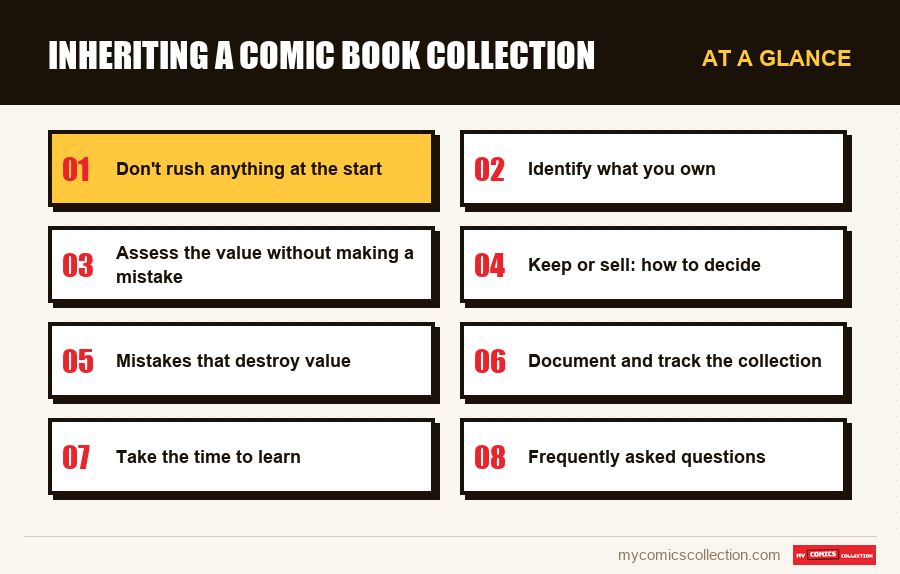
Don't rush anything at the start
The first rule of inheriting a comic book collection is to not rush anything. Faced with boxes or shelves full of copies, the temptation may be to sell in bulk quickly, or on the contrary to throw everything away out of ignorance. These two reactions should be avoided: a collection can contain little-known pieces of great value, just as it can be made up of current examples. Without prior assessment, it is impossible to know. Taking the time to examine what you have inherited, before making any decision, is therefore essential. This initial caution protects against costly mistakes, whether it is selling off a treasure or maintaining a collection of no particular interest at great expense.
It is also necessary to ensure, from the start, the conservation of copies. An inherited collection has sometimes been stored in poor conditions (humidity, heat, light) or risks deterioration in the hands of an heir who handles them without precaution. Before you even know what they are worth, it is best to place the comics in a dry, temperate environment away from light, and handle them with care. This simple precaution preserves the potential value of the heritage while it is evaluated. Not rushing anything does not mean leaving the comics abandoned: the first useful action is to secure their conservation while waiting to see things more clearly.
Identify what you own
Once the collection is secure, the next step is to identify what you own. For an heir who is not necessarily familiar with it, it begins with a methodical census: going through the copies, noting, for each, the series, the number, the publisher and the year. This inventory work, even summary at the start, makes it possible to transform an indistinct mass into a usable list. It reveals the composition of the collection (the series represented, their age, the possible presence of known titles) and constitutes the basis for any subsequent evaluation. Without this identification, it is impossible to estimate value or decide anything in an informed manner.
During this inventory, certain clues may point to potentially interesting pieces. Old comics, first issues of series, copies bearing the mention of key issues or first appearances deserve particular attention. Likewise, the general state of conservation gives an indication: a collection carefully stored in protective sleeves is more likely to contain valuable, well-preserved items than a pile of dog-eared comics. Identifying these signals, without extensive expertise, makes it possible to direct the evaluation towards the most promising examples. The heir does not need to be an expert to identify the avenues to explore: a little method and attention are enough for this first approach.
Assess the value without making a mistake
Assessing the value is the delicate step for a non-specialist heir. The fundamental rule is that the value of a comic depends closely on its precise number and its state of conservation: the same title can be worth very little or a lot depending on these two criteria. It is therefore necessary to estimate the copies one by one for potentially interesting pieces, by looking for recent sales of comparable issues in similar condition. This research, based on prices actually paid and not on prices displayed, gives a realistic picture of value. For the bulk of current copies, a grouped estimate is generally sufficient, these comics being traded in lots at modest prices.
Faced with a collection whose potential value seems significant, it may be wise to call on a professional for an appraisal. A specialist will be able to identify rare pieces, judge their condition precisely and estimate their market value reliably. This expertise has a cost, but it can be justified when the collection clearly contains valuable examples, a poor estimate of which would result in a significant loss. For a modest collection, on the other hand, a personal evaluation supported by online research is often sufficient. The challenge is to adapt the evaluation effort to the value at stake, without underestimating an important heritage or overinvesting in an ordinary collection.
Keep or sell: how to decide
Once the collection has been identified and evaluated, the decision comes: keep or sell. This choice depends on several factors, starting with the personal interest of the heir. Some people discover a passion for comics on this occasion and choose to preserve and enrich the collection; others, without any particular attachment, prefer to sell it. There is no universal right answer: the decision must take into account the value of the collection, the space and care it requires, and the meaning it has for the heir. Making this decision thoughtfully, once all the information is gathered, avoids later regrets.
If the choice falls on sale, several options exist, each with its advantages. Selling valuable coins individually, especially those in good condition or graded, allows you to get the best price, but requires time and effort. Selling the collection in bulk is faster, but generally brings in less. Common pieces are easily sold in lots, while rare examples deserve a targeted sale to informed buyers. Adapting the sales method to the nature of each item, centerpiece or current lot, is the key to best promoting the heritage. Here again, knowledge of the real value guides the right choices.
Collecting this series?
Track what you own, what you are missing and what your collection is worth. 7 day trial.
Start my trial →Mistakes that destroy value
Several common errors can destroy the value of an inherited collection. The most common is the hasty sale in bulk, at a ridiculous price, due to failure to evaluate the contents: an informed buyer can thus acquire very valuable pieces for a modest sum. On the other hand, throwing away or neglecting a collection out of ignorance leads to the loss of potential heritage. Poor conservation-exposure to humidity, careless handling, inappropriate storage-irreparably degrades the condition of the examples and, with it, their value. Each of these errors results from a lack of information and haste, which the method described here precisely allows us to avoid.
Another mistake is to attempt “repairs” or cleanings on the copies, with the idea of improving their condition. This is generally counterproductive: amateur restoration or inappropriate cleaning often reduces the value of a comic in the eyes of collectors, who favor original condition. Likewise, removing or sticking elements, writing on copies or exposing them to light are all actions that harm their value. The rule is not to alter the comics and to leave them in their found state, simply protecting them. This restraint, counterintuitive to a newbie, is in reality the best protection of the value of an inherited collection.
Document and track the collection
Whether he chooses to keep or sell, the heir has every interest in documenting the collection. Building a detailed inventory (series, number, condition, estimated value) provides a clear vision of the heritage and facilitates all subsequent steps, whether it involves insuring the collection, passing it on again or selling it in stages. This documentation transforms a set of copies into a managed heritage, the composition and value of which is known. It is particularly valuable for a preserved collection, whose value changes over time and the market, and which should be monitored.
Modern tools greatly facilitate this monitoring. A dedicated application or database makes it possible to centralize the inventory, provide information on the condition and value of each part, and update this information over time. For an heir who discovers a collection, such a tool offers a structured framework to take control of this heritage, without having to manage everything on paper. It also helps identify valuable coins, monitor market developments and make informed decisions. Inheriting a collection of comics is thus the opportunity, with a little method, to transform an unexpected inheritance into a controlled heritage, from which we make the most knowingly.
Take the time to learn
Inheriting a collection of comics is often an opportunity for a neophyte to become familiar with a little-known universe. Rather than considering this discovery as a constraint, we can approach it as a learning opportunity. Understanding the major benchmarks (the main publishers, the major figures, the notion of key number, the importance of the state) allows us to better understand what we have inherited and to make more informed decisions. This time devoted to learning the basics, even briefly, radically changes the way we look at the collection: what was only a pile of indistinct examples becomes a whole that we begin to understand and appreciate at its true value.
This increase in skill does not imply becoming an expert overnight. It consists of gradually acquiring useful reflexes: checking a number, judging a state, searching for a value, spotting an interesting piece. Online resources, guides and dedicated tools greatly facilitate this learning, by providing benchmarks and methods. For the heir, this learning effort is an investment that protects the value of the heritage received and sometimes opens the door to an unsuspected passion. Many collectors started this way, with an inheritance that led them to discover a rich universe. Taking the time to learn transforms an acquired transmission into a true appropriation.
Frequently asked questions
Do not rush anything and secure storage. Place the comics in a dry, cool place away from light, and handle them with care, before any decision. Neither sell in bulk quickly, nor throw away out of ignorance: a prior assessment is essential to know what you have.
By establishing an inventory (series, number, publisher, year) then identifying the indices of value: old comics, first issues, key issues, well-preserved copies in sleeves. The value depends on the specific number and state. For a clearly important collection, professional expertise may be justified.
It depends on the personal interest of the heir, the value of the collection and the care it requires. There is no universal answer. The decision should be made once the collection has been identified and evaluated, thoughtfully, to avoid regrets. In case of sale, adapt the method to each part.
No, it's generally counterproductive. Amateur restoration or improper cleaning often reduces the value of a comic in the eyes of collectors, who favor original condition. The rule is not to alter the copies and to leave them in their found state, simply protecting them.
The hasty sale in bulk at a ridiculous price, due to failure to evaluate the contents: an informed buyer can thus acquire very valuable pieces for little. Poor conservation and attempts at repair are also among the errors that most surely destroy the value of a collection.