
You have comics stacked in longboxes, scattered on shelves, packed into cardboard boxes at the back of the garage. You kind of know what you own, but not exactly. And that's where the trouble starts: you buy an issue you already have, you don't know what your collection is worth, and in case of loss you'd be unable to justify anything to your insurer…
Taking inventory of your comic collection: the most effective method
You have comics stacked in longboxes, scattered on shelves, packed into cardboard boxes at the back of the garage. You kind of know what you own, but not exactly. And that's where the trouble starts: you buy an issue you already have, you don't know what your collection is worth, and in case of loss you'd be unable to justify anything to your insurer. Taking inventory of your comic collection isn't a chore: it's the foundation of any serious collection.
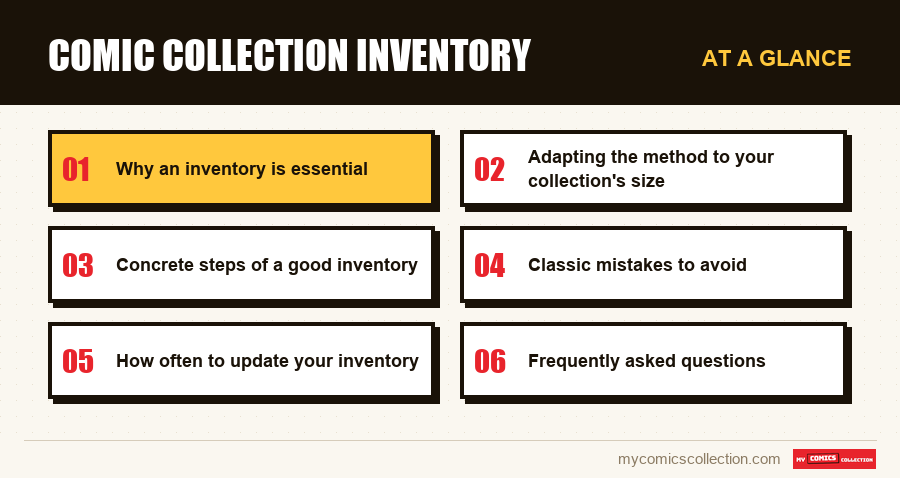
Why an inventory is essential
The first reason, and probably the most immediate, is the duplicates question. When you've been collecting for several years, it's easy to buy the same issue twice, especially at conventions, garage sales or when buying lots. Without a precise inventory, that kind of mistake is inevitable. A collector with a complete, up-to-date catalog can check from their phone in seconds whether they already own the issue in their hands.
Collection value is the second major reason. A comic collection can represent thousands, even tens of thousands, of dollars. Without inventory, that value remains completely invisible. With a digital catalog, you can get an automatic estimate based on market prices, track value evolution over time and make informed buying or selling decisions.
There's also the estate and succession dimension: a collection without an inventory is hard to transmit or appraise. And in case of loss, a dated inventory with photos and values is the only document that lets your insurer reimburse you properly.
Adapting the method to your collection's size
Not all collections require the same approach. The optimal method depends directly on the volume to process.
50 to 200 comics: manual entry is still doable
For a small collection, manual title-by-title entry is perfectly realistic. Count one to two hours of focused work. The upside: you take the time to review each issue, evaluate its condition and add notes. The downside: it's repetitive and prone to input errors. An app with an integrated database significantly speeds the process, even in manual mode.
200 to 500 comics: the scanner becomes profitable
Starting at a few hundred issues, a barcode scanner changes everything. Instead of searching each title manually, you scan the barcode and the app automatically recognizes the comic: its number, publisher, publication date. What would take 8 hours of manual entry takes 2-3 hours with a scanner. That's the inflection point where investing in a good management tool fully pays off.
Beyond 500 comics: an industrial method
For large collections, you have to organize differently. Work box by box: don't try to do everything in one session. Plan several short sessions rather than an exhausting marathon. Sort physically before scanning: first group by publisher or series so you can easily find comics during later checks. At this volume, a complete inventory can take several days spread over a few weeks, and that's perfectly normal.
Concrete steps of a good inventory
1. Preliminary physical sorting
Before scanning anything, spend an hour physically sorting your collection. Group comics by series or publisher. Set aside damaged comics or ones you're unsure about keeping. This prep work saves you a lot of time during entry and prevents you from cataloging comics you're going to resell.
2. Choosing an entry mode
Two main options: barcode scanner (ideal for comics published after the 1980s, which all have a UPC) and manual entry by title and number (essential for older comics or those without a barcode). For a mixed collection, start with everything that has a barcode, then process older issues manually. My Comics Collection offers both modes within the same app.
3. Consistency check
Once entry is done, don't consider the work finished. Browse your catalog and check for inconsistencies: missing issues in a series you thought complete, detected duplicates, incorrect grades. This review phase takes 30 to 60 minutes but prevents errors that could skew all your future management.
Collecting this series?
Track what you own, what you are missing and what your collection is worth. 7 day trial.
Start my trial →Classic mistakes to avoid
The first mistake is wanting to do everything perfectly the first time. Many collectors abandon their inventory halfway because they get stuck on details: what exact grade to assign a lightly read comic, how to classify a cover variant. The golden rule: better an incomplete existing inventory than a perfect one that was never started. You'll refine the data later.
The second mistake is not noting comic conditions. Condition is the primary determinant of value. An Amazing Spider-Man #300 in Near Mint is worth ten times more than in Good. If you omit that information, your inventory loses much of its practical value.
The third mistake is creating an inventory in an unsuitable tool (a spreadsheet, a text document) with no easy update ability or mobile access. An inventory that isn't consulted at the moment of purchase (at a convention or shop) isn't filling its main role.
How often to update your inventory
The ideal answer: immediately after each acquisition. In practice, active collectors find it more convenient to do weekly or monthly updates, logging all comics bought or sold since the last session. The key is to establish a rhythm and stick to it. An inventory that's up to date with a two-week lag is infinitely more useful than a "perfect" one updated once a year.
A good management app makes this discipline easier by making adding a comic as simple as possible: scan the barcode, select condition, done. The less burdensome the update, the more regularly you'll do it.
Frequently asked questions
Yes, ideally. A complete inventory gives you an exact view of your collection and prevents duplicates on every issue, not just the expensive ones. That said, if your collection is very large, you can start with the most valuable comics and complete progressively. What matters is having an existing base.
Comics published before the 1970s-1980s don't have a UPC code. For these issues, entry is manual: title, number, publisher, year. My Comics Collection has a database that includes older comics, enabling title-based recognition even without a barcode.
Standard grades run from Poor to Near Mint or Mint (near perfect). For a practical inventory, a simplified scale is enough: Poor, Good, Very Good, New. The My Comics Collection app offers these levels directly during entry. For comics you plan to have professionally graded, it's worth learning CGC standards.
With a barcode scanner and a proper app, count 3 to 5 hours for 500 comics, roughly 2-3 work sessions. With manual entry, the same volume takes closer to 15-20 hours. That's why a scanner is strongly recommended once the collection exceeds 100-150 issues.