A fire. A flood. A burglary. These scenarios seem abstract until they actually happen to you. For a collector whose collection is worth thousands, even tens of thousands of dollars, the lack of proper insurance can mean a total and irreversible loss.
A fire. A flood. A burglary. These scenarios seem abstract until they actually happen to you. For a collector whose collection is worth thousands, even tens of thousands of dollars, the lack of proper insurance can mean a total and irreversible loss. Yet the vast majority of comic book collectors never check whether their homeowner's insurance actually covers their collection, and the answer is almost always: not enough.
This practical guide explains what standard homeowner's insurance does (and doesn't) cover, how to estimate the insurable value of your collection, and how to find the right coverage.
Why insure your comic book collection?
The value of a comic book collection is often underestimated, including by its owner. You start by buying a few issues at $5-10 each, and years later you end up with a collection whose real market value exceeds $5,000, $10,000, or $50,000. It happens gradually, invisible in daily life, until disaster strikes.
The real risks to cover:
- Theft : a targeted or opportunistic burglary. CGC-graded comics and key issues are recognizable and resalable goods.
- Fire : comics burn easily and are destroyed beyond recovery. No salvaging is possible.
- Water damage : a leak, a burst pipe, a roof infiltration. Moisture is the number one enemy of comics: mold, warping, permanent discoloration.
- Natural disaster : flooding, storms. Less frequent but devastating.
- Accidental damage : a CGC slab that falls and cracks, a stack of comics knocked over by a child or a pet.
Does homeowner's insurance cover comics?
The short answer: yes, partially, but probably not enough for a significant collection.
A standard homeowner's insurance policy covers personal property against common risks (fire, theft, water damage). However, two critical points limit this coverage for collectors:
The overall personal property cap
Standard policies set a maximum reimbursement amount for all personal property, calculated as a percentage of the property's value or set as a flat amount. This cap is often insufficient for large collections.
The specific cap for "valuables"
Most homeowner's policies include a specific clause for valuables : generally defined as any item whose individual value exceeds a threshold (often $300 to $500). These items are subject to a sub-limit, often between 10 and 15% of the total personal property cap, and some policies simply exclude them from coverage without prior declaration.
Urgent check: Call your insurer or read the general terms of your policy. Look for the terms "precious objects," "collections," "valuables." Check the applicable cap and the proof requirements in case of a claim. Do not assume you are covered.
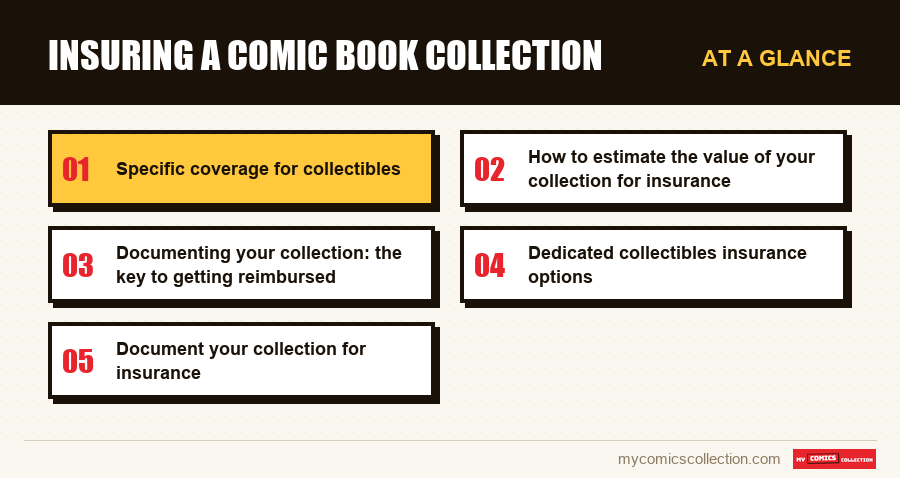
Specific coverage for collectibles
For a collection whose total value exceeds $2,000-3,000, standard coverage will generally not be sufficient. Options to explore:
The "valuables" rider on your homeowner's policy
Most insurers offer a rider or specific extension for collections and valuables. This rider allows you to declare your collection at its actual value and increase the reimbursement cap accordingly. The additional premium is generally low relative to the insured value, often 0.5 to 1% of the declared value per year.
To activate this rider, you will need to provide:
- A detailed inventory of your collection with estimated values
- Proof of value (purchase receipts, CGC certificates, price guide references)
- Sometimes, a professional appraisal for items exceeding a certain amount
Dedicated collectibles insurance
There are insurers and brokers specializing in collectibles insurance (art, coins, stamps, comics, sports cards). Companies like Hiscox , AXA Art, or specialized brokers offer dedicated policies with more tailored coverage: agreed value (no disputes over value in case of a claim), transit coverage, and coverage at conventions and fairs.
How to estimate the value of your collection for insurance
To declare your collection at its fair value, you need a reliable and recent estimate. Methods recognized by insurers:
eBay sold listings
Completed sales on eBay are the most widely accepted reference by insurers because they represent real market prices. For each valuable comic, note the 3-5 most recent comparable sales (same issue, same condition, same edition). The average of these sales is your benchmark value.
GoCollect and price guide databases
GoCollect aggregates CGC sales data by grade and provides trend charts. For graded comics, it is the most precise and well-documented reference.
CGC certificates
A CGC-graded and certified comic has a value that is more easily defensible with an insurer: the grade is documented, and the corresponding value is verifiable in sales databases. CGC slabs are also harder to falsify in case of a fraudulent claim, something insurers appreciate.
The Overstreet guide
The Overstreet Comic Book Price Guide, published annually, is recognized by many insurers as an official pricing reference. Its drawback: it lags behind fast market movements, especially for speculative modern comics.
Collecting this series?
Track what you own, what you are missing and what your collection is worth. 7 day trial.
Start my trial →Documenting your collection: the key to getting reimbursed
In case of a claim, the burden of proof is on you. Without documentation, you cannot prove what you owned or its value. Here is the recommended documentation process:
Photograph each valuable item
For any comic worth more than $50, take a front/back photo with date metadata enabled. Store these photos in the cloud (Google Photos, iCloud), if your home burns down, photos on your local computer burn with it.
Keep a complete, up-to-date inventory
A spreadsheet or a dedicated app like My Comics Collection lets you maintain a structured inventory: series, issue number, condition, edition, estimated value. The export of this inventory is a useful reference document for your insurer and in case of a claim.
Keep all purchase receipts
eBay invoices, PayPal receipts, convention receipts, shop invoices, keep everything in digital form in a dedicated cloud folder. A $500 purchase receipt for a comic is the strongest proof of its acquisition value.
Update your documentation regularly
A growing collection needs growing documentation. Update your inventory after each significant acquisition and do a full reassessment at least once a year. Market values change quickly.
Store documentation outside your home
Inventory and photos stored only at your home can be lost in the same disaster as your collection. Use the cloud, email documents to yourself, or store a copy with a trusted friend or family member.
Dedicated collectibles insurance options
The collectibles insurance market is less developed in some countries than in the United States, but options do exist:
Hiscox Art & Collections
Hiscox is one of the world leaders in art and collections insurance. Their "Collections" product covers collectible items including comics, with agreed value coverage: you declare the value of your collection, and in case of a claim, you are reimbursed without any dispute over that value. Ideal for significant collections.
The "art and collectibles" extension from your regular insurer
Most major insurers offer a specific extension or rider. Call your agent and explicitly ask for coverage for your "comic book collection", specify the total estimated value. The surprise is often that the additional premium is low.
Specialized insurance brokers
For collections whose value exceeds $10,000-20,000, a broker specializing in art and collectibles insurance can find tailored products that general agencies do not offer. Look for specialized brokers in "collections insurance" or "art insurance" in your area.
Final tip: Do not under-declare the value of your collection to save on the premium. In case of a claim, if your insurer discovers that you declared $2,000 for a collection actually worth $15,000, they can apply the under-insurance rule and proportionally reduce your reimbursement, or deny the claim entirely.
FAQ, Insuring your comic book collection
Document your collection for insurance
My Comics Collection lets you maintain a complete inventory with estimated values for each issue, the essential foundation for any insurance process. Export your inventory in one click and send it to your insurer.
Create my inventory for freeNo commitment · Instant access · See pricing