
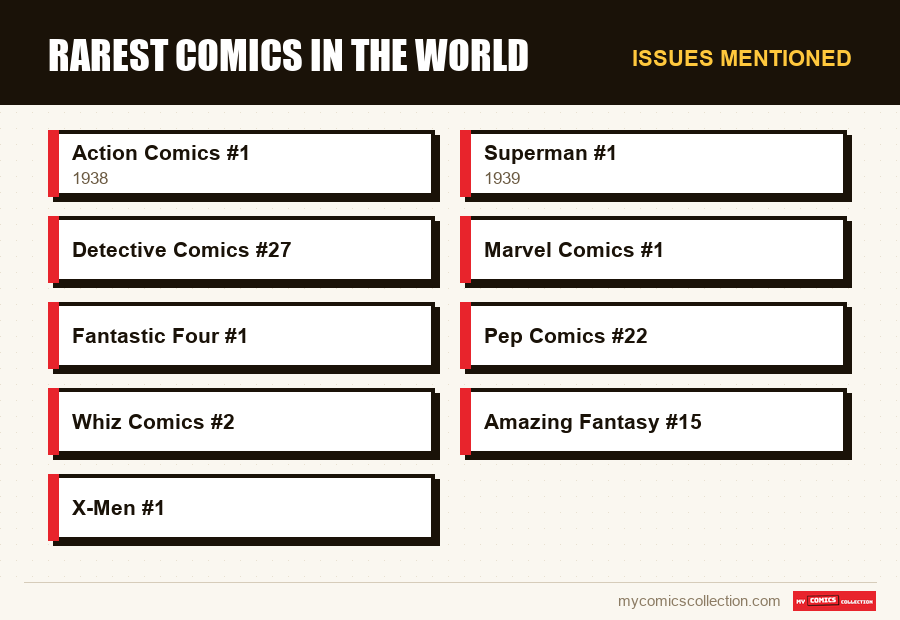
The rarest comics in the world are not necessarily the oldest, but those whose original circulation has been the most decimated by time: pestle of war, intensive reading by children, acidic paper, merciless newsstand distribution. The absolute record today belongs to a Action Comics #1 (1938) graded CGC 9.0, sold over the counter for $15 million by Metropolis Collectibles and ComicConnect, in front of a Superman #1 (1939) sold for $9.12 million at the end of 2025 and another copy of Action Comics #1 in CGC 8.5 sold for $6 million at Heritage Auctions in April 2024. Other seminal titles like Detective Comics #27 ($1.82 million), Marvel Comics #1 (2.43 million), Fantastic Four #1 (2.04 million) or not found Pep Comics #22: barely 21 unrestored examples listed by CGC: complete this very closed circle where census rarity, pedigree and state of conservation dictate seven-figure prices.
Talking about “rarity” in comics is a more subtle exercise than it seems. An issue published in several hundred thousand copies in 1938 can today become one of the rarest objects in all of popular culture, simply because almost its entire circulation has disappeared. Conversely, certain comics that are objectively rarely printed remain almost anonymous to the general public because their content has never aroused any enthusiasm. True rarity therefore combines three factors: the original mintage, the survival rate over nearly a century, and current collector demand: it is this conjunction which shapes the prices that we observe today in the auction room.
This guide takes a look at comics whose rarity is documented by official censuses (the CGC Population Report in the lead) and whose recent sales, public or private, give a reliable snapshot of the market as it behaves at the moment. Each price quoted comes from a sale actually made and sourced: no invented estimates. We will also see why certain titles, although in high demand, remain almost impossible to find in high grades, and how recent film adaptations have directly had an impact on these ratings.
Why have some comics almost disappeared: editorial history and survival factors
In the 1940s, comics were not designed as objects to be kept: they were ten-cent booklets, printed on cheap newsprint, sold on newsstands and intended to circulate from hand to hand until they completely wore out. American distribution at the time operated on a merciless return system: unsold copies had their covers torn off and returned to the publisher as proof of non-sale, while the rest of the magazine went directly to the pestle. A print run of 400,000 copies may thus leave, eighty years later, only a handful of dozens of identifiable and gradable copies.
World War II adds an extra layer of destruction. Paper collection campaigns organized in the United States between 1942 and 1945 directly encouraged households to donate their stacks of comics to the war effort: a practice which removed from circulation considerable quantities of titles published between 1938 and 1942, precisely the period which saw the birth of Superman, Batman, Captain Marvel and the first MLJ heroes like Archie Andrews. It is this editorial window, known as the Golden Age, which today concentrates the majority of the rarest comics listed by grading organizations.
The CGC Population Report, updated continuously, remains the reference tool to objectify this rarity: it indicates, for each number and each grade, how many copies have actually been submitted for certification since the creation of the company in 2000. This figure obviously does not capture copies never graded or still in undeclared private collections, but it provides a solid and comparable statistical basis from one title to another: it is on this basis that all of the figures for rarity cited in this article.
Action Comics #1 and Superman #1: the birth of the multi-million dollar superhero
Published in June 1938 by Detective Comics Inc. (future DC Comics), Action Comics #1 marks the first appearance of Superman and, by extension, the birth of the superheroic genre as we know it. It is today, without a doubt, the most popular comic in history. In April 2024, a CGC 8.5 graded example from the prestigious “Kansas City” collection sold for $6 million at a Heritage Auctions sale, setting a new public record. This record itself was shattered at the end of 2025 when a copy of Superman #1 (1939), discovered in an attic and graded CGC 9.0, sold for $9.12 million: the highest sale ever recorded for a comic book to that date. The record changed hands again shortly after: an Action Comics #1 graded CGC 9.0, negotiated over-the-counter by Metropolis Collectibles and ComicConnect on behalf of buyers and sellers who remained anonymous, sold for $15 million, becoming the most expensive pop culture object ever sold, all categories combined.
What distinguishes these sales from more common transactions of the same title is the grade: almost all known copies of Action Comics #1 are below VF (8.0) on the CGC scale, the intensive handling of the period having left few copies in near-mint condition. A copy graded CGC 0.5, the lowest possible grade, itself sold for $408,000: a figure that reflects the demand for this title, regardless of condition. This price hierarchy illustrates a constant rule of the rare comics market: beyond a certain level of census rarity, each additional level of grade can multiply the value by two, three, or even more.
Detective Comics #27: Batman's first appearance
Released in May 1939, Detective Comics #27 introduced Batman from the pens of Bob Kane and Bill Finger. With only 77 copies listed in the CGC Population Report, only eight of which are in a universal grade higher than the title's average, it is one of the most difficult comics to locate on the market. In March 2024, a CGC 6.5 graded copy set a new record for the title when it sold for $1,825,088 at a ComicConnect sale, surpassing the previous record of $1.74 million achieved by this same copy two years earlier. Detective Comics #27 is part of a very restricted circle of barely eleven comics having, at least once, exceeded the million dollar mark in public sales.
The rarity of this title is due less to a particularly low print run than to its age and the nature of the medium: it was, like Action Comics #1, a low-cost monthly issue, not designed to be kept. The comparison between the two titles is also instructive: Detective Comics #27, released a year after Action Comics #1, benefits from an even smaller census in proportion, which explains why even average grade copies reach seven-figure sums as soon as they go on sale.
Marvel Comics #1: the origins of the House of Ideas
Marvel Comics #1, published by Timely Publications in October 1939, was the very first issue of what would become Marvel Comics. It introduces the original Human Torch and Namor the Sub-Mariner. The most iconic copy of the title, known as the "Pay Copy" because the publisher at the time used it to note payments made to contributors directly on seven interior pages and the cover, sold for $2,427,777 at a ComicConnect sale in March 2022, graded CGC 9.2: a record still in effect for this title. Before this sale, the previous record belonged to a CGC 9.4 example of the “Windy City” pedigree, which sold for $1.26 million in 2019.
This title well illustrates the notion of "pedigree" in comics: beyond the numerical grade, the provenance and conservation history of a copy (original collection, storage conditions, particularities such as Pay Copy annotations) can become arguments of value in their own right, sometimes more determining than the grade itself for institutional buyers and major collectors.
Pep Comics #22: the untraceable grail from Archie Comics
Published by MLJ Magazines in December 1941, Pep Comics #22 marks the very first appearance of Archie Andrews, Betty Cooper and Jughead Jones: the founding characters of what would become Archie Comics. It is today one of the rarest comics of the entire Golden Age: the CGC census only counts 21 unrestored copies in total, with an average rating of only 3.24, one of the lowest among the twenty most sought-after comics of the period. Nearly half of the known examples show traces of restoration, which further limits the number of “pure” copies available to purists.
The documented public sale record for this title remains an unretouched copy graded CGC 8.0, sold for $252,100 in September 2017. The Overstreet 2019 guide for its part valued a copy graded 9.2 at $375,000, placing it in the top 10 of the guide's most valuable Golden Age comics. What makes Pep Comics #22 particularly interesting for understanding scarcity is that it is not the most expensive title on this list, but rather one of the most difficult to physically locate: the demand for Archie Comics, which is very real, remains structurally lower than that for Superman or Batman, which keeps its rating below its level of objective rarity.
Collecting this series?
Track what you own, what you are missing and what your collection is worth. 7 day trial.
Start my trial →Whiz Comics #2: Captain Marvel, Shazam and Rarity at Fawcett
Whiz Comics #2 (numbered #2 but in reality the very first issue published, Fawcett having skipped number 1 for legal deposit reasons) appeared in February 1940 and introduced Captain Marvel (now Shazam), Superman's direct rival who would become, at the height of his popularity in the 1940s, the best-selling superhero on American newsstands. The CGC Population Report lists only about 49 graded copies in total, with only 22 unrestored, and just four unrestored copies graded 6.0 (Fine) or higher-a rarity in high quality comparable to that of the very first DC titles from the same period.
The sales record for this title belongs to the highest-graded copy known, a CGC 9.0, sold for $281,001 during a ComicConnect sale. The more modest grades also remain in demand: examples in grade GD (2.0) and FN (6.0) are traded on the market for several thousand dollars according to specialized price guides, proof that the demand for this character, supported today by its own film franchise, irrigates the entire scale of grades, not just the top.
Amazing Fantasy #15: Spider-Man enters the scene
Amazing Fantasy #15, dated August 1962 and by Stan Lee and Steve Ditko, introduced Spider-Man in what was then an anthology title on the verge of cancellation. The absolute record for this comic remains a copy graded CGC 9.6, sold for $3.6 million during a Heritage Auctions sale in September 2021: at the time, the highest price ever paid for a comic book, all periods combined, even surpassing an Action Comics #1 graded CGC 8.5 sold for $3.25 million. This 2021 record still stands to this day for this specific grade.
The market also remains active on mid-grades: in February 2024, a CGC 8.0 graded copy sold for $271,000 at a ComicLink sale, confirming that even medium-high condition copies of this title continue to generate six-figure sums. Amazing Fantasy #15 illustrates a dynamic specific to the Marvel Silver Age: unlike the Golden Age comics, the original print run was already larger and better documented, but the demand for Spider-Man, fueled for two decades by cinematic adaptations, has pushed the price up well beyond what its relative rarity would justify on its own.
X-Men #1 and Fantastic Four #1: the silver age rarity in very high grade
X-Men #1, published in September 1963, introduced the original team of mutants created by Stan Lee and Jack Kirby. The CGC census currently only has two copies graded 9.8 and four graded 9.6 - a very high grade rarity which contrasts with an original print run much higher than that of Golden Age comics. The documented record for a CGC 9.8 remains a sale of $492,937.50; On the 9.6 grade side, a ComicConnect Event Auction sale reached $807,300, the highest price ever paid for this title across all grades, while another transaction on a 9.6 copy reached $872,000 in 2022.
Fantastic Four #1, published in November 1961 and often considered the birth certificate of the integrated Marvel Universe, followed a similar trajectory. A CGC 9.6 graded example (the highest grade ever recorded for this title, with only one other equivalent example known and none higher) sold for $2,040,000 at a Heritage Auctions sale in September 2024, breaking the previous record of $1.5 million set in 2022 by a CGC 9.2 example. In both cases, the lesson is the same: for high-circulation Silver Age titles, rarity no longer depends on the total number of surviving copies, but almost exclusively on the extreme top of the grade scale, where there are sometimes only one or two "nearly mint" copies left on the entire planet.
The impact of adaptations on the rating
The rare comics market does not evolve in a vacuum: it reacts directly to the cinematographic and cultural news of the characters concerned. The release of the James Gunn-directed Superman film in July 2025 coincided with a dramatic resurgence of interest in the character's earliest comics: a context widely cited by market observers to explain the timing of the record sales of Superman #1 ($9.12 million) and then Action Comics #1 ($15 million) that followed. Industry analysts expect this effect to also spread to the title's lower grades, more accessible to collectors, in the months following the film's release.
The same mechanism worked for Fantastic Four #1: its record sale of $2.04 million in September 2024 came ahead of the release of the new Fantastic Four film carried by Marvel Studios, a proximity in timing which is probably not fortuitous as the announcement of a major adaptation tends to revive demand for the very first issues of the character concerned. Batman has experienced a comparable dynamic for decades: each new trilogy or cinematic series of the character is historically accompanied by a peak of interest and new record sales for Detective Comics #27, including for very modest grades. Spider-Man has followed the same pattern since the launch of the modern film franchise: demand for Amazing Fantasy #15 has remained exceptionally high across all grades, driven by the character's continued on-screen success rather than any isolated event.
For a collector, this correlation has a concrete practical consequence: the periods immediately preceding or following the release of a major adaptation are often the least advantageous for buying, with demand artificially inflating prices in the short term, while the calmer windows of the cinematographic calendar generally allow trading under better conditions.
Buying guide: how to approach the purchase of a rare comic
Acquiring one of the rarest comics on the market cannot be improvised: the amounts involved and the difficulty in verifying the authenticity of a copy require a rigorous method.
- Systematically check the gradation certificate. Each CGC slab has a certification number that can be consulted online on the organization's website; cross-check it with the actual photo of the copy before any financial commitment.
- Consult the CGC Population Report before trading. A seller who presents his copy as "extremely rare" must be able to compare the official census figures for that specific grade: the rarity of a title varies enormously from one grade level to another.
- Be wary of undeclared restored copies. On titles like Pep Comics #22 or Whiz Comics #2, almost half of the census shows traces of restoration; the CGC label clearly distinguishes “Universal” copies from “Restored” copies, a difference that can represent several tens of thousands of dollars.
- Find out about the pedigree of the specimen. A documented provenance (Kansas City, Windy City collection, or other) reassures about the conservation history and can justify a premium compared to an example of identical grade with no known history.
- Never neglect dedicated insurance. A five or six figure copy falls under a specific policy for collectibles, distinct from traditional home insurance whose limits are generally much too low.
- Always compare several recent sales of the same grade before setting a budget. Our free estimator, based on current eBay listings, allows you to obtain in thirty seconds a low, median and high range to situate an offer in relation to the current market.
- Catalog your collection as you go. Whether you already own a few back issues or are starting a collection focused on the Silver Age, our comic collection management application allows you to track each copy, its grade and its provenance in one place.