
Sub-Mariner Comics is the first solo series dedicated to Namor, published by Timely Publications from spring 1941 (issue dated Spring 1941, on newsstands in March) until 1949, then briefly resurrected by Atlas between 1954 and 1955 (issues #33 to #42). Issue #1, with its Alex Schomburg cover showing Namor pounding Axis forces, sold for up to $84,000 in very high grade (CGC 9.0, Larson pedigree, November 2019). The character will then be reborn in a modern series simply titled Sub-Mariner (1968-1974), which introduced cult opponents like Tiger Shark.
Before Superman and Batman, even before the word “superhero” established itself in the American vocabulary, there was already an ambiguous, angry and half-naked character, ready to drown entire cities to avenge his people. Namor the Sub-Mariner is not a hero in the classic sense: he is a fallen prince, half-human, half-Atlantean, whose first mission was never to save the surface people but to punish them. This founding ambivalence, rare for the time, is at the heart of what makes Sub-Mariner Comics one of the most studied titles in the editorial history of what would become Marvel Comics.
Created by screenwriter-cartoonist Bill Everett for the packaging studio Funnies Inc., Namor precedes the creation of Captain America by several months and shares with the Human Torch (Carl Burgos) the status of absolute pioneer of the publisher Timely. His eponymous series, launched in 1941, is the scene of his first entirely autonomous narrative arc: the war of Atlantis against the Axis powers. It is also one of the most fragile and sought-after titles on the Golden Age market, for historical, artistic and statistical reasons that we will detail point by point.
This article traces the complete editorial history of Sub-Mariner Comics, from the obscure origins of the character in an almost impossible to find promotional publication to his successive resurrections, including CGC census data and documented sales which allow us to understand why this title continues to fascinate collectors almost eighty-five years after its creation.
Genesis of an antihero: before the solo series
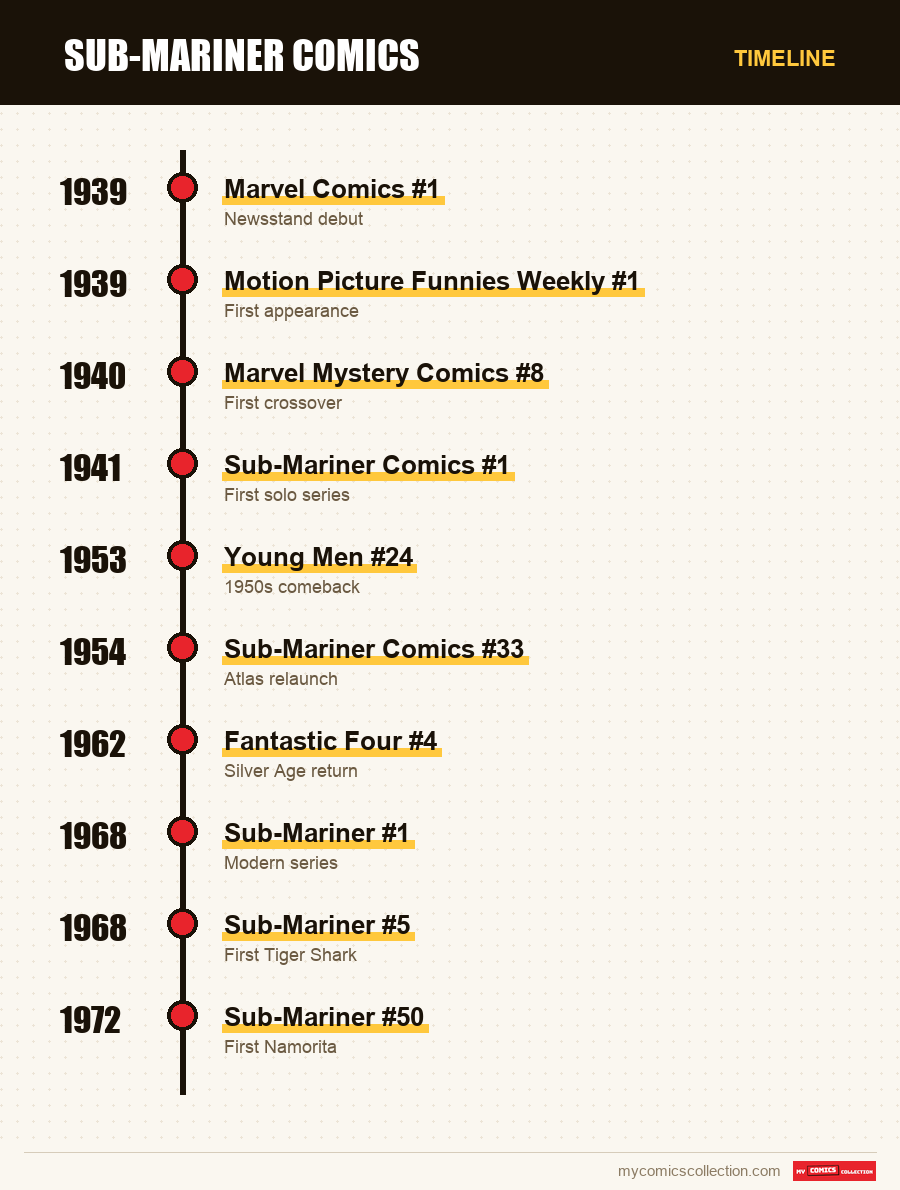
Namor was not born in Sub-Mariner Comics. Its very first appearance dates back to 1939, in Motion Picture Funnies Weekly #1, a 36-page promotional booklet intended for free distribution in American movie theaters. The project was a resounding commercial failure: cinema operators saw no interest in it, and almost the entire print run was never distributed. Result: according to the Overstreet guide, only eight copies are listed today, only one of which is in almost new condition with white pages, the others presenting browned pages characteristic of an edition never put into normal circulation. The so-called “pay copy” graded CGC 9.0 sold for $43,125 at auction in October 2005; a CGC FN-5.5 example reached $20,315 in 2009, and a CGC VG/F 5.0 sold for $15,800 in 2016. This extremely rare status makes it one of the most legendary pieces in the hobby, well beyond the strict scope of the series that interests us here.
It was a few months later, in October 1939, that Namor really reached the general public: he appeared in Marvel Comics #1, the very first comic book published by Timely Publications, alongside the Human Torch. Success is immediate. Namor quickly becomes one of the three pillars of the Timely stable, with the Human Torch of Carl Burgos and Captain America of Joe Simon and Jack Kirby. His growing popularity in the pages of Marvel Mystery Comics logically pushes the publisher to offer him, a year and a half later, his own monthly series.
Sub-Mariner Comics #1 (1941): the founding issue
Sub-Mariner Comics #1 hit newsstands in March 1941, with a cover date of “Spring 1941”. It is a generous editorial page for the time: 68 pages, including 40 entirely devoted to Namor, the rest being occupied by the adventures of the Angel (The Angel) signed Paul Gustavson, a character already known to readers of Marvel Mystery Comics. The cover, by Alex Schomburg, an artist who would become Timely's visual signature throughout World War II, shows Namor directly attacking Nazi forces. It is a precise historical milestone: he is the first character to face the Axis powers on the cover of an American comic book, almost a year before the United States entered the war. This editorial choice is not trivial; he immediately anchored the series in a dimension of patriotic propaganda which would become the norm at Timely until 1945.
In terms of physical rarity, Sub-Mariner Comics #1 suffers from the same handicaps as almost all Golden Age comics: acidic pulp paper, rusty staples, fragile spines, and disastrous domestic storage for decades. The CGC census currently lists 32 copies graded at the Universal level, to which are added a Qualified copy, a Signature Series and three professionally restored copies: figures which testify both to the desirability of the issue and its extreme rarity at high grade. The highest-priced example to reach public auction is a CGC 9.0 of the Larson pedigree, a collectible renowned for the freshness of its conservation: it sold for $84,000 in November 2019, compared to $37,088 at an earlier sale in July 2002 for this same example: a progression that illustrates the basic trajectory of the Golden Age market over nearly two decades.
A title marked by Schomburg’s “war” and “bondage” covers
Alex Schomburg is not only the author of the inaugural cover: he becomes the emblematic roofer of Sub-Mariner Comics for a good part of the Timely run, alternating between swirling battle scenes against the Axis and more provocative compositions, a category that collectors today group together under the name "bondage covers". The Overstreet Guide traditionally places a premium on covers of this type as well as those directly cited in Fredric Wertham's polemical work, Seduction of the Innocent (1954), which fueled the anti-comics moral panic of the 1950s and led to the creation of the Comics Code. This contrasting imagery (warlike patriotism on one side, visual provocation on the other) is an integral part of the graphic identity of the title and partly explains why certain intermediate issues of the series, often overlooked by non-specialists, arouse a disproportionate interest among collectors of Schomburg covers.
Namor's war against the Human Torch: a founding crossover
If we had to choose only one narrative arc to understand why Namor left a lasting mark on the history of American comic books, it would undoubtedly be his confrontation with the Human Torch, staged over several issues of Marvel Mystery Comics (#8 to #10, 1940). This Homeric battle, which precedes the launch of Sub-Mariner Comics, is considered by many historians of the medium to be the very first superhero crossover in American publishing history: long before the formula became a mainstay of the industry's business model. Namor already appears in his most enduring role: that of an antihero whose anger is as dangerous for his adversaries as for the innocents caught in the crossfire. This tension between heroism and destruction permeates the entire series that bears his name from 1941, where the scenarios constantly oscillate between defense of Atlantis, personal revenge and circumstantial loyalty towards the surfacers at war against Nazism.
The 1949 judgment and the resurrection Atlas of 1954-1955
Like almost all superhero titles from the immediate post-war period, Sub-Mariner Comics loses steam as the public turns away from the genre in favor of westerns, horror and comic romance. The series ends after its number #31 in 1949. According to a then common practice consisting of keeping the preferential postal rate attached to a serial number, the numbering is provisionally taken up by titles without any thematic connection -Amazing Mysteries #32, then Best Love #33: an administrative oddity typical of Timely/Atlas publishing of the period.
Namor himself disappears from newsstands until his notable return in Young Men #24 (December 1953), alongside Captain America and the Human Torch. This fleeting return of the founding trio convinced Atlas (the name Timely then bore) to retry the adventure of a solo title: a new series Sub-Mariner Comics, using the historical numbering from #33, was published from April 1954 to October 1955, over ten issues (until #42). Issue #33 reopens the origins of the character, completing the founding story already laid out in Marvel Comics #1 fifteen years earlier. This second life, however, was short-lived: the superhero fashion of the immediate post-war period did not survive the editorial gloom of the mid-1950s, and the title disappeared again in 1955, this time for thirteen years.
1968: the rebirth as a modern solo series
It will be necessary to wait for the thawing of the distribution quotas imposed on Marvel by its historic distributor, Independent News, owned by DC Comics, for Namor to finally obtain a lasting series. In May 1968, Sub-Mariner #1 (sometimes listed Prince Namor, the Sub-Mariner) officially launches the character's first continuing solo series in the modern Marvel era, under the pen of Roy Thomas and the pencil of John Buscema. This seminal issue condensedly traces the character's entire mythology, from his Atlantean childhood to his exploits in World War II, to his more recent clashes with the Fantastic Four and his period of amnesia wandering homeless on the streets of New York: a deft narrative bridge between the Golden Age legacy and the nascent Silver Age continuity.
This series of 72 issues, published until 1974, introduced several elements that had become essential in Namor's mythology: Tiger Shark (Todd Arliss), one of his most emblematic recurring adversaries, made his first appearance in issue #5; issue #8 features a memorable clash with the Thing from Fantastic Four; issue #34 teams him up with the Hulk and the Silver Surfer as the "Titans Three". Issue #50, released for the series' anniversary, was entirely written, drawn, inked and colored by Bill Everett himself: an extremely rare occurrence in the industry at the time, where mass production made this kind of feat almost impossible. Everett, the original creator of the character, finds Namor almost thirty years after having invented him, shortly before his death in 1973.
The impact of adaptations on the rating
Namor has long been one of the few founding characters of the Marvel Universe to have never had a true live-action film adaptation, despite several aborted attempts since the 1990s. This situation changed on November 11, 2022 with the release of Black Panther: Wakanda Forever, directed by Ryan Coogler, in which the character is played by Tenoch Huerta. The adaptation, however, takes notable liberties with the original material: instead of the classic Atlantis of the comics, the underwater kingdom of Namor becomes Talokan, a civilization of Mesoamerican inspiration having fled the surface to escape the Spanish colonizers: an assumed scriptwriting choice, partly motivated by the fact that the name "Atlantis" is already associated with DC Comics' Aquaman in the cinema. The character's powers and mutant origin are also reinterpreted in relation to historical comic continuity.
This type of general public adaptation has a generally well-documented effect on the old comic book market: it revives interest in the first appearances and founding issues of the character concerned, in particular among collectors from the cinema who discover the existence of a paper bibliography dating back several decades. For Namor, this effect mechanically benefits the titles mentioned above:Marvel Comics #1, Motion Picture Funnies Weekly #1 and Sub-Mariner Comics #1: to the extent that these are the only printed milestones capable of documenting the actual genesis of the character brought to the screen. Conversely, the profound changes made to the origin of the character in the film (mutation, Talokan rather than Atlantis) make the Golden Age issues all the more valuable in the eyes of purists, since they are the only ones to tell the original, unedited version of the myth.
Collecting this series?
Track what you own, what you are missing and what your collection is worth. 7 day trial.
Start my trial →Buying guide
- Systematically check the restoration on Golden Age numbers : the CGC census of Sub-Mariner Comics #1 includes three examples graded “professionally restored”: a detail that must appear clearly on the slab and in any sales announcement, and which strongly impacts the price compared to an unrestored example of equivalent grade.
- Distinguish clearly between the two homonymous series: the original Timely series (1941-1949, then 1954-1955, #1 to #42) and the modern Marvel series launched in 1968 (simply titled Sub-Mariner, #1 to #72) have neither the same rarity, nor the same price range, nor the same collector profile. An ambiguous ad mixing the two titles is a red flag.
- Choose Schomburg blankets identified: the artist's war blankets and so-called "bondage" blankets benefit from a premium recognized by the Overstreet guide; check the cover attribution before evaluating an intermediate issue from the 1941-1949 series.
- Consult the CGC census before any high grade purchase: for such a fragile Golden Age issue, the rarity in VF/NM or higher is extreme (32 Universal copies listed for issue #1 alone); a seller advertising a high grade without third-party certification deserves thorough verification.
- Spot the key numbers from the 1968 series: #1 (modern relaunch, complete origin), #5 (first appearance of Tiger Shark), #8 (crossover with the Thing), #34 (team-up with Hulk and the Silver Surfer) and #50 (anniversary issue entirely produced by Bill Everett) concentrate most of the demand on this run.
- Beware of original issues being confused with reprints: numerous facsimiles and compilations (notably the modern omnibuses bringing together the golden age stories) circulate under titles very close to the original series; only an authenticated period example has the collector's value described in this article.
- Have your copy valued before selling or buying: The volatility of the golden age market (#1's CGC 9.0 Larson pedigree more than doubled in value between 2002 and 2019) makes an updated estimate based on actual sales rather than an old printed price guide essential.
Key issues to know
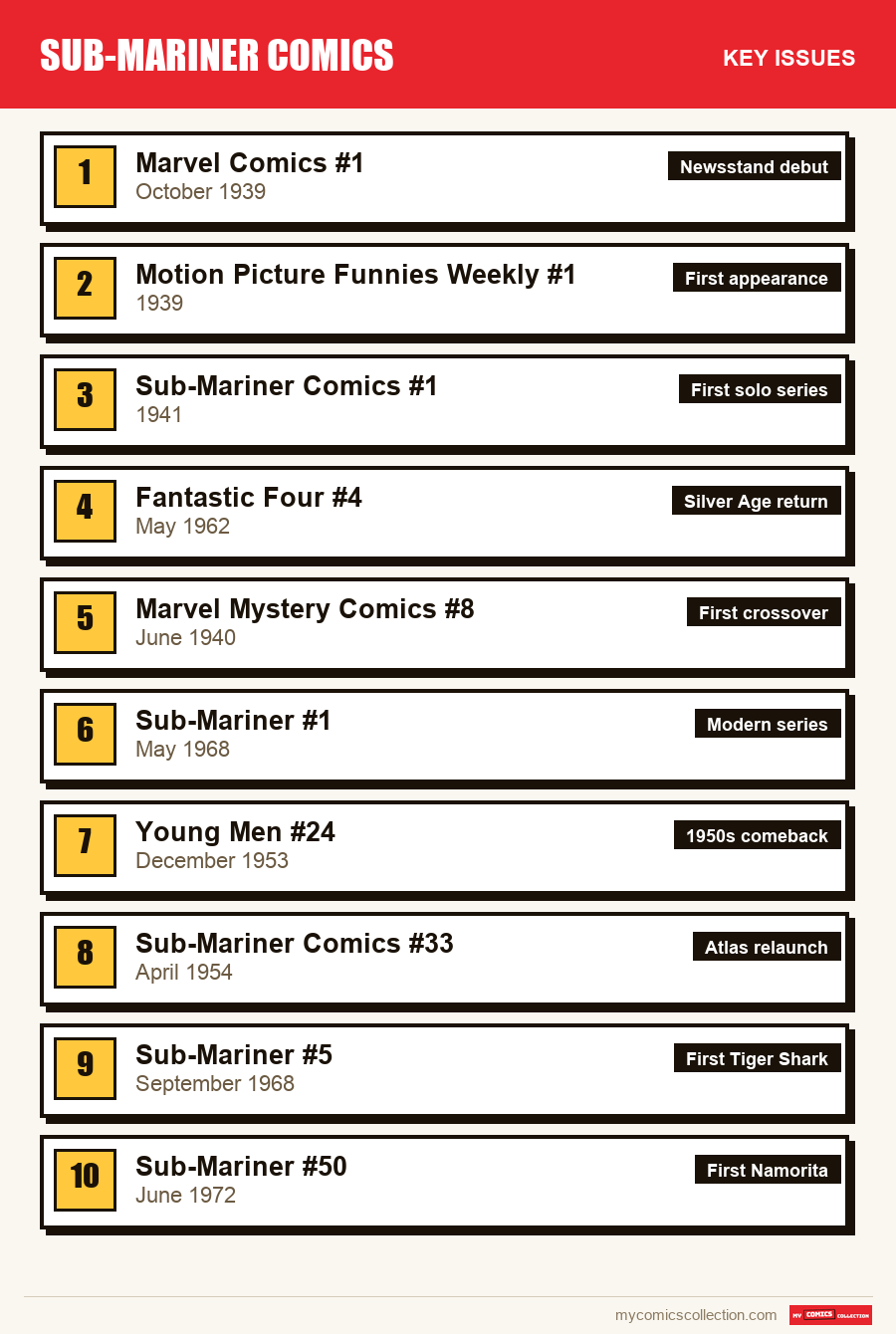
Marvel Comics #1
The first comic book ever published by Timely, this issue introduced Bill Everett's Namor to the general public, alongside Carl Burgos's Human Torch. The first eight pages of Namor's story reprint, in color, the tale that had appeared a few months earlier in Motion Picture Funnies Weekly #1. It is the cornerstone of the entire Marvel universe.
Motion Picture Funnies Weekly #1
This promotional giveaway intended for movie theaters contains Namor's very first story, eight black-and-white pages written and drawn by Bill Everett. The planned distribution never really happened, and only a handful of copies are known. It is one of the rarest pieces of the Golden Age.
Sub-Mariner Comics #1
Dated Spring 1941, the first title devoted to Namor opens with an Alex Schomburg cover showing the Sea Prince attacking Nazi forces while the United States was not yet at war. Bill Everett handles the lead story, which pits the Atlanteans against German U-boats.
Fantastic Four #4
Stan Lee and Jack Kirby bring Namor back: Johnny Storm, the Human Torch, finds him amnesiac in the Bowery and restores his memory. Finding his kingdom in ruins, the prince declares war on the surface world. It is his first Silver Age appearance and the start of a long rivalry with the Fantastic Four.
Marvel Mystery Comics #8
Timely's two stars finally meet: Namor and the Human Torch clash in a duel that runs through issue #10. Often described as the first superhero crossover, the fight sets up a rivalry that would run through the whole of Marvel history.
Sub-Mariner #1
Roy Thomas and John Buscema launch Namor's first lasting monthly series of the modern Marvel era. This issue retells his whole life, from his Atlantean childhood through World War II to his first battles with the Fantastic Four. The series would run 72 issues, until 1974.
Young Men #24
Gone from newsstands since 1949, Timely's three pillars return together: the Human Torch, Captain America and Namor. The story "The Sub-Mariner Returns" puts the prince back in action alongside his friend Betty Dean. This comeback paved the way for the relaunch of his series the following year.
Sub-Mariner Comics #33
Atlas relaunches the series, picking up the original numbering, with Bill Everett back on both script and art. The opening story, "The Origin of the Sub-Mariner", retells the birth of the Sea Prince. This second run ends with issue #42, in October 1955.
Sub-Mariner #5
Roy Thomas and John Buscema create Tiger Shark: Todd Arliss, an injured Olympic swimmer, gains part of Namor's abilities and those of a shark through an experiment. He defeats the prince and kidnaps Lady Dorma, instantly becoming one of his most persistent foes.
Sub-Mariner #50
Bill Everett takes back the character he created on his own, handling script, pencils, inks and colors. The issue introduces Namorita, Namora's daughter, whom Namor rescues from her captors in Antarctica. A return to the roots by Namor's creator, shortly before his death.