
Silver Surfer first appeared in March 1966 in Fantastic Four #48 , created by Stan Lee and Jack Kirby at Marvel Comics. A former astronomer from the planet Zenn-La who became the herald of Galactus to save his world, Norrin Radd rides his cosmic board across the universe and remains one of the publisher's most philosophical characters, defined by the 1970s Stan Lee/John Buscema run and the 1987 Steve Englehart/Marshall Rogers series. This guide traces his creation , his full biography , the series timeline , the key issues to know and the major arcs worth collecting.
Silver Surfer holds a singular spot in the Marvel catalog: a cosmic herald introduced in the Galactus Trilogy from March to May 1966, the character quickly transcended his original role to become a philosophical mouthpiece for Stan Lee. Between 1968 and 1970, his first oversized solo series of 18 issues (drawn by John Buscema) remains one of the writer's most personal projects. The character carries more than fifty years of continuity, runs through Marvel's biggest cosmic events (Infinity Gauntlet, Annihilation, Cancerverse) and remains a Silver Age cornerstone on the secondary market.
This article covers the Surfer's editorial creation, his biography from Norrin Radd to herald and then defender of Earth, the complete timeline of his solo series and defining appearances, the top key issues from a collector's standpoint, plus the cult arcs and runs to know. For analysis focused on values and scarcity, the Silver Surfer key issues guide complements this page.
Silver Surfer biography
Silver Surfer is a Marvel Comics character created by Stan Lee and Jack Kirby. His first appearance comes in Fantastic Four #48 (March 1966), inside the sequence known as the Galactus Trilogy. Lee hadn't planned the character: Kirby added him on his own initiative as the herald of the world-devourer, and the writer then built around him one of the most contemplative figures in his catalog.
Silver Surfer fact sheet
- Real name: Norrin Radd
- First appearance : Fantastic Four #48 (March 1966)
- Creators: Stan Lee, Jack Kirby
- Publisher: Marvel Comics
- Affiliations: Herald of Galactus, Defenders, occasionally Fantastic Four
- Status: Cosmic hero
Character origins
Norrin Radd is a native of Zenn-La, a utopian planet in a distant system whose civilization had eliminated war and disease. An astronomer frustrated by his people's stagnation, Radd volunteers to serve Galactus when the world-devourer threatens to absorb Zenn-La's energy. In exchange for the survival of his world and of Shalla-Bal, his beloved, he agrees to be transformed: Galactus sheaths him in a silver skin of cosmic energy and grants him a board capable of crossing hyperspace, tasking him with finding habitable worlds for his master. For years, Radd roams the galaxy, selecting only uninhabited planets, until he reaches Earth and crosses paths with the Fantastic Four. Through his contact with Reed Richards and especially Alicia Masters, he reclaims his moral conscience and turns against Galactus. In retaliation, the devourer traps him inside an energy barrier that prevents him from leaving Earth: a status that would last from Fantastic Four #50 to Silver Surfer #1 in 1987.
Powers and abilities
- Power Cosmic: the fundamental energy granted by Galactus, allowing matter manipulation, energy conversion and the release of destructive blasts on a planetary scale.
- Intergalactic flight: travel at faster-than-light speeds on the surfboard, capable of crossing solar systems in a few story hours.
- Energy manipulation: the ability to recycle any surrounding form of energy, regenerate his own body and survive in the vacuum of space without food.
- Cosmic surfboard: a psychic extension of the Surfer, indestructible, able to move on its own at his call.
- Cosmic awareness: detection of energy phenomena at great distance, reading black holes and dimensional anomalies.
Costume and visual identity
Kirby's 1966 design remains practically unchanged: a fully silver skin, no costume or mask whatsoever, an elongated board evoking a surfboard. Variations are minimal: a few runs experimented with a black mode during cosmic events (Silver Surfer: Black by Donny Cates in 2019) or a golden glow tied to an overcharged Power Cosmic. This absence of a conventional costume makes the character an instantly recognizable silhouette, leveraged all the way through statuary and contemporary variant covers.
Silver Surfer series timeline
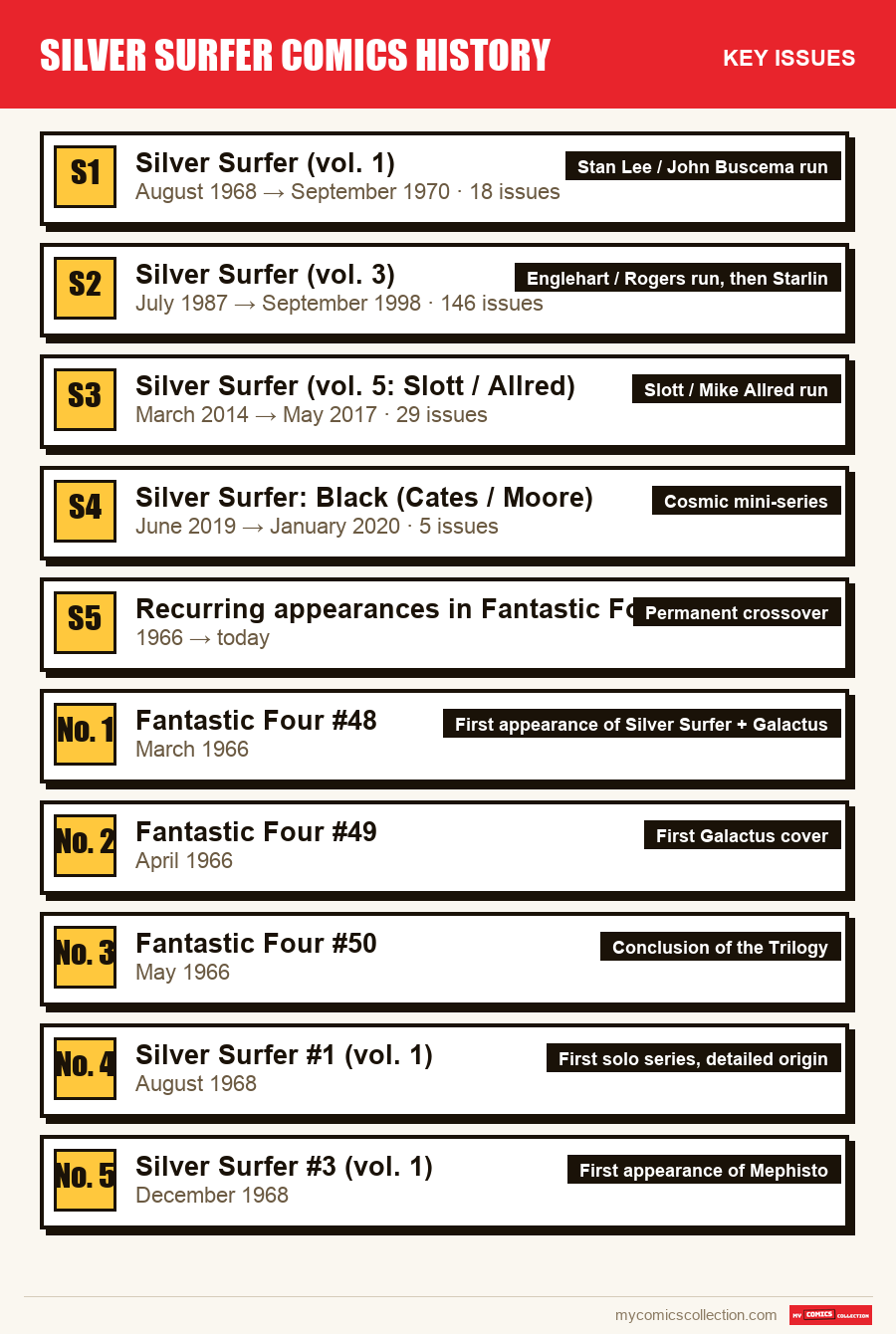
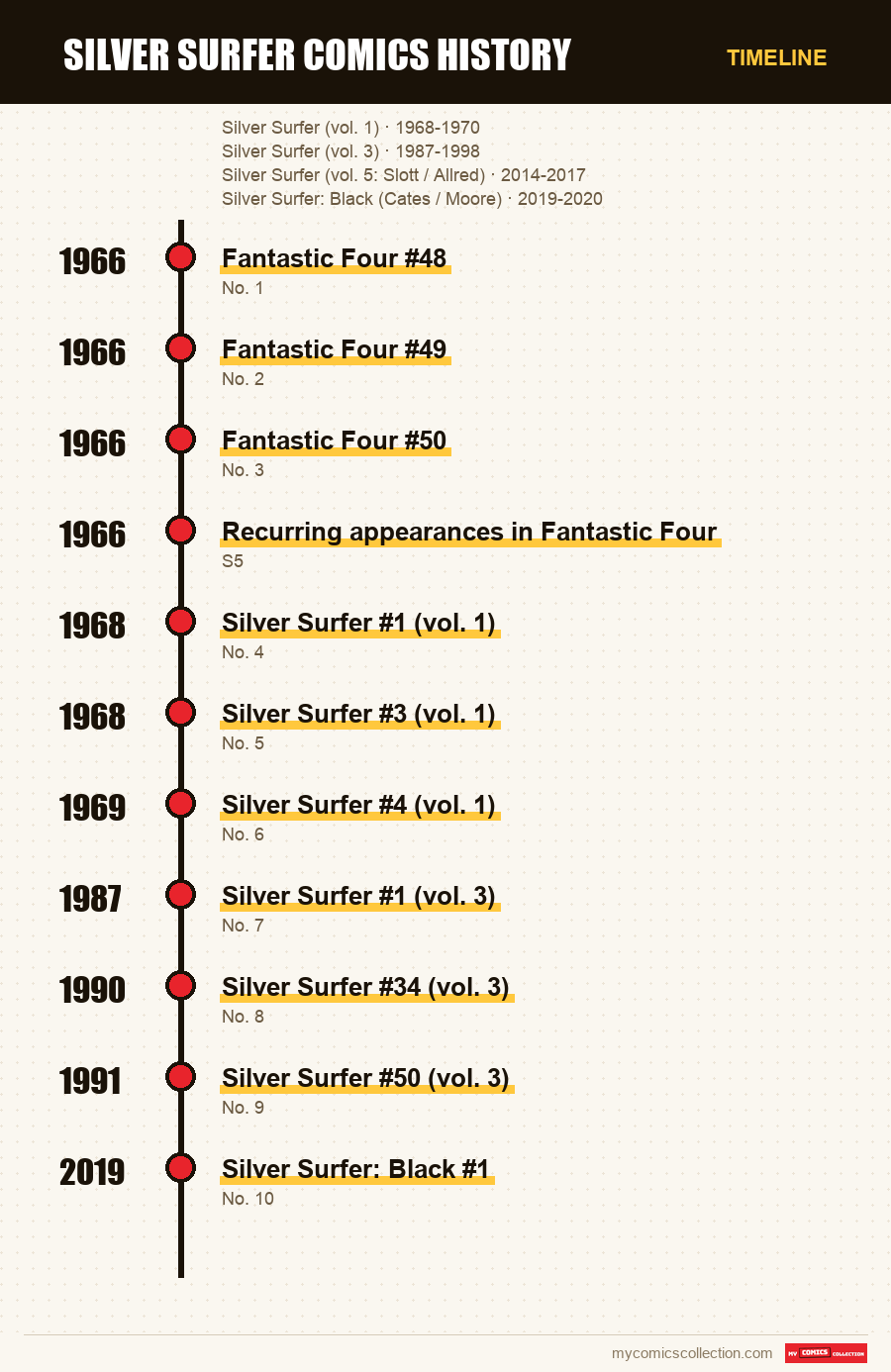
The Surfer's editorial journey alternates between long-running solo series, cosmic mini-series and recurring appearances in the Fantastic Four, Defenders and Marvel event titles. Five blocks structure the timeline.
Silver Surfer (vol. 1)
The first solo series, in the giant 25-cent format for its early issues. Stan Lee develops the character's philosophical dimension through a Surfer trapped on Earth. John Buscema delivers some of the most baroque art of the Silver Age. The series ends for lack of sales but is still cited as a major artistic turning point.
Silver Surfer (vol. 3)
The character's longest series, launched after his Earth exile was lifted. Steve Englehart lays the groundwork, then Jim Starlin takes over from issue 34 onward and builds the runway toward The Infinity Gauntlet. Ron Lim on art during the Starlin period.
Silver Surfer (vol. 5: Slott / Allred)
Dan Slott on script, Mike Allred on art and Laura Allred on colors. A pop, lyrical approach, heavily influenced by Doctor Who, with Dawn Greenwood as the adventuring partner. Issue 11 is built entirely as a narrative Möbius strip and is still cited for its formal originality.
Silver Surfer: Black (Cates / Moore)
A direct consequence of Donny Cates's Guardians of the Galaxy mini. The Surfer is flung back to the dawn of the universe and faces Knull, laying the groundwork for King in Black. Tradd Moore delivers openly psychedelic pages. The collector hardcover edition sold out immediately.
Recurring appearances in Fantastic Four
The Surfer stays tied to Marvel's first family: key appearances in the 1960s Lee/Kirby run, a return in Fantastic Four #155-157 by Roy Thomas, and a presence in the 2009-2012 Hickman run. See the history of the Fantastic Four to map out the crossings.
Collecting this series?
Track what you own, what you are missing and what your collection is worth. 7 day trial.
Start my trial →Top 10 Silver Surfer key issues
A selection of the ten defining issues for a collector, from the 1966 Silver Age to the 2019 mini-series. Values stay variable depending on grade and recent market shifts: for in-depth analysis issue by issue, see Silver Surfer key issues and buying Fantastic Four cheap for the first appearances in the parent series.
Fantastic Four #48
A foundational issue, a double first appearance. A centerpiece of Marvel's Silver Age. The Kirby cover is one of the most reproduced in the publisher's history. Values rising steadily since the Fantastic Four were announced for the MCU.
Fantastic Four #49
The second chapter of the Galactus Trilogy, the first full cover devoted to the devourer. Often bought as a companion to #48 by Silver Age collectors. Stable value, steady demand in mid-grades.
Fantastic Four #50
The end of the trilogy, the Surfer's first act of rebellion against Galactus. A key issue of the Lee/Kirby run. Consistent demand since the 1990s, value rising since 2018.
Silver Surfer #1 (vol. 1)
The first issue of the Lee/Buscema solo series, giant 25-cent format. First appearance of Shalla-Bal and a full flashback to Norrin Radd's origins. A flagship piece for Silver Age collectors.
Silver Surfer #3 (vol. 1)
The first appearance of the demon Mephisto, a recurring Marvel antagonist all the way to WandaVision. A heavily sought issue since the character's rise in recent TV adaptations. Sharp supply/demand tension in high grade.
Silver Surfer #4 (vol. 1)
A cult cover by John Buscema: the Surfer facing Thor. An issue regularly ranked among the most beautiful Marvel covers of the decade. Demand fueled by Thor's parallel popularity in the MCU.
Silver Surfer #1 (vol. 3)
The first issue of the Englehart/Rogers series, the start of the character's new cosmic era. It marks the Surfer's return to space after twenty years of continuity locked on Earth. Large Copper Age print run, modest value but stable demand.
Silver Surfer #34 (vol. 3)
Jim Starlin's first arrival on the series, and the resurrection of Thanos after his death in Marvel Two-in-One Annual #2 in 1977. An issue that directly sets up Thanos Quest and The Infinity Gauntlet. Demand surged since Avengers: Infinity War.
Silver Surfer #50 (vol. 3)
Anniversary issue 50 with a prismatic cover, an editorial event typical of the early 1990s. Central Starlin/Lim story, several backup tales. Currently moderate value but a piece often targeted to complete the Starlin run.
Silver Surfer: Black #1
The first issue of the Donny Cates mini, the point of origin for Knull in modern Marvel mythology. Several variant covers (Mike Deodato, Tradd Moore, Adam Hughes) are already sought after. A collector pivot between the Silver Age and contemporary Marvel.
Major arcs and cult runs
Five narrative blocks structure the Surfer's history for a collector. The Galactus Trilogy (Fantastic Four #48-50, Lee/Kirby, 1966) remains the bedrock. The Lee/Buscema run on the 1968-1970 series offers eighteen issues of theological introspection, one of Stan Lee's most personal projects: issue 18, drawn by Kirby himself, brings the series to an abrupt close. The Infinity Gauntlet (1991, Starlin/Lim/Pérez) places the Surfer at the heart of the clash against Thanos, using the milestones laid down by the Silver Surfer vol. 3 series. Annihilation (2006, Keith Giffen) recasts the character as a cosmic war leader alongside Nova and Drax: an essential pivot for understanding modern Marvel cosmic sagas. Slott/Allred's Silver Surfer (2014-2017) steers the character toward a cosmic adventure comedy paired with Dawn Greenwood, with the fully palindromic issue 11 cited among the best one-shot issues of the decade. Silver Surfer: Black (Cates/Moore, 2019) closes out the sequence by reconnecting the character to the cosmic origin of Knull and to King in Black.
Adaptations and cultural impact
Silver Surfer appeared in the 1994 Fantastic Four animated series, then in his own show, Silver Surfer: The Animated Series, on Fox Kids in 1998 (13 episodes), long considered one of Marvel's most ambitious animated adaptations. The character plays a central role in Fantastic Four: Rise of the Silver Surfer (2007), portrayed by Doug Jones and voiced by Laurence Fishburne. His return is confirmed in The Fantastic Four: First Steps (2025) within the MCU, which triggered a value bump on Fantastic Four #48-50 between 2023 and 2024. On the video game side, the character shows up in Marvel vs. Capcom, Marvel: Ultimate Alliance and Marvel Snap, boosting his visibility with a younger audience. Buying Fantastic Four on a budget remains a sensible strategy for accessing the Surfer's key issues outside of high grade.
Build your Silver Surfer collection methodically
Catalog the Silver Surfer series in 1 click, identify your missing key issues, track their estimated value from current eBay listings. 7-day free trial.
🚀 Start the free 7-day trial