
Stephen Strange / Doctor Strange was born in July 1963 in Strange Tales #110 , written by Stan Lee and drawn by Steve Ditko. The character first ran as a backup feature in Strange Tales through #168 (May 1968), before the title was renamed Doctor Strange and continued from #169 under its own banner as Vol.1. In total, you've got 6 main Doctor Strange volumes + a historic series Doctor Strange: Sorcerer Supreme (90 issues, 1988-1996) + dozens of cult mini-series (The Oath, Damnation, Death of Doctor Strange, Strange, Triumph and Torment). This article walks through the genesis, gives you the complete chronology of the series in order, and lists the key issues to know if you want to build a structured collection of the Sorcerer Supreme of the Marvel Universe.
Alongside Spider-Man, the Fantastic Four, and Hulk, Doctor Strange is one of the pillars of the famous Marvel wave of 1961-1964 that founded the modern Silver Age. But where Spider-Man embodies teenage angst and the Fantastic Four bring family-style sci-fi, Doctor Strange opens a whole different dimension: that of magic , mysticism, astral planes, and cosmic entities. Stephen Strange, an arrogant neurosurgeon brought low by an accident that destroys his hands, becomes a student of the Ancient One in Tibet and eventually inherits the title of Sorcerer Supreme of the Earth Dimension. No other Marvel character carries that kind of esoteric weight.
This guide gives you everything you need to understand the birth of Doctor Strange , follow the complete list of Doctor Strange comics in order , and identify the key issues and major arcs to prioritize. We'll walk through the character's 60+ years, from Strange Tales #110 (July 1963) up to Jed MacKay's current run (Vol.6, launched in 2023), distinguishing the main volumes, the parallel ongoings, and the many cult mini-series (The Oath , Triumph and Torment , Damnation , Death of Doctor Strange , Strange). The psychedelic aesthetic of Steve Ditko, popularized worldwide by the Benedict Cumberbatch films (2016, 2022), remains one of the most singular in the entire comics medium.
The birth of Doctor Strange: Marvel in 1963
To understand how Doctor Strange was born, you've got to step back into the buzz at Marvel Comics in spring 1963. Stan Lee had just rolled out Fantastic Four (#1, November 1961), Hulk (#1, May 1962), Spider-Man (Amazing Fantasy #15, August 1962), Thor (Journey into Mystery #83, August 1962), Iron Man (Tales of Suspense #39, March 1963), and the X-Men (#1, September 1963). The studio was constantly hunting for new concepts for its anthology titles (Tales to Astonish , Tales of Suspense , Strange Tales , Journey into Mystery), which served as labs for new characters.
Steve Ditko, already co-creator of Spider-Man, had spent his whole career working in mystery and horror comics (Charlton, Atlas/Marvel in the 1950s). He pitched Stan Lee a magician character who'd be neither a classic hero in a colorful costume nor a mad scientist, but a true modern sorcerer rooted in occult tradition. Stan Lee gave the green light for a simple 5-page test story in Strange Tales, the house horror/sci-fi title that since 1962 had been sharing its lineup with the Human Torch in solo. The concept of Doctor Strange is largely Ditko's work: he not only drew the early adventures but plotted most of them: Stan Lee often just wrote the dialogue afterward (the famous "Marvel Method").
Strange Tales #110 (July 1963)
Doctor Strange made his first appearance in Strange Tales #110 (cover-dated July 1963, on stands as early as April 1963), in a 5-page story titled "Dr. Strange, Master of Black Magic!". The character was introduced right away with his canonical attributes: the cloak of levitation, the amulet of the Eye of Agamotto, the sanctum sanctorum, his servant Wong, his mentor (the Ancient One, then simply "the Master"), and his rival Baron Mordo (who shows up in #111). No origin is given in #110: Strange is already an accomplished sorcerer, and the reader dives straight into his mystic world, his incantations, and his astral journeys.
The success was gradual but lasting. Strange Tales kept Doctor Strange as a backup feature for 58 issues, from #110 (July 1963) to #168 (May 1968). Steve Ditko drew the episodes from #110 to #146 (through July 1966), at which point he left Marvel after his famous disagreement with Stan Lee over Spider-Man. Bill Everett, Marie Severin, and Dan Adkins took over. Starting with #169 (June 1968), Strange Tales was rebranded Doctor Strange and the backup feature officially became the lead title: that's the starting point of Doctor Strange Vol.1, which is really just a direct continuation of the previous series.
Steve Ditko's pivotal role and the psychedelic aesthetic: Ditko invented an entirely new graphic language for Doctor Strange. Astral planes where impossible geometries float in the void, parallel dimensions populated with organic tentacles, hypnotic mandalas, Escher-like staircases leading nowhere, spiraling levitations, energy beams shooting from fingers in multicolored twists. At a time when superhero comics were mostly realistic-romantic, Ditko imported surrealist imagery (Dalí, Tanguy, Magritte) and pulp horror cover aesthetics into mainstream Marvel. Strange Tales #130-146 remains an absolute visual reference for the entire psychedelic culture of the 1960s (Pink Floyd, the Beatles' Yellow Submarine, hippie counterculture). Without Ditko, Doctor Strange would never have been more than a second-rate magician.
The main Doctor Strange series in chronological order
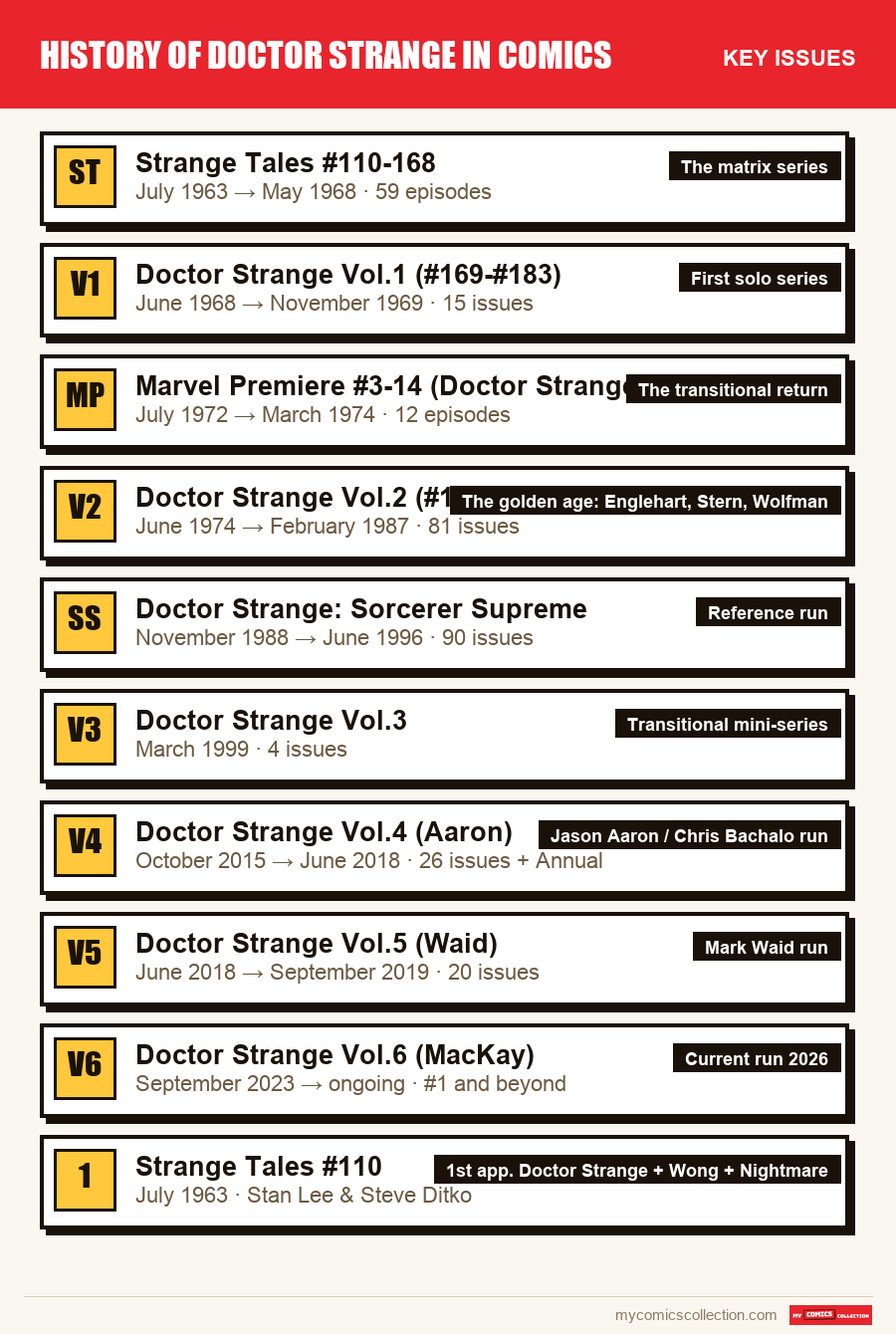
The Doctor Strange franchise is more segmented than Batman's or Spider-Man's: 6 main Doctor Strange volumes split by hibernation periods, plus one crucial historic series (Sorcerer Supreme 1988-1996). Here are the main solo series in order of their first issue:
Strange Tales #110-168
Backup feature in the anthology title Strange Tales shared with the Human Torch (then Nick Fury starting at #135). Doctor Strange first ran 5 pages, then 10, then took the full cover starting at #144. Steve Ditko drew #110-146, followed by Bill Everett, Marie Severin (#153-160), and Dan Adkins (#161-168). It's during this period that nearly the entire mythology was born: Wong (#110), Baron Mordo (#111), Nightmare (#110), Dormammu (#126), Clea (#126), Eternity (#138), the Mindless Ones, the Vishanti, the Ancient One, the Eye of Agamotto. Starting with #169, Strange Tales officially became Doctor Strange.
Doctor Strange Vol.1 (#169-#183)
Direct continuation of Strange Tales under the new title Doctor Strange , keeping the numbering. #169 offers a reformulated origin of the character (Stephen Strange neurosurgeon, accident, Tibet, Ancient One). Roy Thomas wrote most of the scripts, Gene Colan and Dan Adkins drew. The volume ended abruptly at #183 in November 1969: Marvel decided Strange wasn't selling enough and pulled him from newsstands. What followed was a 1969-1971 hibernation where Stephen Strange only appeared as a guest in Hulk, Avengers, and Marvel Premiere.
Marvel Premiere #3-14 (Doctor Strange)
Marvel relaunched the character in its anthology Marvel Premiere, the title where new concepts got tested (Iron Fist would also debut there). Stan Lee wrote the return with #3 (July 1972), followed by Steve Englehart starting at #9. Englehart revolutionized the mythology by introducing the Sise-Neg's Genesis Saga (#13-14), where Doctor Strange travels back in time all the way to the Big Bang. Frank Brunner, P. Craig Russell, and Mike Ploog drew. The success of the Englehart run pushed Marvel to relaunch a solo title: that's Doctor Strange Vol.2, which kicked off in 1974.
Doctor Strange Vol.2 (#1-#81)
The longest and most iconic volume before Sorcerer Supreme . Launched by Steve Englehart and Frank Brunner (#1-5), who continued the Sise-Neg's Genesis. Roger Stern took over at #41 (1980) and delivered one of the most respected runs of the character (#41-62, through 1984), with Marshall Rogers and Paul Smith. Marv Wolfman wrapped up the volume (#63-81) with a more horror-tinged tone, paving the way for Sorcerer Supreme. It's in this volume that Strange regularly faces Dormammu, Mordo, Shuma-Gorath, and officially becomes Sorcerer Supreme after the Ancient One's death.
Doctor Strange: Sorcerer Supreme
The longest volume in the franchise, and probably the most important one for collectors. The title officially shifted to Doctor Strange: Sorcerer Supreme to lock in his new status. Peter B. Gillis launched the series, followed by Roy Thomas and Dann Thomas (#5-31), then Roy Thomas alone , and finally David Quinn and Warren Ellis in the final issues. Jackson Guice, Geof Isherwood, and Mark Buckingham drew. More mature tone, deep exploration of mystic mythology, crossovers with Infinity Gauntlet, Infinity War, Atlantis Attacks. Absolute reference for understanding the modern Doctor Strange.
Doctor Strange Vol.3
Very short volume (4 issues) by Dan Jolley and Tony Harris. An attempt to relaunch Strange after the end of Sorcerer Supreme in 1996. The series didn't find its audience and stopped quickly. Stephen Strange went back to guest appearances and mini-series during the 2000s. Worth noting: the cult mini-series Doctor Strange: The Oath (Brian K. Vaughan / Marcos Martin, 2006-2007, 5 issues) revitalized the character and would heavily inspire the 2016 MCU film.
Doctor Strange Vol.4 (Aaron)
The most notable run of the modern era, launched in Marvel All-New All-Different just before the MCU film (November 2016). Jason Aaron (Thor: God of Thunder, Avengers) and Chris Bachalo (Generation X, Steampunk) wrote/drew the arcs The Way of the Weird (#1-5), The Last Days of Magic (#6-10), Strange loses all the magic of the Earth dimension to the Empirikul, then Blood in the Aether (#11-15). Donny Cates briefly took over at the end (#381-390 legacy numbering). Essential run for understanding Strange since 2015.
Doctor Strange Vol.5 (Waid)
Post-Aaron launch by Mark Waid (Daredevil, Flash) with Jesús Saiz on art. A more adventurous, cosmic approach: Stephen loses magic on Earth and heads into space, swept into adventures that mix sorcery and interstellar exploration. A run condensed into 20 issues, considered an excellent modern entry point for new readers coming from the MCU. Precedes Death of Doctor Strange.
Doctor Strange Vol.6 (MacKay)
Launched by Jed MacKay (Black Cat, Moon Knight) with Pasqual Ferry. Stephen Strange comes back from the dead (following Death of Doctor Strange) and tries to reclaim his place as Sorcerer Supreme from Clea, who'd held the post since 2022. Run ongoing in 2026, riding the momentum of the MCU film Multiverse of Madness (May 2022) and setting up MCU phase 6. Variant covers in high demand, especially convention exclusives and sketch covers.
All parallel Doctor Strange series in chronological order
Alongside the main volumes, Marvel has published dozens of mini-series, OGNs, and anthologies dedicated to Stephen Strange. Here's the chronology of the main titles to help you understand the ecosystem:
- Marvel Premiere #3-14 (1972-1974): 12 Doctor Strange episodes in Marvel's test anthology. Bridge between Vol.1 and Vol.2.
- Doctor Strange / Doom: Triumph and Torment (1989, OGN): Roger Stern / Mike Mignola. Considered by many to be the best Doctor Strange story ever published. Strange and Doctor Doom team up to free Doom's mother from Mephisto's hells.
- Doctor Strange Annual (multiple, 1976-1979 then 1992-1995): annual issues with extended stories, sometimes crucial to the mythology (Annual #1 1976 on Eternity, Annual #2 1992 crossover).
- Doctor Strange: The Oath (2006-2007, 5 issues): Brian K. Vaughan / Marcos Martin. Cult mini-series that reveals Wong's origin and directly inspired the 2016 MCU film (notably the astral surgery scene). Absolute reference for new readers.
- Doctor Voodoo: Avenger of the Supernatural (2009-2010, 5 issues): Rick Remender / Jefte Palo. Jericho Drumm becomes Sorcerer Supreme after Strange loses the title. Important spin-off.
- Doctor Strange and the Sorcerers Supreme (2016-2017, 12 issues): Robbie Thompson / Javier Rodriguez. Cross-era anthology where Strange joins a group of Sorcerers Supreme from past and future (Merlin, Wiccan, Sir Isaac Newton, etc.).
- Doctor Strange: Damnation (2018, 4 issues + tie-ins): Donny Cates / Nick Spencer / Rod Reis. Mephisto sends Las Vegas to hell, Strange has to save it. Crossover with Iron Fist, Ghost Rider, Wong, Moon Knight.
- Doctor Strange: Surgeon Supreme (2019-2020, 6 issues): Mark Waid / Kev Walker. Spin-off following Strange as he regains his surgical skills while remaining Sorcerer Supreme. Cancelled prematurely due to the pandemic.
- Death of Doctor Strange (2021, 5 issues + 7 tie-ins): Jed MacKay / Lee Garbett. Stephen Strange is murdered in #1: the whole mini explores his investigation from the afterlife. Sets up the return in Vol.6 in 2023.
- Strange (2022, 10 issues): Jed MacKay / Marcelo Ferreira. Clea Strange, Stephen's wife, becomes Sorcerer Supreme. Essential mini-series of the post-death era.
- Doctor Strange: Fall Sunrise (2023, 4 issues): Tradd Moore. Black Label mini-series with pure psychedelic aesthetic, a tribute to Ditko.
- Doctor Strange: The End (2020, OGN one-shot): Leah Williams / Filipe Andrade. Alternate story of the end of the Sorcerer Supreme.
- Defenders (multiple volumes, 1972-ongoing): unofficial team where Strange is a founding member alongside Hulk, Namor, and Silver Surfer. Vol.1 (1972-1986, 152 issues), Vol.5 (2017-2018), Vol.6 (2021-2022, Al Ewing).
- Defenders: Beyond (2022, 5 issues): Al Ewing / Javier Rodriguez. Cosmic-cosmological sequel to the 2021 Defenders run.
- Doctor Strange: From the Marvel Vault (2011, 1 issue): Roger Stern / Neil Vokes. One-shot.
- Strange Academy (2020-2022, 18 issues + 2023 reboot): Skottie Young / Humberto Ramos. Strange and Brother Voodoo found a school for young mages. Very popular spin-off.
- Doctor Strange: What If? (multiple): What If? #18 (1979) "What If Doctor Strange Never Became Master of the Mystic Arts?" and many others.
Doctor Strange key issues in chronological order
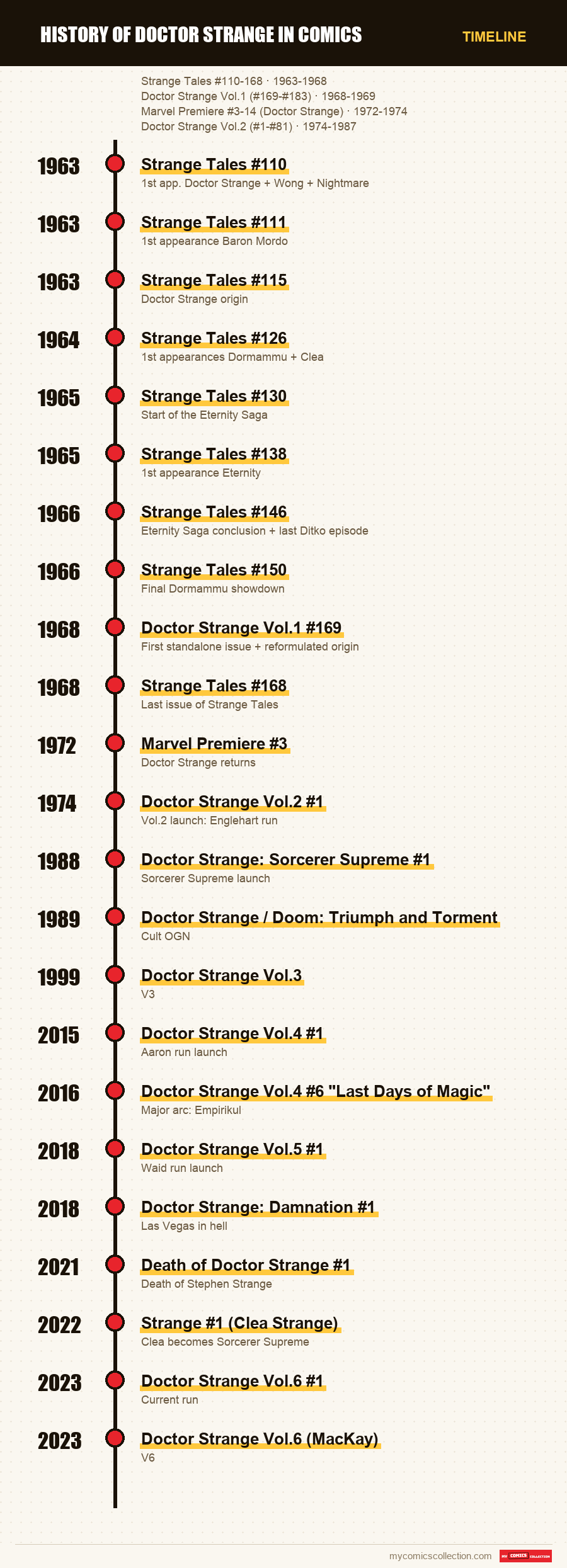
Here are the most important issues to know in chronological order:
Strange Tales #110
The founding issue. Triple first appearance: Stephen Strange / Doctor Strange , his servant Wong , and the villain Nightmare (master of the dream realm). 5-page story "Dr. Strange, Master of Black Magic". A CGC 9.0 copy sold around $65,000 in 2022. Top 20 of the most valuable Silver Age comics. Very rare in high grade.
Strange Tales #111
First appearance of Karl Mordo / Baron Mordo, former student of the Ancient One turned bitter rival of Stephen Strange. Central antagonist of the character for 60 years, popularized by Chiwetel Ejiofor in the 2016 MCU film. CGC 9.0 estimated between $8,000 and $12,000.
Strange Tales #115
First complete account of Stephen Strange's origin: arrogant neurosurgeon, car accident destroying his hands, journey to Tibet, meeting the Ancient One, learning magic. Pivotal issue that establishes the canonical origin, picked up in every adaptation (2007 animation, 2016 MCU). CGC 9.0 estimated between $4,000 and $6,000.
Strange Tales #126
Doubly crucial issue: first appearance of Dormammu, the interdimensional entity from the Dark Dimension who would become Strange's great cosmic rival (and the big bad of the 2016 MCU film); and first appearance of Clea, Dormammu's niece, future apprentice and then wife of Stephen Strange and future Sorcerer Supreme in 2022. CGC 9.0 estimated at $15,000-$20,000 in 2026 thanks to the MCU push.
Strange Tales #130
Start of the arc historians consider the peak of the Lee/Ditko collaboration: the Eternity Saga, which would run for 17 issues (#130-146). Strange travels through dimensions to fight Dormammu, Mordo, and the ultimate cosmic threat, meeting Eternity in person. Absolute visual reference of Ditko's psychedelic aesthetic.
Strange Tales #138
First appearance of the cosmic entity Eternity, personification of the Marvel universe itself. Essential issue for understanding Marvel's cosmology (Eternity, Infinity, Death, Galactus, the Living Tribunal). Returns in Infinity Gauntlet, in the Aaron run, and in every modern cosmic arc. CGC 9.0 estimated at $5,000-$8,000.
Strange Tales #146
Last episode drawn by Steve Ditko before he left Marvel. Conclusion of the Eternity Saga with the final showdown between Strange and Dormammu. Marks the end of a graphic era. Bill Everett would take over starting at #147 with a very different style. Major historic transitional issue.
Strange Tales #150
Issue where Strange definitively settles the score with Dormammu for this era, banishing him from the Earth dimension. Note: Strange Tales #150 is also notable as one of the first to feature John Buscema on a fill-in cover. CGC 9.0 estimated at $1,500-$2,500.
Strange Tales #168
Last issue published under the Strange Tales title. Starting the next month (June 1968), the series was rebranded Doctor Strange and restarted at #169 with Stephen Strange as the main title character. Important issue for Silver Age completists. CGC 9.0 estimated at $1,000-$1,500.
Doctor Strange Vol.1 #169
First issue published under the Doctor Strange title. Roy Thomas took the chance to offer a reformulated origin of the character, denser and more mature than the one from Strange Tales #115. It's technically Doctor Strange Vol.1 #1, but the numbering inherits from Strange Tales to preserve continuity. CGC 9.0 estimated at $800-$1,200 in 2026.
Marvel Premiere #3
Official return of Doctor Strange after 2.5 years of hibernation (1969-1971). First issue of the Marvel Premiere run, which would deliver 12 consecutive episodes (#3-14) until the launch of Vol.2 in 1974. Stan Lee scripted, Barry Smith drew. CGC 9.0 estimated at $200-$400.
Doctor Strange Vol.2 #1
First issue of Doctor Strange Vol.2, which would last 81 issues until 1987. Launched by Steve Englehart and Frank Brunner after the success of their collaboration on Marvel Premiere. They continue the Sise-Neg's Genesis and redefine the tone of the character for the next 40 years. CGC 9.0 estimated at $300-$500.
Doctor Strange / Doom: Triumph and Torment
One-shot graphic novel considered by many to be the best Doctor Strange story ever published. Roger Stern and Mike Mignola (pre-Hellboy) tell the story of the forced alliance between Strange and Doctor Doom to save the soul of Doom's mother from Mephisto's hells. Gothic, dark, deep tone. Absolute reference.
Doctor Strange: Sorcerer Supreme #1
Launch of the longest series in the franchise, which would run 90 issues until 1996. Peter B. Gillis opened, Roy and Dann Thomas quickly took over. More mature and mystical tone. Issue #1 is available at reasonable prices (CGC 9.6 between $80 and $150), so it's an excellent entry point for beginning collectors.
Doctor Strange: The Oath #1-5
5-chapter mini-series that gave the character critical credibility back in the 2000s. Brian K. Vaughan (Y: The Last Man, Saga) and Marcos Martin (The Amazing Spider-Man) deliver a detective story where Strange investigates his own assassination attempt. Direct inspiration for the 2016 MCU film (notably the astral surgery scene). Absolute reference for new readers.
Doctor Strange Vol.4 #1
Launch of the Jason Aaron / Chris Bachalo run, just before the MCU film's release (November 2016). Aaron imposes his vision: Strange is a warrior wizard with a more brutal and physical edge. Chris Bachalo delivers some of the most beautiful psychedelic pages of the 21st century. Variant covers heavily in demand (Skottie Young, Frank Cho, Olivier Coipel).
Doctor Strange Vol.4 #6 "Last Days of Magic"
Start of the arc The Last Days of Magic where the Earth dimension loses all its magic to the Empirikul, interdimensional invaders who systematically destroy magic. One of the most ambitious arcs of the modern era. Strange comes out weakened, which would pave the way for Damnation and Death of Doctor Strange.
Doctor Strange: Damnation #1
Event mini-series where Mephisto sends Las Vegas to hell after Strange resurrects Las Vegas in the wake of Secret Empire. Crossover with Iron Fist, Ghost Rider, Wong, Moon Knight. Horror-pulp tone, written by Donny Cates at the peak of his Marvel popularity. Skottie Young and Joshua Cassara variant covers in high demand.
Doctor Strange Vol.5 #1
First issue of the Mark Waid run post-Aaron. Stephen Strange loses magic on Earth and heads to space for cosmic adventures. More accessible, space-opera approach. Excellent entry point for readers coming from the 2016 film. CGC 9.8 between $25 and $50 in 2026.
Death of Doctor Strange #1
Event mini-series where Stephen Strange is murdered in the first issue. The rest of the mini explores his investigation from the afterlife and the consequences for the Marvel Universe. 5 main issues + 7 tie-ins (Bloodstone, X-Men, Spider-Man, Avengers, Wong, etc.). Leads directly to Strange (2022) and then to Doctor Strange Vol.6 in 2023.
Strange #1 (Clea Strange)
Launch of the Strange series (without "Doctor") where Clea Strange, Stephen's wife, officially becomes the new Sorcerer Supreme after her husband's death. Indispensable first issue because it establishes Clea's status, who would then appear in Doctor Strange in the Multiverse of Madness (May 2022) played by Charlize Theron. 10 issues total.
Doctor Strange Vol.6 #1
Launch of the current run. Stephen comes back from the dead and tries to reclaim his place as Sorcerer Supreme from Clea. Run ongoing in 2026, with heavily collected variant covers (Inhyuk Lee, Peach Momoko, Stanley "Artgerm" Lau, convention sketch covers). Issue #1 available raw between $5 and $15 depending on variant.
The major Doctor Strange story arcs in order
Eternity Saga (1965-1966)
Lee/Ditko peak, 17 issues of cosmic psychedelia. Strange faces Dormammu and meets Eternity.
Dormammu / Mordo (1963-1968)
Central antagonism of the Strange Tales era. Mordo betrays the Ancient One, Dormammu threatens the Earth dimension.
Sise-Neg's Genesis Saga (1973-1974)
Steve Englehart revolutionizes the mythology. Strange travels back in time to the Big Bang. Major cosmological inspiration.
The Death of Strange (Stern era, 1980-1984)
Roger Stern delivers the most respected run of Vol.2. Apparent death of Strange, return, deep exploration of the mythology.
Triumph and Torment (1989)
Roger Stern / Mike Mignola OGN. Strange and Doom team up to free Doom's mother from hell. Absolute reference.
Doctor Strange: The Oath (2006-2007)
Vaughan/Martin mini, 5 issues. Strange investigates his assassination attempt. Direct inspiration for the 2016 MCU film.
The Last Days of Magic (2016)
Aaron/Bachalo. The Empirikul destroy magic on Earth. Strange loses nearly all his powers.
Damnation (2018)
Donny Cates unleashes Mephisto on Las Vegas, sent to hell. Crossover with Iron Fist, Ghost Rider, Moon Knight.
Death of Doctor Strange (2021)
Jed MacKay kills Stephen in #1. Investigation mini from the afterlife. Leads to Strange (Clea) in 2022.
Avengers Forever: Doctor Strange (2022)
Jason Aaron, in his Avengers Forever mega-run, integrates alternate Sorcerers Supreme from the multiverse.
Strange: Clea era (2022-2023)
Clea Strange becomes Sorcerer Supreme. Jed MacKay mini setting up MCU's Multiverse of Madness.
Empire of Brushes (2024)
Vol.6 arc where Strange faces a new entity born from mystical art.
Mephisto's Curse (2024-2025)
Return of Mephisto as central antagonist of the MacKay run. Stephen and Clea team up.
Doctor Strange: The End (2020)
Leah Williams / Filipe Andrade OGN. Alternate story of the ultimate death of the Sorcerer Supreme.
Defenders Saga (Heinberg / Ewing)
Strange founding member of the Defenders. Allan Heinberg (2017) then Al Ewing (2021-2022) revisit the concept.
How to start a Doctor Strange collection in 2026
Set a clear goal
"I want all of Doctor Strange" is a bad goal (300+ issues spread across 6 volumes + dozens of minis). "I want Doctor Strange: The Oath complete (5 issues)" or "the Sorcerer Supreme #1-50 run" or "the Lee/Ditko key issues Strange Tales #110-146" are excellent structuring starting points.
Import the catalog into My Comics Collection
With My Comics Collection, import Strange Tales (1951-1968), Doctor Strange Vol.1 through Vol.6, Marvel Premiere, Sorcerer Supreme, and all the mini-series (The Oath, Damnation, Death of Doctor Strange, Strange, Triumph and Torment). Each issue and volume identified distinctly.
Prioritize the key issues
The 22 listed key issues represent 80% of historical value. See our dedicated top Doctor Strange key issues for focused key issues + updated CGC values for 2026.
Organize by run rather than by issue number
Doctor Strange is collected by run (Lee/Ditko Strange Tales, Englehart/Brunner Vol.2, Stern era, Sorcerer Supreme Thomas, Aaron/Bachalo, Waid, MacKay) rather than strict chronological numbering. It makes reading easier and gives narrative meaning.
Track eBay valuations
Strange Tales #110, #115, #126 are the marquee key issues, very volatile with the MCU push. My Comics Collection updates values based on real eBay and auction sales.
Why Doctor Strange remains collected in 2026
Alongside Iron Man and Spider-Man, Doctor Strange is one of the most collected Marvel characters in 2026. Several reasons:
- Massive MCU push : Doctor Strange (November 2016, $677 million) and then Doctor Strange in the Multiverse of Madness (May 2022, $1 billion) made Stephen Strange one of the key MCU phase 4 characters. Benedict Cumberbatch plays the sorcerer in 7 Marvel films (Doctor Strange, Thor: Ragnarok, Infinity War, Endgame, Spider-Man: No Way Home, Multiverse of Madness, Spider-Man 4 due 2025/2026).
- MCU phase 6 setup: Strange and Clea are both announced for the upcoming Avengers phases (Doomsday, Secret Wars). Spider-Man 4 (2026) will confirm their centrality.
- Unique Ditko aesthetic: no other Marvel franchise offers such a distinctive visual heritage. Steve Ditko's pages from Strange Tales #130-146 are studied in American art schools.
- Mystical villain gallery: Dormammu, Baron Mordo, Mephisto, Shuma-Gorath, Nightmare, Umar, Chthon, Cyttorak, Eternity (sometimes as antagonist), Mister Misery. A unique cosmic-mystical universe at Marvel.
- Cult popularity independent of the MCU: Doctor Strange has always had a hardcore reader base since the 1960s, drawn in by mythological depth and graphic singularity. That base massively expanded post-2016.
Biography of Stephen Vincent Strange, M.D. (Doctor Strange)
Doctor Strange is a character of Marvel Comics created by Stan Lee and Steve Ditko. His first appearance is in Strange Tales #110 , published in July 1963.
Identity card for Stephen Vincent Strange, M.D.
- Real name: Stephen Vincent Strange, M.D.
- Date of birth: July 1963 (creation)
- Place of birth: Philadelphia, Pennsylvania, USA
- First appearance : Strange Tales #110 (July 1963)
- Creators: Steve Ditko (cartoonist, co-creator) and Stan Lee (writer)
- Editor: Marvel Comics
- Memberships: Sorcerer Supreme of Earth, Avengers, Defenders, Illuminati
Character origins
Stephen Strange was an arrogant, billionaire neurosurgeon until a car accident destroyed the fine mobility of his hands. Desperate for healing, he travels to Tibet where he meets the Ancient One and learns the mystical arts. Having become Sorcerer Supreme, he defends the Earth against magical and interdimensional threats from his Sanctum Sanctorum in New York.
Powers and Abilities
- Magic: master of all the mystical arts
- Sorcerer Supreme of the Earth Dimension
- Astralprojection: astral plane travel
- Temporal Manipulation (Eye of Agamotto)
- Cloak of Levitation: flight and defense
- Interdimensional travel
- Spell Mastery (Crimson Bands of Cyttorak, Eldritch Bolts, etc.)
- Medical intelligence: elite neurosurgeon
Costume and visual identity
Blue tunic with red levitation cape (sentience). Yellow sash. Eye of Agamotto pendant. Black gloves. House/Sanctum Sanctorum at 177A Bleecker Street in Greenwich Village, New York.
Build your Doctor Strange collection methodically
Import the 300+ Doctor Strange issues across all volumes + Strange Tales + Sorcerer Supreme + minis in one click, identify your missing key issues, track eBay value. Free 7-day trial.
🚀 Start your free 7-day trialGo further
- Doctor Strange in comics: a reading and collecting guide
- Best Doctor Strange Comic Runs: The Essential Collector's Ranking
- The best Doctor Strange story arcs: a collector's guide
- Top 10 Doctor Strange Key Issues to Own
- Strange Tales #110: The First Appearance of Doctor Strange (1963)
- Doctor Strange Comics Collection: From Strange Tales to Modern Runs. The Complete Guide
FAQ, History of Doctor Strange
Other comic character histories to discover
Our complete "Comics history" article series covers the 20 biggest Marvel and DC franchises. Each article follows the same format: birth, complete chronology of volumes, parallel series, key issues classified chronologically, major arcs, and collection method.
→ See all "History" blog articles