
Batman was born in May 1939 in Detective Comics #27 , written by Bill Finger and drawn by Bob Kane. More than 85 years later, the Dark Knight has the longest unbroken run in American comics: Detective Comics has been published since 1937 (1,100+ issues), Batman since 1940 (4 volumes, 1,500+ legacy issues), plus dozens of parallel series (Detective, Legends of the Dark Knight, Shadow of the Bat, Batman & Robin, All-Star Batman). This article retraces the genesis, lays out the full chronology of the series in order, and lists the key issues to know if you want to build a structured collection.
Along with Superman, Batman is one of the two founding pillars of DC Comics. But where Superman embodies the optimism of the Golden Age, Batman carries its darkness, its trauma and its inner detective. A character with no superpowers, an orphaned billionaire obsessed with justice, Bruce Wayne has crossed every age of American comics by reinventing himself: dark pulp hero of 1939-1942, camp crusader of the 1960s, tormented anti-hero of the O'Neil/Adams era, gothic myth under Frank Miller, psychological detective under Grant Morrison and Scott Snyder. No other comic book character has reached that kind of versatility.
This guide gives you everything you need to understand the birth of Batman , follow the complete list of all Batman comics in order , and identify the key issues and major arcs to prioritize. We'll cover the character's 85+ years, from Detective Comics #27 (1939) to the Batman Vol.4 relaunch (2025), separating out the main volumes, the parallel ongoings, and the many cult mini-series (The Killing Joke, Year One, Hush, Long Halloween…).
The birth of Batman: DC in 1939
To understand how Batman was born, you have to go back to the fall of 1938. Action Comics #1 (June 1938) had just launched Superman and become a runaway hit. National Comics Publications (the future DC Comics) was desperately looking for another character that could capitalize on this brand-new superhero craze. Vin Sullivan, editor of Detective Comics, asked Bob Kane, a 23-year-old artist, to come up with a concept in 24 hours.
Bob Kane sketched a red character with stiff wings and no mask. Bill Finger, his writer friend, saw the rough draft and pushed for radical changes: a gray and black costume instead of red, a mask covering the entire face with two bat-ear points, a scalloped cape evoking wings, gauntleted gloves, a utility belt. Finger also added the founding tragedy: Bruce Wayne is a billionaire whose parents were murdered before his eyes, which drives him to become a nighttime vigilante. The concept of Batman as we know it today is largely Finger's work, but Kane received exclusive creative credit for 75 years (DC finally acknowledged Finger in 2015).
Detective Comics #27 (May 1939)
Batman makes his first appearance in Detective Comics #27 (cover-dated May 1939, on newsstands as early as March 1939), in a 6-page story called "The Case of the Chemical Syndicate." The investigation, partly lifted from a Shadow novella ("Partners of Peril," 1936), is dark, pulpy, humorless. Batman kills his enemies (one falls into a vat of acid). No high-tech gadgets, just a pistol and a grappling hook. The character is credited "by Bob Kane."
The success was immediate. Detective Comics doubled its sales in six months. National Comics announced a solo title for 1940. Bill Finger created the rogues' gallery at a frantic pace: Joker , Catwoman (Selina Kyle) and Robin (Dick Grayson) all appeared in 1940. Batman #1 hit stands in spring 1940 with an extended origin story that would lock in the canonical foundations of the character for 80 years.
The historical irony: Bill Finger wrote most Batman stories between 1939 and 1965, created the Joker, Robin, Catwoman, Two-Face, Riddler, Penguin, and the very concept of Batman as we know it: without ever receiving any official credit or meaningful royalty until 2015. Bob Kane lived as a creative bourgeois while Finger died in poverty in 1974. A late correction was made by DC at the insistence of his family and fans.
The main Batman series in chronological order
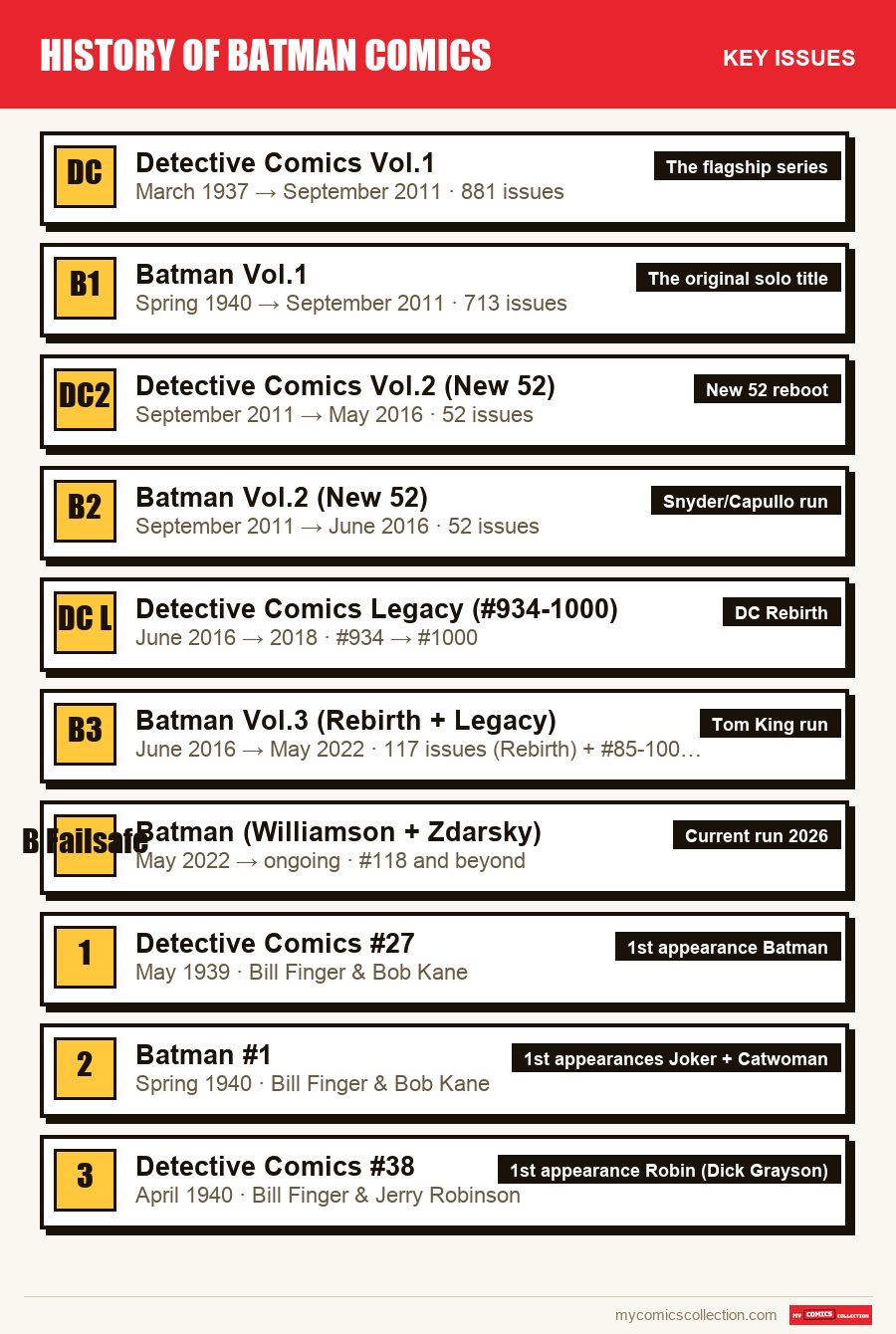
The Batman franchise is one of the most complex in all of DC Comics. Here are the main solo series in order of their first issue:
Detective Comics Vol.1
Even before Batman, Detective Comics was a pulp anthology series. But the character transformed it into the canonical Batman series starting with #27 (May 1939). 881 issues in a single run: one of the longest in all of American comics. Detective Comics is where the Joker first appeared (#27 late 1940: actually, the Joker debuts in Batman #1, but the early Joker stories show up in Detective Comics from 1940), Two-Face (#66), the Riddler (#140), the "New Look" costume (#327), Knightfall (Dixon, '90s), and all the major runs (Englehart, O'Neil, Rucka, Snyder).
Batman Vol.1
Launched on the back of Detective's massive success, Batman #1 introduces the Joker and Catwoman and establishes the official origin. The series ran without interruption for 71 years, spanning the Golden, Silver, Bronze and Modern Ages. Major turning points: #181 (1st app. Poison Ivy), #232 (Ra's al Ghul), #251 ("The Joker's Five-Way Revenge" by Adams/O'Neil), #404-407 (Frank Miller's Year One), #492-500 (Knightfall), #608-619 (Hush), #655-658 (Damian Wayne), #700 (anniversary), then #713 before the New 52 reboot.
Detective Comics Vol.2 (New 52)
Full reboot under the New 52 era. Tony Daniel handled the early issues, followed by John Layman and then Brian Buccellato. Darker tone, return to noir black-and-red roots. The volume wraps with #52 in May 2016.
Batman Vol.2 (New 52)
The most defining run of the 2010s, by Scott Snyder and Greg Capullo. 52 issues of exceptional narrative cohesion that include Court of Owls (#1-11), Death of the Family (#13-17, the Joker returns), Zero Year (#21-33, origin retelling), Endgame (#35-40), Superheavy (#41-50, Jim Gordon as Batman). The absolute reference for getting into modern Batman.
Detective Comics Legacy (#934-1000)
With the DC Rebirth event, Detective Comics returned to legacy numbering, picking up at #934 (52 + 881 + 1). James Tynion IV handled the "Rebirth" run, introducing the Batman team (Batwoman, Spoiler, Red Robin, Clayface). Detective Comics #1000 in March 2019 celebrated the 80th anniversary with an anthology of writers (Snyder, Tomasi, King, Bendis).
Batman Vol.3 (Rebirth + Legacy)
The Tom King run (#1-85) is one of the most debated of the decade: focus on Bruce's psyche, engagement to Catwoman, canceled wedding (#50, the most controversial issue of the Rebirth era), Batman / Flashpoint Beyond. Followed by James Tynion IV (#86-117) with "Joker War" (#95-100), introduction of Punchline and Ghost-Maker. Legacy numbering resumed at #85 in 2019 (#85 = #944 legacy).
Batman (Williamson + Zdarsky)
The Vol.3 numbering continues with "Failsafe" (#125-130, Chip Zdarsky). The title then restarts with Batman Vol.4 #1 (November 2025) by Matt Fraction and Jorge Jimenez. Recent issues are in heavy demand for their variant covers.
All parallel Batman series in chronological order
Alongside Batman and Detective Comics, DC has published dozens of parallel series. Here's the chronology of the main titles to help you understand the ecosystem:
- World's Finest Comics (1941-1986, 323 issues): regular Batman / Superman team-ups. Anthology format at first, then a regular duo from 1971 on.
- Batman Family (1975-1978, 20 issues): title dedicated to supporting characters (Robin, Batgirl, Man-Bat).
- The Brave and the Bold (1955-1983, 200 issues): Batman teams up with another DC hero each month: DC's equivalent of Marvel Team-Up.
- Batman: The Dark Knight Returns (1986, 4 issues): the cult maxi-series by Frank Miller that revolutionized Batman and the entire medium. Original issues are in heavy demand.
- Legends of the Dark Knight (1989-2007, 214 issues): anthology series for creator-owned arcs (Sam Hamm, Garth Ennis, Mike Mignola, Grant Morrison, Brian Bolland).
- Batman: Shadow of the Bat (1992-2000, 94 issues): Alan Grant's title that ran alongside Knightfall and Cataclysm.
- Batman Confidential (2007-2011, 54 issues): short arcs on the villains, runs by Alan Burnett and Tony Daniel.
- All-Star Batman and Robin, the Boy Wonder (2005-2008, 10 issues): Frank Miller / Jim Lee, out of continuity.
- Batman: The Long Halloween (1996-1997, 13 issues): Loeb/Sale maxi-series, the arc that inspired The Batman (2022).
- Batman: Dark Victory (1999-2000, 13 issues): the sequel to The Long Halloween.
- Batman: Hush (Batman #608-619, 2002-2003): the Loeb/Lee arc that re-introduced the entire Batman rogues' gallery.
- Robin (1993-2009, 183 issues): Tim Drake solo series.
- Nightwing Vol.1-2-3-4 (1995-ongoing): Dick Grayson stepping out of Batman's shadow. See our dedicated Nightwing guide.
- Batgirl (multiple volumes, 2000-ongoing): Cassandra Cain, Stephanie Brown, Barbara Gordon.
- Batman: Streets of Gotham (2009-2011, 21 issues): Hush wearing the Batman costume, Paul Dini arc.
- Batman and Robin Vol.1 (2009-2011, 26 issues): Grant Morrison, Damian Wayne becomes Robin, Dick Grayson becomes Batman.
- Batman Inc. (2011, 8 issues + Vol.2 2013, 13 issues): Morrison wraps up his mega-arc with Damian's death.
- Batman: The Dark Knight (New 52, 2011-2014, 29 issues): David Finch.
- Batman Eternal (2014-2015, 52 weekly issues): epic weekly event with Snyder, Tynion, Layman, Seeley, Higgins.
- Batman & Robin Eternal (2015-2016, 26 issues): weekly sequel with the return of Cassandra Cain.
- All-Star Batman (2016-2017, 14 issues): Scott Snyder / John Romita Jr.
- Batman: White Knight (2017-2018, 8 issues): Sean Murphy, expanded Earth.
- Batman: Damned (2018-2019, 3 issues): Brian Azzarello / Lee Bermejo, Black Label.
- Batman: Last Knight on Earth (2019-2020, 3 issues): Snyder / Capullo, alternate ending.
- Batman: Three Jokers (2020, 3 issues): Geoff Johns / Jason Fabok, revelations about the Jokers.
- I Am Batman (2021-2022, 18 issues): Jace Fox, Lucius's son, becomes Batman.
- Batman / Catwoman (2020-2022, 12 issues): Tom King / Clay Mann, conclusion of his arc.
- Detective Comics Vol.3 (2022-2024, ~80 legacy issues): Ram V delivers a cult gothic horror run.
- The Penguin , The Joker , Two-Face: recurring solo series for the major villains.
Batman key issues in chronological order
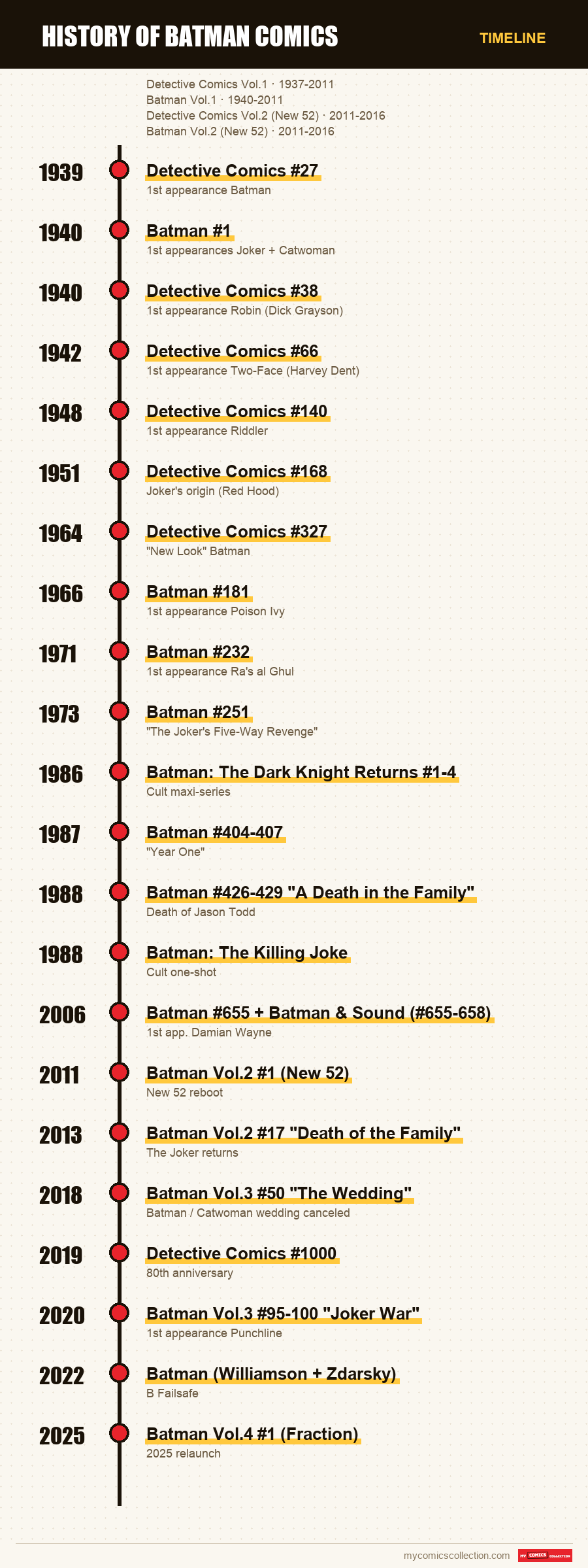
Here are the most important issues to know in chronological order:
Detective Comics #27
The founding issue. A 6-page story where Batman, still called "The Bat-Man," takes down a chemical syndicate. A CGC 8.0 copy sold for $1,740,000 in 2020. Top 5 of the most expensive comics in the world across all characters.
Batman #1
The most valuable Batman issue after Detective #27. Three firsts in a single issue: Joker , Catwoman (under the name "The Cat"), and Batman's extended origin. A CGC 9.0 is estimated at over $2 million.
Detective Comics #38
First appearance of Dick Grayson / Robin, the most iconic sidekick in comic history. The cover introduces the duo concept that would inspire every following hero/sidekick pairing (Captain America / Bucky in 1941, Spider-Man Annual #1, etc.).
Detective Comics #66
First appearance of Harvey Dent / Two-Face, one of the most tragic villains. A district attorney and friend of Bruce Wayne disfigured by acid, Two-Face would become the central antagonist of The Long Halloween, The Dark Knight, and The Batman (2008).
Detective Comics #140
First appearance of Edward Nigma / The Riddler. A long-underused character, popularized by the 1960s TV show and then modernized by Tom King and Paul Dano (The Batman 2022).
Detective Comics #168
The issue that reveals the Joker's original identity as Red Hood, a criminal who fell into a vat of acid. This origin would be picked up again by The Killing Joke (1988) and every film/series since.
Detective Comics #327
The issue that marks the end of the "weird" Silver Age era and the return to a detective Batman. Slightly modified costume (yellow circle around the symbol), abandoning the sci-fi adventures, going back to pulp roots.
Batman #181
First appearance of Pamela Isley / Poison Ivy. One of Batman's most iconic villainesses, an eco-avenger and the future love interest of Harley Quinn in modern comics.
Batman #232
First appearance of Ra's al Ghul, the Demon's Head. The global villain by O'Neil and Adams who defines modern Batman: popularized by Christopher Nolan in Batman Begins (2005).
Batman #251
The issue that resurrects the Joker after a decade of absence and redefines him as the sociopathic killer we know today. The absolute reference for understanding Batman's Bronze Age turning point.
Batman: The Dark Knight Returns #1-4
The maxi-series that changed everything. Frank Miller imagines an aging Batman coming out of retirement in a dystopian Gotham. With Watchmen, the foundational work of the Modern Age. DKR #1 remains one of the most collected modern comics.
Batman #404-407
Batman's definitive origin. Frank Miller and David Mazzucchelli tell Bruce Wayne's first year as a vigilante. The origin canon since 1987, the basis for Batman Begins (2005) and The Batman (2022).
Batman: The Killing Joke
Alan Moore's one-shot that defines the Joker's origin (a failed Red Hood comedian) and paralyzes Barbara Gordon (Batgirl). The most controversial and most influential work in the Batman canon.
Batman #426-429 "A Death in the Family"
Readers voted by phone to decide Jason Todd's fate (the second Robin). He's killed by the Joker in #428 (by 28 votes). A moral landmark in comics culture.
Batman #492-500 + Detective #659-666 "Knightfall"
The arc that introduces Bane and where Batman literally has his back broken (#497). The mantle passes to Jean-Paul Valley (Azrael) before Bruce reclaims his place.
Batman: The Long Halloween #1-13
13-chapter maxi-series (one a month over a year) that redefines Year Two. Harvey Dent's transformation into Two-Face. A direct inspiration for The Dark Knight (Nolan, 2008) and The Batman (Reeves, 2022).
Batman #608-619 "Hush"
The best-selling Batman arc of the 2000s. Loeb cycles through the entire rogues' gallery in 12 issues, drawn beautifully by Jim Lee. An excellent gateway for discovering Batman.
Batman #655 + Batman & Sound (#655-658)
Start of the Grant Morrison Batman mega-run (2006-2013). First appearance of Damian Wayne, biological son of Bruce and Talia. The future Robin and a major character in the modern Batverse.
Batman R.I.P. + Final Crisis (Batman #676-683)
Conclusion of Morrison's first phase. Bruce Wayne disappears after his fight with Darkseid in Final Crisis. Dick Grayson becomes Batman. Damian Wayne becomes Robin.
Batman Vol.2 #1 (New 52)
Launch of the Snyder/Capullo run. The "Court of Owls" storyline introduces the secret society that has ruled Gotham for centuries. A model run for narrative cohesion.
Batman Vol.2 #17 "Death of the Family"
Conclusion of a horror-intense arc where the Joker (with his face stitched back on) attacks the entire Bat-family. Sold over 100,000 copies, one of the biggest hits of the New 52 era.
Batman Vol.3 #50 "The Wedding"
The most controversial issue of the Rebirth era. Bruce and Selina don't get married (the twist was revealed on the cover by the NY Times before publication). The emotional turning point of King's run.
Detective Comics #1000
Anniversary issue celebrating 80 years of Detective Comics and Batman. Anthology of major writers (Snyder, Tomasi, King, Bendis, Capullo). Variant covers are highly collected.
Batman Vol.3 #95-100 "Joker War"
Tynion crossover that introduces Punchline (#92 cameo, #95 full) and Ghost-Maker. The Joker takes control of Wayne Enterprises.
Batman Vol.4 #1 (Fraction)
Launch of Batman Vol.4, as part of the All In event. Variant covers are in high demand among modern collectors.
The major Batman story arcs in order
Year One (1987)
Definitive origin by Frank Miller / Mazzucchelli. The absolute reference.
The Killing Joke (1988)
Alan Moore / Brian Bolland one-shot. Joker's origin, paralyzes Barbara Gordon.
A Death in the Family (1988)
Jason Todd's death following the reader vote.
Arkham Asylum: A Serious House on Serious Earth (1989)
Grant Morrison / Dave McKean graphic novel, a psychological experience.
Knightfall (1993-1994)
Bane breaks Batman. Jean-Paul Valley becomes Azrael-Batman.
The Long Halloween (1996-1997)
Loeb / Sale maxi-series. Harvey Dent's transformation into Two-Face.
No Man's Land (1999)
An earthquake devastates Gotham, abandoned by the authorities. Year-long saga.
Hush (2002-2003)
Loeb / Lee, tour of the Bat-mythology. Best-seller.
Under the Hood (2005)
Jason Todd returns as Red Hood. Revenge saga.
Batman R.I.P. (2008)
Conclusion of phase 1 of Grant Morrison's run. Bruce's apparent death.
Batman and Robin (2009-2011)
Dick Grayson becomes Batman, Damian Wayne becomes Robin. Morrison run.
Court of Owls (2011-2012)
Snyder / Capullo launch. The secret society ruling Gotham.
Death of the Family (2012-2013)
Joker returns with stitched-on face. Attacks the Bat-family.
Zero Year (2013-2014)
Origin retelling for the New 52. Snyder / Capullo, 11 issues.
Endgame (2014-2015)
Final Snyder showdown with the Joker. Conclusion of phase 1.
I Am Gotham + I Am Suicide (2016-2017)
Tom King takes over. Introduction of Gotham and Gotham Girl.
The War of Jokes and Riddles (2017)
Tom King retraces a Year Three war between the Joker and the Riddler.
City of Bane (2019)
Climax of the Tom King run. Bane takes Gotham.
Joker War (2020)
Tynion launches Punchline. The Joker takes Wayne Enterprises.
Failsafe (2022-2023)
Zdarsky launch. An anti-Batman robot designed by Bruce, turned against him.
How to start a Batman collection in 2026
Set a clear goal
"I want all of Batman" is a bad goal (1,500+ legacy issues). "I want the complete Snyder/Capullo run (#1-52)" or "the 5 Loeb/Sale maxi-series (Halloween, Dark Victory, Catwoman, Hush, Haunted Knight)" are excellent starting points.
Import the catalog into My Comics Collection
With My Comics Collection, import Detective Comics, Batman Vol.1-4, Legends of the Dark Knight and all the spin-off series. Each issue and volume distinctly identified.
Prioritize the key issues
The 25 key issues listed account for 80% of the historical value. See our dedicated Batman top 10 for key issues + CGC values.
Organize by run rather than by issue
Batman is best collected by run (Miller, Morrison, Snyder, King, Zdarsky) rather than by strict chronological issue. It makes for easier reading and gives you context.
Track eBay valuation
Detective #27 is out of reach but plenty of other key issues move constantly. My Comics Collection updates values based on real sales.
Why Batman is still the most collected franchise in 2026
Along with Spider-Man, Batman is the most active franchise by monthly sales (DC + Marvel combined) in 2026. Several reasons:
- Long continuity: Detective Comics has been published since 1937 without interruption. It's the longest single-character comic series in the world.
- Rogues' gallery: 80+ recurring antagonists (Joker, Two-Face, Riddler, Penguin, Scarecrow, Mr. Freeze, Bane, Ra's al Ghul, Hush, Court of Owls…). No other hero has such a rogues gallery.
- Multimedia presence: Burton/Schumacher/Nolan/Reeves films, animated series (BTAS, The Brave and the Bold, Beware), Arkham games, live-action series (Gotham, Pennyworth), spin-offs (Joker 2019/Folie à Deux 2024).
- Versatility of the character: pulp, camp, gothic, psychological, sci-fi… each era has its Batman.
Biography of Bruce Wayne (Batman)
Batman is a character of DC Comics created by Bob Kane and Bill Finger. His first appearance is in Detective Comics #27 , published in May 1939.
Bruce Wayne's identity sheet
- Real name:Bruce Wayne
- Date of birth: February 19, 1939 (date of creation): 1915 (fictional)
- Place of birth: Gotham City, USA
- First appearance : Detective Comics #27 (May 1939)
- Creators: Bob Kane (with Bill Finger not officially credited until 2015)
- Editor: DC Comics
- Memberships: Justice League, Outsiders, Bat-Family (Robin, Nightwing, Batgirl, Oracle)
Character origins
Bruce Wayne witnesses the murder of his parents Thomas and Martha Wayne at the age of 8, shot dead by Joe Chill in a Gotham alley after a movie viewing. This tragedy pushes him to travel around the world training in martial arts, criminology and forensic science. Upon his return to Gotham, he decides to fight crime using the fear inspired by a bat: Batman is born.
Powers and Abilities
- No superpowers: Bruce Wayne is an ordinary human
- Genius intellect: detective, strategist, scientist, engineer
- Martial arts: mastery of 127 fighting styles
- Peak Fitness: strength, agility, elite endurance
- High-tech arsenal: batarangs, Batmobile, Batcave, Wayne Tech
- Fortune Wayne: almost unlimited financial resources
Costume and visual identity
Grey/black costume with cape, bat mask, yellow utility belt. The symbol of the black bat (sometimes yellow oval) on the torso has become a global cultural mark.
Build your Batman collection methodically
Import the 1,500+ Batman + Detective + spin-off issues in one click, identify your missing key issues, track eBay values. 7-day free trial.
🚀 Start the 7-day free trialGo further
FAQ: History of Batman
Other comic character histories to explore
Our complete "History of comics" article series covers the 20 biggest Marvel and DC franchises. Each article follows the same format: birth, full chronology of the volumes, parallel series, key issues ranked chronologically, major arcs, and method for collecting.
→ See all "History" articles on the blog