
Wonder Woman was born in December 1941 in All Star Comics #8 , created by psychologist William Moulton Marston and artist Harry G. Peter. More than 84 years later, the Amazon princess Diana of Themyscira is one of DC Comics' three pillars alongside Superman and Batman, and the first superheroine to land her own solo series. Her continuity spans six main volumes: Wonder Woman Vol.1 (1942-1986, 329 issues), Vol.2 by George Pérez (1987-2006, 226 issues), Vol.3 (2006-2010, 44 issues), Vol.4 New 52 by Azzarello (2011-2016, 52 issues), Vol.5 Rebirth by Greg Rucka (2016-2020), and the current Vol.6 by Tom King (2023+). This article retraces the genesis, walks through the full chronology of the series, lists the key issues you need to know, and details the major runs that shaped Amazon mythology.
Along with Superman and Batman, Wonder Woman forms DC Comics' holy trinity. But where Superman carries Golden Age optimism and Batman its darkness, Diana of Themyscira embodies something radically more singular: a heroine born from a political project. Designed in the middle of World War II by a feminist academic convinced that women would eventually run the world, Wonder Woman has crossed 84 years of continuity without ever ceasing to be a culturally charged character. She's the first superheroine to have landed her own solo series, as early as the summer of 1942: only a year after her debut in All Star Comics #8.
This guide gives you everything you need to understand the birth of Wonder Woman , follow the list of all Wonder Woman comics in chronological order , and identify the key issues and major arcs to prioritize. We'll cover the character's 84+ years, from All Star Comics #8 (December 1941) to Tom King's current run in 2026, separating out the six main volumes, the parallel ongoings (Sensation Comics , Trinity , Earth One), and the many cult mini-series (The Hiketeia , Spirit of Truth , Dead Earth , Historia: The Amazons).
The birth of Wonder Woman: a feminist project in wartime
To understand how Wonder Woman was born, you have to go back to 1940. Action Comics #1 (June 1938) had launched Superman, Detective Comics #27 (May 1939) had launched Batman, and All-American Publications (which would merge with National Comics Publications to form the future DC Comics) was looking to diversify its superhero catalog. More specifically, publisher Maxwell Charles Gaines wanted to answer growing criticism of superhero comics' violence and exclusively male portrayal of power. That's the context in which he brought in a consultant as unexpected as he was incendiary: William Moulton Marston.
Marston wasn't a comics writer. He was a Harvard psychologist, the inventor of the blood-pressure test that would become the ancestor of the polygraph (the lie detector), a theorist convinced that women possessed a natural moral superiority, and a man who openly lived in a triad with his wife Elizabeth Holloway Marston (also a psychologist) and their younger partner Olive Byrne. Olive Byrne, daughter of feminist activist Ethel Byrne (sister of Margaret Sanger, contraception pioneer), was probably the main visual muse for Wonder Woman: her silver bracelets, which she wore at all times in place of a wedding ring, would become Diana's silver bracelets. In a now-famous interview, Marston declared in 1943: "Wonder Woman is psychological propaganda for the new type of woman who, I believe, should rule the world."
All Star Comics #8 (December 1941)
Wonder Woman makes her very first appearance in All Star Comics #8, cover-dated December 1941 / January 1942 (on newsstands as early as October 1941, before Pearl Harbor but published just after). The story, titled Introducing Wonder Woman, takes up the last 9 pages of the issue and is presented as a back-up to the Justice Society's adventure. Diana, princess of Paradise Island (Themyscira), leaves her Amazon kingdom to escort American pilot Steve Trevor back to the United States. Marston signs under the pseudonym Charles Moulton, a contraction of his middle name and Gaines's first name. Harry G. Peter, a 60-year-old veteran artist at the time, would remain Wonder Woman's only artist until his death in 1958.
The success was immediate. As early as Sensation Comics #1 (January 1942, on newsstands as early as November 1941), Wonder Woman was on the cover and became the headliner. The anthology series Sensation Comics ran with her for 106 issues (1942-1952). Most importantly, the summer of 1942 saw the launch of Wonder Woman #1 (June-July 1942), making Diana the first superheroine ever to have her own solo series in all of comics history. No other heroine would land that status before the 1970s.
The historical irony: William Moulton Marston died of cancer in 1947, at 53, after only six years writing Wonder Woman. Without him, the character immediately lost his political DNA: his successors (Robert Kanigher, primarily) softened the feminism and turned Wonder Woman into a romantic heroine smitten with Steve Trevor. It would take Gloria Steinem putting classic Wonder Woman on the cover of the first issue of Ms. Magazine in 1972, and then George Pérez's run in 1987, for the character to recover her original charge. Olive Byrne and Elizabeth Holloway Marston, for their part, would live together until their respective deaths in 1985 and 1993, raising the four children of the triad.
The main Wonder Woman series in chronological order
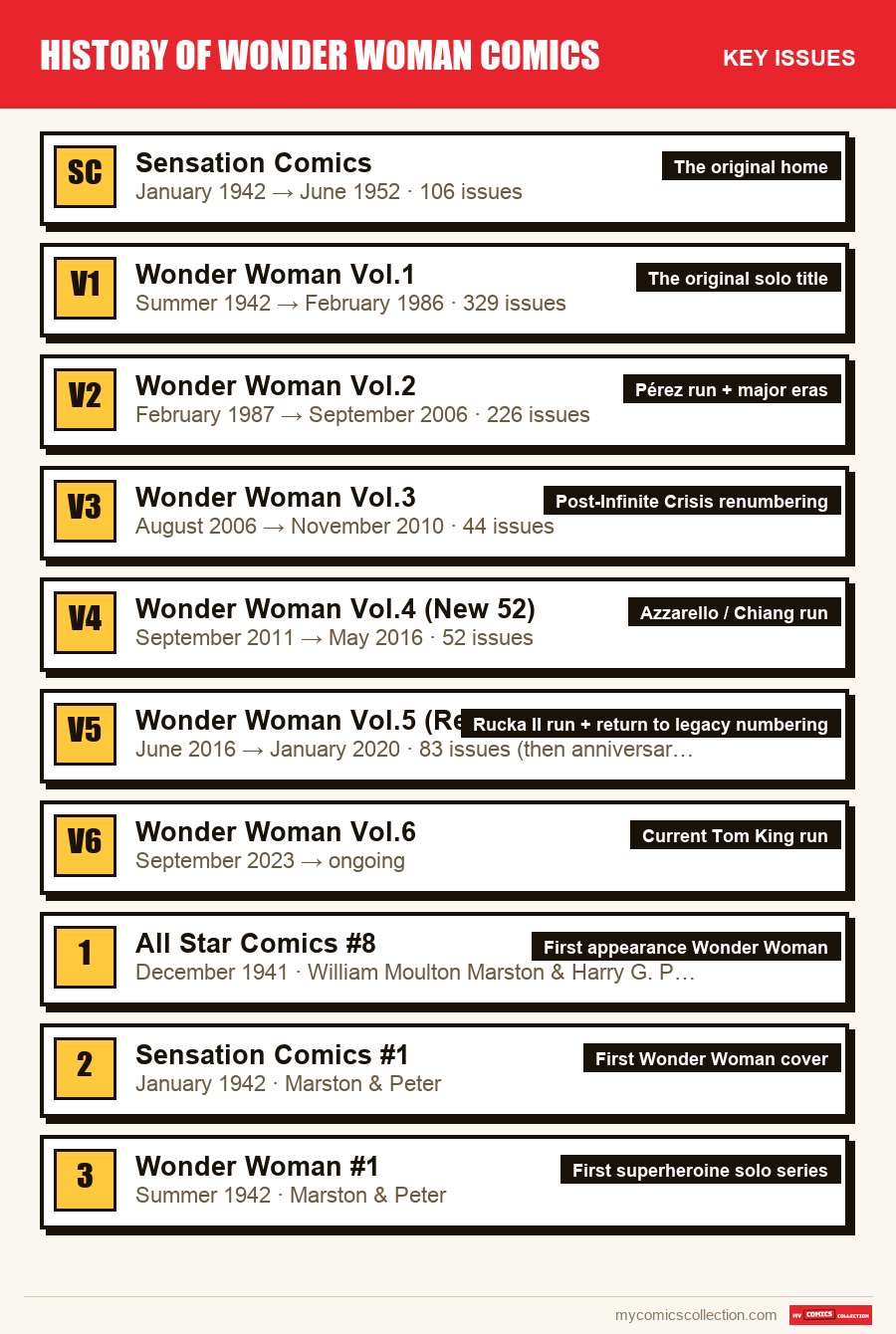
The Wonder Woman franchise has six main numbered volumes plus the original anthology series. Here's the chronology in order of first issue:
Sensation Comics
Even before Wonder Woman #1, Diana is the headliner of this anthology series. Sensation Comics #1 (January 1942) marks her first solo cover and the first time a superheroine headlines a monthly series. The series runs 106 issues, also featuring adventures of Mister Terrific, Wildcat, Black Pirate and Sargon the Sorcerer. Its end in 1952 reflects the Golden Age decline, but Wonder Woman keeps going in her own solo title.
Wonder Woman Vol.1
Launched only six months after the character's debut, Wonder Woman #1 (June-July 1942) then runs without interruption for 44 years, crossing the Golden, Silver, Bronze ages and the start of the Modern Age. It's one of DC's longest single-character series. Major turning points: #98 (1958, "New Look" Silver Age and arrival of Robert Kanigher as sole writer), #105 (extended origin of Diana as a child), #178-179 (1968, end of the Amazon, start of the powerless "Diana Prince era"), #204 (1973, return of the Amazon costume), #288 (1982, new double-W symbol), #329 (February 1986, last issue right before Crisis on Infinite Earths). The entire volume is then rebooted by George Pérez.
Wonder Woman Vol.2
Complete post-Crisis on Infinite Earths reboot driven by George Pérez (#1-62, 1987-1992). Pérez delivers one of the finest rewrites in DC history: he restores Greek mythology as the foundation, rebuilds Themyscira as a spiritual matriarchal society, and gives Diana back her original political charge. The volume then moves through the runs of William Messner-Loebs (#63-100), John Byrne (#101-136, who kills Diana and turns her into the goddess of Truth), Eric Luke, Phil Jimenez (a nod to Pérez), Walter Simonson, and especially Greg Rucka (#195-226, first Rucka run, casting Diana as ambassador).
Wonder Woman Vol.3
Renumbering following Infinite Crisis (2005-2006). Allan Heinberg opens the volume with "Who is Wonder Woman?", a run cut short by delays. Followed by Jodi Picoult (a guest bestselling author), Gail Simone (#14-44, 2007-2010, one of the most beloved runs of the 2000s) and the "Amazons Attack" event (2007). The volume ends at #44 then jumps directly into "Odyssey" (#600-614) with a return to legacy numbering to celebrate the 600th cumulative issue.
Wonder Woman Vol.4 (New 52)
Complete reboot under the New 52 era. Brian Azzarello and Cliff Chiang deliver the first 35 issues (2011-2014), a radical mythological horror run that turns Diana into a daughter of Zeus (replacing the traditional clay birth with a biological origin). Polarizing for purists but praised for its visual consistency. Followed by Meredith and David Finch (#36-52) with a more classic tone. The series ends at #52 in May 2016 to make way for the Rebirth reboot.
Wonder Woman Vol.5 (Rebirth)
With the DC Rebirth event, Greg Rucka returns to Wonder Woman for his second run (#1-25, 2016-2017) with two alternating threads: "The Lies" (odd issues, drawn by Liam Sharp) which questions Diana's memory, and "Year One" (even issues, by Nicola Scott) which rewrites her origins. A run cited as one of three Wonder Woman peaks alongside Marston and Pérez. Followed by G. Willow Wilson, Steve Orlando and Mariko Tamaki. The volume culminates with Wonder Woman #750 (January 2020), an anniversary issue with a return to legacy numbering (#83 + #500 + #167 cumulative according to DC's official math).
Wonder Woman Vol.6
Launch of the new volume by Tom King and Daniel Sampere. King sets up a dystopian frame where the U.S. government has declared the Amazons criminals, forcing Diana to become both a fugitive and a symbol of resistance. The run integrates Trinity (her future daughter Lizzie Prince, heiress to the Trinity Wells concept) and weaves a long thread through #25+ ongoing in 2026. Variant covers in heavy demand, the run is considered the most political since Marston and Pérez.
All parallel Wonder Woman series in chronological order
Alongside the six main volumes and Sensation Comics, DC has published many spin-off series and cult mini-series. Here's the chronology to understand the full ecosystem:
- Sensation Comics (1942-1952, 106 issues): the original anthology series, headlining Wonder Woman, see details above.
- Comic Cavalcade (1942-1954, 63 issues): another anthology series where Diana shares the bill with Golden Age Flash and Green Lantern.
- Wonder Woman: The Once and Future Story (1998, one-shot): Trina Robbins / Colleen Doran, a plea against domestic violence, prestige format.
- Wonder Woman: The Hiketeia (2002, OGN): Greg Rucka / J.G. Jones, a short but cult story on the concept of sacred supplication. A reference for understanding Rucka.
- Wonder Woman: Spirit of Truth (2001, OGN tabloid format): Paul Dini / Alex Ross, a spiritual sequel to Superman: Peace on Earth. Luxury oversize format.
- Wonder Woman: The Blue Amazon (2003, OGN): Doselle Young / Patrick Lehe, Diana in an alternate Art Deco universe.
- JLA: A League of One (2000, OGN): Christopher Moeller, Wonder Woman betrays the Justice League to save it. Often cited among the best Diana solo stories.
- Wonder Woman/Conan (2017-2018, 6 issues): Dark Horse × DC crossover, Gail Simone, two warriors face to face.
- The Legend of Wonder Woman (2016, 9 issues): Renae De Liz, a digital-first then print mini-series, a Year One retelling for younger audiences.
- Wonder Woman: Earth One Vol.1, 2, 3 (2016, 2018, 2021): Grant Morrison / Yanick Paquette trilogy, out of continuity, a philosophical retelling of the Amazon origins.
- DC: The New Frontier (2004, 6 issues): Darwyn Cooke, Diana plays a major role in this retro-futurist fresco on the Golden Age → Silver Age transition.
- Sensation Comics Featuring Wonder Woman (2014-2015, 17 issues): a digital-first anthology series, a tribute to the original series, with several guest authors.
- The Legend of Wonder Woman Vol.2 New 52 (rare digital).
- Wonder Woman: Dead Earth (2020, 4 issues): Daniel Warren Johnson, Black Label, Diana wakes up in a post-apocalyptic world.
- Wonder Woman Historia: The Amazons (2021-2023, 3 issues): Kelly Sue DeConnick / Phil Jimenez / Gene Ha / Nicola Scott, Black Label prestige, the founding myth of the Amazons before Diana. A visual peak.
- Trinity (multiple volumes: 2003 Matt Wagner mini-series, 2008-2009 weekly 52-issue series, 2016-2018 Vol.2 of 22 issues): a title dedicated to the Superman / Batman / Wonder Woman trio.
- Superman/Wonder Woman (2013-2016, 29 issues): a series dedicated to their New 52 romance.
- Wonder Woman: Black & Gold (2021, 6 issues): a black-and-gold anthology celebrating the 80th anniversary.
- Wonder Woman 1984 (2020, one-shot): tie-in to the Patty Jenkins film.
- Wonder Woman: Come Back to Me (2019, 6 issues): Amanda Conner / Jimmy Palmiotti, a Black Label mini.
- Wonder Woman / Conan , Wonder Woman / Star Trek and other one-off crossovers.
Wonder Woman key issues in chronological order
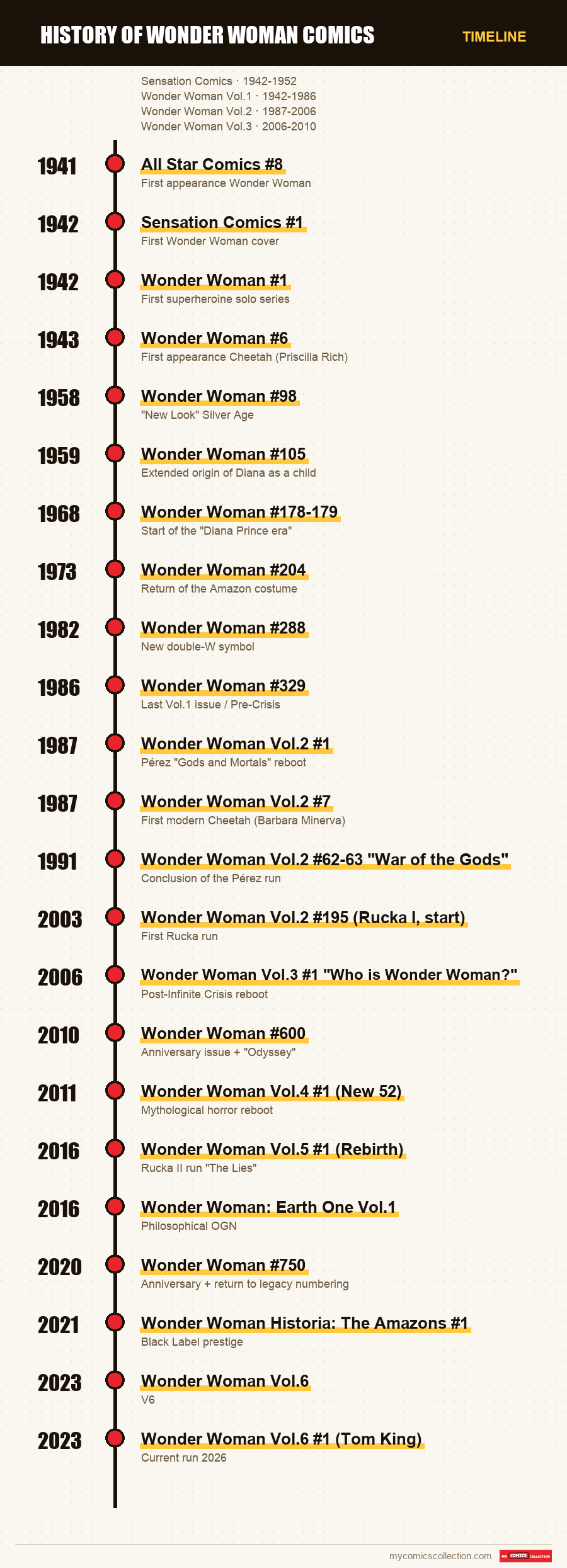
Here are the most important issues to know in chronological order of publication:
All Star Comics #8
The founding issue. A 9-page story (back-up to the Justice Society) where Diana, the Amazon princess, escorts Steve Trevor from Paradise Island. Top 10 of the most valuable Golden Age comics in the world across all characters. A CGC 9.4 copy reached $936,000 in 2022; CGC 8.0+ regularly clear $200,000. Estimated print run of 250,000 copies, of which fewer than 200 are known in certified grade.
Sensation Comics #1
First issue where Diana is the headliner and appears on the cover. The first superheroine in comics history to receive that honor. Extended origin story, arrival in Washington D.C., adoption of the Diana Prince civilian identity. A heavily collected issue: CGC 8.5+ between $50,000 and $90,000.
Wonder Woman #1
The very first solo series dedicated to a superheroine. Iconic Harry G. Peter cover with Diana brandishing the American flag. Canonical origin told in fuller form: Queen Hippolyta sculpts Diana from clay, Aphrodite breathes life into her. The most valuable issue in the franchise after All Star Comics #8. A CGC 9.0 reached $936,223 in 2024, the highest Wonder Woman sale ever.
Wonder Woman #6
First appearance of Cheetah, Wonder Woman's historical archenemy. The original version is Priscilla Rich, an unstable socialite debutante. The modern version (Barbara Ann Minerva) wouldn't be introduced until 1987 by Pérez. A highly demanded Golden Age issue, CGC 6.0 to 8.0 between $8,000 and $25,000.
Wonder Woman #98
A pivotal issue marking the end of the Marston-Peter era and the move into the Silver Age. Robert Kanigher becomes sole writer (he'd been on the book since 1947 but redefines the direction here), Ross Andru and Mike Esposito take over the art. Slightly modified costume, a more juvenile-adventure tone, gradual abandonment of Marston's political subtext.
Wonder Woman #105
The canonical Silver Age origin issue. Child Diana ("Wonder Girl") fights on Paradise Island, her powers granted by the individual goddesses (Hercules's strength, Athena's wisdom, Aphrodite's beauty, Hermes's speed). This pantheonic structure becomes the basis for every later version. First canonical appearance of Wonder Girl as young Diana.
Wonder Woman #178-179
One of the most radical turning points in Wonder Woman history. #178 announces the end of the Amazon, #179 renders Diana mortal: she loses her powers, abandons the starred costume for mod outfits, opens a boutique in Manhattan and learns martial arts from I-Ching. This "white" era runs through #204 (1973). Criticized by Gloria Steinem, who put classic Wonder Woman on the cover of Ms. #1 in 1972 to "bring the Amazon back."
Wonder Woman #204
A restoration issue. Under fan pressure and from Gloria Steinem, DC ends the Diana Prince era. Diana recovers her Amazon powers, her traditional costume, her golden lasso and her bracelets. Tragic death of I-Ching. Marks the start of the more political and more mature Bronze Age Wonder Woman.
Wonder Woman #288
The issue that introduces the famous double-W symbol stylized as an eagle on the bustier, since become the most recognizable graphic element of the costume. Before 1982, the costume's chest carried a stylized American eagle; afterward, the double-W took over and was carried by every medium up to the Patty Jenkins films.
Wonder Woman #329
The closing issue of 44 years of continuity. End of the pre-Crisis on Infinite Earths era. Diana marries Steve Trevor before the multiverse crisis rewrites her history. A symbolic issue for Bronze Age collectors, the end of a 329-consecutive-issue matrix.
Wonder Woman Vol.2 #1
The most important Wonder Woman reboot. George Pérez rewrites everything: Themyscira becomes a spiritual matriarchal society outside time, Greek mythology is restored as the foundation, Diana is sculpted from clay by Hippolyta and receives the blessing of six Olympian deities. Pérez's run from #1 to #62 (1987-1992) is considered the modern canonical definition of the character. Initial print run of more than 800,000 copies.
Wonder Woman Vol.2 #7
First appearance of Barbara Ann Minerva, a British archaeologist transformed into Cheetah by an African ritual. This is the version that becomes the modern canonical archenemy, popularized by Wonder Woman 1984 (Patty Jenkins film, 2020) with Kristen Wiig.
Wonder Woman Vol.2 #62-63 "War of the Gods"
Conclusion of Pérez's major arc: a cosmic war between the Greek and Roman pantheons. A 4-issue crossover + tie-ins, Pérez leaves the series on a mythological apotheosis. #62 (May 1992) is his last issue as sole writer-artist.
Wonder Woman Vol.2 #195 (Rucka I, start)
Launch of the first Greg Rucka run on Wonder Woman (#195-226, 2003-2006). Diana becomes Themyscira's ambassador to the United Nations, publishes a manifesto book, manages a hostile press. A political and diplomatic run, considered the character's peak before Rebirth. A direct inspiration for the Patty Jenkins film.
Wonder Woman Vol.3 #1 "Who is Wonder Woman?"
Launch of Vol.3. Diana has abdicated and Donna Troy temporarily wears the costume. Allan Heinberg delivers a brilliant identity arc slowed by delays. Terry Dodson variant covers heavily collected. The Gail Simone run starts with #14 (2007) and stretches through #44.
Wonder Woman #600
Return to legacy numbering to celebrate the 600th cumulative issue. Launch of the Odyssey arc by J.M. Straczynski: a controversial new costume (jacket, black pants), an alternate reality where Themyscira never existed. The arc divides the fanbase but remains a marker for collectors.
Wonder Woman Vol.4 #1 (New 52)
Launch of the Azzarello / Chiang run. Horror tone, a brutal return to the Greek gods in monstrous forms, and a shock reveal: Diana wasn't born of clay but is in fact the biological daughter of Zeus and Hippolyta. A controversial origin that has stayed partially canonical since. Cliff Chiang variant covers in heavy demand.
Wonder Woman: Earth One Vol.1
First volume of Grant Morrison's Earth One trilogy, out of continuity. A sensual, literal retelling of the Marstonian concept (bondage, feminism, Amazon rituals). Followed by Vol.2 (2018) and Vol.3 (2021). Prestige hardcover format, value steadily climbing.
Wonder Woman Vol.5 #1 (Rebirth)
Launch of the second Greg Rucka run, with a double structure: "The Lies" (odd issues, drawn by Liam Sharp) where Diana discovers her own memories are false, and "Year One" (even issues, by Nicola Scott) which rewrites her origins for the Rebirth canon. A run cited as the best since Pérez.
Wonder Woman #750
Anniversary issue celebrating 750 cumulative issues and the character's ~80 years. Anthology of major authors (Brian Michael Bendis, Greg Rucka, Steve Orlando, Mariko Tamaki, Colleen Doran, Gail Simone). More than 40 commemorative variant covers, heavily collected by completists.
Wonder Woman Historia: The Amazons #1
First Black Label mini-series on the Amazons' origins. Three issues by Phil Jimenez (#1), Gene Ha (#2) and Nicola Scott (#3). Visually among the most ambitious comics of the decade. Multi-award-winning at the Eisner Awards. Luxury oversize format.
Wonder Woman Vol.6 #1 (Tom King)
Launch of the current Vol.6 by Tom King. Dystopian frame: Amazons criminalized, Diana a fugitive and a symbol of resistance. Appearance of Trinity (her future daughter). The run is ongoing in 2026, Sampere and J.G. Jones variant covers in heavy demand among modern collectors. The most political run since Marston and Pérez.
Major Wonder Woman story arcs in order
Gods and Mortals (1987)
The George Pérez reboot. A canonical rewrite of the Amazon origins and Greek mythology.
Challenge of the Gods (1987-1988)
Pérez plunges Diana into the Greek underworld. The first major post-reboot arc, entirely mythological.
War of the Gods (1991)
Pérez crossover: Greek and Roman pantheons in cosmic war. Conclusion of the original Pérez run.
The Contest (1994-1995)
Hippolyta organizes a new tournament for the Amazon crown. Artemis temporarily becomes Wonder Woman.
The Hiketeia (2002)
Greg Rucka / J.G. Jones. Diana faces off against Batman to protect a young runaway. Cult OGN.
Rucka Run I, "Bitter Rivals" / "Stoned" / "Down to Earth" (2003-2006)
Diana as ambassador at the UN, publishes her manifesto book, faces Veronica Cale.
Who is Wonder Woman? (2006-2007)
Allan Heinberg / Terry Dodson. Vol.3 launch, Diana's return after Infinite Crisis.
Amazons Attack (2007)
Will Pfeifer / Pete Woods. Hippolyta invades Washington D.C., a controversial crossover event.
Gail Simone Run, "The Circle" / "Rise of the Olympian" (2007-2010)
The longest run on Wonder Woman, redefines Diana as an intuitive warrior and adoptive mother figure (Genocide, Achilles).
Odyssey (2010-2011)
J. Michael Straczynski. An alternate reality where Themyscira has been destroyed, Diana as a young fugitive.
Azzarello / Chiang Run, "Blood" / "Iron" (2011-2014)
New 52. Diana as daughter of Zeus, mythological horror, gods as villains.
Earth One Trilogy (2016, 2018, 2021)
Grant Morrison / Yanick Paquette. OGN trilogy out of continuity, a philosophical retelling.
The Lies + Year One (2016-2017)
Greg Rucka II. Double alternating narrative thread, deconstructs Diana's memory and rebuilds her Rebirth origins.
The Truth (2017)
Conclusion of the Rucka II run. Diana discovers the truth about Themyscira and her link to Steve Trevor.
Dead Earth (2020)
Daniel Warren Johnson, Black Label. Diana wakes up in a post-apocalyptic world. 4 prestige issues.
Historia: The Amazons (2021-2023)
Kelly Sue DeConnick / Jimenez / Ha / Scott. Founding myth of the Amazons before Diana, Black Label.
Tom King Run, "Outlaw" (2023+)
Current Vol.6. Amazons criminalized, Diana as a symbol of resistance, introduction of her daughter Trinity.
How to start a Wonder Woman collection in 2026
Set a clear goal
"I want all of Wonder Woman" is a bad goal (700+ legacy issues + spin-offs). "I want the complete Pérez run (Vol.2 #1-62)," "the complete Rucka run (Vol.2 #195-226 + Vol.5 #1-25)," or "both Earth One trilogies + Historia + Dead Earth in Black Label" are excellent structured starting points.
Import the catalog into My Comics Collection
With My Comics Collection, import Sensation Comics, Wonder Woman Vol.1 through Vol.6, and all the spin-off series (Trinity, Earth One, Historia). Each volume distinctly identified to avoid duplicates between Wonder Woman #1 (1942) , #1 (1987) , #1 (2006) , #1 (2011) , #1 (2016) and #1 (2023).
Prioritize key issues
The 22 key issues listed represent 80% of the historical value. See our dedicated Wonder Woman top 10 for key-issue focus + CGC values + realistic acquisition budgets.
Organize by run rather than by issue
Wonder Woman is collected by run (Marston, Kanigher, O'Neil/Sekowsky, Pérez, Rucka I, Simone, Azzarello, Rucka II, King) rather than by strict chronological issue. It makes for easier reading, gives narrative meaning, and lets you target the standout arcs without thinning out your budget on filler.
Track eBay valuations
All Star Comics #8 and Wonder Woman #1 (1942) are out of reach for most collectors, but plenty of other key issues move constantly (Wonder Woman #98, #178, #204, Vol.2 #1, Vol.5 #1). My Comics Collection updates values based on real GoCollect, GPA and eBay sales.
Why Wonder Woman is still collected in 2026
Along with Superman and Batman, Wonder Woman is one of DC's three most active franchises in monthly sales in 2026. Several structural reasons explain this longevity:
- 84 years of continuity: Wonder Woman has run without a major interruption since December 1941. Six main volumes, a coherent mythological thread despite the reboots, a character who has never stopped being published.
- Patty Jenkins films : Wonder Woman (2017) with Gal Gadot earned $822 million worldwide at the box office, becoming the biggest commercial success for a superheroine film. Wonder Woman 1984 (2020) divides but maintains the momentum. A new film with James Gunn / James Wan is announced for the post-2026 DC Studios phase.
- Feminist charge: no other superheroine has the same historical depth or political legitimacy. Diana spans 84 years while remaining a symbol of empowerment, from Gloria Steinem's Ms. Magazine (1972) to today's feminist marches.
- Reinvented Greek mythology: Themyscira, the Amazons, the Olympian pantheon, the lasso of truth, the bracelets, the invisible plane: a visually unique universe with no equivalent at Marvel or in the rest of DC.
- DC Trinity: Wonder Woman is a mandatory complement to Superman and Batman in any serious reading of the DC universe. No serious DC collection can skip Diana.
Build your Wonder Woman collection with method
Import the 700+ Wonder Woman + Sensation Comics + spin-off issues in one click, identify your missing key issues, track eBay value. Free 7-day trial.
🚀 Start the free 7-day trialGo further
- Wonder Woman Reading Guide: Where to Start and Which Runs to Follow
- The Best Wonder Woman Runs: A Collector's Ranking from Marston to Cloonan
- Best Wonder Woman Story Arcs: A Collector's Guide
- Top 10 Wonder Woman Key Issues to Own
- First Appearance of Wonder Woman: All Star Comics #8 (1941): Analysis, CGC Grades & Value
- Wonder Woman Comics Collection: The Complete Collector's Guide
FAQ, History of Wonder Woman
Other character history articles to discover
Our complete "Comics history" article series covers the 20 biggest Marvel and DC franchises. Each article follows the same format: birth, full chronology of volumes, parallel series, key issues ranked chronologically, major arcs and a method for collecting.
→ See all "History" articles on the blog