
Aquaman (Arthur Curry, aka Orin) was born in November 1941 in More Fun Comics #73 , written by Mort Weisinger and drawn by Paul Norris. He spent 21 years as a backup feature (More Fun Comics #73-#107, then Adventure Comics #103-#280) before finally landing his own solo title with Aquaman Vol.1 in February 1962. Since then, the King of the Seven Seas has had nine main volumes, dozens of mini-series (The Atlantis Chronicles, Time and Tide, Sword of Atlantis, Andromeda) and cult runs (Peter David 1991-1995, Geoff Johns 2011-2013, Dan Abnett 2016-2021). This article walks you through his birth, gives you the complete chronological list of series, and lays out the key issues you'll want to know to build a structured collection.
Long mocked as the hero who talks to fish, Aquaman is nevertheless one of the oldest DC super-heroes still being published. He first appeared in November 1941, just two years after Batman and three years after Superman, beating Wonder Woman and almost the entire Marvel roster by several months. His longevity comes down to a strong core: a prince of Atlantis torn between two worlds, guardian of an ocean that covers 70% of the planet. While other DC heroes have their cities (Metropolis, Gotham, Central City), Aquaman rules the depths: a unique narrative landscape that only the very best writers (Peter David, Geoff Johns, Dan Abnett) have managed to fully exploit.
This guide will give you everything you need to understand the birth of Aquaman , follow the complete list of Aquaman comics in order , and identify the key issues and major arcs to prioritize. We'll cover 85 years of the character, from More Fun Comics #73 (1941) through the Brandon Thomas / Jeremy Adams run in 2026, distinguishing between main volumes, parallel ongoings, and the many cult mini-series (The Atlantis Chronicles, Time and Tide, Sword of Atlantis, Andromeda...).
The birth of Aquaman: DC in 1941
To understand how Aquaman was born, you've got to go back to the fall of 1941. World War II was raging, the United States was about to enter the war after Pearl Harbor (December 1941), and comic book publishers were churning out heroes to support the patriotic effort. Mort Weisinger, a young editor at DC (then National Comics Publications), was looking to flesh out the lineup of More Fun Comics, an anthology series that already published Doctor Fate, Spectre and Johnny Quick. He imagined an aquatic hero capable of fighting Nazi U-boats in the Atlantic: Aquaman was born.
Weisinger handed the visual side to Paul Norris, a 28-year-old artist working part-time at DC. The original costume (bright green scaled shirt, orange pants, yellow gloves) would stay almost unchanged for 70 years. The basic concept was set in that first 6-page story: a man born of an Earth oceanographer and a woman from Atlantis, able to breathe underwater, swim at high speed, and communicate telepathically with sea creatures. The first origin (Adventure Comics #260, 1959) would later be reformulated to make Arthur the son of Tom Curry and Queen Atlanna, exiled from Atlantis.
More Fun Comics #73 (November 1941)
Aquaman makes his first appearance in More Fun Comics #73 (cover-dated November 1941, on newsstands as early as September 1941), in a 6-page story where he saves a refugee ship attacked by a German U-boat. The tone is pulp, patriotic, with no psychological complexity. Aquaman is credited "by Mort Weisinger and Paul Norris": one of the rare DC co-creations where both names appear in the very first issue. The character shares cover space with Green Arrow (also a first appearance in the same issue: an extremely rare event in comics history: two major heroes born in the same issue).
The success was strong enough to turn Aquaman into a recurring backup feature. From More Fun Comics #73 to #107 (1941-1945), he occupied 6 to 8 pages per issue. When DC restructured its anthologies in 1946, Aquaman moved over to Adventure Comics starting with #103 (April 1946) and stayed there through #280 (January 1961), for 177 consecutive issues as a backup. That's one of the longest continuous runs without a solo series in all of comics history: Aquaman waited 21 years before getting his own title.
The historical anomaly: Aquaman is one of only three DC super-heroes to have survived without interruption past the end of the Golden Age (alongside Batman, Superman and Wonder Woman). While Flash, Green Lantern, Hawkman, Atom, Doctor Fate, Spectre and so many others were canceled between 1949 and 1951, Aquaman kept on publishing as a backup, month after month, through the wilderness years of the Late Golden Age. That uninterrupted continuity since 1941 paradoxically gives him a historical status that other, more popular heroes don't have.
The main Aquaman series in chronological order
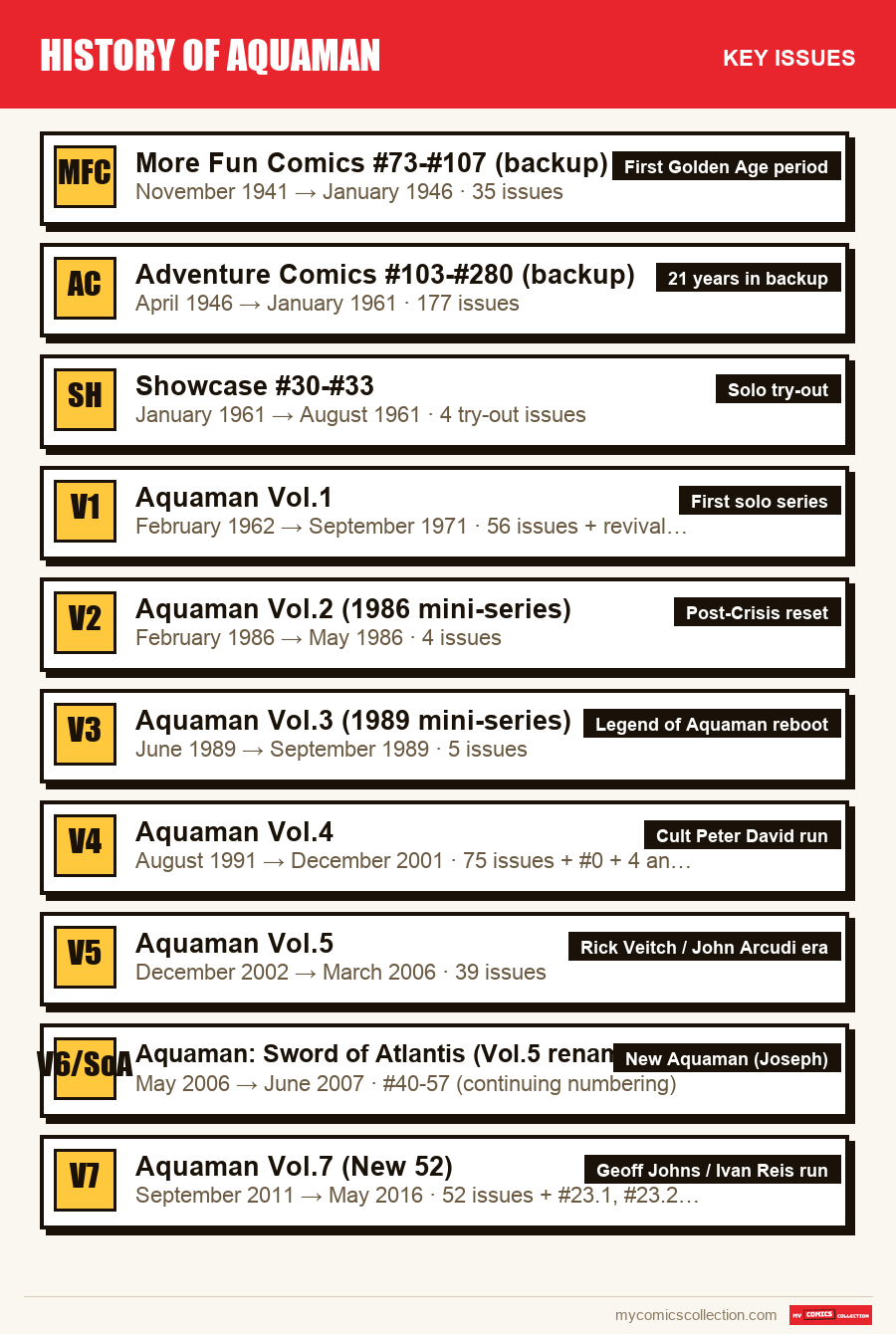
The Aquaman franchise counts nine main volumes plus several transitional periods. Here are the main solo series in the order of their first issue:
More Fun Comics #73-#107 (backup)
Aquaman starts as a backup feature (6-8 pages) in More Fun Comics. Short self-contained stories, pulp wartime patriotic tone. Mort Weisinger writes through 1945, Paul Norris draws the first issues. No expanded mythology yet: no Mera, no Aqualad, no Black Manta: just an aquatic hero fighting enemy submarines and pirates. More Fun Comics #73 is now the most valuable issue in the entire Aquaman franchise.
Adventure Comics #103-#280 (backup)
Aquaman's move to Adventure Comics, where he'll stay for 177 consecutive issues as a backup feature. A foundational period that establishes the entire mythology: Adventure Comics #260 (May 1959) reformulates the Silver Age origin, Tom Curry / Atlanna / exiled Atlantis, which will hold as canon for 50 years. Adventure Comics #269 (February 1960) introduces Aqualad (Garth), the sidekick. It's also in Adventure Comics that the character's definitive powers crystallize.
Showcase #30-#33
Before launching a solo series, DC tested Aquaman's commercial viability across four consecutive issues of Showcase (the same series that had launched Flash, Green Lantern, Atom and the Justice League). Complete stories by Jack Miller and Ramona Fradon. The test was conclusive: sales justified a solo title. Showcase #30-33 are sought-after issues for their transitional status.
Aquaman Vol.1
After 21 years of waiting, Aquaman finally got his own series in February 1962. Launched by Jack Miller / Nick Cardy, it ran through #56 in March 1971 before cancellation. Major turning points: #11 (1st appearance Mera), #29 (1st Ocean Master), #35 (1st Black Manta: an absolutely major key issue), #18 (Arthur / Mera wedding). DC briefly revived the series from 1977 to 1978 with seven additional issues (#57-63) by Steve Skeates / David Michelinie. Those seven "late issues" are scarce.
Aquaman Vol.2 (1986 mini-series)
First post-Crisis on Infinite Earths Aquaman mini-series, by Neal Pozner / Craig Hamilton. New blue costume (different from the iconic green/orange). A commercial flop but a cult favorite among completists. The 4 issues are relatively affordable.
Aquaman Vol.3 (1989 mini-series)
5-issue mini-series by Robert Loren Fleming / Keith Giffen / Curt Swan that reformulates the post-Crisis origin: Arthur is no longer the son of Atlanna and Tom Curry, but a child abandoned with the Idylists and then handed to a lighthouse keeper. This continuity will hold for 20 years before the Geoff Johns reset. Preceded by Aquaman Special #1 (1989) which contains the "Legend of Aquaman" origin, canonical throughout the 1990s.
Aquaman Vol.4
The most significant run in Aquaman's history, launched by Peter David in August 1994 (after 13 transitional Shaun McLaughlin issues). David transforms Arthur into a bearded warrior-king with a metal harpoon replacing the left hand bitten off by piranhas (#2). Tone shifts to something radically more mature: Atlantean politics, royal conflicts, character deaths. Aquaman Vol.4 #1 , #2 (loss of the hand), #23 (death of Tula), #46 (one-handed Aquaman becomes king) are the key issues of the David era. Followed by Erik Larsen and then Dan Jurgens through cancellation at #75 in December 2001.
Aquaman Vol.5
Reboot by Rick Veitch / Yvel Guichet in December 2002. Mystical-ecological tone, Aquaman gets a magical "water hand" replacing the harpoon. John Arcudi takes over (#15-39), bringing the tone back down to earth. Volume issues are sometimes underrated but narratively coherent. The series is canceled to make way for the next reboot.
Aquaman: Sword of Atlantis (Vol.5 renamed)
A direct continuation of Aquaman Vol.5 but with a complete change of protagonist: Arthur Curry disappears, replaced by Joseph Curry (Aquaman II), a brand new character. Launched by Kurt Busiek / Jackson Guice with Sword of Atlantis #40, picking up the Vol.5 legacy numbering. Tai Pham and then Tad Williams wrap things up. Canceled at #57. A transitional period sometimes overlooked but rich with affordable collectibles.
Aquaman Vol.7 (New 52)
The second major run after Peter David. Geoff Johns and Ivan Reis reboot Aquaman for the New 52, tackling the character's mocked image head-on ("the hero who talks to fish") and reinventing him as a serious hero. Arc The Trench (#1-7), then The Others (#7-13), then Death of a King (#14-19), then Throne of Atlantis (Justice League crossover). The reference run for discovering modern Aquaman. Followed by Jeff Parker, Cullen Bunn, then Dan Abnett (foreshadowing Rebirth) through #52.
Aquaman Vol.8 (Rebirth)
Launched with the Rebirth event in June 2016, this volume is carried almost entirely by Dan Abnett (#1-56). Diplomatic-political tone with Black Manta Rising (#1-6), Crown of Atlantis (#7-12), The Drowning, then Underworld (#25-32). Robson Rocha, Stjepan Sejic and Kelley Jones on art. Kelly Sue DeConnick takes over from #43 to the end. An extremely coherent run, a great modern entry point after Johns.
Aquaman Vol.9 (2022)
After a transition through the Aquamen mini-series (2022, 12 issues), Aquaman Vol.9 launches a new era under Brandon Thomas and then Jeremy Adams. Focus on the Arthur / Jackson Hyde (the new Aqualad) relationship, more adventure-driven than political in tone. The run is ongoing in 2026, recent issues are very much in demand in variant covers, fueled by the Jason Momoa films.
All parallel Aquaman series in chronological order
Alongside the main volumes, DC has published numerous mini-series, spin-offs and titles centered on Atlantean mythology. Here's the chronology of the major parallel titles:
- Aquaman: The Atlantis Chronicles (1990, 7 issues): a maxi-series by Peter David / Esteban Maroto, retracing 10,000 years of Atlantean history before Arthur. The absolute reference for Atlantean mythology. One of DC's great achievements of the 1990s.
- Aquaman: Time and Tide (1993-1994, 4 issues): Peter David / Kirk Jarvinen mini-series that definitively reformulates Arthur's origin. Required reading before the Peter David Vol.4 run.
- Aquaman / Green Lantern: Time and Tide: occasional crossovers (not to be confused with the solo Time and Tide mini).
- Aquaman Special #1 (1988): "Legend of Aquaman" by Robert Loren Fleming / Keith Giffen, the basis for the post-Crisis origin.
- Aquaman Annual (multiple issues 1962-2014): annuals from Vol.1, Vol.4, Vol.5, Vol.7, often prologues to major arcs.
- Tempest (1996, 4 issues): mini-series centered on Garth (the former Aqualad). Phil Jimenez on art. Reworking of the character into a sorcerer.
- Aquaman: Secret Files & Origins (1998, 2003): informational one-shots with bios, profiles, short stories.
- Aquaman / Sub-Diego: Vol.5 storyline where part of San Diego is submerged.
- Aqualad / Tempest short series: focus on the aquatic sidekicks across the decades.
- Black Manta (multiple mini-series 2021-2022, 6 issues): Aquaman's nemesis in a solo series. Chuck Brown writing. Reference for understanding the villain.
- Aquamen (2022, 12 issues): series centered on Arthur Curry and Jackson Hyde (Aqualad) as a duo. Brandon Thomas / Chuck Brown.
- Aquaman: Andromeda (2022, 3 issues): Black Label maxi by Ram V / Christian Ward, Aquaman exploring the cosmic abyss. Horror science-fiction tone.
- Aquaman & The Flash: Voidsong (2022, 3 issues): Black Label team-up by Collin Kelly / Jackson Lanzing.
- Aquaman: The Becoming (2021-2022, 6 issues): mini centered on Jackson Hyde. Brandon Thomas / Diego Olortegui.
- Aquaman & Aquagirl (2025, recent short series): focus on Tula and the new Aquagirl.
- Justice League: Drowned Earth (2018, crossover event): Aquaman in a central role, cosmic aquatic enemies.
- JLA #69 and Justice League arcs: Aquaman in team-ups (League of Atlantis, Throne of Atlantis runs across Justice League).
Aquaman key issues in chronological order
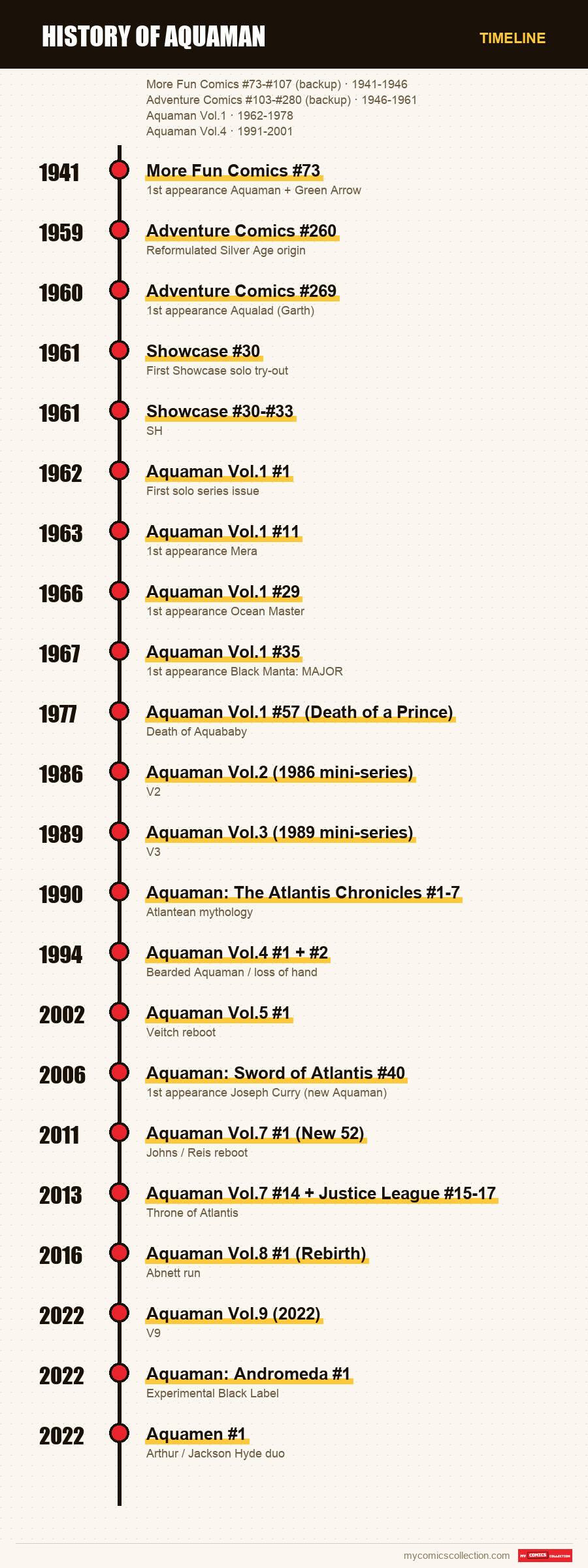
Here are the most important issues to know in chronological order:
More Fun Comics #73
The founding issue. A 6-page story where Aquaman, not yet named "Arthur Curry," fights a German U-boat. A unique quirk in comics history: Green Arrow also makes his first appearance in this very same issue. A CGC 8.0 copy goes for over $100,000 at auction, and a high-grade copy can hit $200,000+. Top 50 most expensive Golden Age comics.
Adventure Comics #260
Aquaman's first reboot. Bernstein and Fradon reformulate the origin: Arthur Curry, son of Tom Curry (lighthouse keeper) and Queen Atlanna (exiled from Atlantis). This Silver Age origin holds for 30 years. A foundational issue for understanding the character's modern identity. High-grade CGC remains accessible (under $5,000).
Adventure Comics #269
First appearance of Garth / Aqualad, Aquaman's sidekick and the future Tempest. A key character who'll play a major role in the Teen Titans starting in 1964 (Brave and the Bold #54). One of the affordable key issues, available in mid-grade.
Showcase #30
The first of four Showcase try-outs that lead to the Aquaman Vol.1 series. Showcase is the historic series that had launched Flash, Green Lantern, Atom and the JLA. These four issues (#30-33) are essential transitional pieces for completists.
Aquaman Vol.1 #1
After 21 years of waiting, Aquaman finally has his own series. Iconic Nick Cardy cover (seahorse in the background, definitive green/orange costume). A foundational issue for understanding Aquaman's arrival to "lead character" status. CGC 9.0+ is in high demand among Silver Age collectors.
Aquaman Vol.1 #11
First appearance of Mera, princess of another aquatic dimension, future queen of Atlantis and Aquaman's wife. A major female DCU character, she'll become central in the Peter David and Geoff Johns runs and in the Aquaman film (Amber Heard). Key issue with prices climbing since the 2018 movie.
Aquaman Vol.1 #29
First appearance of Orm Marius / Ocean Master, Aquaman's half-brother and central family antagonist. A character revisited head-on in the Geoff Johns run (Throne of Atlantis) and played by Patrick Wilson in the Aquaman films (2018, 2023).
Aquaman Vol.1 #35
The most important Aquaman key issue after More Fun Comics #73. First appearance of Black Manta, Aquaman's nemesis, one of the most iconic adversaries in the DCU. Black Manta will kill Arthur Jr. (Aquababy) in the Death of a Prince storyline (1977), and play the central antagonist of every Aquaman film. CGC 9.0 tops $5,000 in 2024-2026, climbing fast since the films were announced.
Aquaman Vol.1 #57 (Death of a Prince)
Shocking issue from the 1977 revival. Black Manta kills Arthur Jr. (Aquababy), a foundational trauma that will mark Aquaman for 40 years. Storyline starts in Adventure Comics #452 and culminates here. One of the most memorable Bronze Age issues in the franchise.
Aquaman: The Atlantis Chronicles #1-7
A 7-issue maxi-series retracing 10,000 years of Atlantean history. The most ambitious work ever devoted to Atlantean mythology. A reference for anyone wanting to understand Aquaman's cultural backdrop. A relatively affordable and essential maxi-series.
Aquaman: Time and Tide #1-4
4-issue mini-series that lays the groundwork for the Vol.4 run. Reformulates the origin, sets up the bearded / harpoon transformation. Required reading as a prelude to Aquaman Vol.4. Time and Tide issues are often overlooked but essential.
Aquaman Vol.4 #1 + #2
Official launch of the Peter David run. #2 is the issue where Aquaman loses his left hand, devoured by piranhas, and replaces it with a metal harpoon. An iconic visual transformation that lasts until 2003. A major franchise turning point. CGC 9.4+ is highly sought after.
Aquaman Vol.5 #1
Launch of Vol.5 by Rick Veitch. Aquaman gains the magical "waterhand" replacing the harpoon. More mystical-ecological tone. A minor run overall but an important transitional one.
Aquaman: Sword of Atlantis #40
Continuation of the Vol.5 numbering under the title "Sword of Atlantis," with a new character in place of Arthur: Joseph Curry. A transitional period that wasn't widely followed but offers affordable collectibles. Arthur will return quickly in 2010 in Brightest Day.
Aquaman Vol.7 #1 (New 52)
Launch of the Geoff Johns / Ivan Reis run that reinvents Aquaman for the 21st century. The first issue tackles the character's mocked image head-on and redefines him as a serious hero. Kicks off the The Trench arc. The reference run for discovering modern Aquaman, comparable to Court of Owls for Batman.
Aquaman Vol.7 #14 + Justice League #15-17
Mega Aquaman / Justice League crossover where Atlantis attacks the surface. The arc directly inspired the 2018 Aquaman film (James Wan). Aquaman becomes king of Atlantis. Required reading to understand the character's royal position in 2026.
Aquaman Vol.8 #1 (Rebirth)
Rebirth launch carried by Dan Abnett. Kicks off "The Drowning" arc. A run with exceptional narrative coherence, underrated compared to Johns but just as good. A solid modern entry point for new Rebirth readers.
Aquaman: Andromeda #1
3-issue Black Label maxi-series by Ram V and Christian Ward. Aquaman explores the cosmic abyss. An unprecedented horror science-fiction tone. One of the most visually striking works in the franchise. Variant covers in high demand.
Aquamen #1
Launch of the transition series between Vol.8 and Vol.9, putting Arthur Curry and Jackson Hyde (the new African-American LGBT+ Aqualad) on equal footing. A major franchise evolution toward a diverse cast. 12 issues in total.
The major Aquaman story arcs in order
Death of a Prince (1977)
Black Manta kills Arthur Jr. A foundational trauma, shapes Aquaman for 40 years.
The Atlantis Chronicles (1990)
Peter David / Maroto maxi-series retracing 10,000 years of Atlantis.
Time and Tide (1993-1994)
Peter David reformulates the origin. Setup for Vol.4.
The Hand (1994)
Aquaman loses his left hand, becomes bearded, harpoon. Iconic transformation.
Obsidian Age (2001-2002)
JLA / Aquaman crossover in ancient Atlantis. Cosmic arc.
Sub-Diego (2003-2005)
San Diego submerged, Aquaman as guardian. Veitch / Arcudi run.
The Trench (2011)
Johns / Reis launch. Abyssal creatures attack the surface.
The Others (2012)
Team of Arthur's hidden friends, Atlantean relics. Johns run continues.
Throne of Atlantis (2013)
JL / Aquaman crossover. Atlantis attacks the surface. Source arc for the 2018 film.
Death of a King (2013-2014)
Atlan, the first king of Atlantis, returns. The Johns run hits its peak.
The Drowning (2016)
Rebirth launch by Dan Abnett. Atlantis / surface diplomacy.
Black Manta Rising (2016-2017)
Black Manta forms N.E.M.O. A structured antagonist.
Crown of Atlantis (2017)
Conflict over the throne. Aquatic Game of Thrones tone.
Underworld (2017-2018)
Aquaman in the slums of Atlantis. Stjepan Sejic on art.
Justice League: Drowned Earth (2018)
Aquaman at the heart of a DC event against cosmic aquatic gods.
Andromeda (2022)
Black Label by Ram V / Christian Ward. Cosmic abyss, horror SF.
Aquamen (2022)
Arthur and Jackson Hyde as a duo. Brandon Thomas relaunches the franchise.
How to start an Aquaman collection in 2026
Set a clear goal
"I want all of Aquaman" is a bad goal (More Fun Comics #73 hits $100,000+ in good shape). "I want the Geoff Johns Vol.7 #0-25 run" or "the Peter David Vol.4 #1-46 run" are excellent starting points. A serious completist can target all of Vol.4 (76 issues) at prices that are still very accessible.
Import the catalog into My Comics Collection
With My Comics Collection, import the nine Aquaman volumes + Adventure Comics #103-280 + the mini-series (Atlantis Chronicles, Time and Tide, Andromeda, Aquamen). Each volume is identified separately: essential since "Aquaman #1" exists in 2002, 2003, 2011, 2016 and 2022.
Prioritize key issues
The 19 key issues listed represent 80% of the historical value. See our dedicated Aquaman top 10 for a focus on key issues + CGC values.
Organize by run rather than by issue number
Aquaman is best collected by run (Peter David, Geoff Johns, Dan Abnett, Brandon Thomas) rather than by strict chronological issue. That gives you narrative coherence and makes resale by lot easier.
Track eBay valuation
More Fun Comics #73 and Aquaman Vol.1 #35 (1st Black Manta) have been climbing steadily since the Jason Momoa films. My Comics Collection updates values based on actual sales.
Why Aquaman remains a collected character in 2026
Long mocked in popular culture ("the hero who talks to fish," running gag of the 1970s-2000s), Aquaman has experienced a spectacular reversal in the 21st century. Several reasons:
- Jason Momoa films : Aquaman (2018, James Wan) earned $1.15 billion at the box office, becoming the biggest solo DC hit of the decade. Aquaman and the Lost Kingdom (2023) confirms the franchise on screen and pushes key issues to historic highs.
- Modern heroic image: since the Geoff Johns run in 2011, Aquaman is no longer a minor hero but a powerful warrior-king, the equal of Superman and Wonder Woman in the Justice League. That rise is reflected in modern comic sales.
- Unique mythology: unlike other DC heroes, Aquaman rules over Atlantis, a millennia-old civilization with its own history (The Atlantis Chronicles). Inexhaustible narrative ground.
- Strong rogues gallery: Black Manta, Ocean Master, Charybdis, N.E.M.O., Atlan, The Trench. Black Manta is regularly ranked among the top 20 DC villains.
- Multimedia presence: animated Justice League (2001-2006), Smallville, Young Justice, Aquaman: King of Atlantis, The Brave and the Bold. Aquaman is now a recognized pillar of the DCU.
Biography of Arthur Curry (Aquaman)
Aquaman is a character of DC Comics created by Mort Weisinger and Paul Norris. His first appearance is in More Fun Comics #73 , published in November 1941.
Identity sheet of Arthur Curry
- Real name: Arthur Curry (aka Orin)
- Date of birth: November 1941 (creation)
- Place of birth: Atlantis (underwater kingdom)
- First appearance : More Fun Comics #73 (November 1941)
- Creators: Paul Norris (cartoonist) and Mort Weisinger (writer)
- Editor: DC Comics
- Memberships: Justice League (founding member), Atlantis (royalty)
Character origins
Arthur Curry is the son of Tom Curry (human lighthouse keeper) and Atlanna (exiled Atlantean princess). Endowed with superhuman aquatic powers, he discovers his Atlantean heritage and inherits the throne. Becomes the king of Atlantis and founding member of the Justice League, defender of the boundary between the surface world and the underwater realm.
Powers and Abilities
- King of the Seven Seas and Atlantis
- Superhuman strength, speed, endurance
- Unlimited water breathing
- Resistance to abyssal pressures
- Aquatic telepathy: control of sea creatures
- Trident of Atlantis: mystical weapon with elemental powers
- Night and thermal vision
Costume and visual identity
Orange scaled tunic with belt, green pants, yellow gloves. Golden trident as signature weapon. Modern versions: more martial gold and green armor.
Build your Aquaman collection methodically
Import the nine Aquaman volumes + Adventure Comics #103-280 + every mini-series in one click, identify your missing key issues, track eBay value. Free 7-day trial.
🚀 Start the free 7-day trialGo further
- Aquaman Reading Order: The Complete Guide to Every Run and Era
- Best Aquaman Comic Runs: The Essential Reading List for Collectors
- Best Aquaman Story Arcs: The Essential Reading Guide for Collectors
- Top 10 Aquaman Key Issues to Own
- Aquaman's First Appearance: More Fun Comics #73. The Complete Collector's Guide
- Aquaman Comics Collection: The Complete Collector's Guide to Key Issues, Runs & Strategy
FAQ, History of Aquaman
Other comics character histories to discover
Our complete "Comics history" article series covers the 20 biggest Marvel and DC franchises. Each article follows the same format: birth, complete chronology of volumes, parallel series, key issues sorted chronologically, major arcs and collection method.
→ See all "History" blog articles