
The first Green Lantern , Alan Scott, was born in July 1940 in All-American Comics #16 , written by Bill Finger and drawn by Martin Nodell. Nearly twenty years later, the hero got a full Silver Age rebirth when Hal Jordan appeared in Showcase #22 (October 1959), created by John Broome and Gil Kane. Since then, the mantle has been worn by Guy Gardner , John Stewart , Kyle Rayner , Jessica Cruz , Simon Baz , and Sojourner Mullein. This article walks through the full genesis of the franchise in 1940 and 1959, gives you the precise chronology of every Green Lantern volume in order, and lists the major key issues to build a coherent collection.
Alongside Batman and Superman, Green Lantern is one of the pillars DC Comics has reinvented more brilliantly than any other franchise. No other hero has had such a complete Golden Age → Silver Age transition: Alan Scott, the mystic-sorcerer of 1940, was literally replaced by Hal Jordan, a test pilot who receives his ring from a dying alien Green Lantern in 1959. That narrative reset was so decisive that it inaugurated the entire DC superhero Silver Age, opening the door for the rebirth of Flash, Atom, Hawkman, and all the others.
This guide gives you everything you need to understand the birth of Green Lantern in 1940 and 1959 , follow the complete list of Green Lantern comics in order , and identify the key issues and major arcs to prioritize. We'll walk through 85+ years of the character, from All-American Comics #16 (1940) up to Jeremy Adams's current run in 2026, distinguishing the main volumes, the parallel ongoings dedicated to the Green Lantern Corps, and the event sagas that have redefined the franchise (Hard-Traveling Heroes, Emerald Twilight, Rebirth, Sinestro Corps War, Blackest Night).
The birth of Green Lantern: 1940 then 1959
To understand how Green Lantern was born, you've got to separate two completely different founding moments. The first in 1940 at All-American Publications (the affiliate that would later merge with National to form DC). The second in 1959, at a moment when superheroes were coming back into fashion after the post-Wertham collapse. No other major franchise has had two such distinct origins, written by two pairs of authors with no link between them. That double beginning is what makes the character singular and explains why the franchise today counts more than eight human Green Lanterns coexisting in the modern continuity.
Alan Scott: All-American Comics #16 (July 1940)
Martin Nodell was 25 in 1940 when he pitched Sheldon Mayer, editor at All-American Publications, a character inspired by Aladdin's lamp and a New York subway car (legend has it that Nodell saw a railroad worker waving a green lantern on the tracks and saw his concept in it). Mayer accepted right away. For the script, the call went to Bill Finger: yes, the same Finger who was co-creating Batman at the same time over at Detective Comics. Alan Scott appeared in All-American Comics #16 cover-dated July 1940 (on stands starting May 1940). A railroad engineer, Scott discovers a magical lantern made of green metal that fell from a mystic meteor. A voice speaks to him and asks him to carve a ring from the metal and use it to fight evil: provided he recharges the ring once every 24 hours on the lantern.
The 1940 Alan Scott has no link to an intergalactic corporation: he's alone, mystical, with powers that come from a "Starheart" with mythological origins. His iconic weakness: wood (whereas the 1959 Hal Jordan version would be vulnerable to yellow). Success was immediate. Alan Scott got his own title with Green Lantern Vol.1 #1 in spring 1941, and became a founding member of the Justice Society of America in All-Star Comics #3 (winter 1940). Vol.1 ran through #38 (1949) before the superhero collapse at the turn of the 50s.
Hal Jordan: Showcase #22 (October 1959)
Twenty years later, DC Comics is in full revival mode. Showcase #4 (October 1956) had relaunched Flash with an entirely new character (Barry Allen) and inaugurated the Silver Age. The success was so big that editors and creators tried to repeat the trick. Julius Schwartz, the visionary editor behind Flash, asked John Broome (writer) and Gil Kane (artist) to relaunch Green Lantern with the same approach: new character, new costume, new origin, total abandonment of the mystical in favor of science fiction.
Hal Jordan appeared in Showcase #22 (October 1959, on stands August 1959). A Coast City test pilot, a brave and stubborn young man, Hal is summoned aboard a crashed ship where a dying alien named Abin Sur passes him his power ring. That ring is the weapon of an intergalactic organization: the Green Lantern Corps, guardians of order in 3,600 cosmic sectors, led by the Guardians of the Universe on Oa. The classic wood weakness is replaced by yellow (a limitation imposed by the Guardians themselves). With this complete reboot, Green Lantern becomes a space opera. The solo series Green Lantern Vol.2 kicked off in July 1960 and would run 224 issues. Hal Jordan is the Silver Age canon and would remain the central figure of the myth for 50 years, until Geoff Johns's runs in the 2000s.
The editorial stroke of genius: unlike Marvel, which invented its heroes from scratch in the 1960s, DC reused old names (Flash, Green Lantern, Hawkman, Atom) by completely emptying them of their Golden Age substance. This editorial process, rewriting existing concepts with an entirely new character, saved the American superhero industry. And it laid the groundwork for the DC multiverse: if Alan Scott and Hal Jordan both exist, it can only be on two parallel Earths. That's how, in 1961 in Flash #123 "Flash of Two Worlds", the concept of Earth-Two was born.
The main Green Lantern volumes in chronological order
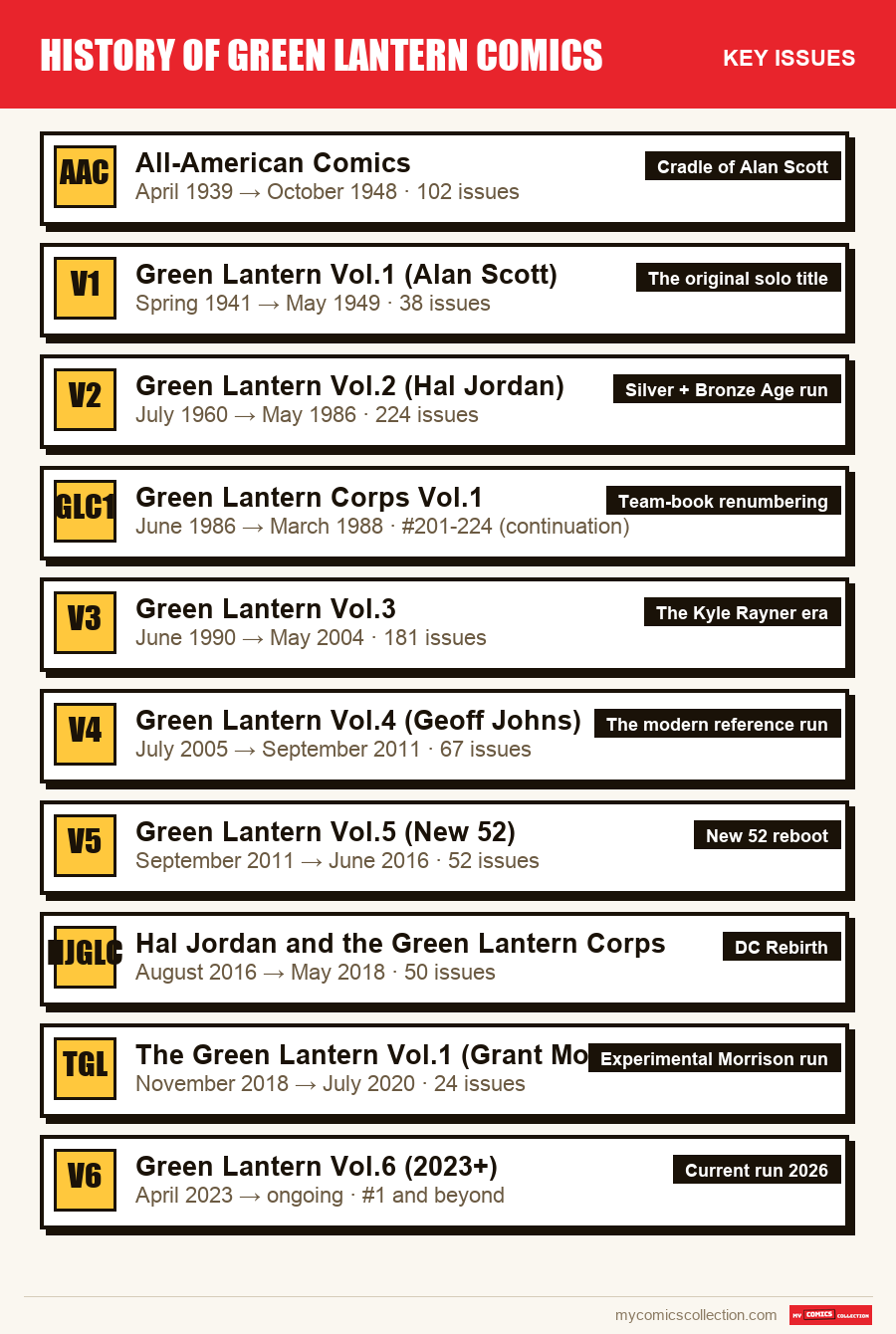
The Green Lantern franchise is one of the most structured at DC. Here are the main ongoing volumes in order of their first issue:
All-American Comics
All-American Publications anthology that would be folded into National (DC) in 1944. It's in #16 (July 1940) that Alan Scott first appears. The series continues to feature Green Lantern as the lead through #102, before becoming All-American Western. It's one of the most expensive Golden Age series on the market: an AAC #16 CGC 9.0 exceeded $500,000 in 2024.
Green Lantern Vol.1 (Alan Scott)
First Green Lantern solo title. Mavis Jordan (love interest) appears as early as #1, the sidekick Doiby Dickles starting at #11 (summer 1944), and the villain Solomon Grundy in #11. The series ran 8 years before the post-Wertham superhero collapse. Green Lantern Vol.1 #1 remains one of the rarest Golden Age books in the world, valued between $60,000 and $250,000 in CGC 7.0+. Essential volume for understanding the Alan Scott era before the Silver Age rebirth.
Green Lantern Vol.2 (Hal Jordan)
The matrix Hal Jordan series, which ran 26 years without interruption after the triumph of Showcase #22. First appearance of Sinestro (#7), Star Sapphire (#16), Black Hand (#29 then proper origin #20), Krona and the origin of the Guardians (#40), Guy Gardner (#59), John Stewart (#87): basically the entire classic GL pantheon. The Denny O'Neil / Neal Adams "Hard-Traveling Heroes" run (#76-89, 1970-1972) with Green Arrow revolutionized the Bronze Age and inaugurated socially engaged comics. The series became Green Lantern Corps at #201 (June 1986).
Green Lantern Corps Vol.1
When Steve Englehart took over the series in 1985, he transformed Green Lantern Vol.2 into a team book and rebranded it Green Lantern Corps at #201. Technically not a new volume but a continuation. The title ended at #224 (1988), the last issue before the long Hal Jordan break of 1988-1990. Characterized by lore expansion: the Corps itself becomes the subject, Hal shares the pages with Guy Gardner, John Stewart, Arisia, Salaak, Kilowog.
Green Lantern Vol.3
Launched in 1990 by Gerard Jones, this volume would experience the most traumatic event of the franchise: Emerald Twilight (#48-50, 1994). Hal Jordan, broken by the destruction of Coast City in Reign of the Supermen, becomes Parallax, massacres the entire Green Lantern Corps, kills the Guardians, and plunges the franchise into chaos. At #50, a young New York artist named Kyle Rayner receives the last ring. The Ron Marz run, then Judd Winick, accompanies the entire 1990s-2000s decade of Kyle Rayner. Key volume for understanding the transition between Hal Jordan and the Geoff Johns resurrection.
Green Lantern Vol.4 (Geoff Johns)
The most important run of the franchise since O'Neil/Adams. Preceded by the maxi-series Green Lantern: Rebirth (2004-2005, 6 issues) which brings Hal Jordan back to life and redefines the mythology by revealing that Parallax was a yellow parasitic entity that had possessed Hal. Vol.4 (#1-67) is entirely written by Geoff Johns . Includes Sinestro Corps War (#21-25, 2007), Blackest Night (#43-52, 2009-2010), Brightest Day (#53-58, 2010-2011), War of the Green Lanterns (#64-67, 2011). Launches the concept of the emotional spectrum (red, orange, yellow, green, blue, indigo, violet) which still structures the franchise in 2026.
Green Lantern Vol.5 (New 52)
New 52 reboot but with continuity preserved for Green Lantern (a unique case in the 2011 DC). Geoff Johns continued through #20 (June 2013) and his farewell issue is one of the most emotional modern comics of the run. Robert Venditti took over (#21-52) with the arcs Lights Out (2013), Godhead (2014), and The Final Bow of Hal Jordan (2016). Sinestro got his own solo title in parallel.
Hal Jordan and the Green Lantern Corps
Launched under the DC Rebirth event. Robert Venditti continued his run identically (with the Sinestro Corps taking over the GLC's rings at one point), followed by Liam Sharp for the final phase. The series replaces Vol.5 and runs 50 issues before passing the torch to Grant Morrison.
The Green Lantern Vol.1 (Grant Morrison)
The legendary return of Grant Morrison to Green Lantern. 12 issues of Vol.1, 12 issues of "Season Two", for 24 issues total. Morrison transforms the series into a psychedelic space opera with Liam Sharp on art. Heavy Metal, Moebius, Bertrand Russell influences. A polarizing run, but now cult among fans of experimental comics.
Green Lantern Vol.6 (2023+)
Launched after the maxi-series Dark Crisis on Infinite Earths. Jeremy Adams writes Hal Jordan in a modernized return to Silver Age roots. The title coexists with Alan Scott: The Green Lantern (2023, Tim Sheridan mini-series), John Stewart: The Emerald Knight (2024), and Green Lantern Corps (2024+). Variant covers in high demand thanks to the arrival of James Gunn's HBO series Lanterns (2025).
All parallel Green Lantern series in order
Alongside the main volumes, DC has published dozens of derivative series dedicated to the Green Lantern Corps, to specific Lanterns, or to the various emotional Lantern Corps introduced by Geoff Johns. Here's the chronology of the main titles:
- Green Lantern Corps Quarterly (1992-1994, 8 issues): quarterly anthology for stories of secondary Lanterns.
- Guy Gardner / Guy Gardner: Warrior (1992-1996, 44 issues): Guy Gardner solo title after he loses his ring. Becomes Warrior at #16, transformation into an alien warrior.
- Green Lantern: Mosaic (1992-1993, 18 issues): John Stewart series by Gerard Jones and Cully Hamner. Cult run on the planet Mosaic, where John oversees an experiment in interstellar coexistence.
- Green Lantern: Emerald Dawn (1989-1990, 6 issues): Keith Giffen / Gerard Jones / James Owsley mini-series that retells Hal Jordan's origin.
- Green Lantern: Emerald Dawn II (1991, 6 issues): sequel covering Hal's first months in uniform.
- Green Lantern: Ganthet's Tale (1992, OGN): Larry Niven scripts an OGN that reinvents the history of the Guardians.
- Green Lantern: Rebirth (2004-2005, 6 issues): the Geoff Johns / Ethan Van Sciver maxi-series that resurrects Hal Jordan and redefines Parallax. Indispensable.
- Green Lantern Corps Vol.2 (2006-2011, 60 issues): co-existing with Vol.4. Dave Gibbons run then Peter Tomasi. Includes all Sinestro Corps War and Blackest Night tie-ins.
- Green Lantern Corps Vol.3 (2011-2015, 40 issues, New 52): Tomasi then Van Jensen. Lights Out, Godhead tie-ins.
- Green Lantern: Sinestro Corps Special (2007, one-shot): essential prologue to Sinestro Corps War.
- Tales of the Sinestro Corps (2007-2008, 5 one-shots): profiles of the main Sinestro Corps members (Parallax, Anti-Monitor, Cyborg Superman, Superman-Prime, Mongul).
- Blackest Night (2009-2010, 8 issues): central maxi-series of the crossover. All emotional Lantern Corps appear. One of the best-selling events of the 2010 era.
- Blackest Night: Tales of the Corps , Black Lantern Corps , Blackest Night: Batman / Superman / Wonder Woman / Flash / Titans / JSA / Justice League: multiple tie-ins.
- Brightest Day (2010-2011, 24 bi-monthly issues): post-Blackest Night event with Hal and Sinestro as a team.
- Red Lanterns (2011-2015, 40 issues, New 52): ongoing dedicated to the Red Lantern Corps led by Atrocitus.
- Larfleeze (2013-2014, 12 issues): Larfleeze solo ongoing, the only Orange Lantern. Cosmic comedy by Keith Giffen / J.M. DeMatteis.
- Green Lantern: New Guardians (2011-2015, 40 issues): ongoing with Kyle Rayner as White Lantern, exploration of the seven spectra.
- Sinestro (2014-2016, 23 issues): Sinestro solo title after Hal Jordan's death in Vol.5.
- Green Lanterns Vol.1 (2016-2018, 57 issues, Rebirth): ongoing dedicated to Jessica Cruz and Simon Baz as a duo. Sam Humphries then Tim Seeley.
- Hal Jordan and the Green Lantern Corps (2016-2018): already mentioned as a main volume.
- The Green Lantern: Blackstars (2019-2020, 3 issues): Morrison mini-series between Vol.1 and Season Two.
- Far Sector (2019-2021, 12 issues, DC Young Animal): N.K. Jemisin / Jamal Campbell maxi-series that introduces Sojourner "Jo" Mullein, a new Green Lantern. Hugo Award winner. Indispensable.
- Green Lantern: 80th Anniversary 100-Page Super Spectacular (2020): anniversary issue with 11 stories covering all Green Lanterns.
- Future State: Green Lantern (2021, 2 issues): mini-series from the Future State event exploring a future without Guardians.
- Alan Scott: The Green Lantern (2023, 6 issues): Tim Sheridan / Cian Tormey mini-series that redefines Alan Scott's origin and explores his coming-out (canon since 2020).
- John Stewart: The Emerald Knight (2024, 4 issues): mini-series focused on John Stewart's military and sniper past.
- Green Lantern Corps (2024+): new Corps title accompanying Vol.6.
Green Lantern key issues in chronological order
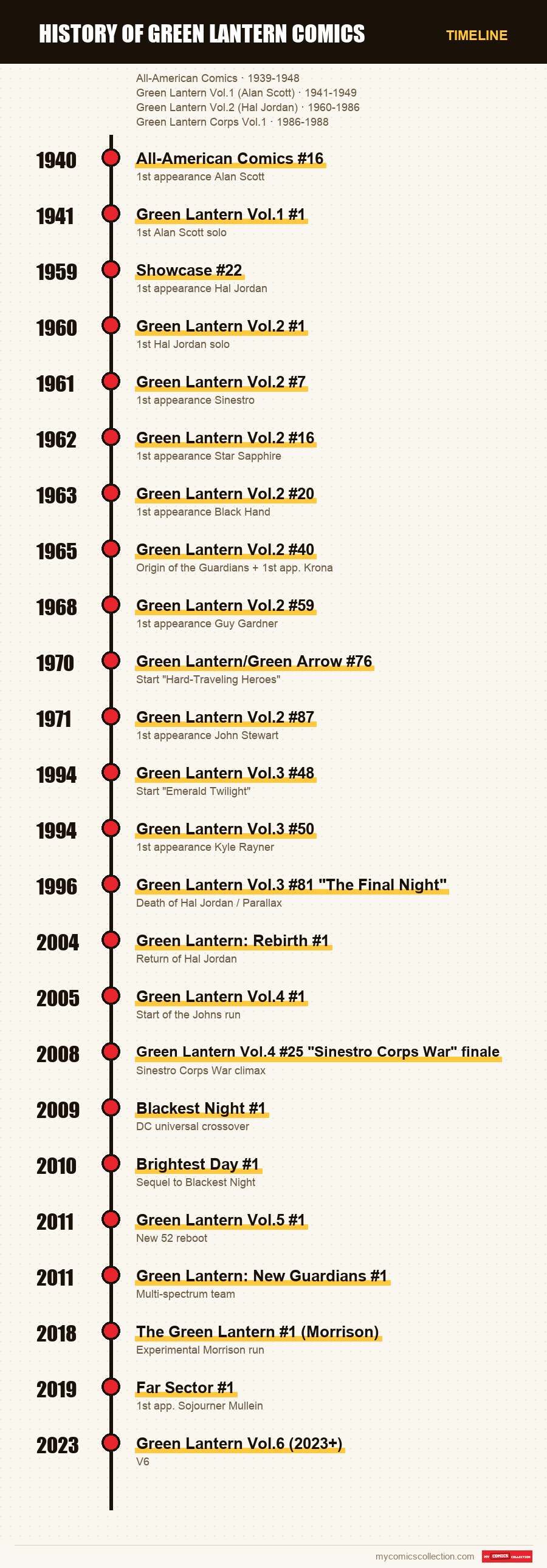
Here are the most important issues to know in chronological order of publication:
All-American Comics #16
The founding issue of the entire franchise. First appearance of Alan Scott, the Golden Age Green Lantern. 16-page story where Scott discovers the magic lantern and carves his ring. A CGC 9.0 copy sold for over $500,000 in 2024. Top 30 of the most expensive comics in the world across all characters.
Green Lantern Vol.1 #1
First issue of the Alan Scott solo title. Extended origin, introduction of Doiby Dickles (sidekick), introduction of the iconic green and purple graphic codes. CGC 8.0 estimated between $60,000 and $100,000 depending on edition.
Showcase #22
The issue that inaugurates the Silver Age Green Lantern. First appearance of Hal Jordan , Abin Sur , the Green Lantern Corps , and the Guardians of the Universe. Just as important for DC as Showcase #4 (Flash). A CGC 9.4 copy sold for over $600,000 in 2022. Indispensable for any Silver Age collector.
Green Lantern Vol.2 #1
First issue of the Hal Jordan solo title. Introduction of Carol Ferris (love interest, future Star Sapphire), Pieface Kalmaku (sidekick), Coast City. CGC 9.0 estimated between $25,000 and $50,000 in 2024.
Green Lantern Vol.2 #7
First appearance of Sinestro, fallen Green Lantern, future most iconic nemesis of Hal Jordan. Creation of the Qwardian yellow ring. CGC 9.0 estimated between $15,000 and $35,000 depending on edition.
Green Lantern Vol.2 #16
First appearance of Star Sapphire, Carol Ferris transformed by the Zamarons. Villain and love interest, she would become central in Blackest Night and the entire Geoff Johns run.
Green Lantern Vol.2 #20
First appearance of William Hand / Black Hand. A minor Silver Age villain who would become the absolute center of the franchise when Geoff Johns made him the first Black Lantern in Blackest Night (2009).
Green Lantern Vol.2 #40
Foundational issue that reveals the cosmic origin of the Guardians of the Universe and introduces Krona, the renegade Guardian whose curiosity created the Multiverse. Absolute reference in GL mythology, mined by Geoff Johns 40 years later.
Green Lantern Vol.2 #59
First appearance of Guy Gardner, Abin Sur's second choice (Hal was closer at the moment of the crash). Initially a kindly instructor, Guy would become the gruff and arrogant Lantern we know in the Englehart run of the 80s.
Green Lantern/Green Arrow #76
The issue that changed the medium. Denny O'Neil and Neal Adams take Hal Jordan and Green Arrow on a road trip across America to confront the hero with real social problems (racism, addiction, poverty). The iconic cover of a Black old man calling out Hal on the absence of help for African Americans has become a symbol. Inaugurates the socially engaged Bronze Age.
Green Lantern Vol.2 #87
First appearance of John Stewart, an African American architect who becomes Hal Jordan's backup Green Lantern. The first Black DC superhero to play a Green Lantern role, John would become a central figure starting in the 80s, and the version best known to the general public thanks to Justice League animated (2001-2006). Essential issue for the diversification of the DC pantheon.
Green Lantern Vol.3 #48
Pivot issue. Hal Jordan, broken by the destruction of Coast City in Reign of the Supermen, refuses the Guardians' order. Start of the Emerald Twilight arc where he's about to massacre the Corps. One of the most controversial arcs in DC history, which turned the hero into a villain for 10 years.
Green Lantern Vol.3 #50
Hal Jordan kills the Guardians and officially becomes Parallax. In the final scene, the surviving Guardian Ganthet finds a young New York artist named Kyle Rayner and entrusts him with the very last ring. Turning-point issue for the franchise. CGC 9.8 still in high demand in 2026.
Green Lantern Vol.3 #81 "The Final Night"
Hal Jordan sacrifices himself to reignite the sun after the Sun-Eater extinguished it in The Final Night . Becomes the Spectre in Day of Judgment (1999). Stays dead until Green Lantern: Rebirth in 2004.
Green Lantern: Rebirth #1
The issue that resurrects Hal Jordan, redefines Parallax as a yellow parasitic entity (retroactive explanation of the hero's fall), and brings back all the Lanterns gone since 1994. Marks the beginning of the Geoff Johns mega-run on the franchise. Indispensable.
Green Lantern Vol.4 #1
Launch of the post-Rebirth Johns run. Hal Jordan reclaims his place as Green Lantern, his job as a test pilot, his life in Coast City. Six years of narrative consistency that reinvent the entire franchise and set up Sinestro Corps War and then Blackest Night.
Green Lantern Vol.4 #25 "Sinestro Corps War" finale
Conclusion of the event that reinvented the antagonism. Sinestro founded his own Yellow Lantern Corps using fear. The crossover (GL #21-25 + GLC #14-19 + tie-ins) is the best-selling DC event of 2007. Sets up the "War of Light" of Blackest Night.
Blackest Night #1
Launch of the mega-event that resurrects EVERY dead DC hero as hostile Black Lanterns. Black Hand is the avatar of Nekron, and all the emotional Lantern Corps (red, orange, yellow, green, blue, indigo, violet) have to unite. One of the best-selling DC events since Crisis on Infinite Earths.
Brightest Day #1
Bi-monthly maxi-series of 24 issues following the 12 heroes resurrected at the end of Blackest Night (Aquaman, Martian Manhunter, Hawk, Captain Boomerang, etc.). Hal Jordan and Sinestro team up to track the White Lantern entity. Brightest Day relaunches Aquaman and Hawkman for the New 52.
Green Lantern: New Guardians #1
New 52 launch that brings together a Lantern of every color (Kyle Rayner Green, Bleez Red, Munk Indigo, Saint Walker Blue, Glomulus Orange, Arkillo Yellow, Fatality Violet) as a team. 40 issues that expand the Johns emotional lore.
Green Lantern Vol.5 #1
New 52 launch, with a twist: Hal Jordan has lost his ring and it's Sinestro (temporarily reformed) who wears the green ring. Geoff Johns continues 20 issues before passing the baton. Essential reading to understand the Wrath of the First Lantern and Rise of the Third Army arcs.
The Green Lantern #1 (Morrison)
Launch of the Grant Morrison run. Heavy Metal approach, dense philosophical references, psychedelic art by Liam Sharp. Polarizing run but cult among fans of experimental comics. 24 issues total (Vol.1 + Season Two).
Far Sector #1
DC Young Animal maxi-series in 12 issues. First appearance of Sojourner "Jo" Mullein, an African American ex-cop turned Green Lantern in a distant sector (City Enduring). Hugo Award winner 2021. Today considered one of the best Green Lantern runs of the 2020 decade.
The major Green Lantern story arcs in order
Hard-Traveling Heroes (1970)
O'Neil/Adams Hal + Green Arrow road trip. Inaugurates the socially engaged Bronze Age.
Crisis on Infinite Earths (1985-1986)
Multiple tie-ins. Death of several secondary Lanterns. Multiverse reunification.
Emerald Twilight (1994)
Hal Jordan becomes Parallax, massacres the Corps, kills the Guardians. Kyle Rayner gets the ring.
The Final Night (1996)
Hal Jordan sacrifices himself to reignite the sun. Becomes the Spectre in Day of Judgment (1999).
Green Lantern: Rebirth (2004-2005)
Geoff Johns resurrects Hal Jordan, rewrites Parallax as a yellow entity, restores the Corps.
Sinestro Corps War (2007)
Sinestro founds his Yellow Corps. GL Vol.4 + GLC Vol.2 crossover. Sets up Blackest Night.
Blackest Night (2009-2010)
All dead DC heroes resurrect as Black Lanterns. Universal crossover.
Brightest Day (2010-2011)
Direct sequel. Hal and Sinestro track the White Lantern entity for 24 issues.
War of the Green Lanterns (2011)
Krona takes possession of every ring. Conclusion of the Geoff Johns phase before New 52.
Rise of the Third Army (2012-2013)
The corrupted Guardians create their own army. New 52 crossover.
Wrath of the First Lantern (2013)
Volthoom, the first Lantern, unleashes his fury. Final of the Johns run on GL Vol.5 #20.
Lights Out (2013)
Relic empties the central battery. The Corps has to rebuild from scratch. Venditti run.
Godhead (2014)
Highfather of New Genesis wants to reclaim all the Light Energies. NG x GL crossover.
The Final Bow of Hal Jordan (2016)
Conclusion of the Venditti run. Hal Jordan disappears temporarily at the end of Vol.5.
The Green Lantern by Morrison (2018-2020)
Psychedelic space-opera run in 24 issues. Polarizing but cult run.
Last Will and Testament (2020)
Conclusion of Morrison Season Two. Hal becomes a cosmic Green Lantern without a body.
Far Sector (2019-2021)
N.K. Jemisin invents Sojourner Mullein in a distant city-world. Hugo Award 2021.
How to start a Green Lantern collection in 2026
Pick YOUR Green Lantern
With 8+ human Green Lanterns coexisting in continuity (Alan Scott, Hal Jordan, Guy Gardner, John Stewart, Kyle Rayner, Jessica Cruz, Simon Baz, Sojourner Mullein), it's essential to pick an entry point. "I want all of Hal Jordan" is still doable (Vol.2 + Vol.4 + Vol.5 = ~340 issues). "I want the entire Corps" is titanic (1500+ issues). The Geoff Johns run 2004-2013 remains the best modern entry point.
Import the catalog into My Comics Collection
With My Comics Collection, import Green Lantern Vol.1 through Vol.6, Green Lantern Corps, the emotional ongoings (Red Lanterns, New Guardians, Sinestro, Larfleeze, Green Lanterns Vol.1), and the maxi-series (Rebirth, Blackest Night, Far Sector). Each issue and volume identified distinctly.
Prioritize the key issues
The 23 listed key issues represent 80% of historical value. See our dedicated top Green Lantern key issues for focused key issues + updated CGC values.
Organize by run rather than by issue number
Green Lantern is collected by run (O'Neil/Adams 1970, Englehart late 80s, Marz 90s, Johns 2004-2013, Morrison 2018-2020) rather than strict chronological numbering. The Johns runs in particular are best discovered as a coherent block (Rebirth → Sinestro Corps War → Blackest Night → Brightest Day).
Track eBay valuations
Showcase #22 and All-American Comics #16 are out of reach, but plenty of key issues move all the time (GL #87 1st John Stewart, GL #59 1st Guy Gardner, GL Vol.3 #50 1st Kyle Rayner, Far Sector #1). My Comics Collection updates values based on real sales.
Why Green Lantern remains collected in 2026
With the announced return of the superhero on HBO via James Gunn's Lanterns series (first episode due late 2025, full season 1 airing in 2026), the franchise is enjoying a massive collector revival. Several structural reasons explain the franchise's lasting strength:
- Multiplicity of heroes: with 8+ human Green Lanterns officially coexisting, the franchise can host every kind of profile. Hal Jordan for fans of pulp Silver Age, John Stewart for fans of the animated, Kyle Rayner for the 90s generation, Sojourner Mullein for the 2020s readership. No other DC hero has such a deep roster.
- The Geoff Johns run as the ideal entry point: 80+ issues (Rebirth + Vol.4 + Vol.5 #1-20) that make up a complete, self-contained, accessible story. Considered by pros to be the best run since O'Neil/Adams.
- The emotional spectrum as a narrative structure: 7 colors, 7 corps, 7 emotions. A brilliant Geoff Johns invention that allowed the franchise to be reinvented and remains a powerful narrative tool since 2009.
- The HBO return : Lanterns by James Gunn and Damon Lindelof is massively reigniting interest in Hal Jordan + John Stewart. Variant covers and republished omnibuses in 2025-2026.
- Continuity preserved: unlike Batman or Superman whose continuity has been massively reset (New 52, Rebirth, Infinite Frontier), Green Lantern has broadly preserved its continuity since 2004. Coherent reading from Rebirth (2004) to Vol.6 (2023+) possible without editorial gymnastics.
Biography of Alan Scott (Green Lantern)
Green Lantern is created by John Broome and Gil Kane (Hal Jordan) and published by DC Comics. His first appearance is in Showcase #22 (Hal Jordan): All-American Comics #16 (Alan Scott) in October 1959 (Hal Jordan): July 1940 (Alan Scott).
Identity sheet
- Full name: Alan Scott (Golden Age, 1940) (Hal Jordan (Silver Age, 1959)) John Stewart, Guy Gardner, Kyle Rayner
- Date of birth: October 1959 (Hal Jordan): July 1940 (Alan Scott)
- Place of birth: Coast City, California (Hal Jordan)
- First appearance : Showcase #22 (Hal Jordan): All-American Comics #16 (Alan Scott)(October 1959 (Hal Jordan): July 1940 (Alan Scott))
- Creators: John Broome (screenwriter) and Gil Kane (designer) for Hal Jordan. Bill Finger and Martin Nodell for Alan Scott.
- Editor: DC Comics
- Memberships: Green Lantern Corps, Justice League, Justice Society of America (Alan Scott)
Origins
Hal Jordan, test pilot for Ferris Aircraft, sees an alien ship crash in the desert. The dying Green Lantern on board, Abin Sur, passes his ring of power to him saying he is "fearless" and "honest". Hal becomes the Green Lantern of Sector 2814 (which includes Earth), member of the inter-galactic Green Lantern Corps of the 7200 protectors of the universe, supervised by the Guardians of Oa.
Powers and Abilities
- Power Ring: creates solid constructs from will
- Unlimited flight in space and atmosphere
- Force fields, energy weapons, holographic projections
- Environmental protection suit (space vacuum, pressures)
- Instant interstellar communication via the ring
- Ring Memory: access to all Corps information
- Classic weakness: yellow (Hal Jordan): based on fear
Costume and visual identity
Green and black jumpsuit with Green Lantern symbol at center torso. Green mask covering the upper face. White gloves and white boots. Green ring on finger as main weapon.
Build your Green Lantern collection methodically
Import the Hal Jordan + Corps + spin-off volumes in one click, identify your missing key issues, track eBay value. Free 7-day trial.
🚀 Start your free 7-day trialGo further
- Green Lantern: a reading guide for new and returning collectors
- Top Green Lantern Runs: The Essential Comics Every Collector Should Own
- Best Green Lantern Story Arcs: A Collector's Guide
- Top 10 Green Lantern Key Issues to Own
- Green Lantern First Appearance: Alan Scott (1940) and Hal Jordan (1959): Key Issues & CGC Values
- Collection Guide: Green Lantern : Complete Guide
FAQ, History of Green Lantern
Other comic character histories to discover
Our complete "Comics history" article series covers the 20 biggest Marvel and DC franchises. Each article follows the same format: birth, complete chronology of volumes, parallel series, key issues classified chronologically, major arcs, and collection method.
→ See all "History" blog articles