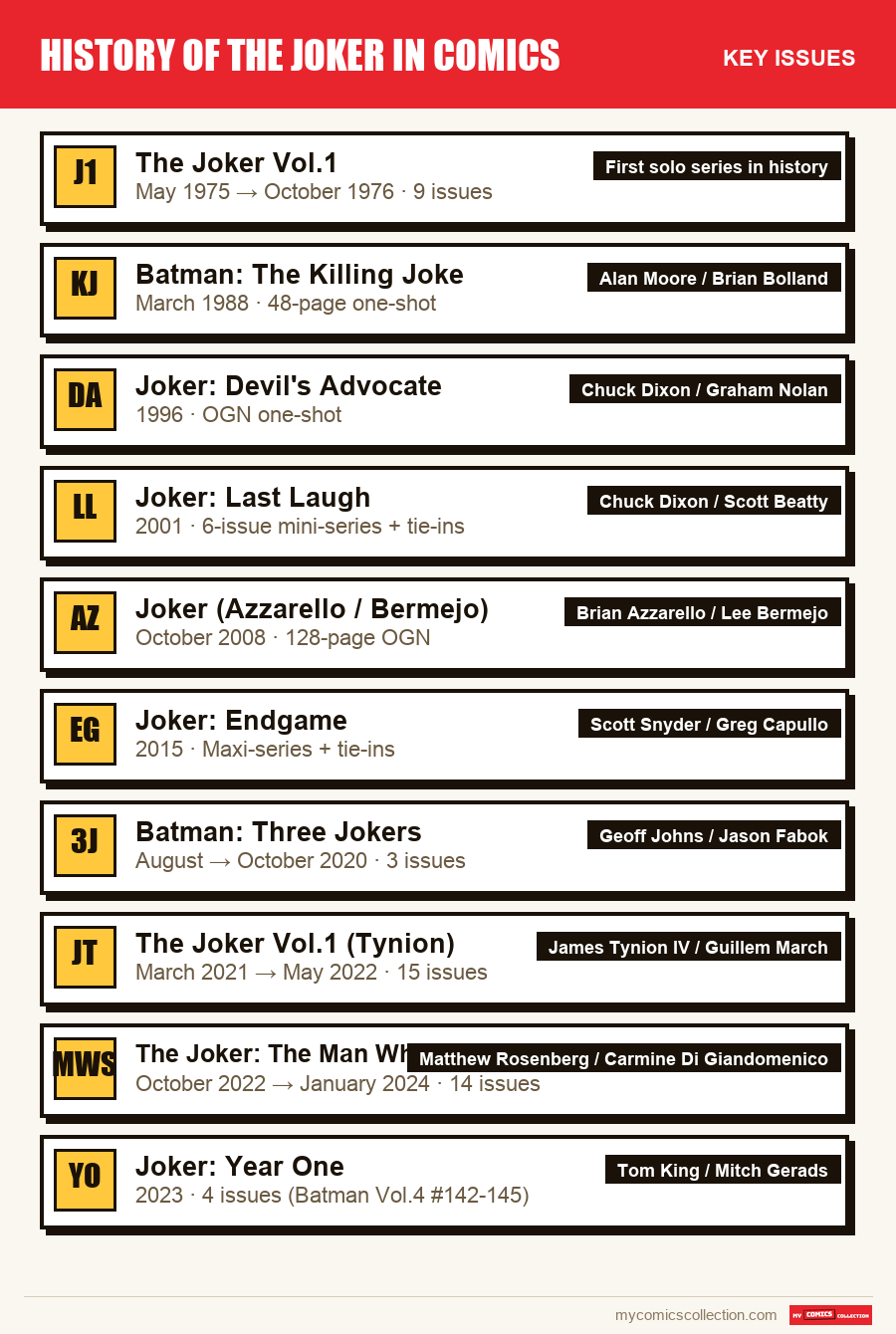
The Joker was born in spring 1940 in Batman #1 , written by Bill Finger , drawn by Bob Kane , and conceived by Jerry Robinson. The first comics villain to land his own regular solo series (The Joker Vol.1, 1975-1976, 9 issues), he then strung together cult mini-series: The Killing Joke (1988, Alan Moore / Brian Bolland), Joker: Devil's Advocate (1996), Joker: Last Laugh (2001), Joker OGN (2008, Brian Azzarello / Lee Bermejo), Joker: Endgame (2015), Three Jokers (2020, Geoff Johns / Jason Fabok), The Joker Vol.1 (2021-2022, James Tynion IV, 15 issues), The Joker: The Man Who Stopped Laughing (2022-2024), and Joker: Year One (2023, Tom King / Mitch Gerads). This article retraces the birth, chronology, and key issues of the Clown Prince of Crime.
No comics antagonist has ever left a deeper mark on pop culture than the Joker. Born in April 1940, barely a year after Batman himself, the Clown Prince of Crime spans 86 years of unbroken continuity, six editorial ages (Golden, Silver, Bronze, Modern, New 52, DC Rebirth + Infinite Frontier), about a dozen film incarnations (Cesar Romero, Jack Nicholson, Heath Ledger, Jared Leto, Joaquin Phoenix), and over 5,000 appearances in DC comics. He's the only villain to have killed a Robin (Jason Todd, 1988), paralyzed a Batgirl (Barbara Gordon, 1988), taken control of Wayne Enterprises (2020), and spawned his own line of imitators (Punchline, Daughter of the Joker, Joker Junior).
This guide is going to give you everything you need to understand the birth of the Joker , identify the solo series in chronological order , follow the major Joker arcs (from The Killing Joke to Joker: Year One ), and recognize the key issues to prioritize in a collection. For value ratings and the top 10 most expensive issues, check out our dedicated Joker key issues guide; this article focuses on the historical chronology.
The Birth of the Joker: DC in 1940
To understand how the Joker was born, you have to step back to 1940. Batman had just appeared in May 1939 in Detective Comics #27, and his success was so big that National Comics Publications (the future DC Comics) launched the Batman solo title as early as spring 1940. Bob Kane, Bill Finger, and their very young assistant Jerry Robinson (barely 17 at the time) had to produce 64 pages of content for Batman #1, and the brief required at least one new memorable antagonist. Depending on which version of the story you hear, and the controversy has been running for 80 years, each of the three would claim authorship of the Joker.
Batman #1 (Spring 1940): The First Appearance
Batman #1 came out in April 1940 and includes two distinct stories featuring the Joker, who appears as a serial killer with a face frozen in a macabre smile, dressed in a purple suit and using a lethal toxin (the future "Joker Venom"). In the first story, he murders several Gotham notables by publicly announcing the time of their deaths on the radio. Batman and Robin (who also appears in costume for the first time in the same issue) take him down, but the Joker is explicitly left alive: a last-minute editorial decision made by Whitney Ellsworth, then DC's editor, who saw the recurring potential of the character. That decision made the Joker, from his very first appearance, the first "ongoing" villain in the entire history of superhero comics. He'd return in Batman #2 , #3 , #4… and never leave the DC canon again.
Three major "firsts" therefore live in Batman #1: 1st appearance of the Joker, 1st appearance of Catwoman (under the name "The Cat"), and Batman's expanded origin. A CGC 9.0 copy now goes for over $2 million at public sale, putting this issue among the 5 most expensive comics in the world across all characters.
The Robinson / Finger / Kane Controversy
Who really created the Joker? The question has divided comics historians for eight decades. Three versions face off:
- The Bob Kane version: Kane always claimed to be the sole creator of the Joker. He described conceiving him on his own, drawing on a playing card and the German silent film The Man Who Laughs (1928) by Paul Leni, in which the actor Conrad Veidt plays Gwynplaine, a disfigured character whose mouth is locked in a permanent grin. The iconic photo of Veidt is, according to Kane, the direct visual inspiration.
- The Jerry Robinson version: Robinson, then a very young assistant to Kane, always maintained he created the concept from a Joker playing card he'd drawn and presented to Kane and Finger. According to him, he invented the face and the criminal "joker = killer clown" concept.
- The Bill Finger version: Finger, Batman's uncredited writer, brought in the Man Who Laughs dimension by recognizing the Conrad Veidt photo and pushing it as the visual reference. Finger wrote nearly all the early Joker stories between 1940 and 1965.
The most consensual historical truth, supported by the research of Marc Tyler Nobleman (author of Bill the Boy Wonder) and confirmed by DC in 2015 when they officially recognized Finger, is most likely a three-handed co-creation: Robinson brought in the playing card and the clown concept, Finger imposed the Man Who Laughs iconography and wrote the foundational scripts, Kane oversaw visually and got the sole official credit for 75 years thanks to the bulletproof contract he negotiated with DC back in 1939. Today, modern comics generally credit "Joker created by Jerry Robinson, Bill Finger, and Bob Kane": without ranking them.
The Man Who Laughs irony: the 1928 film that inspired Conrad Veidt is itself only an adaptation of Victor Hugo's novel The Man Who Laughs (1869). The Joker therefore descends, in a direct line, from a Hugo character: the child Gwynplaine disfigured by the comprachicos. A literary lineage few fans suspect, but one that anchors the Joker in a European gothic tradition far older than American comics.
Joker Solo Series in Chronological Order
Unlike most villains, the Joker has scored several regular series of his own. Here are the main ones in order:
The Joker Vol.1
The Joker is the first comics antagonist to get his own regular solo series. The Joker Vol.1 #1 (May 1975), written by Denny O'Neil and drawn by Irv Novick, kicks off the ambitious concept: each issue pits the Joker against another DC character (Two-Face, Lex Luthor, Catwoman, Sherlock Holmes…). The series is canceled at #9 in 1976 because of the general mid-70s sales drop and the Comics Code, which forbade a villain from being a recurring "hero". Issue 10 was produced but never published at the time (it eventually came out in a 2019 retrospective).
Batman: The Killing Joke
The most influential one-shot in all of Batman / Joker history. Alan Moore (fresh off Watchmen) and Brian Bolland tell a definitive Joker origin: a failed comedian, married, whose pregnant wife dies accidentally, who disguises himself as the Red Hood for a heist, falls into a vat of chemical acid, and emerges crazy and bleached. Meanwhile, the Joker shoots Barbara Gordon (Batgirl) and paralyzes her for life: an event with narrative consequences for 25 years (Barbara becomes Oracle). The title refers to the closing monologue: "I went mad. He didn't. That's the punchline." Massive initial print run, reprinted more than 50 times since 1988.
Joker: Devil's Advocate
An out-of-continuity Original Graphic Novel where the Joker is sentenced to death for a murder he (exceptionally) didn't commit. Batman has to prove his innocence so justice can be served according to the law, but also because he refuses to let the Joker die for a crime he didn't sign. A dense moral reflection on capital punishment.
Joker: Last Laugh
A major 2001 DC crossover. Diagnosed with an apparently terminal brain tumor, the Joker decides to "joker-ize" the entire super-villain community, turning dozens of DC characters into clones of himself. The 6-issue mini runs in parallel with tie-ins across all the Bat- titles, JLA, and Suicide Squad. The narrative punchline: the "tumor" was fake, just a psychological test the Joker ran on himself to see how far he could go.
Joker (Azzarello / Bermejo)
An OGN released right alongside the film The Dark Knight (Christopher Nolan, July 2008). Brian Azzarello (100 Bullets) and Lee Bermejo (a hyper-realistic style) tell the story of the Joker's return after a release from Arkham, from the point of view of a small-time hood he takes under his wing. Crime noir tone, aesthetic directly inspired by Heath Ledger. An absolute best-seller in 2008-2009.
Joker: Endgame
A 6-issue conclusion (Batman Vol.2 #35-40) of the Snyder/Capullo run, plus a one-shot Joker: Endgame #1 and tie-ins across every Bat- title. The Joker, in his most mythological version (presented as a possible immortal demon haunting Gotham for centuries), faces Batman in what could be the final confrontation. Massive print run, the major editorial event of 2015.
Batman: Three Jokers
A 3-issue Black Label maxi-series that answers the shocking reveal in Justice League #50 (2016): Batman supposedly discovered, via the Mobius Chair, that there are three distinct Jokers in DC continuity: the Criminal (Golden Age), the Comedian (Silver/Bronze, Killing Joke style), and the Clown (modern, Death of the Family). Geoff Johns explores the consequences with Batman, Red Hood (Jason Todd), and Batgirl (Barbara Gordon) facing all three Jokers together. Variant covers exploded in print run, a recent cult series.
The Joker Vol.1 (Tynion)
The first regular Joker solo series since 1976 (45 years!). James Tynion IV (just off Joker War) launches a globe-trotting thriller series: after the events of Joker War, a retired Jim Gordon takes a contract from Cherry, heir to a Joker victim, to hunt the clown across the world. Punchline backup story by Tynion / Sam Johns in every issue, developing Punchline's story and trial. A 15-issue run, wrapped in May 2022.
The Joker: The Man Who Stopped Laughing
A direct follow-up (with separate numbering) to the Tynion series. Matthew Rosenberg imagines a scenario where the Joker has split in two: one Joker stays in Gotham, another lives in Los Angeles. Pulpier tone, exploration of the West Coast. 14 issues, wrapped early 2024.
Joker: Year One
A 4-issue mini-series running in Batman Vol.4 #142-145 , by Tom King (off Strange Adventures) and Mitch Gerads. A modern rewrite of the Joker's origin, parallel to Batman's origins in Miller's Year One. A psychological tone, focused on the foundational Bruce / Joker meeting. Critically praised, sold in prestigious variant covers.
The Joker: Uncovered
An anthology one-shot celebrating Batman's 85 years and, indirectly, the Joker's 84 years. Several writers (King, Tynion, Snyder, Williamson) contribute short stories. Variant covers heavily collected in 2024-2026.
Joker Appearances in Other Series
Beyond his solo series, the Joker shows up in countless runs of the Bat- and team-up books. Here are the major contexts where you'll find him:
- Detective Comics (1937-ongoing, 1100+ issues): the Joker's main turf in the 1940s-1960s. Detective #168 (1951) introduces the Red Hood origin. Detective #475-476 (1978) carry the legendary The Laughing Fish by Steve Englehart / Marshall Rogers.
- Batman Vol.1 (1940-2011, 713 issues): his natural habitat. Batman #1 (1st app), #251 ("Joker's Five-Way Revenge" 1973), #321 (anniversary), #400 , #426-429 (A Death in the Family), #544 (No Man's Land prologue), #655-658 (Batman & Son includes an appearance).
- World's Finest Comics (1941-1986): Batman/Superman team-ups where the Joker takes on both heroes, notably in the "The Galaxy Broadcasting Joker" saga from the '70s.
- Death of the Family (2012-2013): a Snyder/Capullo crossover in Batman Vol.2 #13-17 + tie-ins in Batgirl , Catwoman , Detective Comics , Nightwing , Red Hood , Suicide Squad , Teen Titans. The Joker stitches his own face back on and attacks the entire Bat-family.
- Endgame (2015): Batman Vol.2 #35-40. A presumed final confrontation. Appearances in every Bat- tie-in from February to June 2015.
- Joker War (2020): Batman Vol.3 #95-100 + tie-ins in Detective Comics , Catwoman , Harley Quinn , Red Hood , Nightwing. The Joker takes control of Wayne Enterprises and 1st app of Punchline (#92 cameo, #95 full).
- Three Jokers (2020): 3 Black Label issues out of official continuity.
- Suicide Squad and Harley Quinn: recurring appearances as Harley's ambivalent companion / abuser.
- Justice League: appearances in major arcs (JLA #16 , JL Vol.2 #50 "Darkseid War" which reveals the existence of the Three Jokers).
- Knightfall (1993-1994): cameos in the saga.
Joker Key Issues in Chronological Order
Here are the 18 most important issues to know to grasp the Joker's evolution:
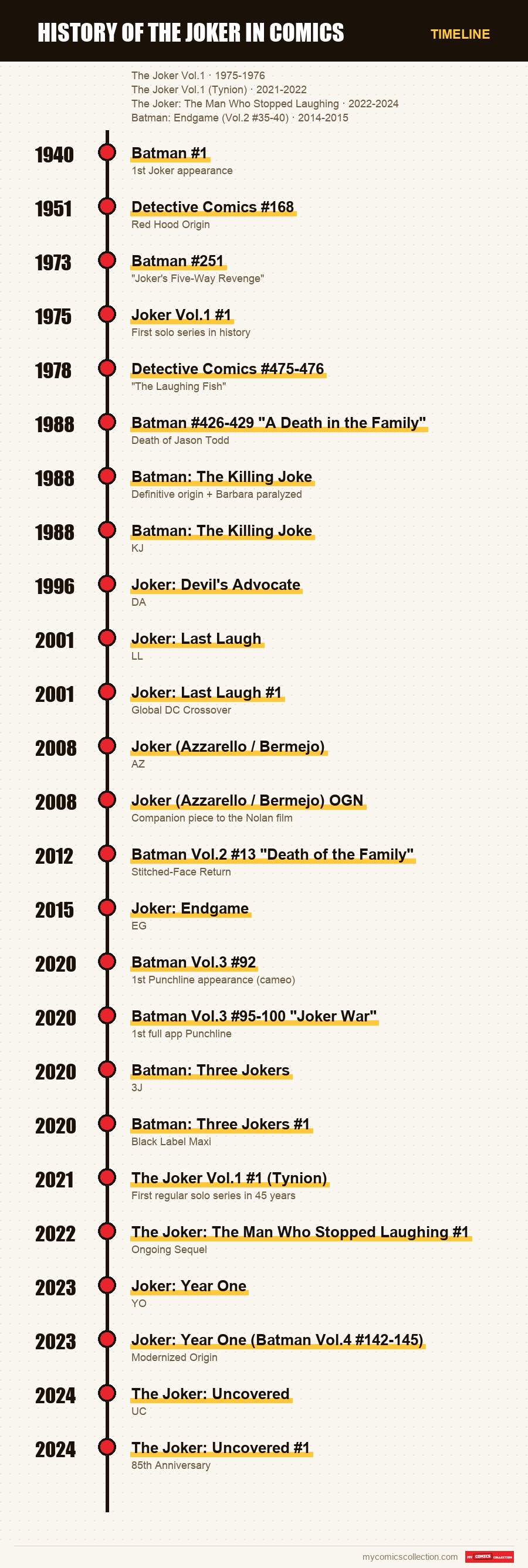
Batman #1
The foundational issue. First appearance of the Joker in two distinct stories in the same issue, plus the 1st app of Catwoman. A CGC 9.0 copy goes for over $2 million. Top 10 of the most expensive comics in the world.
Detective Comics #168
The issue that reveals for the first time the Joker's original identity as the Red Hood, a criminal who fell into a vat of chemical acid. This origin would later be picked up canonically by The Killing Joke (1988) and every film/show after.
Batman #251
The issue that resurrects the Joker after a decade-long absence (the Comics Code of the '60s had neutralized him). Dennis O'Neil and Neal Adams redefine him as a modern sociopathic killer, the foundation of every later version. An absolute reference for the Bronze Age.
Joker Vol.1 #1
Launch of the first regular solo series ever dedicated to a comics villain. The concept of an antagonist carrying his own title was unheard of in 1975: it would take Punisher (Marvel, 1986) and then Venom (1993) to see other examples. A historic precursor issue.
Detective Comics #475-476
An absolute myth: the Joker tries to copyright fish with his face on them. A cult story by Steve Englehart and Marshall Rogers, considered one of the best Joker stories ever written. Directly inspired Bruce Timm for Batman: The Animated Series (the "Laughing Fish" episode, 1992).
Batman: The Killing Joke
An Alan Moore one-shot that defines the Joker's canon origin (failed comedian, vat of acid) and paralyzes Barbara Gordon (Batgirl). The most controversial and most influential work in the Joker canon. CGC 9.8 of the original printing in high demand.
Batman #426-429 "A Death in the Family"
Readers voted by phone (1-900) to decide Jason Todd's fate, the second Robin. He's killed by the Joker in Batman #428 (by 28 votes). An absolute moral reference for comics history. The Joker officially becomes Robin's killer.
Joker: Last Laugh #1
Launch of the 2001 crossover where the Joker "joker-izes" the entire super-villain community after a fake tumor diagnosis. Tie-ins across more than 50 issues throughout the DC Universe. A 6-issue mini-series + extended tie-ins.
Joker (Azzarello / Bermejo) OGN
Original Graphic Novel released alongside the film The Dark Knight. Crime noir tone, Heath Ledger aesthetic directly referenced. A best-seller in DC's catalog since 2008, multiple reprints. The reference for cinema-going readers.
Batman Vol.2 #13 "Death of the Family"
Launch of the crossover where the Joker (back after a long absence) has had his face cut off and wears it stitched on like a mask. Snyder reinvents the character for a modern generation. The issue sold over 100,000 copies, one of the biggest hits of the New 52 era.
Batman: Endgame (Vol.2 #35-40)
Conclusion of the Snyder/Capullo phase. The Joker is presented as a possible immortal entity haunting Gotham for centuries (the "Pale Man of the Bowery"). Apparent death of Bruce and Joker in a final duel. Massive print run.
Batman: Three Jokers #1
Launch of the 3-issue Black Label maxi-series confirming the existence of three distinct Jokers in DC continuity. Variant covers exploded in September-October 2020, a recent cult story. CGC 9.8 collected.
Batman Vol.3 #92
First cameo of Punchline (Alexis Kaye), a new Joker accomplice designed as a modern rival to Harley Quinn. Cameo only, but a heavily collected issue as "1st cameo Punchline". Brian Stelfreeze and Jorge Jimenez variants.
Batman Vol.3 #95-100 "Joker War"
The Tynion crossover that takes Punchline from cameo (#92) to first full appearance (#95). The Joker takes control of Wayne Enterprises. Batman #100 is the run's peak and a huge anniversary issue.
The Joker Vol.1 #1 (Tynion)
The first Joker solo series since 1976. Tynion launches a globe-trotting thriller in 15 issues. Prestigious variant covers (Frank, Lee Bermejo, Ben Oliver), an issue in heavy demand at high grade.
The Joker: The Man Who Stopped Laughing #1
Launch of the second Joker solo series of the 2020s. The split-Joker concept (Gotham vs LA). 14 issues, wrapped in 2024.
Joker: Year One (Batman Vol.4 #142-145)
A 4-issue mini-series in Batman Vol.4 #142-145. Tom King and Mitch Gerads (the Mister Miracle team) tell the Joker's first year alongside Batman's Year One. Critically praised.
The Joker: Uncovered #1
An anthology one-shot celebrating the character's legacy. Several major writers (King, Tynion, Snyder, Williamson). Variant covers heavily collected.
The Major Joker Arcs in Chronological Order
The Killing Joke (1988)
One-shot by Alan Moore / Brian Bolland. Definitive Joker origin, Barbara Gordon paralyzed.
A Death in the Family (1988)
Death of Jason Todd, voted on by phone by readers. The Joker as Robin-killer.
Joker's Last Laugh (2001)
Global crossover where the Joker contaminates the super-villain community after a fake terminal diagnosis.
Death of the Family (2012-2013)
Snyder / Capullo. Stitched-face Joker attacks the Bat-family. Multiple tie-ins.
Endgame (2015)
Presumed final confrontation. The Joker presented as an immortal entity haunting Gotham.
Joker War (2020)
Tynion. The Joker takes Wayne Enterprises. First full Punchline appearance.
Three Jokers (2020)
Geoff Johns / Jason Fabok. Black Label maxi revealing three distinct Jokers.
The Man Who Stopped Laughing (2022-2024)
Rosenberg. Joker split between Gotham and Los Angeles. 14 issues.
Joker: Year One (2023)
Tom King / Mitch Gerads. Modernized origin in 4 issues alongside Year One Batman.
Punchline backup (2021-2022)
Backup story in every issue of The Joker Vol.1 (Tynion). Trial and ambiguous redemption.
Beneath the Cowl
Psychological arcs exploring the Bruce/Joker relationship as a mirror, from the Morrison run to recent runs.
Brave and the Bold Joker
Team-up appearances in The Brave and the Bold and anthologies (notably the Russ Heath / Sergio Aragonés arc).
How to Start a Joker Collection in 2026
Set a clear goal
"All Joker" is unrealistic (5,000+ appearances). Aim instead for "the 4 regular solo series" (Joker 1975, Joker 2021, Man Who Stopped Laughing 2022, plus the OGNs) or "the 5 cult mini-series" (Killing Joke, Last Laugh, Azzarello OGN, Three Jokers, Year One). A goal you can reach in 30-50 issues.
Import the catalog into My Comics Collection
With My Comics Collection, import the 4 solo Joker series, the 5 Black Label mini-series, and the 18 key issues identified above. Each variant cover separately referenced.
Prioritize the key issues
The 18 key issues listed represent the bulk of the historical value. See our dedicated top 10 for a focus on CGC values and the variants to track.
Organize by run rather than by issue
The Joker is best collected by writer run (Moore, Snyder, Tynion, Johns, King, Rosenberg) rather than strict chronology. It makes the reading easier and gives narrative coherence.
Track eBay and CGC valuations
Batman #1 is out of reach but plenty of other key issues move fast (Three Jokers variants, Punchline 1st app). My Comics Collection updates the values based on real sales.
Why the Joker Is Still the #1 Antagonist in 2026
No other villain, Marvel or DC, has the cultural longevity or the multimedia reach of the Joker. Several reasons:
- Heath Ledger, The Dark Knight (2008): Heath Ledger's performance earned him a posthumous Oscar for Best Supporting Actor. A crime noir tone that redefined Joker iconography for the next decade. The Azzarello/Bermejo OGN (2008) followed right behind.
- Joaquin Phoenix, Joker (2019) then Folie à Deux (2024): Todd Phillips delivers a 2019 Joker film outside DC continuity, character-study mode, that crosses $1 billion in worldwide receipts and earns Phoenix the Best Actor Oscar. The 2024 sequel Joker: Folie à Deux, with Lady Gaga as Harley Quinn, divides audiences more but reignites the franchise.
- Total iconography : Cesar Romero (TV series 1966-1968), Jack Nicholson (Batman, 1989), Heath Ledger (The Dark Knight, 2008), Jared Leto (Suicide Squad, 2016 and Justice League: Snyder Cut, 2021), Joaquin Phoenix (Joker, 2019 / Folie à Deux, 2024). Five major actors, five readings of the character, five audiences. No other villain has produced such a gallery of canonical film interpretations.
- Narrative depth: the Joker doesn't have a single canon origin: he has several (Red Hood criminal, failed comedian of Killing Joke, immortal of Endgame, Three Jokers of Johns…). That narrative plasticity makes him an infinitely renewable character.
- Continuous multimedia presence: films, animated series (BTAS Mark Hamill = the canonical voice for 30 years), Arkham games (Hamill again), Lego Batman, DC Animated series (the Harley Quinn show 2019-2026 where the Joker is antagonist-rival).
Biography of Unknown (The Joker)
The Joker is created by Bill Finger, Bob Kane and Jerry Robinson and published by DC Comics. His first appearance is in Batman #1 in April 1940.
Identity sheet
- Full name: Unknown (multiple stories: Jack Napier, Arthur Fleck in the films)
- Date of birth: April 1940 (creation): fictional: variable depending on the version
- Place of birth: Gotham City, USA (variable origins)
- First appearance : Batman #1 (April 1940)
- Creators: Bill Finger (writer), Bob Kane (officially) and Jerry Robinson (designer)
- Editor: DC Comics
- Memberships: No perm. Sworn enemy of Batman. Former partner of Harley Quinn.
Origins
The origin of the Joker is deliberately multiple and contradictory in the comics ("If I'm going to have a past, I prefer it to be multiple choices!"). The most famous version (The Killing Joke, Alan Moore, 1988): a failed comedian named Jack Napier becomes the criminal Red Hood, falls into a vat of chemical acid at ACE Chemicals while fleeing Batman, and emerges disfigured with white skin and a permanent smile. Complete madness transforms him into Joker, Batman's mortal enemy.
Powers and Abilities
- No superpowers: human with limitless criminal genius
- Mastery of chemistry: creates Joker Venom (deadly laughing gas)
- Criminal Intellect: one of DC's most dangerous criminal minds
- Close combat: martial arts and improvisation
- Total unpredictability: no rational motive (absolute chaos)
- Resistance to torture (the eternally laughing face)
- Arsenal: deadly gas, “BANG” flag gun, knives
Costume and visual identity
Purple three-piece suit with green shirt, orange tie, white gloves. Chalk white skin, green hair, red lips stretched in an eternal smile. Variants: patterned purple suit (Heath Ledger), JOKER tattoos (Jared Leto), failed clown makeup (Joaquin Phoenix).
Build Your Joker Collection With a Real Method
Import the 4 solo series, the 5 cult mini-series, the 18 key issues, and every variant in one click. Identify your missing issues, track eBay/CGC values. Free 7-day trial.
🚀 Start your free trial, 7 daysGo further
- Joker Reading Guide: Where to Start
- Best Joker Comic Book Runs: The Essential Story Arcs to Collect
- The Best Joker Story Arcs: A Collector's Guide
- Top 10 essential Joker key issues
- Joker First Appearance: Batman #1 (Spring 1940): CGC Value & Collector Guide
- Joker Comics Collection: The Complete Guide to Key Issues, Grading & Budget Strategies
FAQ, History of the Joker
Other Comic Character Histories to Discover
Our complete "Comics history" article series covers the 20 biggest Marvel and DC franchises. Each article follows the same format: birth, complete chronology of volumes, parallel series, key issues classified chronologically, major arcs, and collection method.
→ See all "History" blog articles