
Iron Man was born in March 1963 in Tales of Suspense #39 , created by Stan Lee , scripted by his brother Larry Lieber , drawn by Don Heck on the interior pages, with an iconic cover by Jack Kirby. Tony Stark, billionaire arms dealer captured during the Cold War (Vietnam originally, then changed to Afghanistan post-2008), builds his armor to survive. More than 60 years later, the Golden Avenger has 6 main volumes of the Iron Man title, plus the long opening phase in Tales of Suspense (#39-99, shared with Captain America), plus 3 Invincible Iron Man volumes and dozens of parallel series. This article retraces the Silver Age genesis, the complete chronology of the series, and the key issues you need to know to build a structured collection.
In the Marvel pantheon, Iron Man holds a special place: he's the only major superhero born directly out of the Cold War, the only one whose technology is his very identity, and the one who: thanks to Robert Downey Jr. and the MCU: became in 2008 the public face of a new era of comics adapted to the big screen. Before the film, Iron Man was a second-tier character in mainstream perception, behind Spider-Man, the X-Men and Hulk. After the film, Tony Stark became the archetype of the brilliant billionaire superhero, and Tales of Suspense #39 exploded on the Silver Age market.
This guide will give you everything you need to know to understand the birth of Iron Man , follow the complete chronology of Iron Man comics in order , and identify the key issues and major arcs to prioritize. We'll cover the character's 60+ years, from Tales of Suspense #39 (March 1963) to Gerry Duggan's current run in 2026, distinguishing the main volumes, parallel series (Ironheart, Tony Stark: Iron Man, Superior Iron Man, Iron Man 2020), and the cult arcs (Demon in a Bottle, Armor Wars, Extremis, World's Most Wanted).
The birth of Iron Man: Marvel in 1963
To understand how Iron Man was born, you have to put Marvel Comics back in the early 1960s. Stan Lee and Jack Kirby had just relaunched the company with Fantastic Four #1 (November 1961), Hulk #1 (May 1962) and Amazing Fantasy #15 (August 1962, first appearance of Spider-Man). Success was immediate, and Lee was looking to expand the pantheon with a radically different hero: an industrial billionaire, a "capitalist playboy," at the very moment American youth was radicalizing to the left. Stan Lee often said he wanted to create "the hero readers were supposed to hate", and make them love him anyway.
Stan Lee defines the general concept: an arms-industrialist, wounded in the heart, forced to wear an armature that keeps him alive while granting him superhuman powers. Lee passes the script to his brother Larry Lieber, who writes the 13-page story. Don Heck draws the interior pages in a realistic style that contrasts with Kirby's nervous pencil. Jack Kirby, for his part, signs the iconic cover: Iron Man, still in massive gray armor, standing in a Vietnamese jungle, defying enemy soldiers. This creative split, Lee + Lieber + Heck + Kirby cover, is unique in the Marvel canon: Iron Man is the only founding Avenger without Kirby on the interior pages of #1.
Tales of Suspense #39 (March 1963)
Iron Man makes his first appearance in Tales of Suspense #39 (cover-dated March 1963, on newsstands as early as December 1962), in a 13-page story titled "Iron Man Is Born!". Tony Stark, industrial billionaire and weapons expert, is on a mission in Vietnam to oversee the U.S. military's use of his transistors. Captured by warlord Wong-Chu after an explosion that lodges a piece of shrapnel near his heart, Stark is forced to build a weapon for his captor. With the help of fellow prisoner physicist Yin Sen (whose heroic death will crystallize Stark's calling), he secretly builds a massive gray armor that saves his life and lets him escape.
The success is gradual but lasting. Iron Man shares Tales of Suspense in an anthology format for several issues, then becomes the main feature. Stan Lee creates the supporting cast at a quick clip: Pepper Potts and Happy Hogan appear in ToS #45 (September 1963), The Mandarin in ToS #50 (February 1964), Hawkeye in ToS #57 (September 1964). In 1968, Iron Man takes off into his own solo title and leaves Tales of Suspense, which becomes a Captain America title.
The historical irony: Stan Lee explicitly designed Iron Man as a challenge to readers. In an era when American youth was protesting the Vietnam War and the military-industrial complex, Lee creates a hero who is the military-industrial complex personified. "I wanted to see if I could make them love this guy," he said. The post-2008 modification (moving the origin from Vietnam to Afghanistan in modern canon) reflects how inseparable Iron Man's origin is from the geopolitical context of his creation.
The main Iron Man series in chronological order
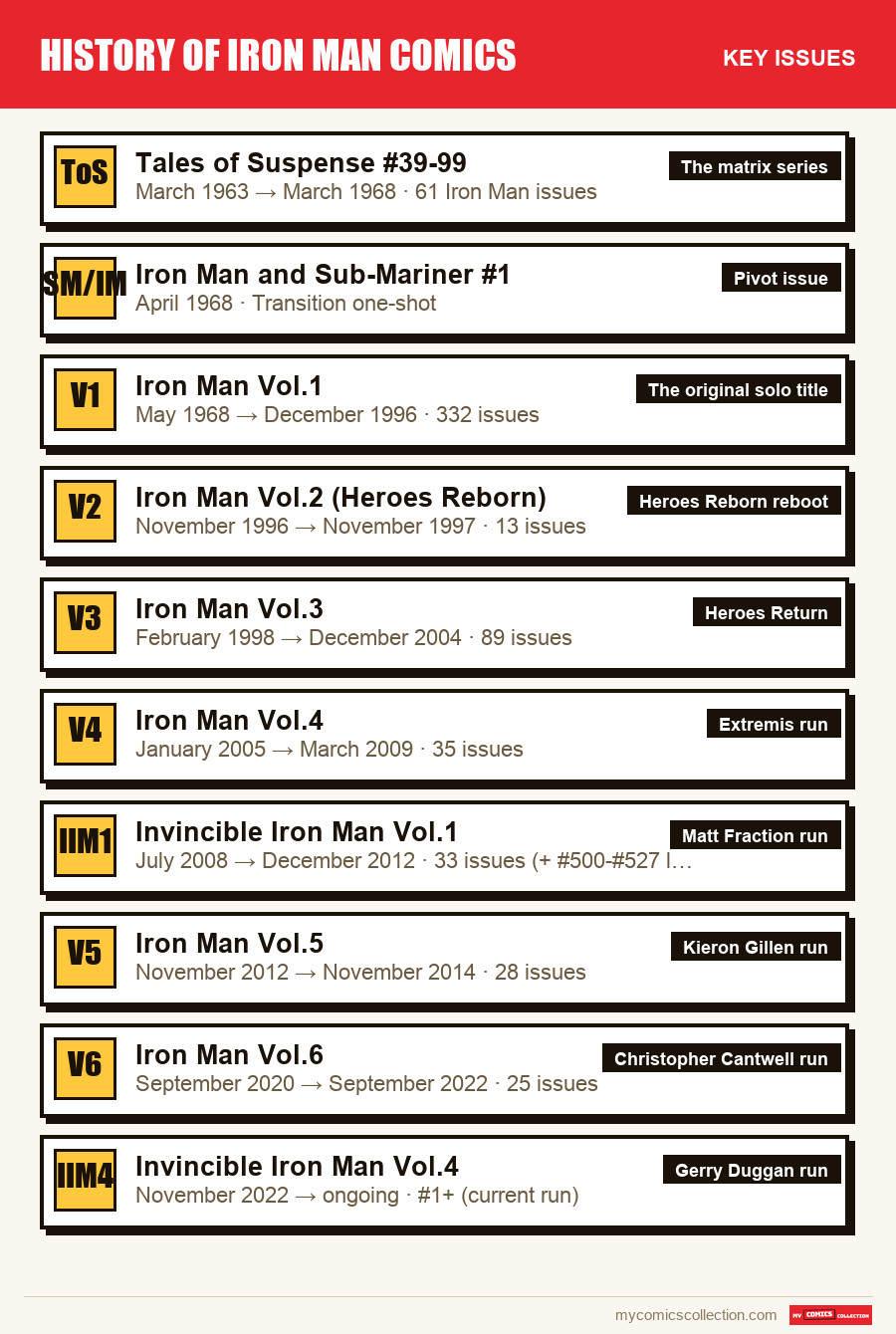
The Iron Man franchise is one of the most structured at Marvel. Here are the main solo series in the order of their first issue:
Tales of Suspense #39-99
Iron Man was born and lived his first 5 years in Tales of Suspense, sharing the title with an anthology feature, then with Captain America (starting at #59). This period contains the essential first appearances: #39 (1st Iron Man + 1st gray armor), #40 (1st golden armor), #45 (Pepper Potts + Happy Hogan), #48 (1st red and gold armor), #50 (Mandarin), #57 (Hawkeye), #58 (Cap joins the title). The 61 issues are the cornerstone of any Silver Age Iron Man collection.
Iron Man and Sub-Mariner #1
One-shot published in April 1968 to bridge Tales of Suspense and the new solo titles. The issue contains an Iron Man story and a Sub-Mariner story, just before the two heroes launch their own dedicated series. An issue sought after by completists: small print run, technical transition.
Iron Man Vol.1
Launched directly after Tales of Suspense #99 , Iron Man Vol.1 #1 covers nearly 30 years of continuous history. Major turning points: #54 (1st app. Moondragon), #55 (1st app. Thanos + Drax: one of the biggest key issues in all of Marvel), #128 (Demon in a Bottle 1979, Tony Stark's alcoholism), #170 (Iron Monger / Obadiah Stane), #200 (new red/silver armor), #225-232 (Armor Wars), #298 (first War Machine costume). The most emblematic run is David Michelinie and Bob Layton's, which signed Demon in a Bottle, Armor Wars and defined modern Iron Man.
Iron Man Vol.2 (Heroes Reborn)
Complete reboot as part of the Heroes Reborn event, which outsourced Iron Man, Captain America, Avengers and Fantastic Four to the Image studios (Jim Lee and Rob Liefeld). Iron Man Vol.2 is drawn by Whilce Portacio and written by Scott Lobdell. Ultra-90s tone, extreme design. The experiment lasted only a year before the return to the main Marvel universe through Heroes Return.
Iron Man Vol.3
Iron Man's return to the main Marvel universe after Heroes Reborn. Launched by Kurt Busiek and Sean Chen, Vol.3 strings together several notable creative teams: Joe Quesada , Mike Grell , and especially John Jackson Miller, who closes the volume. A period in which Tony Stark becomes U.S. Secretary of Defense, laying the groundwork for post-9/11 Marvel and the future Civil War.
Iron Man Vol.4
Vol.4 launches with the cult Extremis arc by Warren Ellis and Adi Granov (#1-6, 2005-2006). This arc completely redefines the Iron Man armor by integrating it biologically with Tony Stark: a direct foundation for the aesthetic of the 2008 film. The volume also covers Civil War (Stark becomes pro-registration and SHIELD leader), and Tony's election as Director of SHIELD. An essential volume of the 2000s.
Invincible Iron Man Vol.1
Launched in parallel with the Iron Man film (May 2008). Matt Fraction and Salvador Larroca deliver one of the most accomplished Iron Man runs in history. Major arcs: The Five Nightmares (#1-7), World's Most Wanted (#8-19, Tony goes on the run to wipe his own brain), Stark Disassembled (#20-24), Stark Resilient (#25-32). The title shifts to legacy numbering at #500, then concludes at #527. Mandatory post-MCU run.
Iron Man Vol.5
Marvel NOW! launch by Kieron Gillen and Greg Land . Arcs Believe , The Secret Origin of Tony Stark (revelation that Tony is adopted), Iron Metropolitan , Rings of the Mandarin. A divisive but essential run for fans of Stark mythology: the revelation that Tony has a biological brother (Arno Stark) reshapes the entire family status quo.
Iron Man Vol.6
Reboot post-Iron Man 2020 (the Arno Stark event). Christopher Cantwell and Cafu bring Tony back to a more human format, with introspection on addiction, responsibility and mentorship. Arcs Big Iron (#1-5), Cosmic Iron Man (#6-10), Books of Korvac (#11-19), The Whole World Burns (#20-25). A run praised by critics for its return to fundamentals.
Invincible Iron Man Vol.4
Current run by Gerry Duggan and Juan Frigeri. Tony Stark becomes a fugitive after the events of Fall of X (the X-Men saga), allies with Emma Frost, fights the Stark Sentinels and Feilong. The run crosses heavily with the 2023-2025 X-Men sagas. In 2026, Iron Man enters a new narrative phase post-Krakoa with the return of Riri Williams and Rhodey.
All parallel Iron Man series in chronological order
Alongside the main volumes, Marvel has published many spin-off Iron Man series. Here's the chronology of the main titles to understand the ecosystem:
- Iron Manual (1993, 1 issue): official guide to all Stark armors, sought after by mythology technicians.
- Marvel Knights: Iron Man (2002, 4 issues): Joe Quesada mini-series exploring a darker Tony Stark, outside the classic mainstream.
- Iron Man: The End (2008, one-shot): mini-series imagining Tony Stark's last mission, in the vein of Marvel's "End" series (Hulk, Spider-Man, Punisher).
- Iron Man: Hypervelocity (2007, 6 issues): sci-fi mini by Adam Warren in which Tony's consciousness is uploaded into an experimental armor.
- International Iron Man (2016, 7 issues): Brian Michael Bendis explores Tony's childhood and biological family. A rare introspective run.
- Infamous Iron Man (2016-2018, 12 issues): Doctor Doom becomes Iron Man during Tony's disappearance post-Civil War II. Brian Michael Bendis / Alex Maleev.
- Superior Iron Man (2014-2015, 9 issues): follow-up to the AXIS event in which Tony becomes morally inverted, narcissistic and amoral. Tom Taylor / Yildiray Cinar.
- Tony Stark: Iron Man (2018-2019, 19 issues): Dan Slott takes over Iron Man after his Spider-Man run. Arcs Self-Made Man , Stark Realities , The War of the Realms , Books of Korvac. Launches eScape (virtual reality) and reveals Arno Stark.
- Iron Man 2020 (2020, 6 issues): Arno Stark becomes Iron Man and tries to prove that AIs aren't conscious. Dan Slott / Pete Woods.
- Ironheart (2018-2019, 12 issues): Riri Williams gets her own solo series after succeeding Tony in Invincible Iron Man. Eve L. Ewing / Kevin Libranda.
- Iron Man 2.0 (2011, 12 issues): a series dedicated to James "Rhodey" Rhodes / War Machine, by Nick Spencer. An elegant spin-off that redefines the character.
- The Invincible Iron Man Vol.2 (2015-2016, 14 issues): direct sequel to Fraction's run, by Brian Michael Bendis . Reboot arc, Civil War II, official introduction of Riri Williams (#7).
- Invincible Iron Man Vol.3 (Riri) (2016-2017, 11 issues): takes over directly when Tony goes into a coma after Civil War II. Riri Williams carries the title.
- Iron Patriot (2014, 5 issues): mini-series on Rhodey in Iron Patriot armor, by Ales Kot.
- Force Works (1994-1996, 22 issues): Avengers West Coast spin-off team including Iron Man, Spider-Woman, U.S.Agent. A run divided in judgment.
- Ultimate Iron Man (2005-2008, 10 issues): Ultimate version of Tony Stark written by Orson Scott Card. Alternate continuity.
Iron Man key issues in chronological order
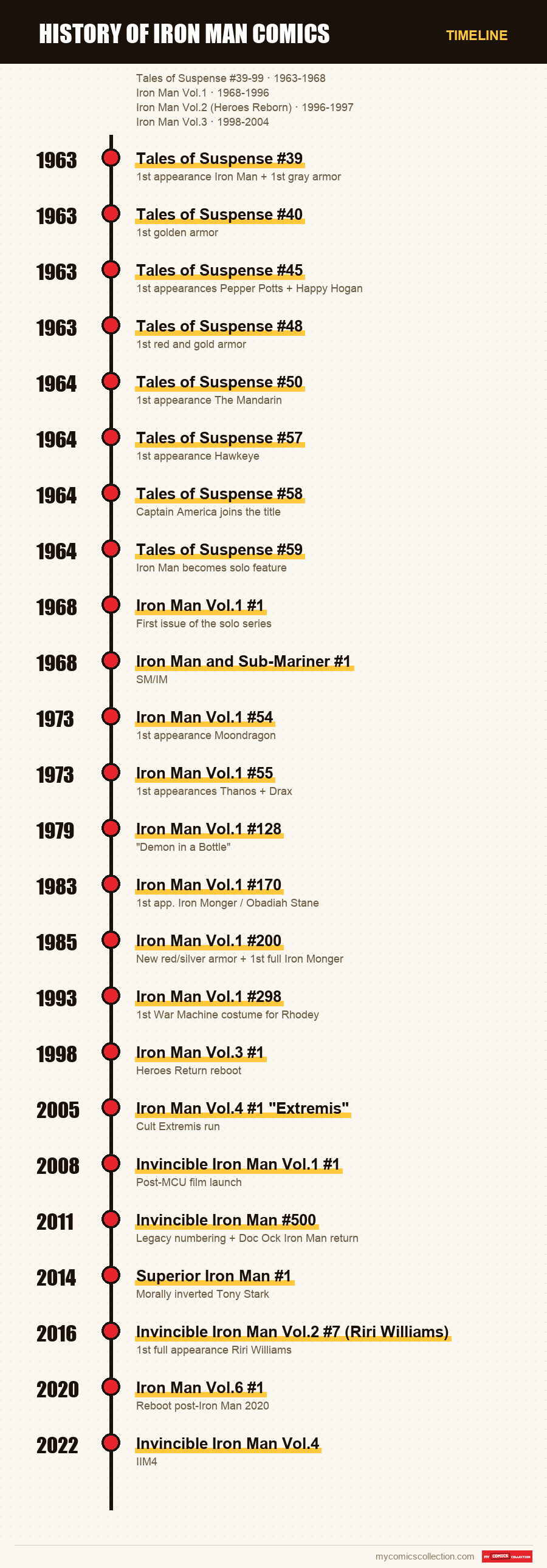
Here are the most important issues to know in chronological order:
Tales of Suspense #39
The founding issue. 13-page story "Iron Man Is Born!" in which Tony Stark, prisoner in Vietnam, builds the first armor to escape. A CGC 9.4 copy sold for $375,000 in 2022. Top 10 most expensive Silver Age comics across all characters.
Tales of Suspense #40
Tony Stark abandons the heavy gray armor for a sleeker, more flexible golden version. This transformation marks the shift from raw military concept to classic superhero. #40 is in high demand at top grades, and its rarity puts it close to #39 on the Silver Age market.
Tales of Suspense #45
First appearance of Virginia "Pepper" Potts (Tony's secretary) and Harold "Happy" Hogan (driver and bodyguard). Two key characters in Stark's lore, popularized by Gwyneth Paltrow and Jon Favreau in the MCU. A heavily collected issue since 2008.
Tales of Suspense #50
First appearance of The Mandarin, Iron Man's historical nemesis. A character controversial for his 1960s stereotypes, modernized in Shang-Chi and the Legend of the Ten Rings (2021). A very sought-after issue since the arrival of Wenwu (Tony Leung) in the MCU.
Tales of Suspense #57
First appearance of Clint Barton / Hawkeye. Originally an Iron Man antagonist (manipulated by Black Widow), Hawkeye will join the Avengers in Avengers #16. An essential issue for Avengers and MCU collectors. CGC 9.0 easily exceeds $5,000.
Tales of Suspense #58
Issue in which Captain America becomes co-feature of Tales of Suspense, sharing the title with Iron Man. The Iron Man vs Captain America fight on the cover is a major Marvel marketing event of 1964. It foreshadows the Civil War rivalry 40 years later.
Tales of Suspense #59
Iron Man becomes an official solo feature (on a par with Captain America). The title is now structured around two complete stories per issue. This structure will last until #99 and prefigures the two solo volumes launched in 1968.
Tales of Suspense #48
First appearance of the red and gold armor, redesigned by Steve Ditko, which became Iron Man's lasting visual identity. Before #48, Iron Man wore the gold armor introduced in #40. The Mandarin only arrives two issues later, in #50.
Iron Man Vol.1 #1
The launch of the classic solo series. Iron Man leaves the Tales of Suspense anthology for his own title, where he'll stay for 332 issues (1968-1996). A founding issue for any Bronze Age Iron Man collection.
Iron Man Vol.1 #54
First appearance of Heather Douglas / Moondragon, a major cosmic heroine in the Marvel universe. A key character for the Guardians of the Galaxy in the comics, possible candidate for a future MCU rollout. An undervalued Bronze Age key issue.
Iron Man Vol.1 #55
One of the biggest key issues in the entire Marvel universe. First appearance of Thanos and Drax the Destroyer , created by Jim Starlin. With Thanos's arrival in the MCU (Avengers Infinity War 2018), this issue exploded in value: a CGC 9.6 exceeds $30,000 in 2024.
Iron Man Vol.1 #128
Conclusion of the cult Demon in a Bottle arc (#120-128) that tackles Tony Stark's alcoholism head-on. The first adult treatment of an addiction in a mainstream comic. It defines the modern Iron Man and remains the absolute reference for the character. Iconic Bob Layton cover with a drunk Tony in front of the mirror.
Iron Man Vol.1 #170
First appearance of Obadiah Stane (rival industrialist who takes over Stark Industries) and the start of Tony's relapse into alcoholism. Iron Monger (Stane's armor) appears in #200. A central character in the 2008 MCU film (Jeff Bridges).
Iron Man Vol.1 #200
Anniversary issue with a new red and silver armor (the "Silver Centurion"), Tony reclaims the Iron Man suit, and the final showdown with Iron Monger. Double-page epic battle issue. Iconic Iron Man cover of the 1980s.
Iron Man Vol.1 #225-232 "Armor Wars"
The Armor Wars arc (8 issues) in which Tony Stark discovers his technology has been stolen and used by other characters (Stilt-Man, Beetle, Crimson Dynamo). He decides to neutralize all derivative armors, making him a fugitive. A reference saga for understanding technological responsibility. The inspiration for the Disney+ series Armor Wars (2026).
Iron Man Vol.1 #298
First appearance of the War Machine costume worn by James "Rhodey" Rhodes. Before this issue, Rhodey wore the classic Iron Man armor as Tony's replacement. The new armor (gold, red, loaded with heavy weapons) will become Rhodey's definitive identity. An essential post-MCU issue.
Iron Man Vol.3 #1
Vol.3 launch after the Heroes Reborn experiment. Iron Man returns to the main Marvel universe. A Busiek run that re-establishes the classic status quo and launches the character's 2000s decade. An excellent affordable Modern Age entry point.
Iron Man Vol.4 #1 "Extremis"
Launch of the Extremis arc by Warren Ellis and Adi Granov. Tony Stark injects himself with the Extremis serum that integrates the armor into his biology. This arc is the direct foundation for the aesthetic of the Iron Man film (2008) and the trilogy. One of the most influential Marvel arcs of the 2000s.
Invincible Iron Man Vol.1 #1
Launched alongside the MCU film (May 2008) to capitalize on the massive success of Robert Downey Jr. Matt Fraction's 33-issue run (then legacy numbering up to #527) defines the post-MCU modern Iron Man. First arc The Five Nightmares with Ezekiel Stane.
Invincible Iron Man #500
Anniversary issue with a switch to combined legacy numbering (Tales of Suspense + Vol.1 + Vol.2 + Vol.3 + Vol.4 + Invincible = #500). Double-sized issue with a futuristic arc in which Doc Ock becomes Iron Man. Variant covers very heavily collected.
Superior Iron Man #1
Sequel to the AXIS event in which Tony Stark's morality is inverted. Now narcissistic and selfish, he monetizes Extremis in San Francisco. A 9-issue mini-series that dives into Stark's dark psyche. The "Superior Iron Man" character has been recurring in the multiverse ever since.
Invincible Iron Man Vol.2 #7 (Riri Williams)
First full appearance of Riri Williams, MIT prodigy student who builds her own Iron Man armor. Cameo in #7, official costume, future successor to Tony Stark. A central character in the Disney+ series Ironheart (2025) and appearing in Wakanda Forever. A fast-growing Modern Age key issue.
Iron Man Vol.6 #1
Reboot after the conclusion of Iron Man 2020 (Arno Stark). Cantwell brings Tony back to an introspective format. The Big Iron arc and the follow-up Books of Korvac redefine the Tony / Patsy Walker / Korvac dynamic. A run praised for returning to the emotional core.
The major Iron Man story arcs in order
Demon in a Bottle (1979)
Tony Stark's alcoholism tackled head-on. A moral landmark and the foundation of modern Iron Man.
Stark Wars / Armor Wars (1987-1988)
Tony neutralizes all armors derived from his stolen technology. A major ethical saga.
Onslaught (1996)
Iron Man "dies" during Onslaught and moves into Heroes Reborn (parallel universe).
Heroes Reborn (1996-1997)
Iron Man outsourced to Image (Jim Lee). 13 Vol.2 issues, extreme 90s aesthetic.
Extremis (2005-2006)
Warren Ellis / Adi Granov re-found Iron Man biologically. Aesthetic basis of the MCU film.
Civil War (2006-2007)
Tony Stark becomes pro-registration and leader of SHIELD forces. Major conflict with Captain America.
World's Most Wanted (2009)
Tony flees Norman Osborn and wipes his own brain to protect secret identities. Fraction run.
Stark Resilient (2010-2011)
Tony rebuilds his company after World's Most Wanted. Industrial redemption phase.
Iron Man 2.0 (2011)
Rhodey / War Machine spin-off by Nick Spencer. 12 issues that redefine the sidekick.
Fear Itself: Iron Man (2011)
Iron Man becomes alcoholic again to make a pact with Odin. Marvel event saga.
The Future (2012)
Conclusion of the Fraction run. Tony faces the consequences of all his mistakes.
The Secret Origin of Tony Stark (2013)
Kieron Gillen reveals Tony is adopted and has a biological brother. Reshaping of Stark mythology.
International Iron Man (2016)
Bendis explores Tony's childhood and biological family. A rare introspective run.
Civil War II (2016)
Iron Man is central: his conflict with Captain Marvel divides the heroes and puts him in a coma.
The Search for Tony Stark (2017-2018)
While Tony is in a coma, Riri Williams carries the Invincible Iron Man title and Doom becomes Infamous Iron Man.
Tony Stark: Iron Man (Slott) (2018-2019)
Dan Slott run, eScape virtual reality, Arno Stark reveal, War of the Realms tie-ins.
Iron Man 2020 (2020)
Arno Stark becomes Iron Man and fights AIs. Slott / Pete Woods event.
Big Iron (2020-2021)
Cantwell brings Tony back to fundamentals. First arc of Vol.6.
Books of Korvac (2021)
Cantwell uses Korvac as Tony's dark mirror. Cosmic saga.
The Whole World Burns (2022)
Conclusion of Vol.6. Tony faces the cosmic consequences of his choices.
Avengers Forever (2022-2023)
Multiversal Iron Man in the Jason Aaron run. Multiple appearances.
Iron Cat (2022)
Crossover mini-series with Black Cat. Comedic heist.
How to start an Iron Man collection in 2026
Set a clear goal
"I want all of Iron Man" is a bad goal (700+ issues across the main volumes, plus ToS, plus all the parallel series). "I want the complete Fraction run (Invincible Iron Man Vol.1 #1-33 + #500-527)" or "the 5 cult arcs (Demon in a Bottle, Armor Wars, Extremis, World's Most Wanted, The Secret Origin)" are excellent starting points.
Import the catalog into My Comics Collection
With My Comics Collection, import Tales of Suspense (#39-99 Iron Man), Iron Man Vol.1-6, Invincible Iron Man Vol.1-4, and all the spin-off series (Ironheart, Tony Stark, Superior, Infamous, Iron Man 2020). Each volume is identified separately to avoid legacy numbering confusion.
Prioritize key issues
The 23 key issues listed represent 80% of the historical value. See our dedicated Iron Man top 10 for a focus on key issues + CGC values. Tales of Suspense #39 is the absolute priority, followed by Iron Man Vol.1 #55 (1st Thanos), which is probably the second most valuable.
Organize by run rather than by issue
Iron Man is best collected by run (Michelinie/Layton, Fraction, Bendis, Slott, Cantwell, Duggan) rather than by strict chronological issue order. It makes reading easier and gives the collection meaning. The cult arcs (Demon in a Bottle, Armor Wars, Extremis) are best collected in bundle.
Track eBay valuation
Tales of Suspense #39 is in heavy demand, but many other key issues move constantly (Iron Man #55 Thanos, ToS #50 Mandarin with Shang-Chi 2). My Comics Collection updates values based on real sales.
Why Iron Man remains a central franchise in 2026
Iron Man, long a second-tier character in public perception, became in 2008 the face of a new era for Marvel. Several reasons:
- The MCU Phase 1-3 effect : Robert Downey Jr. played Tony Stark from 2008 (Iron Man) to 2019 (Avengers: Endgame). His performance turned a second-tier character into a global archetype. Tales of Suspense #39 exploded in value post-2008, followed by every other Iron Man key issue.
- Cult Demon in a Bottle: the Michelinie/Layton arc from 1979 remains one of the most cited comics for its adult treatment of addiction. It influenced the entire Modern Age and is still taught in writing schools.
- Tales of Suspense #39 = Silver Age top tier: alongside Amazing Fantasy #15 (Spider-Man), Fantastic Four #1 and X-Men #1, ToS #39 sits in the top 10 most valuable Silver Age comics. Its rarity in high grade (CGC 9.0+) makes it extremely heavily collected.
- Riri Williams / Wakanda Forever / Ironheart 2025 : the succession through Riri Williams (Ironheart, played by Dominique Thorne in Wakanda Forever and the 2025 Disney+ series Ironheart) keeps the Iron Man myth alive for a new generation. Invincible Iron Man Vol.2 #7 (1st app. Riri) is growing fast.
- Armor Wars Disney+ series 2026 : the Armor Wars series with Don Cheadle (Rhodey) revisits the cult 1987-1988 arc, boosting demand on the corresponding key issues.
Biography of Anthony Edward "Tony" Stark (Iron Man)
Iron Man is a character of Marvel Comics created by Stan Lee, Larry Lieber, Don Heck and Jack Kirby. His first appearance is in Tales of Suspense #39 , published in March 1963.
Identity sheet of Anthony Edward "Tony" Stark
- Real name: Anthony Edward "Tony" Stark
- Date of birth: March 1963 (creation)
- Place of birth: Long Island, New York, USA
- First appearance : Tales of Suspense #39 (March 1963)
- Creators: Stan Lee, Larry Lieber (screenplay) and Don Heck, Jack Kirby (drawing)
- Editor: Marvel Comics
- Memberships: Avengers (founding member), Stark Industries, S.H.I.E.L.D., Illuminati
Character origins
Tony Stark, billionaire heir to Stark Industries and engineering genius, is captured by terrorists while demonstrating a new weapon in Vietnam (Afghanistan in modern versions). Wounded by a shrapnel near the heart, he builds a rudimentary suit of armor with the help of physicist Ho Yinsen to escape. Returning to the United States, he perfected the armor and became Iron Man, a founding member of the Avengers and iconic Marvel hero.
Powers and Abilities
- No natural superpowers: ordinary genius
- Superhuman Intellect (IQ 270+): engineer, inventor, scientist
- Iron Man armors: force, flight, energy weapons (repulsors, unibeam)
- ARC reactor: generates the energy of the armor and maintains its core
- AI Connectivity: Jarvis, Friday, Veronica
- Fortune: billionaire owner of Stark Industries
Costume and visual identity
Powered red and gold armor (Mark I to Mark LXXXV+). The helmet with luminous yellow eyes and the circular breastplate (ARC reactor) are iconic. Constant evolution of models.
Build your Iron Man collection methodically
Import the 700+ Iron Man issues (Tales of Suspense + Vol.1-6 + Invincible Vol.1-4 + spin-offs) in one click, identify your missing key issues, track eBay values. 7-day free trial.
🚀 Start free 7-day trialGo further
- Iron Man Reading Order: The Complete Guide to Tony Stark's Best Comics
- Best Iron Man Comic Runs: The Essential Reading List for Collectors
- The Best Iron Man Story Arcs: From Demon in a Bottle to Extremis
- Iron Man Key Issues: Collector's Guide
- Tales of Suspense #39: The First Appearance of Iron Man (1963)
- Iron Man Comic Collection Guide: Key Issues to Collect
FAQ: History of Iron Man
Other comics character histories to discover
Our complete "Comics history" article series covers the 20 biggest Marvel and DC franchises. Each article follows the same format: birth, complete chronology of volumes, parallel series, key issues sorted chronologically, major arcs, and collection method.
→ See all "History" blog articles