
The X-Men were born in September 1963 in X-Men #1 , written by Stan Lee and drawn by Jack Kirby. The original team consists of five teenage mutants: Cyclops , Iceman , Beast , Angel and Marvel Girl (Jean Grey), brought together by Professor Charles Xavier. But the franchise sputters along for six years, until the series goes into hiatus from 1970 to 1975 (reprint issues only). It's Giant-Size X-Men #1 (May 1975) by Wein/Cockrum, then Uncanny X-Men #94 (August 1975) with Chris Claremont, that propel the title to the top by introducing the international team (Wolverine, Storm, Colossus, Nightcrawler, Banshee, Thunderbird). More than 60 years later, in 2026, over 30 X-Men series are active in the post-Krakoa era, making the X-Men one of Marvel's most sprawling franchises.
Along with Spider-Man and the Avengers, the X-Men are one of Marvel Comics' three foundational pillars. But no other franchise has had such an unusual trajectory: created in 1963 in the wave of the Stan Lee / Jack Kirby "Marvel Renaissance," the X-Men long remained the poor cousins of the Bullpen, struggling to find their audience against Spider-Man, the Fantastic Four and the mythological Thor. The original series was even put on hold from 1970 to 1975, publishing only reprints. Then, in May 1975, Giant-Size X-Men #1 changed everything. Len Wein and Dave Cockrum dreamed up an international team (a Canadian, an African, a Russian, a German, an Irish woman, an Apache) that reshuffled the deck. Chris Claremont took over the title at Uncanny X-Men #94 and stayed for 17 years (1975-1991), an absolute record. He's the one who turned the X-Men into a political metaphor for minorities, writing the Dark Phoenix Saga, Days of Future Past, God Loves, Man Kills.
This guide will give you everything you need to understand the birth of the X-Men , follow the complete chronology of the series in order , and identify the key issues and major arcs to prioritize. We'll walk through 60+ years of the franchise, from X-Men #1 (1963) through the current From the Ashes run by Jed MacKay in 2026, distinguishing the main X-Men and Uncanny X-Men volumes, the parallel ongoings (New Mutants, X-Factor, Excalibur, X-Force…), and the many cult mini-series (House of X, Powers of X, X of Swords, Age of Apocalypse).
The birth of the X-Men: Marvel in 1963
To understand how the X-Men came to be, you have to go back to the summer of 1963. Marvel was in the middle of a roaring renaissance since the creation of Fantastic Four #1 in November 1961. Stan Lee and Jack Kirby had been launching titles at a stunning pace: Hulk (1962), Spider-Man (August 1962), Thor (1962), Iron Man (March 1963), the Avengers (September 1963). Marvel was operating on a tight budget with a limited number of titles per month: every new launch had to find its audience or disappear. In that context, Stan Lee imagined a group of super-heroes that would side-step the thorny question of origins: rather than inventing a different exposition story for each member (irradiation for Hulk, spider bite for Spider-Man, orbital accident for the Fantastic Four), he'd create heroes born that way. "Mutants." Stan Lee later explained he initially wanted to call them "The Mutants," but publisher Martin Goodman thought readers wouldn't understand the word. Lee made the call: it would be "X-Men," for the X as in "X-tra power" and for the X of Charles Xavier, their mentor.
Jack Kirby designs the team: five teenagers in identical yellow-and-black uniforms, led by a telepathic professor in a wheelchair. The members: Cyclops (Scott Summers, projecting energy beams from his eyes, forced to wear a ruby-quartz visor), Iceman (Bobby Drake, the youngest, able to generate ice), Beast (Hank McCoy, athletic with huge hands and feet, a science prodigy), Angel (Warren Worthington III, a winged multi-millionaire), and Marvel Girl (Jean Grey, a telekinetic later renamed Phoenix). The central concept (mutants persecuted by humanity, secretly trained by Charles Xavier at his Westchester school to defend a world that fears them) is from the start a transparent political metaphor for American minorities. During the civil rights movement (1955-1968), Stan Lee often acknowledged drawing on the Martin Luther King / Malcolm X pairing to create the Charles Xavier / Magneto duo: the first preaching peaceful coexistence, the second armed struggle for mutant supremacy.
X-Men #1 (September 1963)
The X-Men make their first appearance in X-Men #1 (cover-dated September 1963, on newsstands as early as July). The issue is credited to Stan Lee (script) and Jack Kirby (art), Sol Brodsky (inks), Sam Rosen (letters). The story runs 23 pages: Charles Xavier gathers Cyclops, Iceman, Beast, Angel and Marvel Girl at his Westchester institute, teaches them to master their powers, and sends them to face Magneto (Erik Lehnsherr, still called "Magneto, the Magnetic Man" in this first issue), master of magnetism who has just attacked a military base to proclaim mutant supremacy. The issue cost 12 cents on the newsstand. Very important historical detail: X-Men #1 is a multi-key first appearance. The X-Men team debuts here, along with each of the five members individually, Professor Xavier, and Magneto. Those six condensed first appearances in a single issue explain why X-Men #1 (1963) is today one of the most expensive Silver Age comics: a CGC 9.8 copy sold for more than $800,000 in 2023.
Initial success is… modest. Sales top out around 200,000 copies while Spider-Man passes 400,000. Stan Lee and Jack Kirby leave the series quickly after a few issues. Roy Thomas takes over the script as early as #20 (1966), Werner Roth then Don Heck handle the art. The series still introduces crucial characters: Quicksilver and Scarlet Witch in X-Men #4 (March 1964) as part of the Brotherhood of Evil Mutants, Banshee in X-Men #28 (January 1967), Havok in X-Men #54 (1969), the Sentinels in X-Men #14 (November 1965). Despite these additions, the series stalls commercially. Neal Adams and Roy Thomas attempt an artistic rescue in 1969-1970 (issues #56-66) with a revolutionary proto-Bronze Age style, but it's too late. Marvel decides to stop producing new stories.
The historic pivot: 1975 and the international team
From 1970 to 1975, X-Men enters a strange phase: the series isn't cancelled, but it now publishes only reprints of earlier issues. Issues #67 to #93 (1970-1975) are reprints of #12-66. Marvel hesitates to invest in a fading team but doesn't want to lose the copyright on the characters. It's a period of commercial purgatory. Then editor Roy Thomas has an idea: relaunch the X-Men with an international team to win over rapidly expanding foreign markets. He hands the mission to Len Wein (the writer who had just co-created Wolverine in Hulk #181 in 1974) and Dave Cockrum (a young rising-star artist).
The result is Giant-Size X-Men #1 (May 1975), a 50-cent oversized one-shot. Wein and Cockrum imagine a new international team that rescues the original X-Men captured by the living island Krakoa. The new members: Wolverine (Logan, the Canadian with adamantium claws, already introduced in Hulk #181 in November 1974), Storm (Ororo Munroe, African weather goddess), Colossus (Piotr Rasputin, Russian farmer with steel-hard skin), Nightcrawler (Kurt Wagner, blue German acrobat teleporter), Banshee (Sean Cassidy, Irish screamer already introduced in 1967) and Thunderbird (John Proudstar, an Apache warrior). This younger, more diverse and more violent team completely redefines the tone.
Three months later, in August 1975, the original series resumes publication with Uncanny X-Men #94: not a new #1, but a continuation of the legacy numbering. It's an editorial decision that proves crucial: the long 1963-to-today continuity of the X-Men has turned issues from the 1970s and '80s into highly collected treasures. Dave Cockrum draws #94-107, then John Byrne takes over #108-143: this is the absolute golden age. Chris Claremont writes the entire era, and remains the sole writer for 17 years (1975 to 1991, or 186 consecutive issues of Uncanny X-Men). No other Marvel writer has matched that record. His political vision, his deep characterization of female characters (Storm, Phoenix, Kitty Pryde, Rogue), his obsession with long-form storytelling will turn X-Men into Marvel's #1 franchise as early as the 1980s.
The historical irony: X-Men, created in 1963 as a second-tier Stan Lee / Jack Kirby title, became Marvel's most profitable franchise from 1980-1991 thanks to a low-key British writer (Claremont) and the new international team conceived by a Canadian (Wein) and a fanzine illustrator (Cockrum). The X-Men's success saved Marvel from bankruptcy several times (1985, 1996), and it's this franchise, not Spider-Man or the Avengers, that fueled the 1990s boom (X-Men Vol.2 #1 in 1991 remains, to this day, the best-selling American comic in history with 8.1 million copies sold).
The main X-Men volumes in chronological order
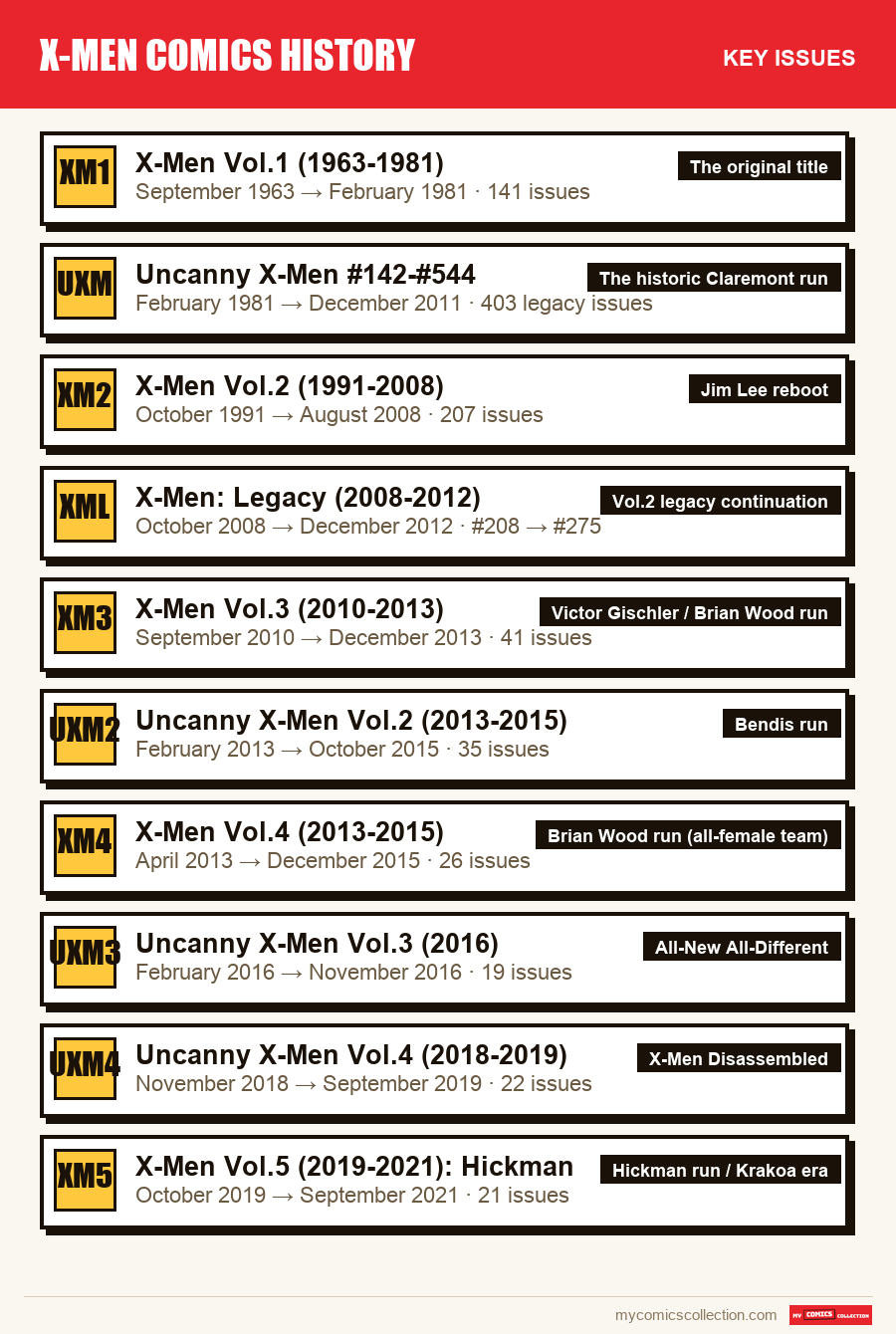
The X-Men franchise is one of the most complex in all of Marvel. The main title has been rebooted or renumbered eight times in six decades. Here are the main volumes in order of their first issue:
X-Men Vol.1 (1963-1981)
Launched by Stan Lee and Jack Kirby in September 1963, X-Men Vol.1 runs 141 issues under the simple title X-Men. Issues #1-66 form the original 1963-1970 era (Stan Lee, Roy Thomas, Neal Adams). Issues #67-93 (1970-1975) are reprint-only: the series isn't cancelled but is on a creative hiatus. With Giant-Size X-Men #1 (May 1975), the new international team relaunches production. Issues #94-141 (1975-1981) are by the Claremont/Cockrum then Claremont/Byrne team and mark the absolute golden age, including the Dark Phoenix Saga and Days of Future Past. Starting with #142 (February 1981), the title is renamed Uncanny X-Men.
Uncanny X-Men #142-#544
Starting with #142, the series changes its title to The Uncanny X-Men, with no break in numbering. Chris Claremont continues through #279 (August 1991), 186 consecutive issues as writer: Marvel's all-time record. He's followed by Jim Lee (artwork #267-280), Whilce Portacio, Scott Lobdell (#280-350), Joe Casey, Chuck Austen, Ed Brubaker (#475-500), Matt Fraction (#500-544). Key issues: #129 (1st Kitty Pryde + Emma Frost + Hellfire Club), #130 (1st Dazzler), #131-138 (Dark Phoenix Saga), #141-142 (Days of Future Past), #266 (1st Gambit), #268 (iconic Wolverine/Black Widow/Captain America cover by Jim Lee). The volume ends at #544 in December 2011 during Schism, with the Wolverine/Cyclops split.
X-Men Vol.2 (1991-2008)
A parallel launch of a second X-Men title alongside Uncanny X-Men, with X-Men Vol.2 #1 in October 1991. The issue is drawn by Jim Lee with a script by Chris Claremont, and published with five different covers (four regulars plus a "gatefold" combining all four). Sales reach 8.1 million copies: the best-selling American comic in modern history, a record still unbeaten in 2026. The series is renamed X-Men Vol.2 at #114 (July 2001) after a minor break. At #188 (September 2006), the title temporarily becomes X-Men: Legacy. Numbering ends at #207 in 2008.
X-Men: Legacy (2008-2012)
Direct continuation of X-Men Vol.2 under the name X-Men: Legacy, starting at #208 (October 2008). Mike Carey writes the run, with a focus on Charles Xavier and then Rogue. The series wraps at #275 in December 2012 during the Marvel NOW! reboot. A new X-Men: Legacy Vol.2 (24 issues) will be published in 2013-2014 with Si Spurrier writing, focused on David Haller / Legion.
X-Men Vol.3 (2010-2013)
A new launch with X-Men Vol.3 #1 in July 2010 by Victor Gischler. Vampire run (Curse of the Mutants), then Brian Wood takes over with an all-female team in the 2013 version's #1. The series ends at #41 in December 2013.
Uncanny X-Men Vol.2 (2013-2015)
Marvel NOW! reboot with Brian Michael Bendis writing. Uncanny X-Men Vol.2 #1 in February 2013 follows Cyclops as a revolutionary figure after Avengers vs X-Men. The series wraps at #35 in 2015 during Secret Wars.
X-Men Vol.4 (2013-2015)
A parallel X-Men Vol.4 launch in April 2013, written by Brian Wood and drawn by Olivier Coipel. The team is all-female: Storm, Rogue, Kitty Pryde, Psylocke, Rachel Grey, Jubilee. 26 issues through the end of 2015.
Uncanny X-Men Vol.3 (2016)
A short post-Secret Wars reboot during the All-New All-Different Marvel era. Cullen Bunn writes the run, which follows Magneto's team. Wraps at #19 in 2016.
Uncanny X-Men Vol.4 (2018-2019)
A weekly Matthew Rosenberg / Ed Brisson / Kelly Thompson run, "X-Men Disassembled" then "Age of X-Man." 22 issues between November 2018 and August 2019, serving as a bridge to House of X / Powers of X and the Krakoa era.
X-Men Vol.5 (2019-2021): Hickman
The revolutionary reboot by Jonathan Hickman. Preceded by the twin mini-series House of X #1-6 and Powers of X #1-6 (July-October 2019), X-Men Vol.5 #1 (October 2019) launches the Krakoa era: every mutant now lives on the island nation of Krakoa, which becomes a sovereign power recognized by the UN. 21 issues under Hickman before the transition to Reign of X and Destiny of X. The most influential X-Men run since Claremont.
X-Men Vol.6 (2021-2024): Duggan
Continuation of the Krakoa era by Gerry Duggan, who runs the annual Hellfire Galas (X-Men elected by reader vote each year). 35 issues through May 2024, capped by the fall of Krakoa during the Fall of X event in 2023-2024.
X-Men Vol.7 (2024+): From the Ashes
A post-Krakoa launch with the From the Ashes initiative in July 2024. Jed MacKay writes X-Men Vol.7 with an Alaska-based team led by Cyclops. The current run in 2026: variant covers are being actively collected.
Every parallel X-Men series in chronological order
Alongside X-Men and Uncanny X-Men, Marvel has published more than sixty spin-off series over six decades. Here's the chronology of the main titles to help you understand the ecosystem:
- The New Mutants (1983-1991, 100 issues): Charles Xavier's second mutant generation (Cannonball, Sunspot, Wolfsbane, Karma, Magma, Cypher, Magik). Created by Claremont / McLeod. Becomes X-Force at #100.
- X-Factor Vol.1 (1986-1998, 149 issues): brings the five original X-Men (Cyclops, Iceman, Beast, Angel, a resurrected Marvel Girl) together as an elite team. Launched by Bob Layton, taken over by Louise and Walter Simonson, then Peter David who reinvents it as a government team (1991-1993).
- Excalibur Vol.1 (1988-1998, 125 issues): a British team with Captain Britain, Meggan, Nightcrawler, Kitty Pryde, Rachel Summers / Phoenix. Created by Claremont / Davis.
- X-Force Vol.1 (1991-2002, 129 issues): a continuation of New Mutants from #100 onward under Cable's leadership. Rob Liefeld designs the team (Cable, Domino, Shatterstar, Warpath). X-Force #1 (August 1991) remains one of the best-selling comics ever with its five covers and more than 5 million copies.
- Generation X (1994-2001, 75 issues): the third mutant generation (Jubilee, Husk, Skin, Synch, M, Chamber). Scott Lobdell / Chris Bachalo, led by Emma Frost and Banshee. A more pop teenage generation in the 1990s.
- X-Men: The Hidden Years (1999-2001, 22 issues): John Byrne tells the previously untold 1969-1975 years between X-Men #66 and Giant-Size #1, filling the historic hiatus.
- X-Treme X-Men (2001-2004, 46 issues): Chris Claremont returns to the X-Men with a team curated by himself (Storm, Bishop, Sage, Lifeguard, Slipstream).
- Astonishing X-Men Vol.3 (2004-2013, 68 issues): Joss Whedon and John Cassaday handle #1-24, the most notable run of the 2000s. Followed by Warren Ellis (#25-35), Daniel Way, Marjorie Liu.
- Ultimate X-Men (2001-2009, 100 issues): a modern reboot in the Ultimate universe by Mark Millar then Bendis, Brian K. Vaughan, Robert Kirkman. More political, darker.
- Wolverine and the X-Men (2011-2014, 42 issues + Vol.2 12 issues): Jason Aaron post-Schism, Wolverine founds the Jean Grey School for Higher Learning. A funny, accessible run.
- Cable & Deadpool (2004-2008, 50 issues): the unlikely Fabian Nicieza duo that establishes the Cable / Wade Wilson chemistry.
- Cable Vol.1-3: multiple Nathan Summers solo series since 1993.
- Deadpool: a multi-volume franchise since 1997, who became a Marvel mascot under Joe Kelly and then Daniel Way.
- X-23 (2010-2012, 21 issues + multiple relaunches): Laura Kinney, Wolverine's female clone. Becomes the main Wolverine starting in 2015.
- X-Men: Red Vol.1 (2018, 11 issues): Tom Taylor, Jean Grey reformed political X-Men. Continued in Vol.2 (2022-2024).
- X-Men: Blue (2017-2018, 36 issues): the original young X-Men from the past, by Cullen Bunn.
- X-Men: Gold (2017-2018, 36 issues): Marc Guggenheim, classic team with Kitty Pryde as leader.
- Marauders (2019-2022, 27 issues + Vol.2): Gerry Duggan, Krakoa team led by Kitty Pryde / Captain Kate. Mutant pirates rescuing mutants.
- X-Force Vol.6 (2019-2024, 50 issues): Benjamin Percy, the Krakoa black-ops team with Wolverine, Domino, Sage, Quentin Quire.
- Excalibur Vol.4 (2019-2022, 26 issues): Tini Howard, magical Otherworld team with Betsy Braddock as Captain Britain.
- New Mutants Vol.4 (2019-2022, 33 issues): Hickman then Vita Ayala, return of Sunspot, Magik, Wolfsbane, Cypher.
- Hellions (2020-2021, 18 issues): Zeb Wells, Krakoa's "wild ones" team: Empath, Wild Child, Greycrow, Sinister.
- X-Factor Vol.4 (2020-2021, 10 issues): Leah Williams, the team that investigates mutant deaths in Krakoa.
- Way of X (2021, 5 issues): Si Spurrier, Nightcrawler explores Krakoa spirituality.
- Children of the Atom (2021, 6 issues): Vita Ayala, a young team of X-Men fans.
- S.W.O.R.D. (2020-2021, 11 issues): Al Ewing, mutant space agency with Abigail Brand.
- X-Men Unlimited Infinity Comics (2021+): Marvel Unlimited's vertical digital series, mobile vertical format.
- Immortal X-Men (2022-2024, 18 issues): Kieron Gillen, focused on the Quiet Council (Krakoa's government).
- X-Men Forever (2024): Kieron Gillen and Jonathan Hickman wrap up the Krakoa era during Fall of X.
- X-Men: Wakanda Forever , Astonishing X-Men: Xenogenesis , Generation Hope , X-Treme X-Men Vol.2 , Wolverines , Inhumans vs X-Men , X-Men/Fantastic Four , X-Men: The Trial of Magneto , Sabretooth , Knights of X , Legion of X , Sabretooth and the Exiles , Realm of X , X-Men Annual: and many other event mini-series.
X-Men key issues in chronological order
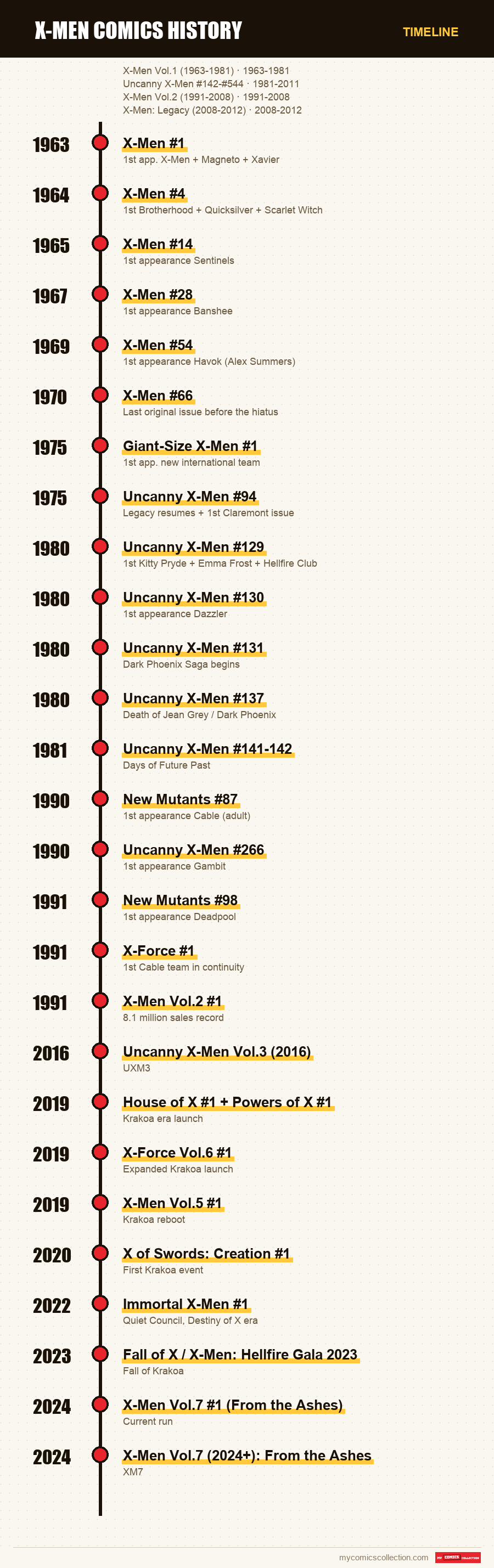
Here are the most important issues to know in chronological order:
X-Men #1
The foundational issue. First appearances of the X-Men as a team (Cyclops, Iceman, Beast, Angel, Marvel Girl), Professor Xavier and Magneto. A massive multi-key concentrated in a single issue. A CGC 9.8 copy sold for more than $800,000 in 2023. Top 10 most expensive Silver Age comics.
X-Men #4
Triple key. First appearances of Magneto's Brotherhood of Evil Mutants , Quicksilver (Pietro Maximoff) and Scarlet Witch (Wanda Maximoff). The latter two would become central to the MCU with WandaVision and Avengers. CGC 9.4 estimated above $50,000.
X-Men #14
First appearance of the Sentinels, the giant mutant-hunting robots designed by Bolivar Trask. Recurring antagonists who structure Days of Future Past and the entire X-Men imagination.
X-Men #28
First appearance of Banshee (Sean Cassidy), Irish character with an over-powered sonic scream. Key member of the new 1975 international team and of Generation X.
X-Men #54
First appearance of Havok (Alex Summers), Cyclops' younger brother, capable of absorbing and projecting cosmic energy. A recurring character for 50+ years.
X-Men #66
Last issue with an original story before the five-year hiatus (1970-1975) during which the series only publishes reprints. A historic pivot issue for understanding X-Men chronology.
Giant-Size X-Men #1
The most important X-Men issue after #1. First appearances of Storm , Colossus , Nightcrawler and Thunderbird as X-Men. First X-Men appearance of Wolverine, Banshee and Sunfire on the team. The issue that relaunched the franchise for 50 years. CGC 9.8 tops $25,000 in 2024.
Uncanny X-Men #94
Resumption of legacy numbering after five years of hiatus. The first issue of Chris Claremont's run, which would last 17 years (through #279 in 1991). Marks the move into the Bronze Age and the X-Men's golden age.
Uncanny X-Men #129
Massive triple key. First appearances of Kitty Pryde (Shadowcat, future Captain Kate of Marauders), Emma Frost (the White Queen, future love interest of Cyclops) and the Hellfire Club as a whole. CGC 9.8 tops $5,000.
Uncanny X-Men #130
First appearance of Alison Blaire / Dazzler, a disco-singer mutant who can transform sound into light. Designed for cross-marketing with Casablanca Records (which never actually came together).
Uncanny X-Men #131
Kickoff of the Dark Phoenix Saga (#131-138), considered the most important Marvel arc since Stan Lee / Steve Ditko. Jean Grey corrupted by the cosmic power of the Phoenix.
Uncanny X-Men #137
The issue where Jean Grey takes her own life on the Moon to stop the Phoenix from destroying the universe. One of Marvel's most emotional issues. Iconic John Byrne cover. CGC 9.8 between $1,500 and $3,000.
Uncanny X-Men #141-142
The Days of Future Past two-parter, a dystopia where the Sentinels have wiped out most mutants by 2013. Kitty Pryde is sent into the past to prevent the assassination of Robert Kelly. Direct inspiration for the X-Men: Days of Future Past film (2014).
Uncanny X-Men #266
First appearance of Gambit (Remy LeBeau), a Cajun thief with electrostatic playing cards. He became a 1990s mascot, Rogue's love interest. Heavily collected, CGC 9.8 tops $1,500.
New Mutants #87
First full appearance of Cable (Nathan Summers, son of Cyclops and Madelyne Pryor from the future). A revolutionary 1990s character, future X-Force leader. CGC 9.8 tops $2,000 on variants.
New Mutants #98
The most valuable modern key issue in the entire mutant franchise. First appearance of Deadpool (Wade Wilson), a psychopathic mercenary who'd become a global mascot thanks to the Ryan Reynolds films. CGC 9.8 tops $4,000 in 2024.
X-Men Vol.2 #1
The best-selling American comic of the modern era. Five different covers (four regulars + a combined "gatefold") drove 8.1 million copies sold: a record still unbeaten in 2026. Parallel launch of a second X-Men title with art by Jim Lee. The combined cover is highly sought after by collectors.
X-Force #1
First issue of X-Force, continuation of New Mutants. Five covers with collectible Marvel Universe trading cards. More than 5 million copies sold. Cable's first official team.
House of X #1 + Powers of X #1
The twin event series that relaunched the franchise. Hickman reshuffled every card by turning mutants into a sovereign nation on the living island of Krakoa. A revolutionary concept, philosophical references (Nietzsche, Foucault), unprecedented narrative structure. House of X #1 1:200 variants top $1,000.
X-Men Vol.5 #1
Official launch of the new X-Men Vol.5 in the Krakoa era. The franchise restarts on a new foundation: every mutant lives on Krakoa, the dead are resurrected by the Five protocol, and the political mutant utopia is born.
X-Force Vol.6 #1
Launch of the new Krakoa-era X-Force. A black-ops team with Wolverine, Domino, Sage, Quentin Quire, Beast (now a moral antagonist). The most beloved run of the Reign of X.
X of Swords: Creation #1
The first crossover event of the Krakoa era, in 22 chapters spread across all the X titles. Launches the magical Otherworld concept and introduces Captain Britain Betsy Braddock, Apocalypse, and the Arthurian confrontation.
Immortal X-Men #1
Launch of Kieron Gillen's political run focused on Krakoa's Quiet Council (the mutant government). 18 issues that culminate in the fall of Krakoa. A run very much loved for its narrative intelligence.
Fall of X / X-Men: Hellfire Gala 2023
The event that ends the Krakoa era. Orchis attacks the mutants at the Hellfire Gala 2023, kicking off the Fall of X event (summer 2023 - summer 2024). Conclusion in X-Men #35 (Vol.6) in May 2024 and X-Men Forever in July 2024.
X-Men Vol.7 #1 (From the Ashes)
Launch of the From the Ashes initiative. Cyclops leads a new team based in Alaska. Ongoing run in 2026 with Jed MacKay writing, with variant covers in high demand from modern collectors.
The major X-Men story arcs in order
The Dark Phoenix Saga (1980)
The most important Marvel arc. Jean Grey corrupted by the cosmic power of the Phoenix takes her own life on the Moon.
Days of Future Past (1981)
A dystopia where the Sentinels exterminate the mutants. Kitty Pryde is sent into the past. Inspired the 2014 film.
God Loves, Man Kills (1982)
A Claremont/Anderson graphic novel about religious anti-mutant persecution. Inspiration for X-Men 2 (2003).
The Mutant Massacre (1986)
Crossover Uncanny X-Men, X-Factor, New Mutants, Thor: the Marauders massacre the Morlocks in the sewers.
Fall of the Mutants (1988)
Three teams (X-Men, X-Factor, New Mutants) face their own apocalypses. The X-Men "die" and are reborn in Australia.
Inferno (1989)
Demonic crossover with the return of Madelyne Pryor (Jean's clone) as the Goblin Queen. New York invaded by demons.
X-Tinction Agenda (1990)
Genosha and Cameron Hodge's regime persecute mutants. Crossover in 9 parts. Death of Warlock.
X-Cutioner's Song (1992)
Stryfe (Cable's clone) tries to assassinate Charles Xavier. A 12-part crossover spanning every X title.
Age of Apocalypse (1995)
Alternate universe where Apocalypse rules the world. All X titles replaced for 4 months. A 1990s cornerstone.
Onslaught (1996)
A corrupted Charles Xavier merges with Magneto to become Onslaught. Apparent death of the Avengers and FF (Heroes Reborn).
Operation: Zero Tolerance (1997)
Bastion launches a government anti-mutant war. More than 25 issues across all X titles.
House of M (2005)
Scarlet Witch rewrites reality, Magneto rules. Concluded by "No More Mutants": 99% of mutants lose their powers.
Decimation (2005-2006)
Consequences of House of M. Mutant population reduced to 198 individuals. X-Men in survival mode.
Messiah Complex (2007-2008)
The first mutant birth since Decimation: Hope Summers. A 13-part crossover. Charles Xavier's death (temporary).
Schism (2011)
Split between Cyclops (militant) and Wolverine (school). Splits the X-Men into two factions for the first time.
Avengers vs X-Men (2012)
The Phoenix Force returns to Earth. Avengers/X-Men confrontation. Charles Xavier's death (by a corrupted Cyclops).
House of X / Powers of X (2019)
Hickman reboot. Birth of the Krakoa era, sovereign mutant nation. The most important turning point since Giant-Size.
X of Swords (2020)
The first Krakoa crossover, in 22 chapters. Arthurian Otherworld, Captain Britain Betsy Braddock, Apocalypse.
Hellfire Gala (2021-2023)
Three major Hellfire Gala events (2021, 2022, 2023). Reader vote for the X-Men team. Concluded by Fall of X.
Judgment Day (2022)
Avengers vs X-Men vs Eternals. Major Kieron Gillen crossover. Temporary deaths of several heroes.
Fall of X (2023-2024)
Fall of Krakoa. Orchis attacks the Hellfire Gala 2023. Worldwide mutant diaspora. Concluded in X-Men Forever 2024.
How to start an X-Men collection in 2026
Set a clear goal
"I want all of X-Men" is a bad goal (more than 4,000 canonical issues across all titles). "I want the complete Claremont run on Uncanny X-Men #94-279" or "the 2019-2024 Hickman/Duggan/Gillen Krakoa era" are excellent structured starting points.
Import the catalog into My Comics Collection
With My Comics Collection, import X-Men Vol.1-7, Uncanny X-Men #94-544 and Vol.2-4, plus the spin-off series (New Mutants, X-Factor, X-Force, Excalibur, Generation X). Each issue and volume distinctly identified.
Prioritize key issues
The 25 key issues listed above represent 80% of the historical value. See our dedicated X-Men key issues top for a focus on key issues + CGC values, or the Uncanny X-Men top for the legacy franchise.
Organize by run rather than by issue
X-Men is collected by run (Claremont, Morrison, Whedon, Hickman, Duggan, MacKay) rather than by strict issue chronology. This makes the reading easier and gives it meaning. The Claremont Uncanny X-Men #94-279 run, for example, is the most-collected run at Marvel.
Track eBay valuations
X-Men #1 (1963) is out of reach, but many other key issues move constantly. My Comics Collection updates values based on real sales. New Mutants #98 (1st Deadpool) and Uncanny X-Men #266 (1st Gambit) are among the most volatile.
Why the X-Men are so collected in 2026
Along with Spider-Man and Batman, the X-Men are one of the three most active franchises in monthly sales (DC + Marvel combined) in 2026. Several reasons:
- Fox films 2000-2020: Bryan Singer's trilogy (X-Men 2000, X2 2003, Last Stand 2006), First Class (2011), Days of Future Past (2014), Apocalypse (2016), Dark Phoenix (2019), plus the solo Wolverine films (2009, 2013, 2017 Logan), Deadpool 1-2-3, and Dark Phoenix. 13 cumulative Fox features generated more than $6 billion at the box office.
- MCU Phase 6 and X-Men on Disney+: Disney got the X-Men rights back in 2019 with the Fox acquisition. The first MCU X-Men films are announced for Phase 6 (Avengers: Doomsday 2026, Avengers: Secret Wars 2027). Marvel Studios is preparing a complete reboot of the franchise for the big screen.
- X-Men '97 on Disney+: the direct sequel to the X-Men: The Animated Series (1992-1997) animated series brutally relaunched interest in the X-Men in March 2024. Season 2 planned for 2026, season 3 confirmed. Record audience on Disney+.
- Video games: Marvel's Midnight Suns (2022), Marvel Snap (2022) with X-Men cards, Marvel Rivals (2024), and the future Marvel 1943: Rise of Hydra game (2025) with Storm.
- A galaxy of characters: 200+ canonical X-Men and more than 80 recurring antagonists (Magneto, Apocalypse, Mister Sinister, Mystique, Dark Phoenix, Sentinels, Sabretooth, Bastion, Stryfe, Onslaught). No other franchise has such a mutant rogues' gallery.
- Political relevance: the X-Men metaphor about minorities, persecution, identity, fear of the other remains eternally relevant. That's what makes the franchise readable across every generation for 60 years.
Biography of Team of mutants founded by Professor Charles Xavier (X-Men)
X-Men is a character of Marvel Comics created by Stan Lee and Jack Kirby. His first appearance is in X-Men #1 , published in September 1963.
Identity sheet of Mutant team founded by Professor Charles Xavier
- Real name: Team of mutants founded by Professor Charles Xavier
- Date of birth: September 1963 (creation of the team)
- Place of birth: Westchester County, New York (Xavier Institute)
- First appearance : X-Men #1 (September 1963)
- Creators: Stan Lee (writer) and Jack Kirby (artist)
- Editor: Marvel Comics
- Memberships: Avengers (occasional), X-Force, X-Factor, New Mutants, Generation X, Krakoa
Character origins
Professor Charles Xavier, the most powerful telepath in the world, founds a school for young mutants in Westchester. Its mission: to protect a world that fears and hates them, while seeking peaceful coexistence between humans and mutants. The original team included Cyclops, Marvel Girl, Iceberg, Angel and Beast. In 1975 (Giant-Size X-Men #1), a new international team joined the team: Wolverine, Tornado, Colossus, Nightcrawler.
Powers and Abilities
- Mutants: superhuman powers linked to the X gene
- Cyclops: destructive optical rays
- Marvel Girl/Phoenix: telepathy, telekinesis, Phoenix Force
- Wolverine: healing factor, adamantium claws, animal senses
- Tornado: weather control
- Magneto: control of magnetism (classic antagonist)
Costume and visual identity
Various individual costumes. Classic X-Men uniform: blue and yellow jumpsuit with black belt. Modern versions: black and yellow (Whedon's Astonishing X-Men style).
Build your X-Men collection methodically
Import the 4,000+ X-Men + Uncanny + spin-off issues in one click, identify your missing key issues, track eBay value. 7-day free trial.
🚀 Start the 7-day free trialGo further
FAQ: History of the X-Men
Other comic character histories to discover
Our complete "Comic history" article series covers the 20 biggest Marvel and DC franchises. Each article follows the same format: birth, full chronology of the volumes, parallel series, key issues sorted chronologically, major arcs and a collecting method.
→ See all "History" articles on the blog