
Hulk was born in May 1962 in Incredible Hulk #1 , written by Stan Lee and drawn by Jack Kirby. Bruce Banner, nuclear physicist, is exposed to a gamma-ray blast during a G-bomb test and turns into a green monster whenever he gets angry. The original series (Vol.1) was canceled after just 6 issues in March 1963, after Hulk's color shifted from gray to green starting with #2. Marvel relaunched the character in Tales to Astonish #60-101 (1964-1968), then renamed the series Incredible Hulk Vol.2 #102 (April 1968), picking up the legacy numbering. In total, 5 main solo volumes mark the character's 60+ years, plus around a dozen parallel series (Red Hulk, She-Hulk, Skaar, Immortal Hulk).
Along with Spider-Man and the Fantastic Four, Hulk is one of the founding characters of the Marvel Age of Comics launched by Stan Lee and Jack Kirby in the early 1960s. But where Spider-Man embodies the teenage hero and the FF the scientific family, Hulk carries tragic duality: Bruce Banner, brilliant frail scientist, harbors a monstrous, uncontrollable force. Inspired simultaneously by Stevenson's Dr Jekyll and Mr Hyde and Mary Shelley's Frankenstein, the character crystallizes the atomic anxiety of 1960s America and becomes one of the most enduring symbols of the Marvel Universe.
This guide will give you everything you need to know to understand the birth of Hulk , follow the chronology of all Hulk comics in order , and identify the key issues and major arcs to prioritize. We'll cover the character's 60+ years, from Incredible Hulk #1 (May 1962) to Phillip Kennedy Johnson's current run in 2026, distinguishing the five main volumes, the Tales to Astonish pivot, and the many cult runs (Peter David, Bruce Jones, Greg Pak, Jason Aaron, Mark Waid, Al Ewing, Donny Cates).
The birth of Hulk in 1962: Marvel after the Fantastic Four
To understand how Hulk was born, you have to go back to November 1961. Fantastic Four #1 (cover-dated November 1961) had just kicked off what would later be called the Marvel Age of Comics. Sales were good, and publisher Martin Goodman was pushing Stan Lee to put out another superhero title to capitalize on this new excitement. Stan Lee, then editor-in-chief of a small publishing house called Atlas Comics (renamed Marvel Comics in 1961), was working hand in hand with Jack Kirby, the prodigy artist already co-creator of the FF.
This time, Stan Lee and Jack Kirby were looking for a different hero: not a family quartet, not a teenager (Spider-Man would arrive nine months later in Amazing Fantasy #15). Lee wanted a tragic character at the crossroads of Robert Louis Stevenson's Dr Jekyll and Mr Hyde and Mary Shelley's Frankenstein revisited: a brilliant scientist who turns against his will into a monstrous creature, the embodiment of his repressed urges. Cold War nuclear paranoia would provide the trigger:gamma rays, then a common scientific fantasy in the pulps of the era.
The Marvel context post-Fantastic Four
In 1961-1962, Marvel Comics is still a small company against the giant DC. Distribution is limited by a one-sided agreement with Independent News (a DC subsidiary), which caps the number of monthly titles Marvel can publish. So Stan Lee has to choose each new launch carefully. Hulk is the company's second superhero bet after the FF. The concept: a protagonist who is both hero and antagonist, whose own transformation is the source of the drama. Bruce Banner will be a nuclear physicist working for the U.S. military on an ultra-secret gamma-bomb project, "the G-bomb".
The canonical origin: during a test in the New Mexico desert, Banner spots a teenager (Rick Jones, future recurring sidekick of the Marvel Universe) who has carelessly wandered into the test zone. He rushes to save him, pushes him into a bunker, and takes the lethal dose of gamma rays himself. But instead of dying, Banner transforms at night into a giant humanoid monster with superhuman strength, whom a journalist will dub Hulk . The concept of Hulk as we know him today is the joint work of Stan Lee (script, dialogue, tone) and Jack Kirby (visual design, narrative dynamic, expressive monstrosity), in the pure tradition of the Marvel Method they're inventing in real time.
The Tales to Astonish pivot (1964-1968)
Incredible Hulk #1 comes out cover-dated May 1962 (on newsstands as early as March 1962). Jack Kirby cover, giant menacing gray Hulk, Banner and Rick Jones in the background. The reception is mixed. Sales don't take off as expected, partly due to an unexpected technical problem: printers can't reproduce the gray color planned for the monster's skin properly, and it comes out greenish, brownish or almost black depending on the copy. Stan Lee makes the call as early as #2 (July 1962): from now on Hulk will be green. This definitive color will become one of the most iconic signatures of the Marvel Universe.
But the damage is done: sales remain disappointing. Marvel cancels Incredible Hulk Vol.1 in March 1963 after just 6 issues. The character is saved at the last minute: Stan Lee decides to recycle him in Tales to Astonish, an anthology series shared with Giant-Man (Hank Pym). Hulk shows up in a backup story starting in Tales to Astonish #60 (October 1964), gains traction, becomes the lead headliner, then takes over the entire series until #101 (March 1968). By then, sales have taken off and the character has established himself. Marvel simply renames the series: Tales to Astonish becomes Incredible Hulk Vol.2 at #102 (April 1968), picking up the legacy numbering. Hulk is saved.
The historical anomaly: Hulk is one of the very rare Marvel superheroes to have been canceled after just 6 issues, then accidentally resurrected in an anthology series. Without Stan Lee's gamble of recycling the character in Tales to Astonish, Hulk could have remained a forgotten Silver Age curiosity like Solar Man or Captain Savage. The Vol.2 numbering starting at #102 (and not #1) is a unique quirk in Marvel history that still complicates issue identification for new collectors today.
The main Hulk volumes in chronological order
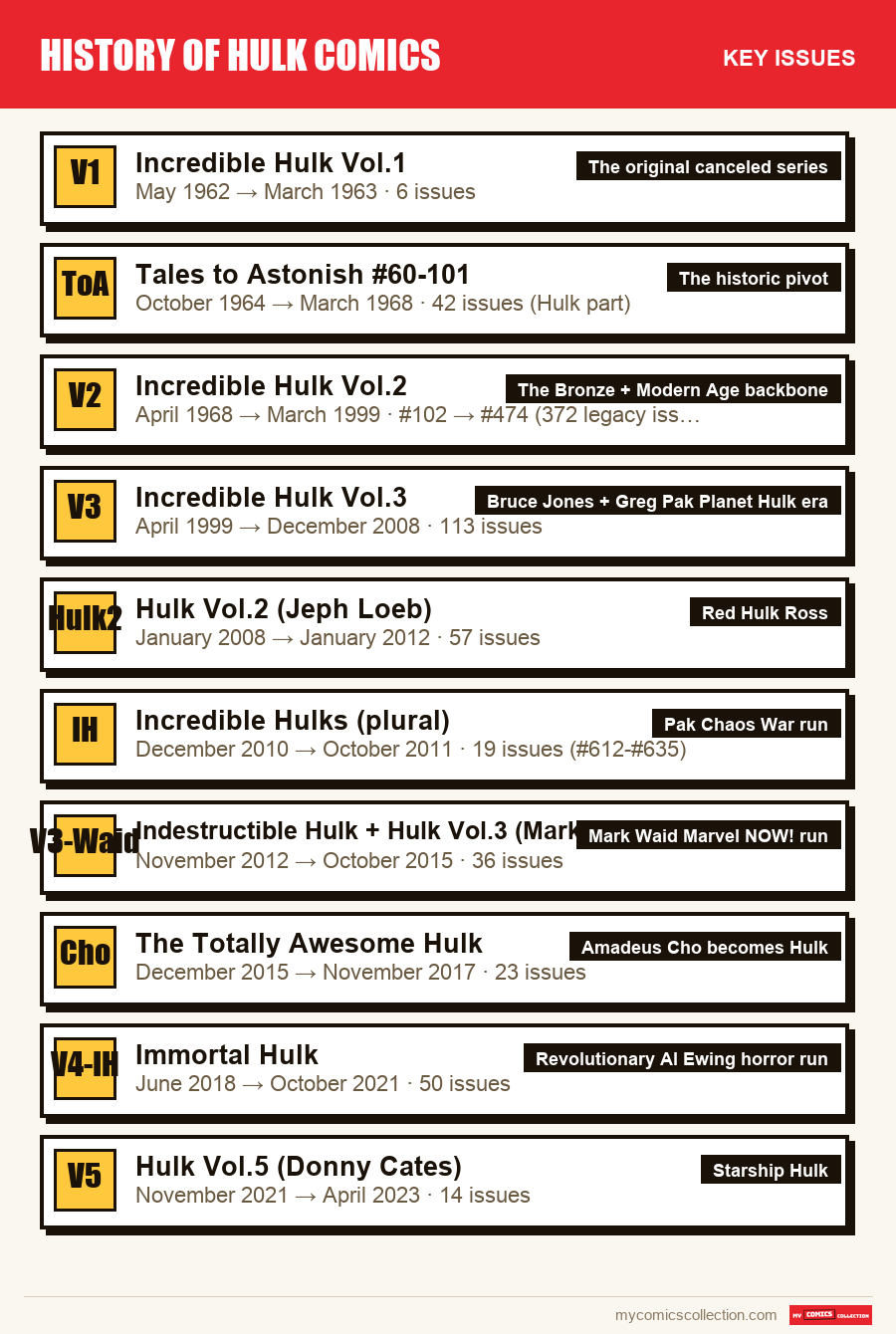
Here are the five main volumes of the solo Hulk series (under its various titles) in chronological order:
Incredible Hulk Vol.1
The founding volume by Stan Lee and Jack Kirby. Only six issues, but with exceptional historical density: #1 (May 1962, 1st appearance gray Hulk, Bruce Banner, Rick Jones, General Thunderbolt Ross, Betty Ross), #2 (1st appearance green Hulk, 1st appearance The Toad Men), #3 (1st appearance Ringmaster), #4 (Banner-Hulk morning transformations), #5 (Tyrannus, Mongu), #6 (March 1963, last issue Vol.1, 1st appearance Teen Brigade, last issue with Stan Lee/Kirby together on Hulk before a long hiatus). Canceled by Marvel due to insufficient sales.
Tales to Astonish #60-101
The rescue series. Hulk starts in a backup story in #60, sharing space with Giant-Man (then Sub-Mariner from #70 onward). Issue after issue, Hulk gains pages and popularity. Major turning points: #62 (1st appearance The Leader, signature villain), #90 (1st appearance Abomination, monstrous nemesis), #93-94 (1st appearance The Inhumans in a non-FF series, an important link for the Marvel Universe), #101 (March 1968, last issue before the legacy title resumes). This series is essential for understanding Silver Age Hulk and his earliest antagonists.
Incredible Hulk Vol.2
The cardinal Hulk volume. 372 uninterrupted issues, spanning Bronze Age, Copper Age and Modern Age. Picks up legacy numbering (#102 = continuity from Tales to Astonish #101). Major turning points: #180-181 (Oct-Nov 1974, cameo + 1st full appearance Wolverine, the most valuable Hulk issue after #1), #271 (1st appearance Rocket Raccoon), #324 (1st Red She-Hulk), #340 (Hulk vs Wolverine McFarlane cult cover), #377 (1st appearance Professor Hulk by Peter David), #393 (anniversary issue with foil cover), #474 (final issue March 1999). Major run: Peter David (#330-467, 1987-1998), 12 years on the title, considered the cornerstone of modern Hulk.
Incredible Hulk Vol.3
Reboot with a fresh #1 numbering. First run by John Byrne and Erik Larsen (#1-12), followed by Paul Jenkins. The turning point comes with Bruce Jones (#34-76), who puts the character back on the run in a paranoid "Six Million Dollar Man " comics-style. Then Greg Pak arrives with the mega-arc Planet Hulk (#92-105, 2006), exiling Hulk to the planet Sakaar: one of the most striking arcs of the 21st century, which would inspire Thor: Ragnarok (2017). The volume ends with the World War Hulk crossover (a separate mini-series but directly tied in).
Hulk Vol.2 (Jeph Loeb)
Parallel volume that starts at #1 under the simplified title Hulk . Run by Jeph Loeb (#1-24), then Jeff Parker. The major innovation: introduction of the Red Hulk, whose identity remains a mystery for two years before the reveal that he's General Thaddeus "Thunderbolt" Ross, Banner's longtime enemy, who has become the very monster he spent his life chasing. A divisive run (Loeb heavily criticized for his pop approach), but a commercial juggernaut with Ed McGuinness's designs.
Incredible Hulks (plural)
Resumes Vol.2 legacy numbering (#612-635). Greg Pak wraps up his Hulk-family saga with Skaar, Hiro-Kala, Lyra, and the Chaos War storyline. A short but important volume to close out the Pak decade.
Indestructible Hulk + Hulk Vol.3 (Mark Waid)
Launched under Marvel NOW! as Indestructible Hulk #1-20 (Mark Waid / Leinil Yu), then renamed Hulk Vol.3 #1-16 (2014-2015). A fresh approach: Banner becomes a SHIELD scientific consultant, Hulk his official weapon. Major Original Sin crossover with Iron Man (the reveal that Stark contributed to Banner's gamma accident).
The Totally Awesome Hulk
Post-Civil War II spin-off in which Bruce Banner dies (Civil War II #3, killed by Hawkeye) and Amadeus Cho, young Korean-American genius (7th smartest brain on the planet), takes on the gamma curse. Run by Greg Pak (returning to the title) and Frank Cho . Renamed The Incredible Hulk at #15, then merged with other titles in 2017.
Immortal Hulk
The most acclaimed Hulk run since Peter David. Al Ewing and Joe Bennett reinvent the character as gothic horror: Banner resurrects every night as Hulk, metaphysical descent into the Below-Place, psychiatric exploration of dissociation, return of every historical character (Leader, Abomination, General Ross). 50 issues of exceptional narrative coherence, steadily rising print runs, near-unanimous critical acclaim. A complete reboot of Hulk mythology for the 2020s.
Hulk Vol.5 (Donny Cates)
Run by Donny Cates and Ryan Ottley. Concept: Banner pilots Hulk like a living spaceship via a mental console. Major Banner of War crossover with Thor (2022). The run was cut short by Cates's accident and finished by other writers.
Incredible Hulk Vol.4 (PKJ)
Ongoing run by Phillip Kennedy Johnson and Nic Klein. Picks up Vol.4 numbering (the fourth series to bear this title). Folk-horror tone: Banner and Hulk travel through a gothic America populated by forgotten gods. Story still ongoing in 2026, with a much-anticipated Hulk vs Gods arc.
The parallel Hulk series in chronological order
Alongside the main Hulk series, Marvel has published many spin-off titles exploring the gamma galaxy. Here's the chronology of the main parallel titles:
- The Rampaging Hulk (1977-1981, 27 issues): black-and-white magazine, European format, out-of-continuity stories.
- Hulk! Magazine (1978-1981, 27 issues): follow-up to the previous title, integrating the Bill Bixby TV show.
- Marvel Comics Presents Hulk (1988+ anthologies): parallel stories in the Marvel anthology series.
- Hulk: Future Imperfect (1992, 2 issues): Peter David / George Pérez maxi-series introducing Maestro, future dystopian tyrant Hulk. Considered one of the best Hulk stories of all time.
- Bruce Banner (Hulk temporarily renamed Vol.2 #468-474, 1998-1999): final Vol.2 issues under this title, John Byrne run.
- Hulk: Gray (2003, 6 issues): Jeph Loeb / Tim Sale maxi-series, lyrical retelling of the origins in the original gray color. Companion piece to Spider-Man: Blue, Daredevil: Yellow and Captain America: White.
- She-Hulk Vol.1-3 (1980-2018+, several hundred cumulative issues): the cousin Jennifer Walters, created in Savage She-Hulk #1 (1980) by Stan Lee and John Buscema. See cult runs by John Byrne (1989-1994) and Dan Slott (2004-2007).
- Hulk: Destruction (2005, 4 issues): Peter David, bridge mini-series.
- Skaar: Son of Hulk (2008-2009, 17 issues): Greg Pak develops Hulk's Sakaar offspring. Skaar will become a recurring character.
- World War Hulks (2010, 6 issues + tie-ins): Jeff Parker crossover, conclusion of the Red Hulk arc.
- Fall of the Hulks (2009-2010, multiple minis): Jeph Loeb event leading into World War Hulks.
- Red Hulk (2008-2012, multiple mini-series): ongoing parallel to Hulk Vol.2 Loeb.
- Hulk and the Agents of S.M.A.S.H. (2013-2015, 12 issues): tie-in to the Disney XD animated series.
- Old Man Logan (Wolverine #66-72, 2008): central Hulk-family element: Bruce Banner Sr. is the breeding tyrant, his descendants the "Hulk Gang" massacre the X-Men. Mark Millar / Steve McNiven.
- Maestro (2020-2022, 3 mini-series): Peter David returns to Maestro, the future tyrant Hulk of Future Imperfect, and tells his fall in a trilogy.
- Hulk: Grand Design (2022, 2 issues): Jim Rugg condenses 60 years of Hulk mythology into two issues, a model of synthesis.
- The Immortal She-Hulk , The Immortal Hulks and Gamma Flight (2021): post-Immortal Hulk tie-ins.
- Avengers: World War She-Hulk (2024): recent crossover with Jen Walters.
Hulk key issues in chronological order
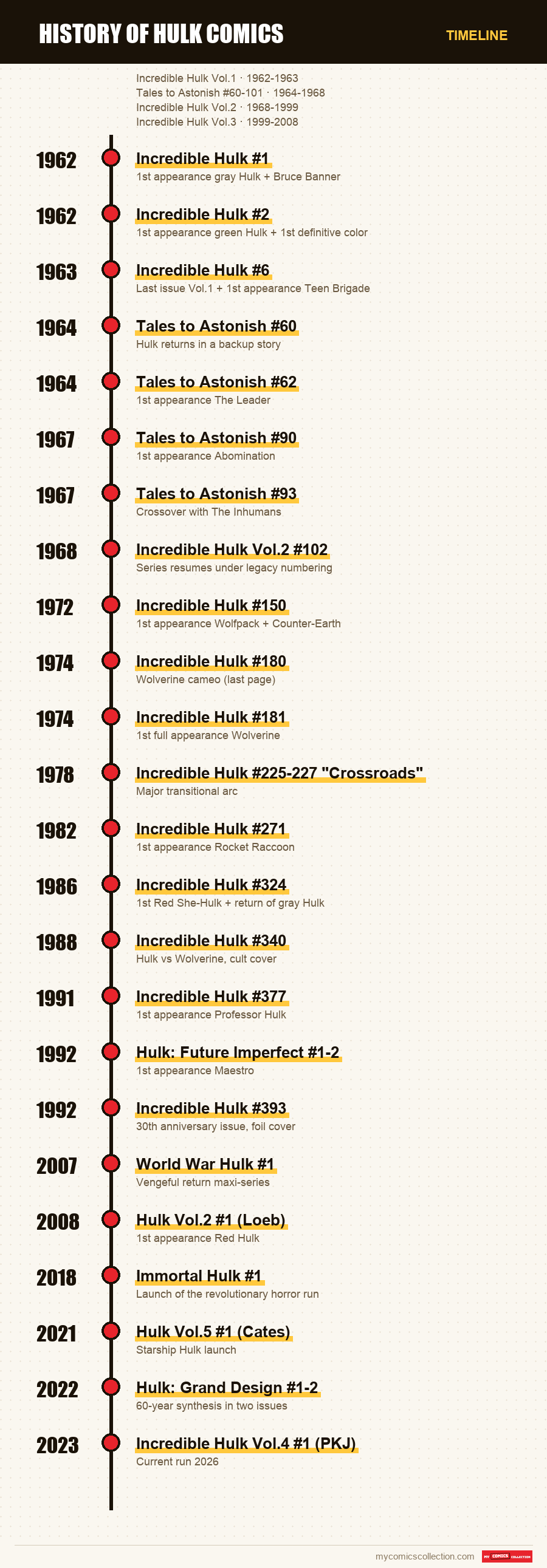
Here are the most important issues to know in chronological order:
Incredible Hulk #1
The founding issue. 1st appearance of Hulk (in original gray color), Bruce Banner , Rick Jones , General Thaddeus Ross , and Betty Ross. Iconic Jack Kirby cover. A CGC 9.4 copy sold for $490,000 in 2022. Top 15 most expensive Silver Age comics. Gray color corrected to green starting with #2 due to a printing incident.
Incredible Hulk #2
First appearance of Hulk in green, the color that will remain the character's visual signature for the next 60+ years. Also 1st appearance of the Toad Men, the first alien antagonists. A heavily demanded issue thanks to its dual historical status.
Incredible Hulk #6
Final issue of Vol.1, the last one before cancellation. 1st appearance of the Teen Brigade led by Rick Jones, a group of young radio amateurs who'll play a key role in Avengers #1 (September 1963). Steve Ditko ends his short stint on Hulk to focus on Spider-Man.
Tales to Astonish #60
The rescue issue. Hulk goes back into action in a backup story in Tales to Astonish, sharing the title with Giant-Man. Steve Ditko on art. A historically pivotal issue, proving the character still had an audience when given a chance.
Tales to Astonish #62
First appearance of The Leader (Samuel Sterns), Hulk's intellectual nemesis. A genius hyper-developed by gamma rays, the cerebral antithesis of the monster's brute force. One of Hulk's two most iconic villains alongside Abomination. Adapted in the Hulk MCU film 2008 (Tim Blake Nelson) and Captain America: Brave New World (2025).
Tales to Astonish #90
First appearance of Emil Blonsky / Abomination, a Soviet spy turned into a gamma monster even more powerful than Hulk. One of the most iconic antagonists. Adapted in The Incredible Hulk (2008, Tim Roth) and She-Hulk: Attorney at Law (2022).
Tales to Astonish #93
Major appearance of the Inhumans (Black Bolt, Medusa, Karnak, Crystal, Gorgon, Triton) outside Fantastic Four. Hulk vs Inhumans confrontation in the Great Refuge. Marie Severin signs the artwork: one of the rare female Marvel artists of the 1960s.
Incredible Hulk Vol.2 #102
The official resurrection issue. Tales to Astonish is renamed Incredible Hulk, picking up legacy numbering at #102 (Tales to Astonish #101 + 1). A pivotal issue marking the start of Vol.2, the series that will run for 372 issues until 1999.
Incredible Hulk #150
Double-sized anniversary issue with adventures on Counter-Earth (the counter-world created by High Evolutionary). First major appearance of Herb Trimpe at his peak: the artist who'll graphically define Hulk throughout the 70s.
Incredible Hulk #180
The most famous cameo in comics history. Wolverine appears for the first time in a cameo on the last page (cliffhanger), created by Len Wein and John Romita Sr. (design). Extremely sought-after issue. CGC 9.8 estimated between $8,000 and $12,000 in 2026. See our dedicated guide How much is Hulk #1 worth.
Incredible Hulk #181
The most valuable Hulk issue after #1. First full appearance of Wolverine, the Canadian agent sent against Hulk by the government. Created by Len Wein, Herb Trimpe and John Romita Sr. A few months later, Wolverine will join the X-Men and become Marvel's most profitable character. CGC 9.8 estimated between $80,000 and $120,000 in 2026, with record sales exceeding $250,000 for exceptional copies.
Incredible Hulk #225-227 "Crossroads"
Original Crossroads arc, in which Hulk crosses parallel dimensions. The concept was reused and expanded later in the Bill Mantlo run (#300+), which would exile Hulk to the Crossroads of Eternity.
Incredible Hulk #271
First appearance of Rocket Raccoon, future Guardian of the Galaxy. Character created by Bill Mantlo as a reference to the Beatles' "Rocky Raccoon." A heavily demanded issue since the MCU success of the Guardians (2014).
Incredible Hulk #324
A pivotal issue marking the return of the gray Hulk (later renamed "Mr. Fixit") and a prototype appearance of Red She-Hulk. The start of Peter David taking over for what will be a long, lasting tenure.
Incredible Hulk #340
One of the most iconic covers of the 80s, signed by Todd McFarlane: Wolverine reflected in Hulk's rage. A legendary fight, visually revisited. A heavily collected issue for the cover alone.
Incredible Hulk #377
Peter David's creation of the Professor Hulk: a psychological fusion of Bruce Banner (intelligence), Joe Fixit (the cynical gray Hulk) and Savage Hulk (the primal green monster). A revolutionary concept that will be adapted in Avengers: Endgame (2019). One of the most heavily collected Peter David issues.
Hulk: Future Imperfect #1-2
Two-issue maxi-series introducing Maestro, a future tyrant Hulk who has ruled a post-apocalyptic world for a century. A work considered one of the best Hulk stories ever written. Pérez on art, the peak of the Copper Age.
Incredible Hulk #393
Issue celebrating Hulk's 30th anniversary with a special green foil cover. Climax of the Peter David / Dale Keown run. Heavily collected in variant covers.
Planet Hulk arc (Vol.3 #92-105)
The Greg Pak arc that exiles Hulk to the planet Sakaar (gladiator in the arena, leader of the oppressed, husband to Caiera). 14 issues of space-opera epic. Adapted in Thor: Ragnarok (2017). See our dedicated guide Planet Hulk + WWH key issues.
World War Hulk #1
Direct sequel to Planet Hulk. Hulk returns to Earth to destroy the Illuminati responsible for his exile. A 5-issue maxi-series that culminates in a Marvel blockbuster. JRJR on art. Highly demanded in variants.
Hulk Vol.2 #1 (Loeb)
Launch of the new Hulk volume. First appearance of the Red Hulk, whose identity remains a mystery for 23 issues (reveal: Thunderbolt Ross). Iconic red-on-red Ed McGuinness cover.
Immortal Hulk #1
The kickoff of the Al Ewing run, one of the most acclaimed of the decade. Horror reinvention of Hulk in seven distinct psychic forms. 50 issues of exceptional narrative coherence. Highly collected first issue, with many variants.
Hulk Vol.5 #1 (Cates)
Launch of the Cates / Ottley run. "Starship Hulk" concept: Banner controls Hulk from a mental console. The run was cut short following Cates's accident in 2022.
Incredible Hulk Vol.4 #1 (PKJ)
Launch of the current run. Folk-horror tone, Banner and Hulk traveling through a gothic America inhabited by forgotten gods. Variant covers heavily sought after by modern collectors in 2026.
Hulk: Grand Design #1-2
The ultimate condensation. Jim Rugg sums up 60 years of Hulk continuity in two chronological issues. A reference work for understanding the character's overall narrative arc. A unique format in the Marvel catalog.
The major Hulk story arcs in order
Crossroads (1985)
Bill Mantlo exiles Hulk to the Crossroads of Eternity. A cosmic dimensional arc.
Mr. Fixit (1987-1988)
The gray Hulk becomes a Las Vegas gangster under the name Joe Fixit. A cult Peter David run.
Future Imperfect (1992)
Peter David / Pérez. Maestro, a post-apocalyptic tyrant Hulk. Cult maxi-series.
Heroes Reborn / Heroes Return (1996-1999)
Marvel reboots its characters in parallel universes. Hulk relaunched in Vol.3 (1999).
Banner (2001)
Brian Azzarello / Richard Corben maxi-series. Hulk on the run, dark adult tone.
Bruce Jones run (2002-2005)
Hulk on the paranoid run, hunted by a Conspirator. 43 issues.
Planet Hulk (2006-2007)
Greg Pak exiles Hulk to Sakaar. Gladiator, leader, husband. Adapted in Thor Ragnarok.
World War Hulk (2007)
Hulk returns to Earth to take revenge on the Illuminati. 5-issue maxi-series + tie-ins.
Fall of the Hulks (2009-2010)
Jeph Loeb. Intelligencia conspiracy (Leader, MODOK, etc.) against all Hulks.
World War Hulks (2010)
Jeff Parker. Sequel to Fall of the Hulks, global gamma war.
Indestructible Hulk (2012-2014)
Mark Waid. Banner becomes a SHIELD consultant, Hulk his official weapon.
Original Sin: Bruce Banner (2014)
Jason Aaron. Reveal that Tony Stark contributed to the gamma accident.
Civil War II: Hulk death (2016)
Hawkeye preemptively kills Bruce Banner. Cho becomes Totally Awesome Hulk.
Immortal Hulk (2018-2021)
Al Ewing / Joe Bennett. 50-issue gothic horror run, the most acclaimed.
Smashtronaut / Starship Hulk (2021-2022)
Donny Cates. Banner pilots Hulk from a mental console.
Banner of War (2022)
Cates + Aaron. Major Hulk vs Thor crossover, dual series.
Hulk: Grand Design (2022)
Jim Rugg condenses 60 years of continuity into 2 issues.
Incredible Hulk vs Gods (2023-2026)
Phillip Kennedy Johnson. Banner and Hulk face the forgotten folk gods of America.
How to start a Hulk collection in 2026
Set a clear goal
"All of Hulk" is unreachable (1,000+ legacy issues + parallel series). "The Peter David Vol.2 #330-467 run" or "complete Immortal Hulk #1-50" are excellent structuring goals. Another approach: target only the key issues #1, #2, #181, #271, #340, #377.
Import the catalog into My Comics Collection
With My Comics Collection, import Incredible Hulk Vol.1, Tales to Astonish, Vol.2 (372 issues), Vol.3, Hulk Vol.2 Loeb, Indestructible Hulk, Totally Awesome Hulk, Immortal Hulk, Hulk Vol.5 and Vol.4 PKJ. Each volume is identified separately to avoid numbering confusion.
Prioritize key issues
The 25 key issues listed represent the bulk of the historical value. See our dedicated Hulk top key issues for a focus on key issues + current CGC values.
Organize by run rather than by strict volume
Hulk is best collected by run (Peter David, Bruce Jones, Greg Pak, Mark Waid, Al Ewing, Donny Cates, Phillip Kennedy Johnson) rather than by strict chronological numbering. It gives narrative meaning to the reading and makes valuation easier.
Watch Hulk #181 prices
Hulk #181 (1st full Wolverine) is the main driver of Hulk value in 2026. Its price tracks MCU Wolverine announcements (Deadpool & Wolverine 2024, the announced X-Men reboot). My Comics Collection updates values based on real sales.
Why Hulk is still collected in 2026
Alongside Spider-Man, Wolverine and Iron Man, Hulk remains one of the most active Marvel franchises in collecting in 2026. Several reasons:
- Continuous MCU presence: Mark Ruffalo has played Bruce Banner from The Avengers (2012) through Captain America: Brave New World (2025) and beyond. Hulk is one of the rare characters with a single actor over 12+ years.
- World War Hulk film 2026 announced: Marvel Studios has confirmed an adaptation of the famous crossover, which should boost the values of Vol.3 #92-105 (Planet Hulk) and World War Hulk #1-5.
- Astronomical Hulk #181 CGC prices: the 1st full appearance of Wolverine has seen its value multiplied by 10 in 15 years. A CGC 9.8 is now worth more than $80,000, up from $5,000 in 2010. No sign of a ceiling.
- Cult Immortal Hulk run: unanimous critical praise of the Al Ewing run (2018-2021) draws a new adult audience to the character, creating strong demand for Vol.4-IH variants.
- Hulk #1 Silver Age milestone: alongside Amazing Fantasy #15 and Fantastic Four #1, it's one of the three pillars of Marvel's Silver Age. A must-have symbol for serious collectors.
Biography of Robert Bruce Banner, Ph.D. (Hulk (The Incredible Hulk))
Hulk (The Incredible Hulk) is a character of Marvel Comics created by Stan Lee and Jack Kirby. His first appearance is in Incredible Hulk #1 , published in May 1962.
Identity sheet of Robert Bruce Banner, Ph.D.
- Real name: Robert Bruce Banner, Ph.D.
- Date of birth: May 1962 (creation): fictional: 1959
- Place of birth: Dayton, Ohio, USA
- First appearance : Incredible Hulk #1 (May 1962)
- Creators: Stan Lee (writer) and Jack Kirby (artist)
- Editor: Marvel Comics
- Memberships: Avengers, Defenders, S.H.I.E.L.D., Pantheon, Warbound
Character origins
Bruce Banner, a brilliant nuclear physicist, is exposed to a gamma bomb explosion while trying to save Rick Jones, a teenager who had ventured into the test zone. This exposure to gamma rays transforms him into the Hulk, a monstrous creature of superhuman strength who appears when Banner is angry or stressed. Banner spends his life on the run from the American military and searching for a cure, oscillating between man and monster.
Powers and Abilities
- Almost unlimited strength (proportional to his anger)
- Superhuman endurance and physical resistance
- Accelerated Healing Factor
- Jumps for miles
- Immunity to diseases and toxins
- Eidetic memory (Bruce Banner): engineering in nuclear physics
- Multiple personalities: Savage Hulk, Joe Fixit, Devil Hulk, Doc Green
Costume and visual identity
The Hulk usually wears ripped purple pants (a convenient color for hiding rips). His skin is green (originally gray in Hulk #1, changed for printing reasons). Its stature exceeds 2m40 and it can weigh more than 500 kg.
Build your Hulk collection methodically
Import the 1,000+ Hulk issues + Tales to Astonish + Immortal Hulk + Vol.4 in one click, identify your missing key issues, track real-time eBay values. 7-day free trial.
🚀 Start free 7-day trialGo further
- Hulk Reading Order: Complete Guide to the Best Arcs and Key Issues
- The Best Hulk Comic Book Runs: The Definitive Collector's Ranking
- Best Hulk Story Arcs: Peter David, Planet Hulk, World War Hulk & Immortal Hulk
- Top 10 Hulk Key Issues Every Collector Must Own
- Incredible Hulk #1 (1962): First Appearance of the Hulk, Rarity & Collector Value
- Hulk Collection: Guide to the Key Comics and Their Values
FAQ: History of Hulk
Other comics character histories to discover
Our complete "Comics history" article series covers the 20 biggest Marvel and DC franchises. Each article follows the same format: birth, complete chronology of volumes, parallel series, key issues sorted chronologically, major arcs, and collection method.
→ See all "History" blog articles