
Amazing Spider-Man was born in August 1962 in Amazing Fantasy #15 (Stan Lee & Steve Ditko), then earned its own series in March 1963. More than 60 years later, the franchise spans 6 main volumes , over 900 issues, dozens of parallel series (Spectacular, Web of, Peter Parker, Sensational, Superior, Friendly Neighborhood…) and hundreds of mini-series. This article tells the comic's origin story, gives the full chronology of the series in order, and lists the key issues to know to build a structured collection.
There aren't many characters whose first appearance fits in eleven pages, in a magazine the publisher was about to cancel, who then go on to become the most profitable hero in global pop culture. Amazing Spider-Man is exactly that story, told issue by issue since 1962. The series is the cornerstone of the modern Marvel universe, the playground for the greatest writers (Lee, Ditko, Romita Sr., Conway, Stern, McFarlane, DeMatteis, Straczynski, Slott, Spencer, Wells), and one of the biggest collecting challenges in the world thanks to its six successive volumes, intertwined spin-offs, and sometimes chaotic numbering.
This guide will give you everything you need to understand Spider-Man's origin , follow the list of Amazing Spider-Man comics in order , and identify the key issues and major arcs to prioritize. We'll walk through six decades of the series together, from the 1962 origins all the way to Zeb Wells' current run in 2026, clearly distinguishing volumes, spin-offs, and disguised relaunches. By the end, you'll know exactly where to start a serious collection, which creative team to look for in each era, and how to avoid the classic Marvel numbering pitfalls.
The birth of Amazing Spider-Man: Marvel in 1962
To understand how Amazing Spider-Man came to be, you have to go back to the summer of 1962. Marvel Comics, then still called Atlas Comics, was a second-tier publisher trailing the giant DC Comics. Stan Lee, the in-house editor and writer at the time, had just rebooted the engine with Fantastic Four #1 (November 1961), followed by Hulk #1 (May 1962) and Thor in Journey into Mystery #83 (August 1962). Publisher Martin Goodman was asking for super-heroes to compete with DC's Justice League, which had been a huge hit since 1960.
Stan Lee wanted a different kind of hero: a teenager, not a sidekick. Someone with real problems (money, loneliness, family), not a billionaire or a god. A character with a name inspired by an insect most people find repulsive. Goodman reportedly rejected the idea: legend has it he said people hated spiders, that a teen hero couldn't carry a title, and that the idea of a super-hero with teenage problems was a bad commercial direction.
Amazing Fantasy #15 (August 1962): the calculated bet
Stan Lee got around Goodman's refusal by placing Spider-Man in Amazing Fantasy #15, an anthology magazine that was about to be cancelled. The math was simple: if the issue sold poorly, it didn't matter, the title was disappearing anyway. If it sold well, the publisher couldn't refuse a solo title. Steve Ditko drew it, while Jack Kirby had initially sketched a few pages that were dropped in favor of Ditko's eerier, more angular style: perfectly suited to the dark mood of the story.
Amazing Fantasy #15 came out in August 1962 with an 11-page story: "Spider-Man!". Peter Parker, an orphaned high school student raised by his Uncle Ben and Aunt May in Forest Hills (Queens), is bitten by a radioactive spider during a science demonstration. He develops the spider's powers, designs a costume and a TV-wrestler identity, makes some money, selfishly refuses to stop a fleeing thief, and later learns that same thief killed his Uncle Ben. The legendary line lands in the final panel: "With great power there must also come: great responsibility".
The sales numbers came in a few months later, and they were spectacular. Amazing Fantasy #15 became one of the best-selling issues in Marvel's catalog that year. Goodman caved. The solo Amazing Spider-Man series was announced for spring 1963.
Why "Amazing"? The solo series name deliberately reuses the adjective from the original title (Amazing Fantasy) to capitalize on reader recognition. That editorial choice, originally pure marketing, is now an iconic landmark: "Amazing" became the unofficial prefix for the entire franchise, all the way to the modern 2026 runs.
Amazing Spider-Man #1 (March 1963): the series begins
The first issue of the solo series shipped in March 1963: officially dated March 1963 but on newsstands as early as December 1962, per the practice of the time. Stan Lee wrote, Steve Ditko handled art and character design. The issue contains two stories: Spider-Man (with the Chameleon's first appearance) and Spider-Man vs The Chameleon, plus a chance encounter with the Fantastic Four. For many fans, this is the issue that truly marks the official start of the series.
The first 38 issues (1963-1966) by Lee & Ditko laid every foundation still active in 2026: the gallery of villains (Vulture, Doctor Octopus, Sandman, Lizard, Electro, Mysterio, Kraven, Green Goblin, Scorpion), the high school double life, the relationship with J. Jonah Jameson at the Daily Bugle, the friendly rivalry with Flash Thompson, the first girlfriend Betty Brant. Steve Ditko left Marvel after ASM #38 in July 1966 over deep disagreements with Stan Lee, particularly over the Green Goblin's identity (Ditko didn't want it to be Norman Osborn).
The handoff to John Romita Sr. (1966)
John Romita Sr. took over the art starting with ASM #39 (August 1966). His version of Spider-Man, more glamorous and more "soap opera," redefined the look of the character and of Mary Jane Watson, whose full appearance in ASM #42 ("Face it tiger… you just hit the jackpot!") is one of the most iconic Silver Age panels. Romita Sr. also drew the famous "Spider-Man No More! " cover on ASM #50 (July 1967), Kingpin's first appearance.
The six volumes of Amazing Spider-Man: the complete list in order
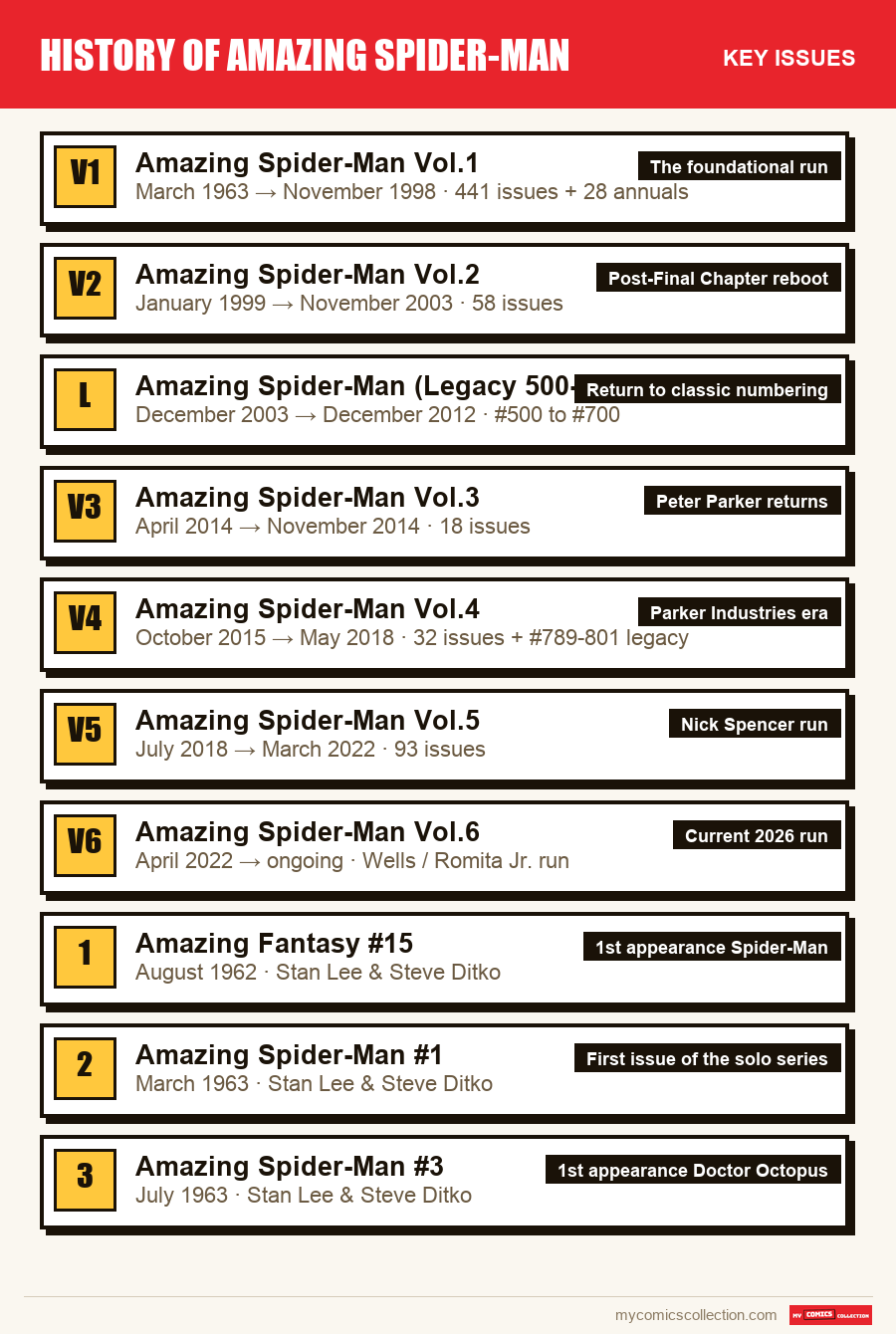
Amazing Spider-Man has gone through six official relaunches since 1963. Understanding these volumes is essential for buying, selling and organizing a collection. Here's the full list with dates, numberings and key creative teams:
Amazing Spider-Man Vol.1
The historic volume. 441 issues published without interruption for 35 years, plus 28 Annuals, Giant-Size issues, Spectaculars, and King-Size issues. This is Marvel's reference series, the one that hosted every major writer: Stan Lee & Steve Ditko (#1-38, 1963-1966), Stan Lee & John Romita Sr. (#39-95, 1966-1971), Gerry Conway & Ross Andru (#96-149, 1971-1975), Marv Wolfman, Roger Stern, Tom DeFalco (#150-250, 1975-1984), Roger Stern & John Romita Jr. (#224-252, 1982-1984), Tom DeFalco & Ron Frenz (#251-285, 1984-1987), David Michelinie & Todd McFarlane (#298-328, 1988-1990), then J.M. DeMatteis, Howard Mackie and John Byrne on the volume's final stretch. The volume ends with #441 in November 1998 with the "Final Chapter" saga, just before the big reboot.
Amazing Spider-Man Vol.2
Launched after the "Final Chapter" saga and Marvel's post-"Heroes Reborn" editorial reboot. The volume kicks off with a new #1 (vol.2) by Howard Mackie and John Byrne, in a monthly format with a dual creative team (alongside Peter Parker, Spider-Man launching simultaneously). Starting with #30 (June 2001) , J. Michael Straczynski takes over the series with John Romita Jr., delivering one of the most memorable modern runs: introduction of Ezekiel Sims, the Spider Totems, Morlun, and the "The Coming of the Ancient One " and " The Conversation" arcs. The volume ends at #58 in November 2003 ahead of a return to legacy numbering.
Amazing Spider-Man (Legacy 500-700)
In December 2003, Marvel decided to "renumber" the series by jumping back to legacy number 500 (which corresponds to Vol.1 #441 + Vol.2 #58 + 1). This accounting trick let them celebrate the symbolic 500th issue and capitalize on the history. The run continues with Straczynski through #545 (One More Day, December 2007), then launches "Brand New Day" with a rotating writer team (Slott, Guggenheim, McKeever, Wells), before Dan Slott's solo run starting with " Big Time" (#648, November 2010). Issue #700 in December 2012 sees Peter Parker's apparent death in his own body and the launch of Superior Spider-Man.
Amazing Spider-Man Vol.3
After the Superior Spider-Man series (Otto Octavius in Peter's body), Dan Slott relaunches Amazing Spider-Man with a new #1 (vol.3) in April 2014. The run includes the "Spider-Verse" crossover (#9-15, November 2014-February 2015), a major event uniting every alternate version of Spider-Man and bringing Spider-Gwen , Silk , Spider-Punk and Spider-Ham into main continuity. The volume ends at #18 in November 2014 (with a #18.1) to make way for the post-Secret Wars reboot.
Amazing Spider-Man Vol.4
Launched in October 2015 after Secret Wars 2015 , Vol.4 by Dan Slott redefines Peter Parker as global CEO of Parker Industries, with offices in San Francisco, London, Shanghai and New York. The run includes "Worldwide ", " Dead No More: The Clone Conspiracy" (the reintroduction of Ben Reilly), and "Go Down Swinging" (Norman Osborn's return as the Red Goblin). The volume uses Vol.4 numbering #1-32 (2015-2017), then switches to legacy numbering #789-801 through May 2018. It marks the end of Slott's run, the longest in the series' history (10 years, more than 200 issues).
Amazing Spider-Man Vol.5
Launched in July 2018 by Nick Spencer and Ryan Ottley, Vol.5 is one of the densest, most cohesive runs in recent memory. Spencer brings back a more grounded Peter Parker, restores the Mary Jane relationship, puts J. Jonah Jameson back front and center, and weaves a 4-year narrative thread around Sins of Norman Osborn, the return of Kindred and Kraven. The run peaks with "Last Remains " and " Spider-Man Beyond ", and wraps at #93 (March 2022): equivalent to #894 in legacy numbering. Even today, it's an excellent entry point for new collectors thanks to its narrative consistency.
Amazing Spider-Man Vol.6
Launched in April 2022 by Zeb Wells and John Romita Jr., Vol.6 is the current run in 2026. Wells brings mystery back to the series with a narrative time jump (Peter and Mary Jane separated without explanation, MJ with two children), introduces new antagonists (Rabin, Tombstone elevated to a major threat), and in 2024 delivers the much-discussed return of Norman Osborn in "Goblin Queen" mode. The run has already passed issue 50 and continues to draw a wide readership. Legacy numbering carries on (#900 hit in June 2023). It's the run to follow right now, both for the content and for the variant covers collectors are chasing.
Every parallel Spider-Man series in chronological order
Alongside Amazing Spider-Man, Marvel has published dozens of parallel series featuring the character. To build a coherent collection, you need to know these titles and whether they tie into ASM (especially for arcs like Kraven's Last Hunt or Maximum Carnage that play out across multiple series). Here's the chronological list of the main Spider-Man series in order of their first issue:
- Marvel Team-Up Vol.1 (March 1972 → February 1985, 150 issues): Spider-Man teams up each month with another Marvel hero. Launched by Roy Thomas, it's the main classic Spider-Man team-up series.
- Giant-Size Spider-Man (July 1974 → July 1975, 6 issues): a quarterly oversized format, with extended team-ups and back-up stories.
- Spectacular Spider-Man Vol.1 (December 1976 → November 1998, 263 issues): the second regular Spider-Man monthly, with notable runs by Bill Mantlo, Roger Stern, Peter David, J.M. DeMatteis and Howard Mackie. Crucial for Kraven's Last Hunt (#131-132).
- Marvel Tales (1966-1994): a reprint series of classic Spider-Man stories (the ASM #1+ at 25¢ for the next generation of readers). A great nostalgic entry point but with no collecting value.
- Web of Spider-Man Vol.1 (April 1985 → July 1995, 129 issues): the third Spider-Man monthly, launched in response to demand. Crucial for Kraven's Last Hunt (#31-32) and Maximum Carnage.
- Spider-Man Vol.1 (August 1990 → May 1998, 98 issues): Todd McFarlane's series, launched as an event, with its #1 selling more than 2.5 million copies (an absolute record at the time, still near the top of the all-time list today).
- Spider-Man Unlimited Vol.1 (1993-1998, 22 issues): a quarterly graphic-novel-format title, important for Maximum Carnage (#1) and Planet of the Symbiotes.
- Spider-Man 2099 Vol.1 (1992-1996, 46 issues): Miguel O'Hara, Spider-Man of the future. A spin-off but a cult favorite, gaining significant value with the release of Across the Spider-Verse.
- Sensational Spider-Man Vol.1 (January 1996 → November 1998, 33 issues): replacement for Web of Spider-Man, important for the Clone Saga (Ben Reilly Spider-Man).
- Peter Parker, Spider-Man Vol.2 (January 1999 → November 2003, 57 issues): the sister series to ASM Vol.2 under Howard Mackie then Paul Jenkins.
- Spectacular Spider-Man Vol.2 (September 2003 → December 2005, 27 issues): "Countdown" run by Paul Jenkins followed by Peter David's "The Hunger".
- Marvel Knights Spider-Man (June 2004 → March 2006, 22 issues): a mature series by Mark Millar then Reginald Hudlin, with the major villains coming back as a team.
- Friendly Neighborhood Spider-Man Vol.1 (December 2005 → December 2007, 24 issues): Peter David / Stuart Moore, follow-up to Peter David's run.
- Avenging Spider-Man (January 2012 → March 2013, 22 issues): modern team-ups after Civil War and Brand New Day.
- Superior Spider-Man Vol.1 (January 2013 → May 2014, 31 issues): Dan Slott's cult series where Otto Octavius takes over Peter Parker's body.
- Amazing Spider-Man & Silk: The Spider(Fly) Effect (2016): a digital-first series, blending continuities.
- Peter Parker, The Spectacular Spider-Man Vol.1 (August 2017 → March 2018, legacy 297-313): Chip Zdarsky, the last run before the Spencer reboot.
- Friendly Neighborhood Spider-Man Vol.2 (March 2019 → January 2020, 13 issues): Tom Taylor, a lighter tone focused on Spider-Man's side missions.
- Non-Stop Spider-Man (March 2021 → April 2022, 5 issues): a pure-action mini-series by Joe Kelly.
- Spine-Tingling Spider-Man (October 2023 → 4 issues): a Halloween horror mini-series by Saladin Ahmed.
- Spectacular Spider-Men (March 2024 → ongoing): a Peter Parker / Miles Morales team-up by Greg Weisman.
On top of that, there are dozens of Annuals (Amazing Spider-Man Annual #1 in 1964 introduces the Sinister Six), One-Shots ( Amazing Spider-Man: Daily Bugle , Spider-Man: Reign , Spider-Man: Life Story ), maxi-series ( Spider-Man: Blue , Spider-Man: Black Cat , Spider-Verse , Spider-Geddon ), and the Ultimate Spider-Man galaxy that forms a complete parallel universe (see our dedicated guide).
Amazing Spider-Man key issues in chronological order
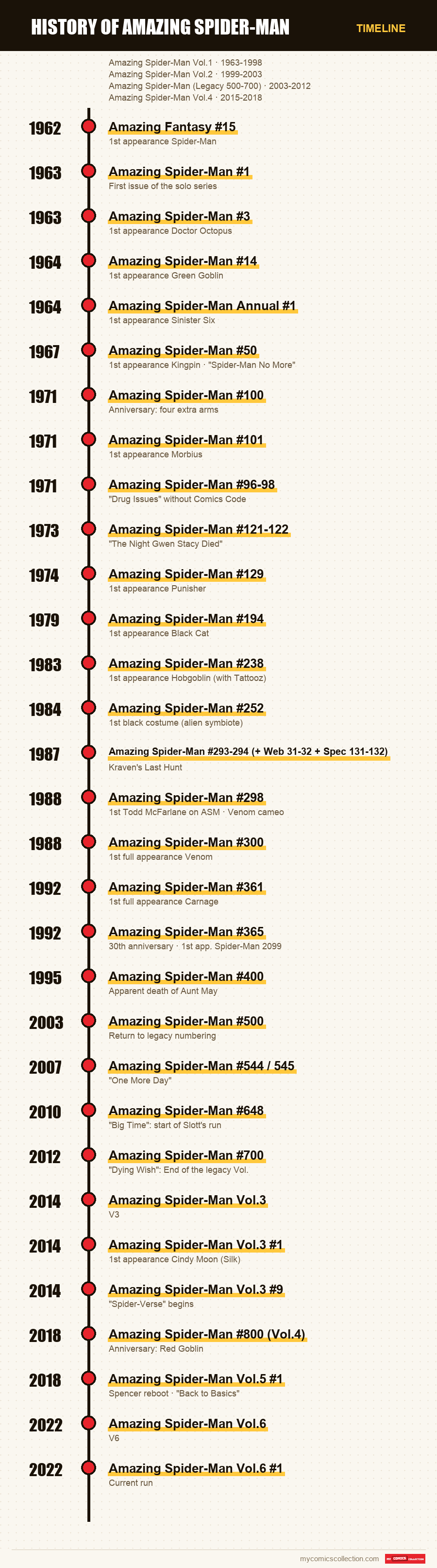
Here's the list of the most important issues to know, in chronological order of publication. This backbone of Amazing Spider-Man lets you grasp the character's evolution without having to read all 900+ issues:
Amazing Fantasy #15
The foundational issue. First appearance of Spider-Man / Peter Parker, Aunt May, Uncle Ben and Flash Thompson. Eleven pages that changed the history of American comics. A CGC 9.6 copy sold for $3.6 million in 2021: the most expensive Marvel comic ever sold at public auction.
Amazing Spider-Man #1
The first official issue of the dedicated series. Introduces the Chameleon, J. Jonah Jameson and the Daily Bugle newsroom. First encounter with the Fantastic Four. The most legendary entry ticket in the entire franchise.
Amazing Spider-Man #3
First appearance of Doctor Otto Octavius, Peter Parker's most enduring archenemy. Otto would go on to become Superior Spider-Man in 2013 and remain a central character right through the modern runs.
Amazing Spider-Man #14
First appearance of the Green Goblin, the future Norman Osborn. The identity wouldn't be revealed until ASM #39 under Romita Sr.'s pencils. Also a Hulk team-up. A major Silver Age key issue.
Amazing Spider-Man Annual #1
The series' first annual, and the first appearance of the legendary Sinister Six (Doctor Octopus, Vulture, Mysterio, Electro, Kraven, Sandman). A 41-page double-size format, the editorial event of 1964.
Amazing Spider-Man #31-33
The peak of the Lee-Ditko collaboration. The famous double-page in ASM #33, where Spider-Man lifts a machine crushing him, is one of the most celebrated images in comic history. First appearance of Gwen Stacy and Harry Osborn in ASM #31.
Amazing Spider-Man #50
Iconic Romita Sr. cover. First appearance of Wilson Fisk / Kingpin, future major Daredevil antagonist. The "Spider-Man No More!" arc across #50-52 marks a psychological turning point for Peter Parker.
Amazing Spider-Man #96-98
Historic trilogy: Marvel publishes these three issues without Comics Code Authority approval at the request of the Department of Health to raise awareness about drugs. These are the issues that brought down the CCA and ushered in the Bronze Age.
Amazing Spider-Man #100
Cult anniversary issue. Peter Parker tries to remove his powers with a potion and ends up with four extra arms. The "double cover" is one of the most reproduced of the Bronze Age.
Amazing Spider-Man #101
First appearance of Morbius the Living Vampire, future hero of his own series. This issue exploded in value in 2022 with the Sony film release.
Amazing Spider-Man #121-122
The arc that pushed the Silver Age into the Bronze Age. The death of Gwen Stacy in #121, followed by the Green Goblin's death in #122, broke the conventions of super-hero comics. Read the detailed analysis of ASM key issues.
Amazing Spider-Man #129
First appearance of Frank Castle / The Punisher. One of the most sought-after Bronze Age key issues. The Punisher would become a pillar of the adult Marvel universe. See our top 10 Punisher.
Amazing Spider-Man #194
First appearance of Felicia Hardy / Black Cat, elite thief and alternate romantic icon for Peter Parker. Her popularity exploded with the Insomniac PlayStation video games.
Amazing Spider-Man #238
First appearance of the Hobgoblin, created to rival the Green Goblin without resurrecting him. A multi-year mystery around his identity. Copies with the intact Tattooz insert command a hefty premium.
Amazing Spider-Man #252
First appearance of Spider-Man's black costume in the main series (following Secret Wars). The costume would later be revealed to be an alien symbiote and give birth to Venom. An iconic homage to the ASM #1 (1963) cover.
Amazing Spider-Man #293-294 (+ Web 31-32 + Spec 131-132)
Considered the best Spider-Man arc ever written. Six parts crossover across three series. Also available in omnibus for those who don't want to chase the six issues separately.
Amazing Spider-Man #298
The first issue of ASM drawn by Todd McFarlane, who revolutionized the series' visual style. The issue also contains the first cameo (hands and silhouette) of Eddie Brock / Venom, just before his full appearance in #300.
Amazing Spider-Man #300
The most iconic modern key issue in the series. First full appearance of Eddie Brock / Venom. 64-page anniversary issue. How much is Amazing Spider-Man #300 worth in 2026?
Amazing Spider-Man #361
First full appearance of Cletus Kasady / Carnage, symbiote offspring of Venom and ultimate serial killer. #360 contains a partial appearance. Highly coveted since the Sony Venom films.
Amazing Spider-Man #365
Giant anniversary issue. Contains the first appearance of Miguel O'Hara / Spider-Man 2099 (preview). Sought-after holographic cover. Launches the Spider-Man 2099 series the same month.
Amazing Spider-Man #400
Double-size issue during the Clone Saga. The emotional death of Aunt May (later retroactively undone). White embossed cover.
Amazing Spider-Man #500
A pivot issue for the franchise: Marvel returns to classic numbering, jumping straight from Vol.2 #58 to #500. Cover by Romita Sr. (a tribute to his artist son). A story closing out a major time-spanning arc.
Amazing Spider-Man #544 / 545
Conclusion of the most controversial arc in the franchise. Peter Parker makes a deal with Mephisto to erase his marriage to Mary Jane and save Aunt May. Launches "Brand New Day" (#546).
Amazing Spider-Man #648
Start of Dan Slott's solo run (10 years, more than 200 issues). Peter joins Horizon Labs, new narrative directions, runs through "Big Time" then "Spider-Island", "Ends of the Earth", "Dying Wish".
Amazing Spider-Man #700
Shock conclusion: Peter Parker apparently dies in Doc Ock's body. Launches Superior Spider-Man. Rare variant cover in high demand.
Amazing Spider-Man Vol.3 #1
Peter Parker returns to his own body. First appearance of Silk / Cindy Moon, bitten by the same spider as Peter. Essential issue for the new Spider-Verse characters.
Amazing Spider-Man Vol.3 #9
Launch of the Spider-Verse crossover that brings every alternate Spider-Man into the main continuity. Introduces the "Web of Life and Destiny" concept and the hunt by Morlun and the Inheritors.
Amazing Spider-Man #800 (Vol.4)
Giant anniversary issue and end of the "Go Down Swinging" arc. Norman Osborn merges with the Carnage symbiote to become Red Goblin. A major turning point in Slott's run. Marvel's biggest issue of 2018.
Amazing Spider-Man Vol.5 #1
A fresh start with a more grounded Peter Parker, Mary Jane back, and the beginning of a 4-year narrative arc. The first issue of a 93-issue run that would peak in "Sins of Norman Osborn" and "Last Remains".
Amazing Spider-Man Vol.6 #1
Launch of Vol.6 and the current run. Peter Parker isolated, Mary Jane gone, a major narrative mystery. Variant covers in high demand from modern collectors (1:25, 1:50, 1:100).
The major Amazing Spider-Man story arcs in order
Beyond individual issues, what really makes the franchise rich is the story arcs. Here's the chronological list of the major events you need to know to understand Spider-Man continuity:
Master Planner Trilogy (1965-1966)
The peak of the Lee-Ditko run. Peter has to save Aunt May with a serum, lifts an industrial machine pinning him down, then faces Doc Ock as the Master Planner. The famous double-page in ASM #33 is the stuff of legend.
The Night Gwen Stacy Died (1973)
The arc that broke the rules of comics. Death of Gwen Stacy at the hands of the Green Goblin. Death of Norman Osborn (who would return decades later). The Bronze Age really starts here.
The Original Clone Saga (1975)
The first clone saga, written by Conway. Introduces Ben Reilly avant la lettre (under his clone name). Would later serve as the basis for the big 1990s Clone Saga.
Secret Wars 1984 (Black costume)
A Marvel out-of-series crossover. Spider-Man brings the black costume back from Battleworld. Revealed to be an alien symbiote in ASM #258, and later the origin of Venom.
The Death of Jean DeWolff (1985)
Peter David's arc in Spectacular Spider-Man. The death of cop Jean DeWolff at the hands of the Sin-Eater. An adult turning point in the franchise, foreshadowing Kraven's Last Hunt.
Kraven's Last Hunt (1987)
The best Spider-Man arc ever written, according to reader polls. Kraven the Hunter buries Spider-Man alive, takes his identity and ends his own life. Six parts across three series.
Venom Saga (1988)
Venom's full appearance in ASM #300. Eddie Brock becomes the major antagonist of the 1990s. Launches the entire symbiote galaxy.
Maximum Carnage (1993)
A 14-part crossover across all the Spider-Man series. Carnage and his crew terrorize New York. Spider-Man and Venom have to team up. A massive marketing event.
The Clone Saga (1994-1996)
The longest and most controversial arc. Ben Reilly returns, doubt creeps in over which Peter Parker is the real one. An editorial saga that stretches over 2 years and 100+ issues.
The Coming of the Ancient One (2001-2002)
Straczynski run. Introduces Ezekiel Sims, the Spider Totems and Morlun. The first time a "magical" origin for Spider-Man is suggested rather than a purely scientific one.
Civil War (2006-2007)
Major tie-ins in ASM. Peter Parker publicly reveals his identity (#533). Picks the Iron Man side, then switches. Consequences echo across the franchise all the way to One More Day.
Back in Black (2007)
Sequel to Civil War. Aunt May is dying after a Kingpin attack. Peter goes back to the black costume to avenge her. Sets up the deal with Mephisto.
One More Day (2007)
A deal with Mephisto to save Aunt May. Peter and Mary Jane's marriage is erased from continuity. The most controversial arc in the franchise.
Brand New Day (2008-2010)
Status quo reset: Peter single, secret identity restored, return to a thrice-monthly format with a rotating writer team.
Spider-Island (2011)
Every Manhattan resident develops spider powers. A major Slott / Ramos crossover that includes every New York hero.
Dying Wish & Superior Spider-Man (2012-2014)
Doc Ock swaps his dying body with Peter Parker's. ASM #700 wraps the saga. Launches Superior Spider-Man for 31 issues, one of the boldest runs Marvel has ever published.
Spider-Verse (2014-2015)
Every alternate Spider-Man brought together against Morlun and the Inheritors. Introduces Spider-Gwen, Silk, Spider-Punk, Spider-Ham. The first Spider multiverse crossover.
Dead No More: The Clone Conspiracy (2016-2017)
Return of Ben Reilly and Doctor Octopus. Slott modernizes the Clone Saga with a large-scale story. Every iconic dead character comes back (Gwen Stacy included).
Go Down Swinging (2018)
The climax of Slott's run. Norman Osborn merges with the Carnage symbiote to become Red Goblin. The conclusion of 10 years of storytelling. Anniversary issue #800.
Sins of Norman Osborn (2020-2021)
Spencer run. Return of Kindred and Norman Osborn. Revelations about the Mephisto deal and "One More Day". One of the densest arcs in Vol.5.
Beyond (2021-2022)
Ben Reilly becomes Spider-Man again, sponsored by the Beyond Corporation. Peter Parker is recovering from "Last Remains". A run shared between Kelly Thompson, Cody Ziglar and others.
Dark Web (2022-2023)
An X-Men / Spider-Man crossover. Madelyne Pryor and Ben Reilly team up as demon-clones. Tie-ins in ASM Vol.6 #15-19.
Gang War & Goblin Queen (2024-2025)
Zeb Wells' current run. A New York gang war (Tombstone, Hammerhead, Madame Masque), the return of Norman Osborn as Goblin Queen, and a mystery around Mary Jane and her children.
How to start an Amazing Spider-Man collection in 2026
Faced with 60+ years of history, six main volumes, more than 900 issues, and around thirty parallel series, starting an Amazing Spider-Man collection can feel dizzying. Here's the five-step method I recommend, whether you're starting with €100 or €10,000:
Set a clear goal
"I want to collect everything Spider-Man" is a bad goal. "I want to complete the McFarlane run #298-328" or "I want all the Annuals 1964-1979" or "I want the 30 key issues from this article" are excellent goals. The more specific it is, the faster the collection will progress and the more coherent it'll be at resale.
Import the catalog into My Comics Collection
With My Comics Collection, import the entire Amazing Spider-Man Vol.1, Vol.2, Vol.3, Vol.4, Vol.5 and Vol.6 runs in two clicks (plus all the spin-off series). Each issue is uniquely identified, annuals and variant covers are managed separately. No more confusion between the "ASM #1"s of 1963, 1999, 2014 or 2022.
Mark owned vs missing issues
The most time-consuming step but the most freeing. Once your catalog is marked, the app shows in one click the exact list of your missing issues, sorted by run and priority. Ideal for conventions and eBay bulk lots.
Prioritize key issues over filler
The 30 key issues listed above represent 80% of the historical and financial value of your collection. Before buying ASM #234 or ASM #587, secure ASM #129, #252, #300, #361 and the annuals first. The 80/20 rule applies perfectly here.
Track value over time
Amazing Spider-Man valuations move constantly based on Marvel Studios, Sony, and Disney+ announcements. ASM #101 tripled in 2022 with the Morbius film, ASM #361 stays sensitive to Carnage announcements. My Comics Collection updates values based on real eBay sales, so you can make informed decisions.
Budget tip: For €500, you can build a credible Spider-Man "showcase collection": an ASM #300 in good ungraded condition (~€250), an ASM #252 (~€80), an ASM #129 reader copy (~€120), plus a few Spencer Vol.5 issues (~€50). That covers the most iconic key issues without going into debt. The Stan Lee/Ditko run remains out of reach for most, but that's exactly what makes it desirable.
Why Amazing Spider-Man is still the most collected series in 2026
More than sixty years after Amazing Fantasy #15, Amazing Spider-Man is still number one in monthly Marvel sales, number one in top-tier comic auctions, and number one in "comics collection" Google searches. Why? Because Spider-Man is the only super-hero who simultaneously combines:
- A relatable hero who has to pay rent, juggle a crappy job and bomb his exams, where Batman has a fortune and Superman has god-like powers.
- A massive villain pantheon (more than 70 recurring antagonists) that only Batman can rival.
- A permanent media presence thanks to the Tobey Maguire, Andrew Garfield, Tom Holland films, Spider-Man: Into the Spider-Verse, Across the Spider-Verse, Spider-Man PS4/PS5 (Insomniac), the Disney+ animated series, and the cyclical return of characters in the MCU.
- A collecting complexity that's part of its charm: six volumes, annuals, variant covers, spin-offs, crossovers. Completing a Spider-Man run is a lifetime project.
That's also why Amazing Spider-Man is our most-consulted series in My Comics Collection. Whether you're a beginner trying to structure a young collection, an intermediate collector aiming to complete a volume, or an expert looking to value a Silver Age inheritance, the app gives you the tools to move forward methodically.
Biography of Peter Benjamin Parker (Amazing Spider-Man (Peter Parker))
Amazing Spider-Man (Peter Parker) is created by Stan Lee and Steve Ditko and published by Marvel Comics. His first appearance is in Amazing Fantasy #15 in August 1962.
Identity sheet
- Full name:Peter Benjamin Parker
- Date of birth: August 1962 (creation): fictional: around 1963
- Place of birth: Forest Hills, Queens, New York, USA
- First appearance : Amazing Fantasy #15 (August 1962)
- Creators: Stan Lee (writer) and Steve Ditko (artist)
- Editor: Marvel Comics
- Memberships: Avengers, Future Foundation, New Avengers, Daily Bugle
Origins
Peter Parker, a young orphaned scientific genius raised by his Uncle Ben and Aunt May, is bitten by a radioactive spider during a science demonstration. Endowed with superhuman powers, he initially decides to use them for show business. But when his Uncle Ben is murdered by a burglar he could have stopped, Peter learns the famous lesson "with great power comes great responsibility" and becomes Spider-Man.
Powers and Abilities
- Strength, agility, speed and endurance proportional to a spider
- Meaning of Spider-Man: instinctive prediction of danger
- Adhesion to surfaces (walls, ceilings)
- Amplified reflexes (20-25 times the human average)
- Scientific genius: designs his web launchers and his formula
- Increased pain endurance and rapid recovery
Costume and visual identity
Red and blue costume with black spider pattern on the chest and back. Full face mask with stylized white eyes. Web shooter on the wrists. Black/white variant (symbiote, 1984-1988). Iron Spider from Iron Man (Civil War, 2006).
Build your Amazing Spider-Man collection methodically
Import the 900+ Amazing Spider-Man issues in one click, identify your missing key issues, track value in real time based on eBay. 7-day free trial.
🚀 Start the 7-day free trialGo further
FAQ: History of Amazing Spider-Man
Other comic character histories to discover
Our complete "Comic history" article series covers the 20 biggest Marvel and DC franchises. Each article follows the same format: birth, full chronology of the volumes, parallel series, key issues sorted chronologically, major arcs and a collecting method.
→ See all "History" articles on the blog