Flash is unique in comics history: he opened two distinct ages . The first Flash, Jay Garrick, was born in January 1940 in Flash Comics #1 , written by Gardner Fox and drawn by Harry Lampert, kicking off the Golden Age craze for superheroes with exotic powers. After the genre collapsed in the late 1940s, the character was completely reinvented in October 1956 with Barry Allen in Showcase #4 , written by Robert Kanigher and drawn by Carmine Infantino: an issue that officially kicked off the Silver Age and relaunched the entire superhero industry. Later, Wally West (Kid Flash who became Flash after Barry's death in 1985) and Bart Allen (Impulse, Barry's grandson from the future) picked up the mantle. This article retraces the dual genesis, walks through the full chronology of the series in order, and lists the key issues you need to know to build a structured collection.
Along with Superman and Batman, Flash belongs to DC Comics' founding pantheon. But where Superman and Batman crossed every age of comics through direct continuity, Flash holds a unique spot: he's the only character whose death and resurrection marked the pivot dates of two distinct ages of the medium. Jay Garrick, the first Flash, is one of the pillars of the Golden Age (1940-1949). His commercial extinction is one of the causes of the superhero genre's collapse in the late 1940s. And it's precisely by relaunching the Flash concept under a new identity, Barry Allen, that DC reignited the spark of the Silver Age in 1956. No other comics character carries that level of documentable historical importance.
This guide gives you everything you need to understand the birth of Flash , follow the complete list of all Flash comics in order , and identify the key issues and major arcs to prioritize. We'll cover the character's 86 years, from Flash Comics #1 (January 1940) to Simon Spurrier's current run in 2026, separating out the main volumes, the parallel ongoings, and the many cult mini-series (Flashpoint, Born to Run, Terminal Velocity, Flash War…). For the most valuable key issues, Showcase #4 in particular, see our dedicated top 10 guide and our Showcase #4 value analysis.
The birth of Flash: 1940 and 1956: the two origins
Understanding Flash means understanding that the character was born twice, sixteen years apart, under two completely different identities but the same code name. This dual birth wasn't an editorial whim: it's an event that defined the entire periodization of American comics.
Jay Garrick (1940): the Golden Age Flash
In the fall of 1939, Action Comics #1 (June 1938) and Detective Comics #27 (May 1939) had proven that the superhero was the new newsstand locomotive. Sheldon Mayer, editor at the All-American Publications imprint (then associated with National Comics, the future DC Comics), asked Gardner Fox: already a prolific writer on Hawkman: to design a hero with a single power, photogenic in action panels. Fox came up with the concept of super-speed: Jay Garrick, a chemistry student at Midwestern University, accidentally inhales heavy water vapors and gains the ability to move at superhuman speeds. Artist Harry Lampert gave him an iconic and unlikely costume: a red T-shirt with a yellow lightning bolt, blue pants, and most importantly a winged metal helmet directly inspired by the Roman god Mercury.
Flash Comics #1 (cover-dated January 1940, on newsstands as early as November 1939) hit the same time as Whiz Comics #1 (Captain Marvel) and a year before Captain America Comics #1. The success was massive: Jay Garrick became one of the bestselling heroes of the Golden Age. He founded the Justice Society of America in All Star Comics #3 (winter 1940), the first superhero team in comics history, alongside Hawkman, Green Lantern (Alan Scott), Atom and Spectre. The Flash Comics series ran 104 issues without interruption (Jan 1940 → Feb 1949), accompanied by the anthology series All-Flash (1941-1948) entirely devoted to the character.
But by the late 1940s, superhero enthusiasm collapsed. Returning veterans, competition from horror, crime and western comics, and reader fatigue brought the Golden Age to an end. Flash Comics #104 (February 1949) is one of the last gems of the Golden Age, and publication stopped cold. Jay Garrick disappeared from newsstands for seven years. DC's editors, being pragmatic, archived the character and moved on to other genres.
Showcase #4, the Silver Age restart (1956)
In 1956, DC tried to relaunch the superhero genre with an unprecedented strategy: rather than resurrecting the old characters as-is, editor Julius Schwartz and his team (Robert Kanigher writing, Carmine Infantino drawing) reinvented the concepts by keeping only the code name and modernizing everything else: origin, civilian identity, costume, tone. They picked Flash as a guinea pig in a pilot anthology title, Showcase, designed to test the commercial viability of various characters before launching solo series.
Showcase #4 (October 1956) introduced Barry Allen, a scientist with the Central City police. Struck by lightning that knocks a shelf of chemicals onto him, Barry gains super-speed and adopts a full red costume with yellow lightning bolts: far more modern and photogenic than Jay's winged helmet. The origin was redrawn with the same logic: science replaces chemical chance, the hero is an adult with a job as a scientist-cop (giving him a built-in narrative frame around investigations), and the costume comes together as a single red block. Carmine Infantino gave the character a dynamic design radically different from the Golden Age, with kinetic effects no one had seen before.
The success was so big that DC launched a solo The Flash series, but with a quirk that has delighted collectors for 70 years: the numbering picked up where Flash Comics had left off at #104 in 1949. The Flash #105 (March 1959) is therefore both the first Silver Age issue of a new series and the legacy continuation of a Golden Age title: one of the first examples of numbered continuity across a character discontinuity. This editorial trick would later be reused for Wonder Woman, Action Comics and Superman during subsequent reboots.
Showcase #4, the issue that opened the Silver Age: historians of the medium unanimously date the Silver Age to October 1956 with the release of Showcase #4. It's the first commercially successful post-Golden Age superhero comic, and it triggered a cascade: the return of DC superheroes (Green Lantern Hal Jordan in 1959, Atom in 1961, Hawkman in 1961) and then the creation of Marvel's superheroes by Stan Lee and Jack Kirby (Fantastic Four in 1961, Hulk and Spider-Man in 1962). Without Showcase #4, no modern Marvel. A CGC 9.4 copy sold for over $600,000 in 2022, and it remains the most valuable Silver Age issue after Amazing Fantasy #15. For detailed pricing, see our Showcase #4 analysis.
The main Flash volumes in order
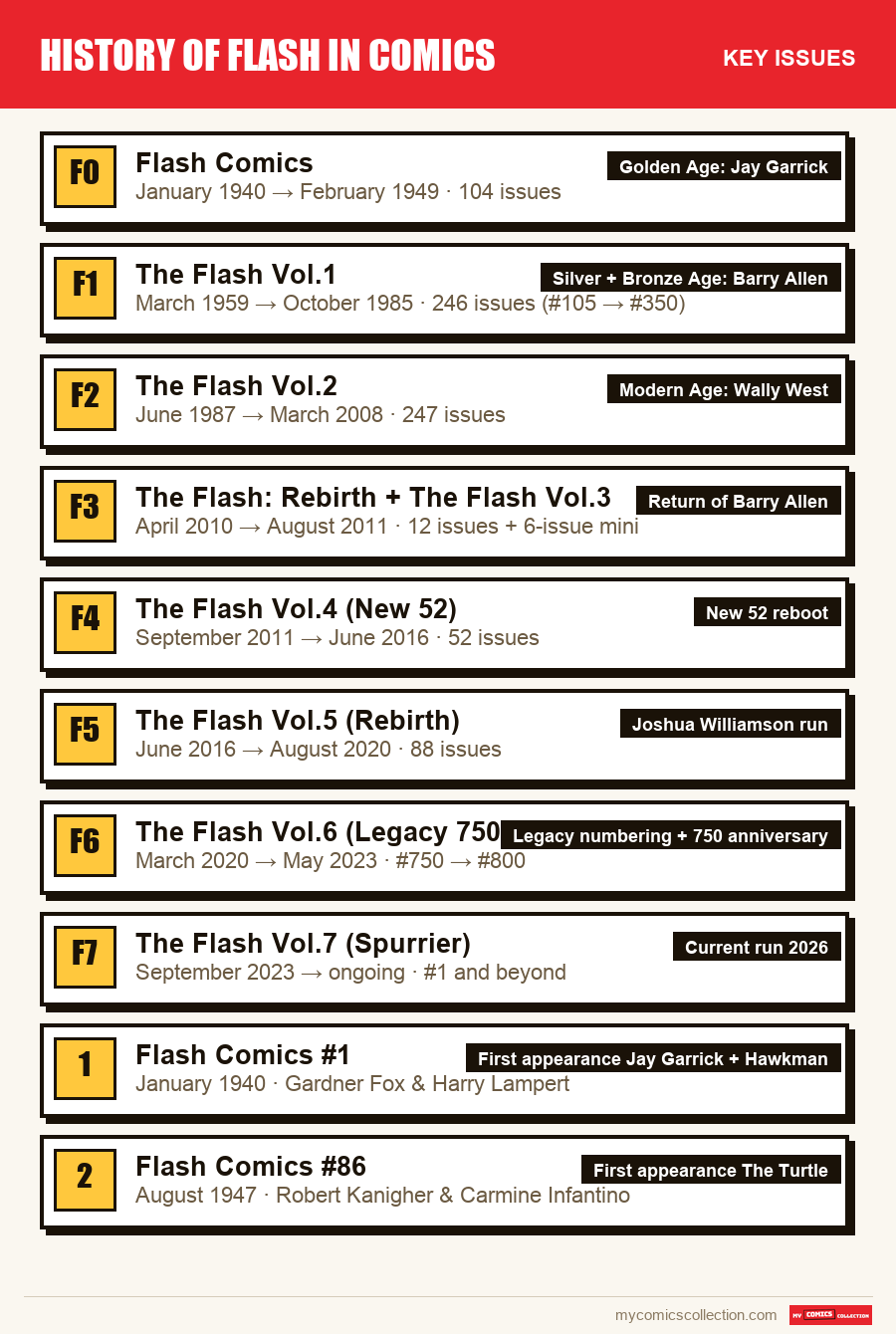
The Flash franchise has seven main volumes and several legacy renumberings. Here are the solo volumes in order of their first issue:
Flash Comics
The matrix series. Flash Comics #1 (Jan 1940) introduces Jay Garrick by Gardner Fox and Harry Lampert. The series runs in anthology format: Flash as the main feature, but also Hawkman (created in the same #1), Johnny Thunder, The Whip, Cliff Cornwall. 104 issues without interruption. It's in Flash Comics #86 (August 1947) that The Turtle appears, Flash's first recurring antagonist and the first "anti-speedster", a concept Reverse-Flash would revisit 20 years later.
The Flash Vol.1
The most important series in Flash history. Launched right after Showcase #4's success, it picks up Flash Comics' legacy numbering: The Flash #105 (March 1959) is technically the character's 105th issue but the 1st of the Silver Age. This numbering continues through #350 (October 1985), spanning 26 years and three ages (Silver, Bronze, early Modern). Major turning points: #105 (1st app. Mirror Master), #110 (1st Kid Flash Wally West + 1st Weather Wizard), #117 (1st Captain Boomerang), #123 ("Flash of Two Worlds," introducing the DC multiverse), #139 (1st Reverse-Flash Eobard Thawne), #155 (1st The Top), #350 (last Barry Allen issue, "The Trial of the Flash" wraps up just before Crisis on Infinite Earths where Barry dies).
The Flash Vol.2
The longest run on Wally West, who became Flash after Barry's death in Crisis on Infinite Earths #8 (1985). Mike Baron launches the series, followed by William Messner-Loebs, then especially Mark Waid (#62-129, 1992-1997) who turns the run into one of the most beloved by fans, and Geoff Johns (#164-225, 2000-2005) who modernizes the Rogues. Turning points: #1 (Wally West official Flash), #62-65 "The Return of Barry Allen" (a fake return orchestrated by Eobard Thawne), #92-94 (1st Bart Allen Impulse), #138 (1st app. Bart Allen Impulse costume), #220-225 "Rogue War." The series ends at #247 with the apparent death of Bart Allen Flash IV.
The Flash: Rebirth + The Flash Vol.3
Geoff Johns brings Barry Allen back in The Flash: Rebirth (6-issue mini-series, 2009-2010), then launches The Flash Vol.3 (April 2010 → August 2011) which only lasts 12 issues before the New 52 reboot. Short but essential: it's Barry's official return after 24 years away (1985-2009) and the prelude to Flashpoint, a major DC event in 2011 that justified the New 52 reboot.
The Flash Vol.4 (New 52)
Complete reboot under the New 52 era, orchestrated by Francis Manapul and Brian Buccellato (#1-25, co-writers and co-artists), followed by Robert Venditti and Van Jensen (#30-52). Younger tone, costume redesign (added white piping). The run popularized Flash visually before the 2014 CW show. Ends at #52 in June 2016.
The Flash Vol.5 (Rebirth)
The Joshua Williamson run is the longest on Barry Allen since Cary Bates in the 1970s. 88 issues of remarkable narrative consistency, including Lightning Strikes Twice (#1-8, return of the Rogues), The Button (Batman crossover, #21-22, prelude to Doomsday Clock), Flash War (#46-50, Wally West vs Barry conflict), Flash Age (#83-88). Williamson stays on the series through #88 before continuing with the legacy numbering.
The Flash Vol.6 (Legacy 750-800)
With DC's Future State event, The Flash returns to its legacy numbering at #750 (March 2020), calculated as Vol.1 (350) + Vol.2 (247) + Vol.3 (12) + Vol.4 (52) + Vol.5 (88) + a commemorative #1. Anniversary issue with stories by Williamson, Geoff Johns, Marv Wolfman, Francis Manapul. Williamson continues through #762, then Jeremy Adams takes over (#763-799). Flash #800 (June 2023) closes the volume with a collective story before the relaunch.
The Flash Vol.7 (Spurrier)
New Vol.1 launched in September 2023 with Si Spurrier (credited as "Simon Spurrier" on covers) writing and Mike Deodato Jr. on art. More experimental and metaphysical tone, exploring the Speed Force as a conscious entity. Wally West is the main Flash, Barry and Bart secondary. Run ongoing in 2026, variant covers in high demand.
All parallel Flash series in order
Alongside the main Flash Comics and The Flash series, DC has published many companion titles. Here's the chronology of the main ones:
- All-Flash (1941-1948, 32 issues): an anthology series entirely devoted to Jay Garrick, published in parallel with Flash Comics. Prestige format with long, complete stories. Considered by Golden Age collectors as one of the genre's most beautiful series.
- Comic Cavalcade (1942-1954, 63 issues): All-American anthology title featuring Flash, Green Lantern (Alan Scott) and Wonder Woman in separate stories. A rare snapshot of the three brands coexisting before the DC merger.
- The Flash 80-Page Giant / 100-Page Super Spectacular (1964, 1971-1976): special issues compiling Silver Age and Golden Age stories: the first accessible reprints of Jay Garrick comics.
- Impulse (1995-2002, 89 issues): solo series for Bart Allen (future Flash IV), Barry Allen's grandson from the future. Mark Waid launches it, Todd Dezago takes over. More humorous and teen-focused tone. Highly collected for the Bart Allen #1 and early issues.
- Flash and Green Lantern: The Brave and the Bold (1999-2000, 6 issues): Mark Waid / Tom Peyer team-up, going back to Silver Age roots with Barry Allen and Hal Jordan as a team.
- Speed Force (1997, one-shot): single issue introducing the concept of the Speed Force, a mystical dimension serving as the source of speedsters' powers, created by Mark Waid. The concept has been central ever since.
- DC Showcase: The Flash (2008-2010, animated shorts and tie-in comics): brief tributes to the character marking Barry Allen's return.
- Flashpoint (2011, 5 issues): a Geoff Johns / Andy Kubert maxi-series serving as the prelude to the New 52 reboot. Barry Allen travels through time to save his mother, creating a dystopian alternate reality. An absolute reference, the basis for the film The Flash (Ezra Miller, 2023).
- Flashpoint Beyond (2022, 6 issues): Geoff Johns revisits Flashpoint, a direct sequel that sets up Justice Society of America Vol.4 and Three Jokers. Considered the official end of "the Geoff Johns era."
- The Flash: Iron Heights (2001, one-shot): Geoff Johns / Ethan Van Sciver, the Rogues' prison, prelude to the Johns run on Vol.2.
- The Flash: Year One (Flash Vol.5 #70-75, 2019): Joshua Williamson retells Barry Allen's origin for new readers.
- The Flash: Plus , The Flash Annual (regular annuals since 1987): annual issues with extended stories, often event tie-ins (Eclipso, Bloodlines, JLApe, Day of Vengeance, Final Crisis).
- Convergence: The Flash (2015, 2 issues): tie-in to the Convergence event, return of pre-Crisis Barry.
- The Flash: Fastest Man Alive (2006-2007, 13 issues): solo series for Bart Allen Flash IV, short and controversial. Bart is killed in #13 by the Rogues.
Chronological key issues
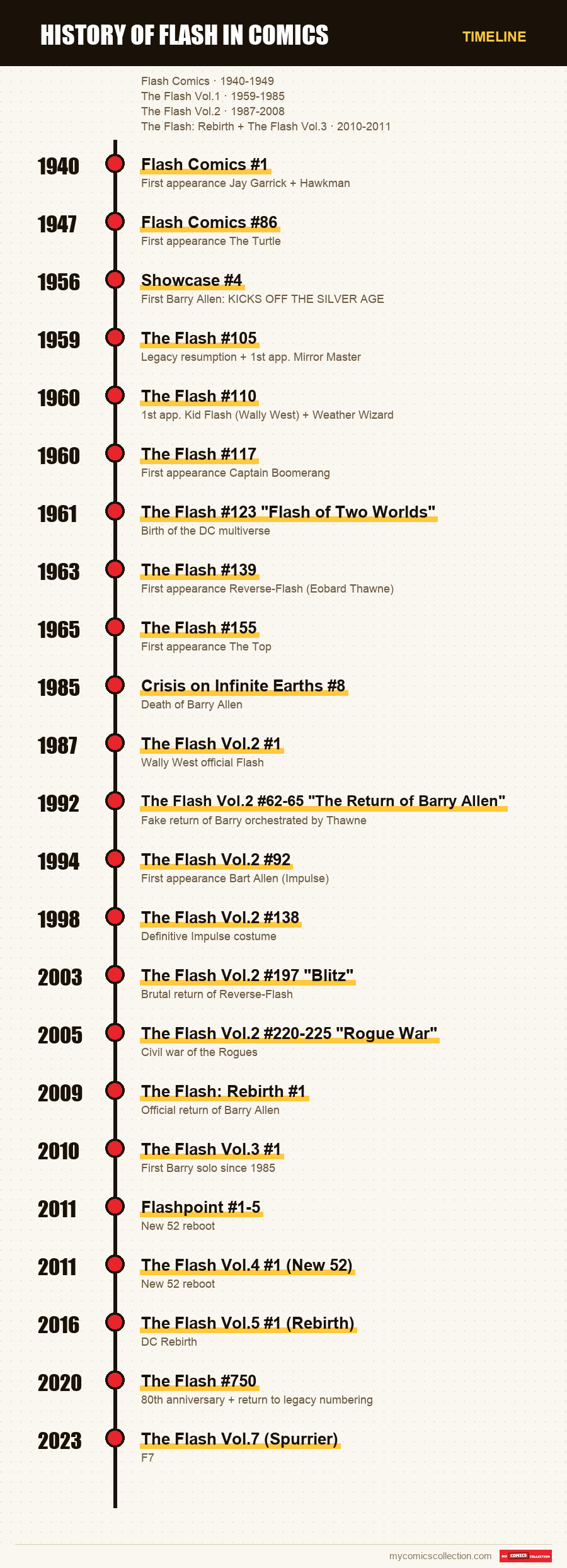
Here are the most important issues to know in chronological order. For the list ranked by market value, see our top 10 Flash key issues.
Flash Comics #1
The founding issue of the Golden Age Flash, and incidentally the first appearance of Hawkman in the same comic. Origin story for Jay Garrick and his winged helmet. A CGC 8.0 copy sold for $800,000 in 2021. Top 20 of the most expensive Golden Age comics in the world. Very rare in high grade: fewer than 5 copies CGC 9.0+ on record.
Flash Comics #86
First appearance of The Turtle, the first "anti-speed" villain in comics history. The concept (an enemy who exploits extreme slowness as a counterpoint to the fast hero) would be reused twenty years later with Reverse-Flash. Important issue for Golden Age completists.
Showcase #4
The most important issue in all of Flash history, and one of the most valuable Silver Age issues across all characters . First appearance of Barry Allen, and the issue that officially marks the start of the Silver Age (1956-1970). Without Showcase #4, no relaunch of DC's superheroes, no Marvel Stan Lee / Jack Kirby in 1961, no Spider-Man, no X-Men. A CGC 9.4 copy sold for over $600,000 in 2022. Top 5 most expensive Silver Age comics, just behind Amazing Fantasy #15 and Action Comics #252. For detailed pricing and sales history, see our complete Showcase #4 analysis.
The Flash #105
First issue of the Barry Allen solo series, picking up the Flash Comics numbering interrupted ten years earlier. First appearance of Mirror Master (Sam Scudder), first of the classic Rogues. Infantino's cover is one of the most iconic of the Silver Age.
The Flash #110
A double key issue. First appearance of Wally West / Kid Flash, Barry Allen's nephew who gains his powers in a replicated chemical accident. Wally would become the 3rd Flash after Barry's death in 1985, and remains one of the most beloved characters by fans. Same issue: 1st app. of Weather Wizard, one of the major Rogues.
The Flash #117
First appearance of Captain Boomerang (Digger Harkness), the iconic Australian Rogue. The character would take off in Suicide Squad (Ostrander, 1987) and The Suicide Squad (James Gunn, 2021).
The Flash #123 "Flash of Two Worlds"
Founding issue of the DC multiverse. Barry Allen vibrates at a frequency that takes him to Earth-2, where he meets Jay Garrick, his childhood inspiration. The concept of parallel universes has been central to all DC comics ever since (Crisis on Infinite Earths, Multiversity, Dark Multiverse). Iconic cover with both Flashes in the same frame.
The Flash #139
First appearance of Eobard Thawne / Reverse-Flash / Professor Zoom, Flash's most important antagonist and one of the most emblematic in comics. A 25th-century speedster obsessed with Barry Allen, Thawne is the murderer of Nora Allen (Barry's mother) and the pivot of Flashpoint. Central character in the CW series The Flash (2014-2023), played by Tom Cavanagh.
The Flash #155
First appearance of The Top (Roscoe Dillon), a minor but recurring Rogue. A spinning-attack character who rounds out the Silver Age villain lineup.
Crisis on Infinite Earths #8
One of the most important issues in DC history. Barry Allen dies saving the multiverse, sacrificing his life to destroy the Anti-Monitor Cannon. His death stayed canonical for 23 years (until 2008). Wally West takes up the Flash mantle. Iconic Pérez cover with Barry's empty costume. For details on Crisis key issues, see our dedicated guide.
The Flash Vol.2 #1
First issue where Wally West is officially Flash, in his new yellow-red costume. Mike Baron launches the run, which would be picked up by Mark Waid and then Geoff Johns. Founding issue of Wally West Flash, highly collected.
The Flash Vol.2 #62-65 "The Return of Barry Allen"
The first major Mark Waid arc. Wally believes Barry Allen has come back, but the "Barry" who reappears is actually Eobard Thawne with reverse amnesia. Founding issue for the new Wally Flash era and a redefinition of Wally's relationship with his lost uncle.
The Flash Vol.2 #92
First appearance of Bart Allen, Barry Allen's grandson from the 30th century. Under the Impulse identity, he would become the 4th Flash in 2006 (briefly) then Kid Flash. Central character in Young Justice and Teen Titans.
The Flash Vol.2 #138
Issue where Bart Allen takes on his definitive yellow-red Impulse costume, redesigned for Humberto Ramos's solo Impulse series. Highly collected by Young Justice fans.
The Flash Vol.2 #197 "Blitz"
The moment when Geoff Johns redefines Reverse-Flash as a pure hate machine pointed at Wally. The "Blitz" arc (#197-200) culminates with the temporary "death" of Linda Park (Wally's wife) and marks the peak of the Johns run.
The Flash Vol.2 #220-225 "Rogue War"
Conclusion of the Geoff Johns run. Internal war between the "classic" Rogues (Captain Cold, Mirror Master) and the "neo-Rogues" (Zoom, reformed Top). Climax of all Johns's redevelopment of the Rogues since 2000.
The Flash: Rebirth #1
First issue of the mini-series that brings Barry Allen back after 24 years away (since Crisis 1985). Geoff Johns reinstalls Barry as the main Flash, modernizes his origin, and lays the groundwork for Flashpoint and the New 52. Highly collected issue.
The Flash Vol.3 #1
First issue of the new Vol.3 series with Barry Allen as the main Flash. Geoff Johns writes, Francis Manapul draws. A short 12-issue run before Flashpoint, but essential to understanding the transition to the New 52.
Flashpoint #1-5
The most important Flash event since Crisis. Barry travels through time to prevent his mother Nora's death, creating a dystopian alternate reality (Aquaman vs Wonder Woman at war, Bruce Wayne dead and Thomas Wayne becoming Batman, Cyborg leading the heroes). Complete reboot of the DC Universe into the New 52. Adapted into the film The Flash (Ezra Miller, 2023).
The Flash Vol.4 #1 (New 52)
Launch of the New 52 Flash. Manapul and Buccellato as co-writers and co-artists. Visually revolutionary, with kinetic effects no one had seen before. Direct precursor to the look of the CW series The Flash (2014).
The Flash Vol.5 #1 (Rebirth)
Launch of the Joshua Williamson run, one of the longest and most appreciated on Barry Allen. 88 issues covering Lightning Strikes Twice , The Button , Flash War , Flash Age. An excellent entry point to discover modern Flash.
The Flash #750
Anniversary issue celebrating Flash's 80 years (1940-2020) and marking the return to legacy numbering after the New 52 reboot. Anthology of authors (Williamson, Geoff Johns, Marv Wolfman, Francis Manapul). Variant covers in heavy demand.
Major story arcs in order
Flash of Two Worlds (1961)
Birth of the DC multiverse. Barry meets Jay Garrick on Earth-2.
The Trial of the Flash (1983-1985)
Barry Allen's trial for the murder of Reverse-Flash. Conclusion of Vol.1.
Crisis on Infinite Earths (1985)
Death of Barry Allen in #8. Wally West becomes Flash.
Born to Run (1992)
Definitive origin of Wally West Flash by Mark Waid. Flashback to his youth.
The Return of Barry Allen (1992)
Fake return of Barry orchestrated by an amnesiac Eobard Thawne.
Terminal Velocity (1995)
Wally faces Kobra, exploration of the Speed Force by Mark Waid.
Dead Heat (1995)
All speedsters united against Savitar. A Speed Force reference point.
Chain Lightning (1999-2000)
Mark Waid, a journey through the future ages of speedsters.
Blood Will Run (2001)
First Geoff Johns arc. Cult of Cicada, darker tone.
Crossfire / Blitz (2002-2003)
Geoff Johns redefines Reverse-Flash. A cult arc of the Johns run.
Rogue War (2005)
Conclusion of the Geoff Johns run. Civil war of the Rogues.
The Wild Wests (2007-2008)
Mark Waid returns to Wally, Linda and their twins Iris and Jai.
Final Crisis: Rogues' Revenge (2008)
Geoff Johns / Scott Kolins, the Rogues face Inertia. Final Crisis tie-in.
The Flash: Rebirth (2009)
Official return of Barry Allen after 24 years. Geoff Johns / Ethan Van Sciver.
Flashpoint (2011)
New 52 reboot. Barry changes the past, creating a dystopian reality.
Forever Evil: Rogues Rebellion (2013-2014)
Forever Evil tie-in. The Rogues refuse the Crime Syndicate.
The Button (2017)
Flash / Batman crossover, prelude to Doomsday Clock. Tom King + Joshua Williamson.
Flash War (2018)
Wally vs Barry. Williamson redefines the rivalry between the two Flashes.
Flash Age (2020)
Williamson wraps his run with one final showdown against Reverse-Flash.
Death of the Speed Force (2021)
Jeremy Adams takes over Wally after the extinction of the Speed Force.
One-Minute War (2023)
Jeremy Adams, alien invasion stopped in one Speed Force minute.
How to start a Flash collection in 2026
Set a clear goal
"I want all of Flash" is a bad goal (1,500+ legacy issues across all volumes). "I want the complete Mark Waid run Vol.2 #62-129" or "all the Silver Age Barry Allen key issues (Showcase #4, Flash #105, #110, #117, #123, #139)" are excellent structured starting points. For high budgets, aiming for Showcase #4 remains the absolute Holy Grail of a Flash collection.
Import the catalog into My Comics Collection
With My Comics Collection, import Flash Comics, The Flash Vol.1 through Vol.7, Impulse, and all the spin-off series. Every issue and volume is distinctly identified, including the legacy stretches (#105 to #350 then #750+).
Prioritize key issues
The 22 key issues listed represent 80% of the historical value. See our dedicated Flash top 10 for key-issue focus + CGC values, and our Showcase #4 analysis for the star issue.
Pick a Flash and a run
Flash is collected by identity (Jay Garrick / Barry Allen / Wally West / Bart Allen) and by run (Broome-Infantino, Mark Waid, Geoff Johns, Joshua Williamson). Deciding "which Flash" and "which writer" first gives your collection meaning instead of a chronological pile-up.
Track eBay valuations
Showcase #4 and Flash Comics #1 are out of reach for most collectors ($200,000 to $1M), but Flash #110, #117, #123, #139 are "affordable" key issues that move constantly. My Comics Collection updates values based on real eBay and auction sales.
Why Flash is still collected in 2026
Flash holds a unique position in the comics collection market in 2026. Several structural reasons keep demand high:
- Historical importance of Showcase #4: no other comic carries such a strong symbolic weight. It's the issue that relaunched the entire superhero medium in 1956. Every serious Silver Age collector wants to own Showcase #4, which keeps permanent upward pressure on high-grade CGC copies (9.0 and up).
- The CW series The Flash (2014-2023): 9 seasons and 184 episodes popularized Barry Allen, Reverse-Flash, Zoom, Killer Frost, Cisco Ramon and the whole mythology with a new generation. Sustained demand on Eobard Thawne (Flash #139), Captain Cold, Heat Wave and Killer Frost key issues.
- The Flash film (Ezra Miller, 2023): despite a mixed reception, the film put Flashpoint back at the heart of pop culture. Demand on the Flashpoint #1-5 (2011) maxi-series and tie-ins.
- DC multiverse: Flash has been the multiverse's key character since Flash of Two Worlds (1961). With the Snyder/James Gunn multiverse strategy (Crisis on Infinite Earths animated 2024, future Flash film returning), the character remains central narratively.
- Four collectible Flashes: Jay (1940), Barry (1956), Wally (1985), Bart (1994). Four identities, four runs, four distinct collector audiences. This diversity keeps demand alive across the entire catalog, from Golden Age to modern.
Biography of Bartholomew Henry "Barry" Allen (Flash)
Flash is a character of DC Comics created by Robert Kanigher and Carmine Infantino (Barry Allen). His first appearance is in Showcase #4 (Barry Allen): Flash Comics #1 (Jay Garrick) , published in October 1956 (Barry Allen): January 1940 (Jay Garrick).
Identity sheet of Bartholomew Henry "Barry" Allen
- Real name: Bartholomew Henry "Barry" Allen (Silver Age), Jay Garrick (Golden Age), Wally West (post-Crisis)
- Date of birth: January 1940 (Jay Garrick): September/October 1956 (Barry Allen)
- Place of birth: Central City, USA (Barry Allen)
- First appearance : Showcase #4 (Barry Allen): Flash Comics #1 (Jay Garrick)(October 1956 (Barry Allen): January 1940 (Jay Garrick))
- Creators: Robert Kanigher (screenwriter) and Carmine Infantino (designer) for Barry Allen. Gardner Fox (screenwriter) and Harry Lampert (designer) for Jay Garrick.
- Editor: DC Comics
- Memberships: Justice League (founding member), Justice Society of America, Speed Force
Character origins
Barry Allen, a young police forensic scientist from Central City, is struck by lightning while working with chemicals in his laboratory. This chemical electrocution connects him to the Speed Force and gives him superhuman speed. Becoming the Flash, he fights supervillains like Captain Cold, Reverse-Flash and Gorilla Grodd, and is one of the founding members of the Justice League.
Powers and Abilities
- Super-speed: able to run at the speed of light
- Molecular vibration: passes through solid matter
- Time travel via the Speed Force
- Accelerated regeneration
- Amplified metabolism
- Creation of tornadoes by circular movement of the arms
- Speed Force: cosmic source of his powers
Costume and visual identity
Full red costume with stylized yellow lightning bolt on the torso, yellow belt, white wings on the helmet (symbol of Mercury). Red mask covering only the upper face. Yellow boots.
Build your Flash collection with method
Import the 1,500+ Flash Comics + Flash Vol.1-7 + Impulse + spin-off issues in one click, identify your missing key issues (Showcase #4, Flash #105, #110, #117, #123, #139), track eBay value. Free 7-day trial.
🚀 Start the free 7-day trialGo further
- The Flash DC Comics Reading Guide: Where to Start
- Best Flash Comic Runs: The Essential Reading List for DC Collectors
- Best Flash story arcs: a collector's guide
- Top 10 The Flash Key Issues to Own
- Flash's First Appearance: Flash Comics #1 (1940) and Showcase #4 (1956): Collector's Guide
- Flash Comics Collection Guide: Key Issues, Essential Runs & Budget Strategy
FAQ, History of Flash
Other character history articles to discover
Our complete "Comics history" article series covers the 20 biggest Marvel and DC franchises. Each article follows the same format: birth, full chronology of volumes, parallel series, key issues ranked chronologically, major arcs and a method for collecting.
→ See all "History" articles on the blog