
Superman was born in June 1938 in Action Comics #1 , created by Jerry Siegel and Joe Shuster. He's the first superhero in comic book history, the founding work of the genre. More than 85 years later, Superman has the longest continuity in history: Action Comics has been running since 1938 (1,100+ issues), Superman since 1939 (5 volumes, 1,200+ legacy issues), plus dozens of parallel series. This article retraces the genesis, lays out the full chronology of the series in order, and lists the key issues to know.
Before Superman, there were no superheroes as we know them today. No costumes, no double identity, no superhuman powers used for good. The pulps had their vigilantes (The Shadow, Doc Savage), but none combined the elements that Jerry Siegel and Joe Shuster assembled in Action Comics #1 in June 1938. Superman literally created the genre. Without Superman, there's no Batman, no Spider-Man, no X-Men, no Watchmen, no MCU. He's the big bang of modern American comics.
This guide gives you everything you need to understand the birth of Superman , follow the complete list of all Superman comics in order , and identify the key issues and major arcs to prioritize. We'll cover the character's 85+ years, from Action Comics #1 (1938) to Joshua Williamson's current run in 2026, separating the main volumes, the parallel ongoings (World's Finest, Adventures of Superman, Superman: The Man of Steel) and the cult maxi-series (Death of Superman, All-Star Superman, Kingdom Come).
The birth of Superman: 1933-1938, the dream of two Cleveland teenagers
To understand Superman, you have to go back to 1933 , in a small Ohio town. Jerry Siegel (writer) and Joe Shuster (artist) are two 18-year-old Jewish teenagers, fans of pulps and science fiction. The character takes shape in a self-published fanzine in 1933 (The Reign of the Super-Man, where Superman is actually a bald telepathic villain). Two years later, in 1935, Siegel reformulates the idea: a hero from another planet, gifted with strength, speed and invulnerability, who defends the oppressed.
For five years, Siegel and Shuster pitched their creation to EVERY comic strip and pulp publisher. Everyone refused. "Too fantastic ," " readers will never believe in a man who flies ," " concept is too childish." The manuscript piled up over 30 rejections between 1935 and 1937. Finally, in 1938, Vin Sullivan (the future editor of Detective Comics #27 / Batman) was looking for a character for the new Action Comics anthology. He accepted the Siegel/Shuster pitch for $130 (about $10 a page), and bought all the rights with it.
Action Comics #1 (June 1938)
Action Comics #1 hit the stands on April 18, 1938, cover-dated June 1938 (common practice at the time). The mythic cover shows Superman lifting a green car over his head, smashing it against a rock, men in suits running away. Inside, 13 pages tell the origin: Krypton explodes, baby Kal-El is sent to Earth by his parents, taken in by the Kents in Kansas, becomes Clark Kent reporter at the Daily Star (which would become the Daily Planet), love interest Lois Lane.
The impact was enormous. Action Comics #1 sold its 200,000 initial copies in a few weeks. Three months later, the print run jumped to a million. National Comics (the future DC) announced a dedicated solo series for 1939. The superhero genre was born, and the entire industry rushed to copy the formula. Detective Comics #27 (Batman, May 1939) followed less than a year later.
The cruel irony for Siegel and Shuster: the two creators sold Superman to DC for $130 in 1938. When DC became a billion-dollar franchise, Siegel and Shuster were living in poverty. Several lawsuits in the 1940s-1970s, public mediation in 1975 when they were on the verge of homelessness, finally got them a modest annual pension and a "Superman created by Jerry Siegel and Joe Shuster" credit on every media since. A late and symbolic correction.
The main Superman series in chronological order
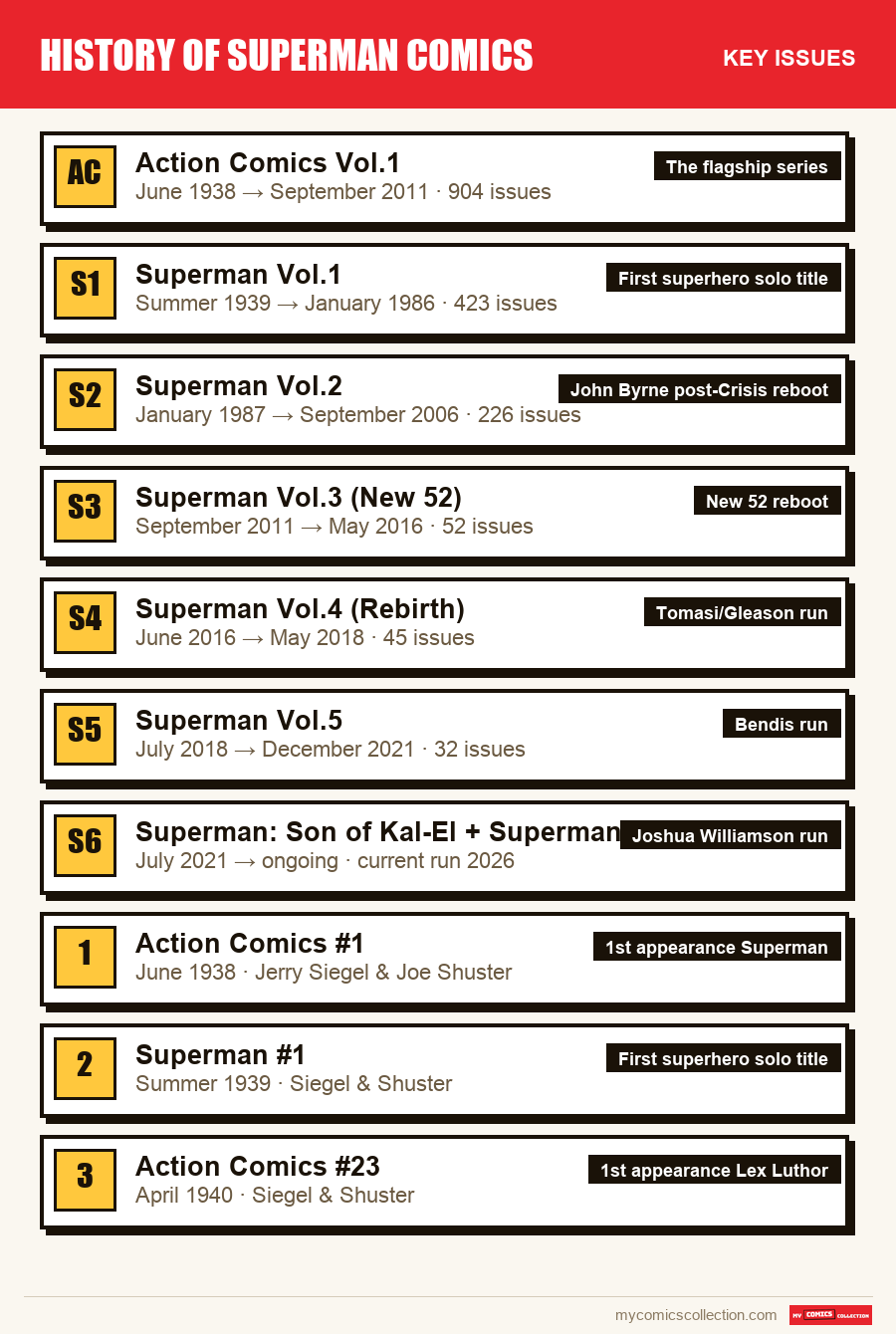
Action Comics Vol.1
The longest series in American comic history. 904 issues without interruption between 1938 and 2011. All the historic first appearances happen here: Superman (#1), Lois Lane (#1), Lex Luthor (#23), Bizarro (#254), Brainiac (#242), Supergirl (#252). All the major classic Superman runs: Mort Weisinger, Cary Bates, Marv Wolfman, John Byrne (post-Crisis), Roger Stern, Joe Kelly.
Superman Vol.1
Launched after Action Comics' explosion. Superman #1 (1939) is the FIRST solo title comic dedicated to a superhero in history. The series ran 423 issues over 47 years. It's the title where Mort Weisinger (editor 1941-1970) imagined the classic mythology: Krypto, Supergirl, the Fortress of Solitude, Bizarro World, Imaginary Stories. The volume wraps with Alan Moore's "Whatever Happened to the Man of Tomorrow?" (#423, September 1986) before the Byrne reboot.
Superman Vol.2
After Crisis on Infinite Earths (1985-1986), DC completely reboots Superman with John Byrne at the helm. The maxi-series Man of Steel (6 issues, 1986) establishes the new canon, then Vol.2 launches. The longest run of the Modern Age: 226 issues, wrapped in 2006. Includes "Death of Superman " (#75, 1992) and " Reign of the Supermen" (1993).
Superman Vol.3 (New 52)
Full New 52 reboot. George Pérez handled the early issues, then Scott Lobdell, Geoff Johns. A run criticized by some fans for its darker / militaristic tone. Wrapped at #52 before Rebirth.
Superman Vol.4 (Rebirth)
With DC Rebirth, the pre-Flashpoint Superman returns along with his son Jonathan Kent (Superboy). The Peter Tomasi / Patrick Gleason run (#1-45) delivers a beloved family-focused period. Followed by Brian Bendis (#1-7 in Vol.5).
Superman Vol.5
Brian Michael Bendis arrives from Marvel and launches Superman Vol.5 plus the Man of Steel mini. Reveals Superman's secret identity (#18, 2019), introduces Rogol Zaar and the destruction of Krypton.
Superman: Son of Kal-El + Superman Vol.6
Jonathan Kent (Jon) becomes Superman while Clark heads off into space. Tom Taylor handles Son of Kal-El. In 2023, Clark returns with Superman Vol.6 #1 (April 2023) by Joshua Williamson. Currently running in 2026, "Power to the People," "House of Brainiac."
All parallel Superman series in chronological order
- World's Finest Comics (1941-1986, 323 issues): regular Superman / Batman team-ups. Anthology format at first, then a regular duo from 1971 on.
- Superboy Vol.1 (1949-1979, 258 issues): Clark Kent as a child in Smallville. First appearance of the Legion of Super-Heroes (#247).
- Superman's Pal Jimmy Olsen (1954-1974, 163 issues): series dedicated to the Daily Planet photographer. Legendary Jack Kirby run 1970-1974 (New Gods, Darkseid).
- Superman's Girl Friend, Lois Lane (1958-1974, 137 issues): Lois Lane's series.
- Adventure Comics (Superboy 1946-1969, then Legion of Super-Heroes): DC catch-all title that hosted Superboy and the Legion.
- Action Comics Weekly (1988-1989, 42 issues): the weekly period of Action Comics.
- The Adventures of Superman (1987-2006, 478 legacy issues): Superman Vol.1 renumbered to preserve historical chronology. Continues to #649 before reverting to Superman.
- Superman: The Man of Steel (1991-2003, 134 issues): 4th monthly Superman series during the golden age of "Triangle Numbers."
- Superman: The Man of Tomorrow (1995-1999, 15 issues): 5th ongoing during the '90s peak.
- Superman/Batman (2003-2011, 87 issues): regular team-up of the two icons. Launched by Jeph Loeb / Ed McGuinness with "Public Enemies."
- All-Star Superman (2005-2008, 12 issues): cult maxi-series by Grant Morrison and Frank Quitely. Considered one of the best comics of the 21st century. Out of continuity.
- Superman: Earth One (2010, 2012, 2015-3 graphic novels): modern reboot by J.M. Straczynski / Shane Davis.
- Superman / Wonder Woman (2013-2016, 29 issues): New 52, their romantic relationship.
- Superwoman (2016-2017, 18 issues): post-Rebirth Lana Lang / Lois Lane fusion.
- Action Comics Vol.2 (2011-2016, 52 issues): New 52 reboot by Grant Morrison (#1-18).
- Action Comics Legacy (2016-ongoing): return to classic numbering #957 → #1000+ → ongoing.
- Action Comics #1000 (April 2018): 80th anniversary issue. Reintroduces Mr. Oz (Jor-El).
- Action Comics by Phillip Kennedy Johnson (2021-2023): "Warworld Saga," beloved run.
- Superman: Lost (2023-2024, 10 issues): Christopher Priest maxi-series, Clark stranded in space for 20 years.
- Action Comics: House of Brainiac (2024): Williamson crossover.
- Absolute Superman (2024-ongoing): ultimate reboot by Jason Aaron, out of continuity.
- Cult maxi-series : The Death of Superman (1992), The Death of Clark Kent (1995), Superman: Red Son (2003, Mark Millar: Soviet Superman), Superman: Birthright (2003-2004), Superman: Secret Origin (2009-2010), Superman: American Alien (2015-2016).
Superman key issues in chronological order
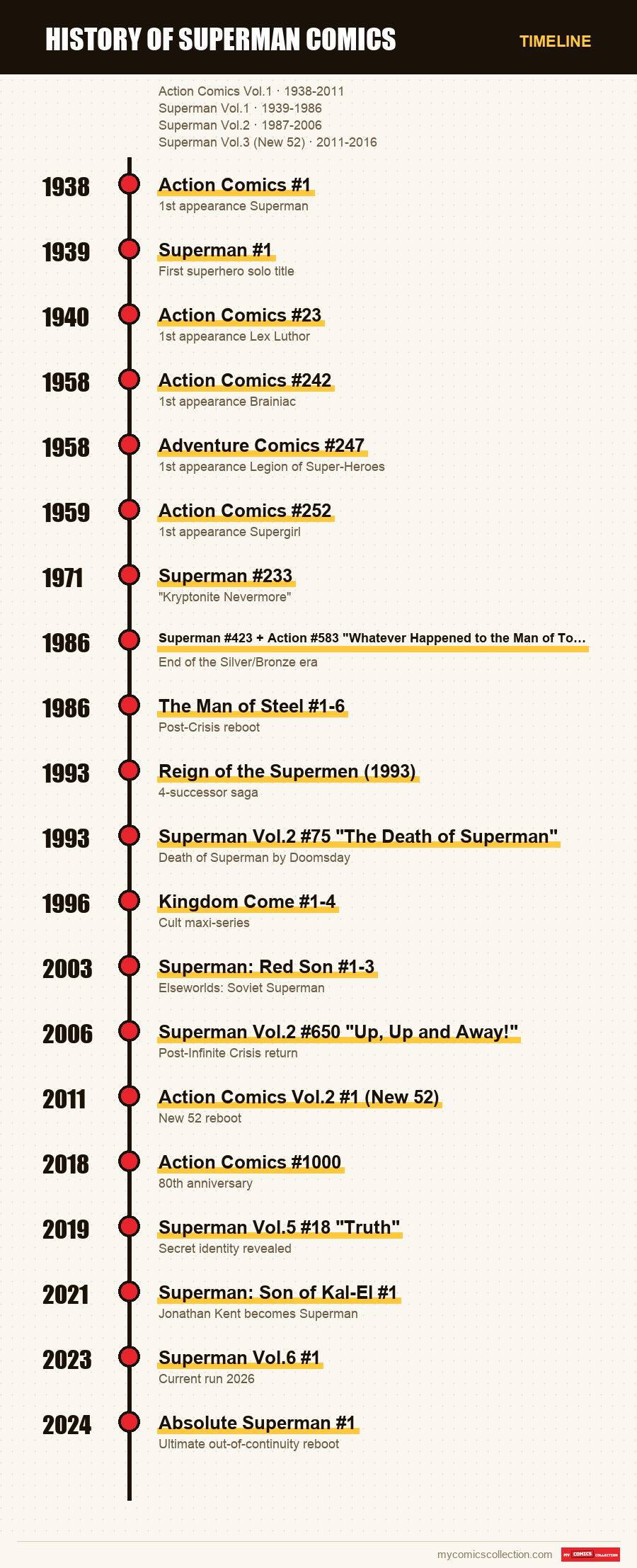
Action Comics #1
The founding issue of the entire superhero genre. First appearance of Superman and Lois Lane. A CGC 8.0 copy sold for $3.25 million in 2014, then $6 million (CGC 8.5) in 2022. The most expensive comic in history (public sale). See our dedicated value sheet.
Superman #1
The first comic dedicated to a superhero. Reprints the Action Comics 1-4 stories plus a new story. A CGC 8.0 is estimated at over $800,000.
Action Comics #23
First appearance of Lex Luthor, the arch-enemy. Initially a mad scientist with red hair, he'd go bald starting with Action Comics #45. A foundational antagonist of the entire Superman mythology.
Action Comics #242
First appearance of Brainiac, the alien supercomputer who shrinks cities. Also introduces the concept of the city of Kandor.
Action Comics #252
First appearance of Kara Zor-El / Supergirl, Superman's cousin. A central character in Kryptonian mythology.
Action Comics #254 + Superman #140
Adult Bizarro appears for the first time in Action Comics #254. The Bizarro World concept is introduced in Superman #140. A pop culture symbol of the doppelgänger.
Adventure Comics #247
First appearance of the Legion of Super-Heroes in a Superboy story. Cosmic futuristic team-up that becomes a franchise of its own.
Superman #233
O'Neil's soft reboot after a decade of Silver Age weirdness. Iconic Neal Adams cover (Superman breaking his kryptonite chains).
Superman #423 + Action #583 "Whatever Happened to the Man of Tomorrow?"
Alan Moore's conclusion to the pre-Crisis Superman. A two-part wrap-up that closes 48 years of continuity. Precedes the Byrne reboot.
The Man of Steel #1-6
6-issue mini-series that re-establishes the origin and the Superman canon for the Modern Age. The absolute post-Crisis reference. Launches Superman Vol.2.
Superman Vol.2 #75 "The Death of Superman"
The best-selling issue of the '90s. 6 million copies sold. Superman dies at Doomsday's hands. Iconic black polybag cover. Event that made the front page of the New York Times.
Reign of the Supermen (1993)
Direct sequel to The Death. Four Supermen (Eradicator, Steel, Cyborg-Superman, Superboy) claim to be the real one. Includes Superman #500, Adventures of Superman #500, Action Comics #687, Superman: The Man of Steel #22.
Kingdom Come #1-4
Elseworlds maxi-series painted by Alex Ross. Aged Superman, generational conflict with a new generation of heroes. One of the best DC comics of all time.
Superman: Red Son #1-3
What if Kal-El had landed in the USSR instead of Kansas. Cult maxi-series by Mark Millar. Adapted as an animated film in 2020.
All-Star Superman #1-12
Considered by many the best Superman comic ever written. 12 chapters celebrating the entire classic mythology. Superman discovers he has 12 months to live. Out of continuity.
Superman Vol.2 #650 "Up, Up and Away!"
Crossover that reintroduces Superman after Infinite Crisis. A legendary issue that transitions to the One Year Later era.
Action Comics Vol.2 #1 (New 52)
Full New 52 reboot. Morrison reimagines a young Superman in jeans and t-shirt in Metropolis. An 18-issue storyline that establishes the new canon.
Action Comics #1000
Historic anniversary. 80-page anthology with Geoff Johns, Brian Bendis (who opens his arc), Tomasi, Marv Wolfman. Reintroduces Mr. Oz (Jor-El) and launches the Bendis phase.
Superman Vol.5 #18 "Truth"
Superman publicly reveals he's Clark Kent. The issue that changes the character's fundamental balance for years to come.
Superman: Son of Kal-El #1
Jon Kent (15 years old) takes up the Superman mantle. Tom Taylor redefines him as a progressive political activist. Comes out as bisexual in #5.
Superman Vol.6 #1
Launch of the ongoing run. Clark is back, "Power to the People" then "House of Brainiac" in 2024. Ongoing in 2026, variant covers heavily collected.
Absolute Superman #1
Launch of the Absolute universe (Marvel Ultimate equivalent). Superman reimagined: Krypton falls again, Clark younger, more isolated, more marginal. Heavy demand on the secondary market.
The major Superman story arcs in order
The Man of Steel (1986)
Byrne post-Crisis reboot. Definitive modern origin in 6 issues.
Whatever Happened to the Man of Tomorrow? (1986)
Alan Moore concludes the Silver Age. Two-part wrap-up.
Funeral for a Friend (1993)
8 issues following Superman's death by Doomsday. Collective mourning.
Reign of the Supermen (1993)
4 successors. Cyborg-Superman, Steel, Eradicator, Superboy. Year-long saga.
The Death of Clark Kent (1995)
Following Death of Superman, Conduit reveals Clark / Superman's identity and threatens him.
Kingdom Come (1996)
Waid / Ross Elseworlds maxi-series. The absolute reference.
Our Worlds at War (2001)
Massive crossover, Superman vs Imperiex. Year-long saga.
Superman: Birthright (2003-2004)
Mark Waid / Leinil Yu maxi-series. Pre-Infinite Crisis origin reboot.
For Tomorrow (2004-2005)
Brian Azzarello / Jim Lee run. 1 million people vanish from Metropolis.
All-Star Superman (2006-2008)
12-issue maxi by Morrison / Quitely. Considered the best Superman comic.
Superman: Brainiac (2008)
Geoff Johns redefines Brainiac. Death of Pa Kent.
New Krypton (2008-2010)
17,000 Kryptonians released. Year-long saga across Action, Superman, Supergirl.
Superman: Secret Origin (2009-2010)
Geoff Johns / Gary Frank. Pre-New 52 last origin reboot.
Superman: American Alien (2015-2016)
Max Landis maxi-series. Origins in 7 emotional vignettes.
The Final Days of Superman (2016)
Death of New 52 Superman, return of pre-Flashpoint Superman with his son.
Superman: Rebirth: Tomasi/Gleason run (2016-2018)
Family-focused period. Clark, Lois and Jon Kent live in Hamilton County.
The Truth (2019)
Bendis. Superman reveals his secret identity to the entire world.
Warworld Saga (2021-2023)
Phillip Kennedy Johnson. Superman gladiator on Warworld.
Failsafe (Williamson, 2023)
Vol.6 launch. "Power to the People" then "House of Brainiac" in 2024.
Absolute Superman (2024-ongoing)
Ultimate out-of-continuity reboot by Jason Aaron. Absolute Universe.
How to start a Superman collection in 2026
Set a clear goal
"All of Superman" is unattainable (2,200+ legacy issues). Much better: complete All-Star Superman (12 issues, $200-400), Death of Superman + Reign of the Supermen (the full arc in single issues), or a coherent run like Tomasi/Gleason or Bendis.
Import the catalog into My Comics Collection
With My Comics Collection, import Action Comics Vol.1+2, Superman Vol.1-6, Adventures of Superman, Man of Steel, Man of Tomorrow and all the maxi-series.
Prioritize Bronze/Modern Age key issues
Action Comics #1 and Superman #1 are out of budget. But Superman Vol.2 #75 (Death), Action Comics #1000, Action #866 (Brainiac Johns) are accessible. See our dedicated Superman top 10.
Track the triangle sagas (1991-2002)
During the golden age of the 4 parallel Superman series (Action, Superman, Adventures, Man of Steel), DC numbered them with "Triangle Numbers" to help readers follow the order. Worth knowing for Modern Age collectors.
Track eBay valuation
Action Comics #1 is out of reach but plenty of others move. My Comics Collection updates values based on real sales.
Biography of Clark Kent (Superman)
Superman is a character of DC Comics created by Jerry Siegel and Joe Shuster. His first appearance is in Action Comics #1 , published in April 1938.
Clark Kent's identity sheet
- Real name: Clark Kent (Kal-El by birth)
- Date of birth: April 1938 (creation): fictional: birth on Krypton before 1938
- Place of birth: Krypton (home planet), Smallville, Kansas (adoption)
- First appearance : Action Comics #1 (April 1938)
- Creators: Jerry Siegel (writer) and Joe Shuster (artist)
- Editor: DC Comics
- Memberships: Justice League, Legion of Super-Heroes, Daily Planet
Character origins
Kal-El is sent to Earth from his home planet Krypton, in agony. His ship crashes in Smallville, Kansas, where he is taken in and raised by Jonathan and Martha Kent under the name Clark Kent. Discovering his superhuman powers as a teenager, he decides to become Superman to protect humanity, while leading a double life as a reporter at the Daily Planet in Metropolis.
Powers and Abilities
- Unlimited superhuman strength (can lift planets)
- Flight at supersonic speed
- X vision, thermal vision, telescopic vision
- Freezing Breath (Super Breath)
- Almost total invulnerability (except to Kryptonite)
- Super-hearing and super-speed
- Source of power: yellow sun radiation
Costume and visual identity
Tight blue suit with red cape and red boots. Stylized "S" symbol (meaning "Hope" in Kryptonian) on the torso in a red and yellow crest. Red briefs over it (removed in some modern versions).
Build your Superman collection methodically
Import the 2,200+ Superman + Action + Adventures + spin-off issues in one click, identify your missing key issues, track eBay values. 7-day free trial.
🚀 Start the 7-day free trialGo further
FAQ: History of Superman
Other comic character histories to explore
Our complete "History of comics" article series covers the 20 biggest Marvel and DC franchises. Each article follows the same format: birth, full chronology of the volumes, parallel series, key issues ranked chronologically, major arcs, and method for collecting.
→ See all "History" articles on the blog