
T'Challa / Black Panther was born in July 1966 in Fantastic Four #52 , written by Stan Lee and drawn by Jack Kirby . He's the first mainstream Black super-hero in American comics history, created a few months before the official founding of the Black Panther Party by Huey Newton and Bobby Seale (October 1966). The character has carried 9 solo series volumes (1977 → 2023) plus the legendary Jungle Action backup (1973-1976) where Don McGregor sculpted the Wakanda mythology in "Panther's Rage." The cult runs: Christopher Priest 1998-2003 (62 issues), Reginald Hudlin 2005-2008 (41 issues), Ta-Nehisi Coates 2016-2021 (43 issues across two volumes) and John Ridley 2021-2023 (15 issues). This article walks you through the genesis, gives you the complete chronological list of series, and lays out the key issues you'll want to know to build a structured Black Panther collection.
Alongside Luke Cage and Storm, Black Panther is one of the pillars of Black representation in American comics. But while Luke Cage emerged as an explicit response to the blaxploitation of the 1970s, T'Challa precedes the entire wave of Black super-heroes: Stan Lee and Jack Kirby create the character in July 1966, several months before the official founding of the Black Panther Party (October 1966). King of Wakanda, a hidden techno-utopian African nation, T'Challa is a billionaire, scientist, monarch and fighter: an aristocratic figure who flips every stereotype of the era when Black characters were confined to secondary roles. No other Marvel character has carried such historical and cultural weight.
This guide will give you everything you need to understand the birth of Black Panther , follow the complete list of Black Panther comics in order , and identify the key issues and major arcs to prioritize. We'll cover 60 years of the character, from Fantastic Four #52 (July 1966) through Eve L. Ewing's volume 9 (2023+), distinguishing between main volumes, parallel ongoings (Jungle Action, World of Wakanda, Shuri, Wakanda 2022), and the cult runs that built the legend of the King of Wakanda (McGregor, Priest, Hudlin, Coates, Ridley).
The birth of Black Panther: Marvel in 1966
To understand how T'Challa was born, you've got to go back to early 1966. Marvel Comics was at the creative peak of the Stan Lee / Jack Kirby era. The Fantastic Four were approaching their 50th issue and Lee / Kirby were looking to refresh the supporting cast. The civil rights movement was at its height in the United States (Selma 1965, Voting Rights Act, Martin Luther King marches), and the comic book industry remained almost exclusively white: not a single Black super-hero in the spotlight, not a single African-American writer employed at Marvel or DC, Black characters reduced to stereotypes (Whitewash Jones, etc.).
Stan Lee and Jack Kirby decided to break that silence by creating an aristocratic , technologically superior Black super-hero who was also monarch of an African nation. The bet was radical: T'Challa is not a victim, not a sidekick, not a product of the American ghetto. He rules Wakanda, the most technologically advanced nation in the Marvel Universe, the unique source of Vibranium (a cosmic material fallen from a meteorite). The costume was designed by Kirby as an entirely black futuristic suit, with no caricature-eared facial mask. The Black Panther concept as we know it today is a pure Lee / Kirby co-creation, but Kirby gave most of the visual and political personality of Wakanda.
Fantastic Four #52 (July 1966)
Black Panther makes his first appearance in Fantastic Four #52 (cover-dated July 1966, on newsstands as early as April 1966), in a story titled "The Black Panther!" The plot: Reed Richards receives a gift plane from a mysterious African king who invites the Fantastic Four to come hunt the black panther in his secret kingdom. The trap turns: T'Challa, in an all-black costume, hunts the FF one by one as a ritual test to evaluate his future allies. Fantastic Four #53 (August 1966) follows directly with the complete origin story: Vibranium fallen from a meteorite, the assassination of King T'Chaka by the scientist Klaus Voorhees (Klaw), T'Challa's training and formation, ascent to the throne, and oath to defend Wakanda against pillagers. Klaw becomes the recurring enemy.
Major chronological point : Black Panther predates by several months the official founding of the Black Panther Party for Self-Defense by Huey Newton and Bobby Seale (Oakland, October 1966). Marvel briefly renamed the character "Black Leopard" in 1972 (Fantastic Four #119) to avoid political confusion, before returning to Black Panther in 1973 with Jungle Action. The fictional character has no historical link with the political party: he predates it by several months and on the contrary embodies an aristocratic African vision, opposed to the urban North American activists.
Jungle Action and the creation of modern Wakanda (1973-1976)
If Lee and Kirby created T'Challa, it's Don McGregor who invented Wakanda as we know it today. Starting with Jungle Action #5 (July 1973), McGregor takes over the character in the anthology series Jungle Action (originally reserved for reprints) and launches the first true solo run dedicated to Black Panther. Across 18 issues (#5 to #22), McGregor delivers two foundational arcs: "Panther's Rage" (#6-18, 1973-1975) and "Panther vs. The Klan" (#19-22, 1976).
Panther's Rage is considered the first graphic novel in Marvel history, well before Watchmen and Dark Knight Returns. McGregor took the radical decision to write 13 consecutive chapters telling a single story: Erik Killmonger foments a rebellion against T'Challa inside Wakanda itself, contesting the legitimacy of a king who spends too much time in America. McGregor invents the geography of Wakanda (the rivers, the mountains, the cities), the mythology of the panther goddess Bast, the throne transmission ritual, the pantheon of tribes, and the anthropological richness that will form the basis of all subsequent runs (Priest, Hudlin, Coates, Ridley) and Ryan Coogler's 2018 film.
The historical irony: Don McGregor wrote Panther's Rage and Panther vs The Klan in a second-tier series (Jungle Action), with modest sales, with no promotion at all, at a time when Marvel didn't believe a Black super-hero could carry a solo series. And yet every idea of modern Wakanda (Killmonger, the Tribal Council, Bast, the heart-shaped herb ritual, Wakandan xenophobia) is invented by McGregor. When Ryan Coogler adapted Black Panther for the screen in 2018 ($1.3 billion at the box office), he directly cited Don McGregor as the film's main influence.
The main Black Panther volumes in chronological order
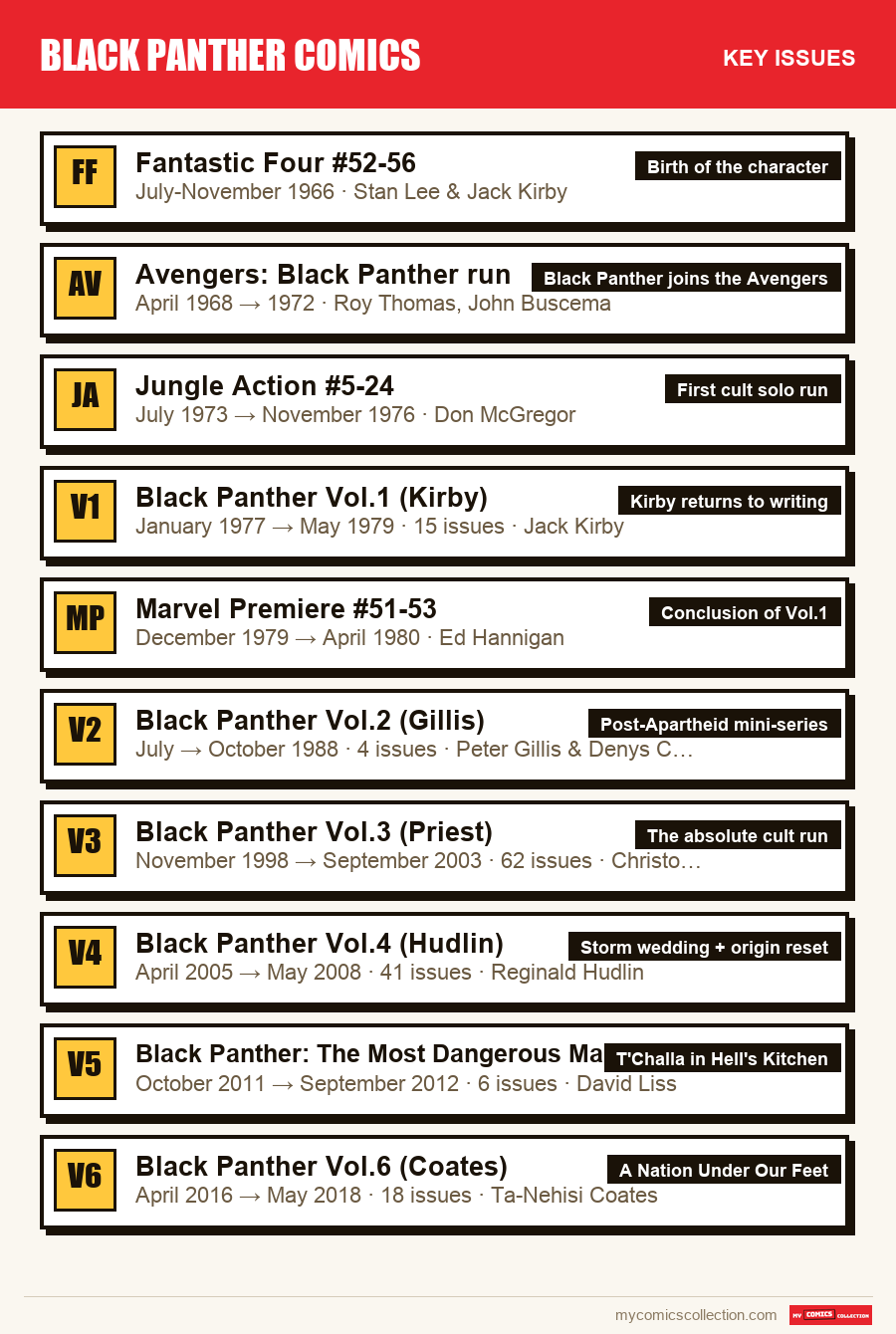
The Black Panther franchise counts 9 solo volumes plus a multitude of mini-series and anthologies. Here are the main titles in the order of their first issue:
Fantastic Four #52-56
The 5 issues that launch T'Challa. FF #52 (July 1966) introduces Black Panther and Wakanda. FF #53 (August 1966) gives the complete origin: Vibranium, T'Chaka's assassination, return for vengeance against Klaw. FF #54-56 deepen the ties between the Fantastic Four and the African kingdom. The cornerstone of the entire Black Panther universe.
Avengers: Black Panther run
Starting with Avengers #51-52 (1968), T'Challa joins the main Avengers team under Roy Thomas's guidance. He becomes a recurring member through Avengers #126 (1974) and appears occasionally afterward. Avengers #62 (March 1969) marks the return to Wakanda and establishes Mbaku the White Gorilla (Man-Ape) as a major antagonist. An underrated but essential period for understanding the character's status in the pre-1973 Marvel Universe.
Jungle Action #5-24
The Don McGregor run that invented everything. 20 issues (#5-24) divided into two foundational arcs: Panther's Rage (#6-18, 13 chapters) introduces Erik Killmonger, the Tribal Council and the complete Wakandan mythology. Panther vs The Klan (#19-22, 1975-1976) sends T'Challa to the American South to face the Ku Klux Klan: one of the most political comics arcs Marvel ever published at that time. The series was canceled at #24 due to weak sales, but it structured the entire later mythology of the character.
Black Panther Vol.1 (Kirby)
The first official solo title for the character. Jack Kirby returns from his time at DC and takes back his own character, handling both writing and art. Tone radically different from McGregor: Kirby drops the political thread for cosmic-pulp adventures (King Solomon's Frog, time-hopping treasure hunts). The volume is interrupted at #15 when Kirby leaves Marvel again. For Lee/Kirby purists, this volume is precious; for fans of Wakandan mythology, the McGregor arc remains superior.
Marvel Premiere #51-53
Three Marvel Premiere issues wrapped up the storylines left hanging by Kirby's Vol.1. Ed Hannigan finishes the King Solomon arc and brings T'Challa back to Wakanda for his return to monarch status. Lesser-known issues, sought after by McGregor / Kirby completists to close out the 1973-1980 chronology.
Black Panther Vol.2 (Gillis)
4-issue mini-series that thrusts T'Challa into Apartheid-era South Africa. Peter Gillis writes a direct political story where Black Panther stands against the South African regime. The series marks the character's return after 8 years away from solo titles. Cowan brings a more modern visual style, foreshadowing the aesthetic of the 1990s. Little known, sought after by fans of political comics.
Black Panther Vol.3 (Priest)
The most important run for the character before Coates. Christopher Priest (the first African-American writer to lead a major Marvel series on a continuous basis) signs 62 issues of pure narrative brilliance: complex flashback structure, introduction of the Dora Milaje (the king's royal guards), Everett K. Ross (the State Department agent who serves as narrator, played by Martin Freeman in the films), Achebe (a brilliant political villain), complete redefinition of Killmonger. Vol.3 #5 introduces the modern version of Killmonger. An essential run for understanding modern Black Panther: the absolute reference of Ryan Coogler for the MCU films.
Black Panther Vol.4 (Hudlin)
Reboot with Reginald Hudlin (African-American filmmaker / writer), art by John Romita Jr. Vol.4 resets T'Challa's origin with a pronounced pan-African focus: Wakanda as economic superpower, T'Challa as a fully assumed monarch on the international stage. BP Vol.4 #18 (August 2006) marks the legendary wedding of T'Challa and Storm (Ororo Munroe), a major Marvel event that seals the union of two of the publisher's biggest Black characters. The run includes Civil War tie-ins and Secret Invasion BP. 41 issues total.
Black Panther: The Most Dangerous Man Alive
Short volume where T'Challa, having temporarily lost his throne, becomes the protector of Hell's Kitchen in Daredevil's place (Matt Murdock being absent at the time). David Liss writes an urban, dark Black Panther, far from Wakandan splendor. The series is numbered legacy #513-529 (carrying over from Daredevil) before being canceled at #523. An atypical volume but appreciated by fans for its street-level tone.
Black Panther Vol.6 (Coates)
The arrival of Ta-Nehisi Coates, journalist for The Atlantic, National Book Award winner, marks a historic turning point: a major African-American literary author takes the reins of Black Panther right when the MCU film comes out. 18 issues that make up A Nation Under Our Feet (#1-12) then Avengers of the New World (#13-18). Coates treats Wakanda as a post-colonial nation crossed by a democratic revolution: Tetu, the Midnight Angels, the People's Council. Art mostly by Brian Stelfreeze. A central volume for understanding the character's modern political vision.
Black Panther Vol.7 (Coates)
Direct continuation of Vol.6 but a complete shift in setting: T'Challa finds himself enslaved in a galaxy where Wakanda exists as a colonial space empire 2,000 years in the future. Coates pushes political space-opera all the way: the The Intergalactic Empire of Wakanda arc runs across 25 issues and redefines the character on a cosmic scale. Art by Daniel Acuña, Kev Walker, Jen Bartel. A very divisive run among fans (some miss earthbound Wakanda), but cinematically spectacular.
Black Panther Vol.8 (Ridley)
John Ridley (Oscar-winning writer for 12 Years A Slave) takes over from Coates with a radically different focus: T'Challa as spymaster, Black Panther as a secret agent. The series explores Wakanda's espionage networks on Earth, internal betrayals, the moral cost of the Wakandan deep state. 15 dense issues, more political and less epic than Coates. Art by Juann Cabal, Stefano Landini, German Peralta.
Black Panther Vol.9 (Ewing)
Launch of the current volume by Eve L. Ewing (sociologist, professor at the University of Chicago, seasoned writer on Ironheart). More character-driven tone, return to an earthbound Wakanda, exploration of the T'Challa / Shuri / Storm relationships. The run is ongoing in 2026, variant covers very much in demand among modern collectors.
All parallel Black Panther series in chronological order
Alongside the solo volumes, Marvel has published numerous mini-series and spin-offs. Here's the chronology of the major titles for understanding the Wakanda ecosystem:
- Jungle Action (1972-1976, 24 issues, including #5-24 dedicated to Black Panther): the anthology series where Don McGregor invented modern Wakanda. Indispensable.
- Black Panther / Captain America: Flags of Our Fathers (2010, 4 issues): Reginald Hudlin writes a WWII mini-series where Cap meets T'Challa's grandfather, Azzuri the Wise, in 1941. A major historical narrative.
- Klaws of the Panther (2010-2011, 4 issues): mini-series by Jonathan Maberry / Gianluca Gugliotta. Shuri (princess, T'Challa's sister) tracks Klaw across the globe. A foundational story for the Shuri character.
- Black Panther: The Most Dangerous Man Alive (2011-2012, see Vol.5 above): T'Challa in Hell's Kitchen.
- Black Panther: A Nation Under Our Feet (2016, see Vol.6): canonical title of the Coates run.
- Black Panther: World of Wakanda (2016-2017, 6 issues): mini-series by Roxane Gay (the first Black woman writer at Marvel) exploring the history of the Dora Milaje. A spin-off of the Coates run, focus on the lesbian couples Aneka / Ayo. A major political story.
- Black Panther and the Crew (2017, 6 issues): Coates / Yona Harvey mini-series where T'Challa teams up with Storm, Misty Knight, Luke Cage and Manifold to solve a case of police violence in Harlem. Canceled prematurely (disappointing numbers), it remains a powerful political story.
- Rise of the Black Panther (2018, 6 issues): mini-series by Evan Narcisse (consultant on the MCU film) that retraces the detailed origins of T'Challa and modern Wakanda. An excellent entry point.
- Shuri (2018-2019, 10 issues): solo series of T'Challa's sister by Nnedi Okorafor (Nigerian-American fantasy author). Shuri temporarily becomes Black Panther in her brother's absence. A major Afrofuturist story.
- Killmonger (2018-2019, 5 issues): mini-series by Bryan Edward Hill exploring Erik Killmonger's past before his return to Wakanda. A psychological biography of the major villain.
- Wakanda Forever (2018, 3 issues: Amazing Spider-Man, X-Men, Avengers): crossover event with the Dora Milaje. Tie-in with the 2018 film.
- Storm and the Brotherhood of Mutants (Sins of Sinister tie-in, 2023): Storm as mutant monarch in the Krakoa arc. A story where Ororo, T'Challa's ex-wife, takes on a political and galactic dimension.
- Wakanda (2022, 5 issues): an anthology of Black writers (Stephanie Williams, Evan Narcisse, Tochi Onyebuchi…) each exploring a Wakandan character (Okoye, Aneka, Ramonda, Shuri). A spin-off of the Ridley Vol.8.
- Hidden Kingdoms (2024-2025, mini-series): exploration of the Marvel Universe's hidden nations, a Wakanda / Atlantis / Latveria crossover.
- Black Panther Annual (2018, one-shot): a 50th anniversary issue bringing together Christopher Priest, Don McGregor and Reginald Hudlin each writing a chapter: a historical must-have.
Black Panther key issues in chronological order
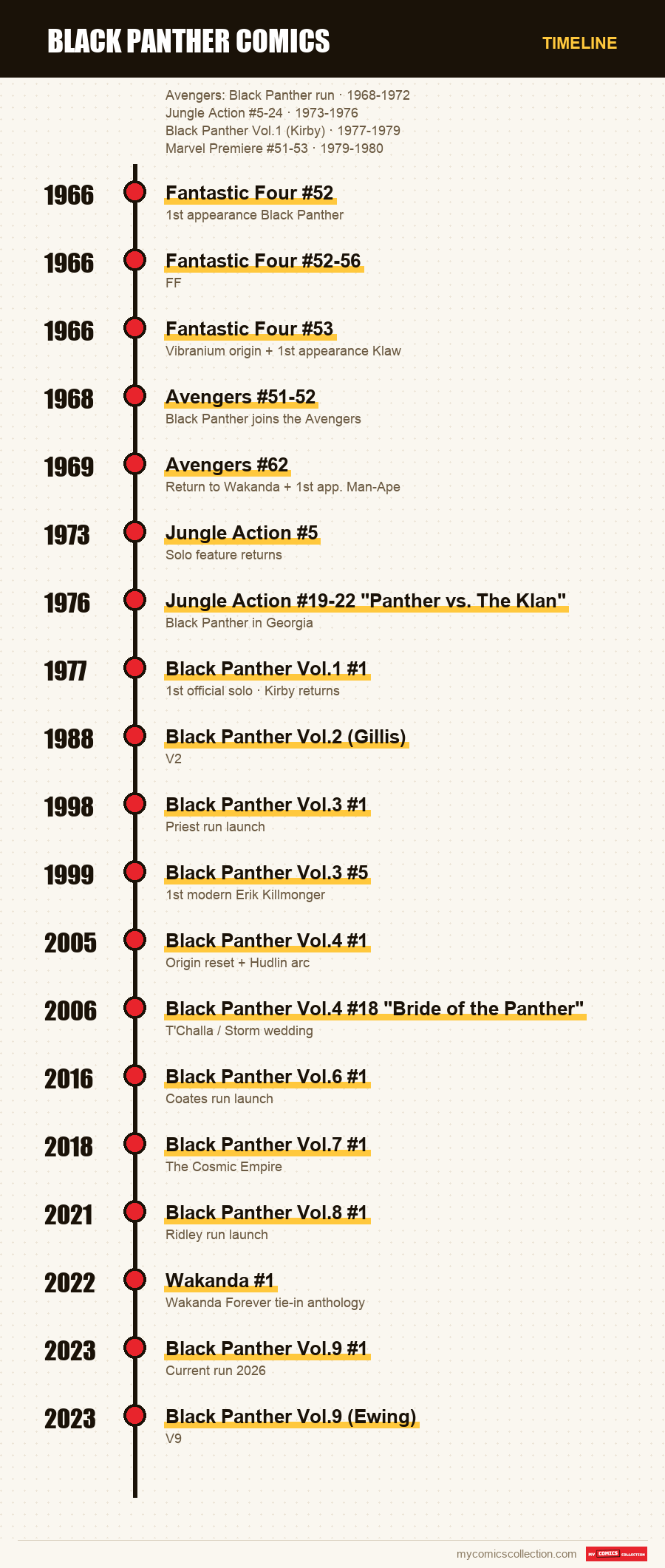
Here are the most important issues to know in chronological order:
Fantastic Four #52
The founding issue. First appearance of T'Challa and Wakanda. A complete story where the Fantastic Four are hunted by the king-panther in his secret kingdom. The first mainstream Black super-hero in comics history. A CGC 9.8 copy sold for $480,000 in 2021 (record), a CGC 9.6 over $100,000. Top 10 most expensive modern comics in the world, a universally recognized key issue.
Fantastic Four #53
The issue that immediately follows the birth and that establishes the permanent mythology: Vibranium meteorite, assassination of King T'Chaka by Klaw, T'Challa's mission of vengeance and protection, geography of Wakanda. First appearance of Ulysses Klaw, the major historical antagonist. CGC 9.6 estimated between $6,000 and $12,000 in 2026.
Avengers #51-52
T'Challa joins the main Avengers team. The first major Marvel team to count a permanent Black member. Roy Thomas kicks off a Wakandan cycle that will stretch over 5 years in Avengers. Long underrated issues, very much in demand post-MCU.
Avengers #62
First return of Black Panther to Wakanda as an Avengers member. First appearance of M'Baku, the Man-Ape / White Gorilla, a major historical antagonist (played by Winston Duke in the MCU films). An essential issue for fans of pre-McGregor Wakandan mythology.
Jungle Action #5
First issue where Don McGregor takes Black Panther back as a solo feature. The cover announces the historical turning point: Black Panther will never again be a secondary character. Foundational issue of the McGregor run.
Jungle Action #6-18 "Panther's Rage"
The foundational arc. 13 consecutive chapters telling the revolt of Erik Killmonger against T'Challa in Wakanda. Creation of the entire modern Wakandan pantheon (Tribal Council, historical Dora Milaje, Jabari tribe, goddess Bast, heart-shaped herb). The first long coherent arc at Marvel, retrospectively considered the publisher's first graphic novel. Jungle Action #6 contains the original first appearance of Erik Killmonger (1973).
Jungle Action #19-22 "Panther vs. The Klan"
The most political arc in Black Panther's history before Coates. T'Challa leaves Wakanda for the American South (Georgia) to investigate racist murders committed by the Ku Klux Klan. McGregor tackles American racism head-on in a mainstream Marvel series: unthinkable in 1976. Issues sought after for their historical value.
Black Panther Vol.1 #1
First issue of the first official solo series. Jack Kirby returns as writer-artist. Launches the King Solomon's Frog arc, pulp / cosmic adventure tone. A historically important issue (first solo title on the newsstand for the character), even if the storyline divides McGregor fans.
Black Panther Vol.3 #1
First issue of the Christopher Priest run. Introduces Everett K. Ross (State Department-attached narrator, played by Martin Freeman in the films), redefines the character's tone. A 62-issue run considered the absolute reference for modern Black Panther.
Black Panther Vol.3 #5
First modern appearance of Erik Killmonger after being reread by Christopher Priest. The character takes on the psychological depth that will inspire Michael B. Jordan in the 2018 film (Killmonger as a legitimate contender for the throne, a returning exile claiming his share). An essential issue for MCU fans.
Black Panther Vol.4 #1
Complete reboot by Reginald Hudlin. Romita Jr. on art. Reset of Wakanda's origins as a modern superpower. A heavily collected relaunch issue, kicks off the Hudlin cycle (Civil War tie-ins, Storm wedding, Secret Invasion).
Black Panther Vol.4 #18 "Bride of the Panther"
The wedding of T'Challa and Storm, a major Marvel event of 2006. Reunion of two of the publisher's biggest Black characters. A variant issue (Frank Cho cover) very much in demand, value tripled since Wakanda Forever (2022).
Black Panther Vol.6 #1
First issue of Black Panther's most high-profile run. Coates, National Book Award winner, takes the reins to set the stage for the MCU film (2018 release). Brian Stelfreeze delivers stunning pages. Launched at over 250,000 copies (a Marvel record for a Black hero). Numerous variant covers, sought after.
A Nation Under Our Feet (Vol.6 #1-12)
First Coates arc (12 issues). Wakanda crossed by a democratic revolution: Tetu, the Midnight Angels, the People's Council. The 3-volume trade paperback is the run's bestseller. A deep political story, with direct references to Coates the journalist for The Atlantic.
Black Panther Vol.7 #1
Launch of Vol.7 directly after the MCU film's release. Coates pivots to space-opera: T'Challa enslaved in the Intergalactic Empire of Wakanda, 2,000 years in the future. The Intergalactic Empire of Wakanda arc. Issue #1 launched at over 200,000 copies.
Black Panther Vol.8 #1
John Ridley, Oscar-winner for 12 Years A Slave, takes over from Coates. Spy run, T'Challa as spymaster. Launched after the death of Chadwick Boseman and before Wakanda Forever (2022 release). Issue very much in demand in variant covers post collective grief around the film.
Wakanda #1
Launch of the Wakanda anthology in parallel with the release of the Wakanda Forever film (November 2022). Stephanie Williams, Evan Narcisse, Tochi Onyebuchi each write a chapter. A spin-off centered on Okoye, Aneka, Ramonda, Shuri.
Black Panther Vol.9 #1
Launch of the current volume by Eve L. Ewing. Return to an earthbound Wakanda, exploration of the T'Challa / Shuri / Storm relationships. Variant covers very much in demand. The run is ongoing in 2026.
The major Black Panther story arcs in order
Panther's Rage (1973-1975)
The first Marvel graphic novel. Killmonger against T'Challa. Don McGregor invents modern Wakanda.
Panther vs. The Klan (1976)
T'Challa investigates the Ku Klux Klan in Georgia. Don McGregor / Billy Graham. Frontal politics.
Coming of the Yeti (1977)
Cosmic-pulp Kirby arc. King Solomon's Frog, time travel.
Enemy of the State (1998-1999)
Priest launch. Everett Ross, complete redefinition of the character.
The Story of Wakanda (1999-2000)
Continuation of the Priest run. Wakandan geopolitics, Achebe.
Civil War: Black Panther tie-ins (2006-2007)
T'Challa traverses the Marvel Universe during Civil War. Wakanda's political stance.
Secret Invasion: Black Panther (2008)
Wakanda alone resists the Skrull invasion. Storm and T'Challa on the front line.
Hudlin Reign Era (2005-2008)
Pan-African vision. Wakanda as global economic superpower.
Time Runs Out (2014-2015)
T'Challa during the Hickman / Avengers events. Incursions, end of the multiverse.
A Nation Under Our Feet (2016-2017)
First Coates arc. Democratic revolution in Wakanda.
Avengers of the New World (2017-2018)
Continuation of the Coates run. Wakandan gods against foreign gods.
The Intergalactic Empire of Wakanda (2018-2021)
Coates moves to space-opera. T'Challa enslaved in the future.
Wakanda Forever event (2018)
Crossover with X-Men, Avengers, Spider-Man. Dora Milaje on a mission to Earth.
Hidden Kingdoms (2024-2025)
Wakanda / Atlantis / Latveria crossover. Diplomacy of the hidden nations.
Brave New World (2024)
Ewing run. Return to an earthbound Wakanda, focus on the royal family.
How to start a Black Panther collection in 2026
Set a clear goal
"I want all of Black Panther" is a bad goal (250+ canonical issues spread across 9 volumes + spin-offs). "I want the complete Priest run (Vol.3 #1-62)" or "the Coates run (Vol.6 + Vol.7, 43 issues)" or "Don McGregor's Panther's Rage (Jungle Action #6-18)" are excellent starting points.
Import the catalog into My Comics Collection
With My Comics Collection, import Fantastic Four, Avengers (BP run), Jungle Action, Black Panther Vol.1 through 9, and all the mini-series (World of Wakanda, Shuri, Killmonger, Wakanda 2022). Each issue and volume is identified separately.
Prioritize key issues
The 18 key issues listed represent 80% of the historical value. See our dedicated Black Panther top 10 for a focus on key issues + CGC values. Fantastic Four #52 (1st app.) is out of reach but plenty of other key issues are constantly moving.
Organize by run rather than by issue number
Black Panther is best collected by run (McGregor, Priest, Hudlin, Coates, Ridley, Ewing) rather than by strict chronological issue. Each run has its own narrative coherence and visual style.
Track post-MCU valuation
Black Panther key issues are among the most volatile in the market: surge in 2018 (film release), another rise in 2022 (Wakanda Forever / death of Chadwick Boseman), maintained at high levels through 2026. My Comics Collection updates values based on actual eBay and auction sales.
Why Black Panther remains a collection pillar in 2026
Black Panther is one of the most collected characters post-2018. Several structural reasons explain the lasting demand:
- MCU films : Black Panther (2018, Ryan Coogler, Chadwick Boseman) racked up $1.3 billion at the global box office, becoming the most profitable super-hero film in history at its release. Wakanda Forever (2022) brought in $859 million as a tribute to Boseman, who passed away in 2020. Source comics have seen continuous demand since then.
- Cultural importance: as the first mainstream Black super-hero in comics history, Black Panther holds an irreplaceable place in the African-American and global imagination. The character has become a symbol of Black pride well beyond geek circles.
- Killmonger / Michael B. Jordan: Michael B. Jordan's performance as Killmonger in the 2018 film propelled the villain to cult antagonist status. The key issues introducing Killmonger (Jungle Action #6, BP Vol.3 #5) have become highly sought after.
- MCU phase 5+: Marvel Studios keeps the franchise active with a Disney+ Wakanda series, appearances by Shuri (Letitia Wright), Riri Williams (Ironheart) and Namor crossing over since 2022. Announced for 2026: a third film centered on the new Black Panther (Shuri).
- Plurality of runs: 5 major cult runs (McGregor, Priest, Hudlin, Coates, Ridley) each with its own identity: a character that's known how to reinvent itself rather than stagnate. No other Marvel hero counts as many major African-American writers (Priest, Hudlin, Coates, Ridley, Ewing, Roxane Gay, Stephanie Williams, Nnedi Okorafor, Evan Narcisse, Tochi Onyebuchi).
Biography of T'Challa (Black Panther)
Black Panther is created by Stan Lee and Jack Kirby and published by Marvel Comics. His first appearance is in Fantastic Four #52 in July 1966.
Identity sheet
- Full name: T'Challa
- Date of birth: July 1966 (creation)
- Place of birth: Birnin Zana, Wakanda (Africa)
- First appearance : Fantastic Four #52 (July 1966)
- Creators: Stan Lee (writer) and Jack Kirby (artist)
- Editor: Marvel Comics
- Memberships: Avengers, Defenders, Illuminati, Royal Family of Wakanda
Origins
T'Challa is the son of King T'Chaka, ruler of Wakanda. When his father is murdered by Klaw (Klaue), T'Challa inherits the throne and the identity of Black Panther, sacred protector of Wakanda. He is the first mainstream black superhero in the history of American comics (1966). His first appearance in Fantastic Four #52 (July 1966) precedes the creation of the Black Panther Party (October 1966) by 4 months: pure coincidence according to Stan Lee.
Powers and Abilities
- King of Wakanda, the most technologically advanced African nation
- Strength, speed, agility, amplified senses and reflexes (heart-shaped herb)
- Mastery of martial arts and close combat (Hannya, Ngozi)
- Vibranium Suit: resistance, absorption of kinetic energy
- Scientific genius and military strategist
- Mystical links with the Panther Goddess (Bast)
- Unlimited access to Wakanda technologies and Vibranium resources
Costume and visual identity
Full black woven Vibranium suit, panther mask with luminous white eyes, retractable Vibranium claws on gloves. Traditional panther teeth necklace. Variants: Combat armor with kinetic purple energy.
Build your Black Panther collection methodically
Import the 250+ Black Panther issues + spin-offs in one click, identify your missing key issues, track post-MCU eBay value. Free 7-day trial.
🚀 Start the free 7-day trialGo further
FAQ, History of Black Panther
Other comics character histories to discover
Our complete "Comics history" article series covers the 20 biggest Marvel and DC franchises. Each article follows the same format: birth, complete chronology of volumes, parallel series, key issues sorted chronologically, major arcs and collection method.
→ See all "History" blog articles