Thor was born in August 1962 in Journey into Mystery #83 , written by Stan Lee , scripted by his brother Larry Lieber and drawn by Jack Kirby. The concept: bring Norse mythology into the nascent Marvel universe by turning the god of thunder into a modern superhero. The anthology series Journey into Mystery officially became The Mighty Thor at issue #126 (March 1966), the starting point for legacy numbering that exceeds 750 issues. Thor today has 5 numbered main volumes + 7 spin-off series (Vol.6 and Vol.7 included), plus dozens of spin-offs (relaunched Journey into Mystery, Loki: Agent of Asgard, Jane Foster Mighty Thor, Thor: God of Thunder…). This article walks through the character's origin, gives you the full chronology of the series in order, and lists the key issues you need to know to build a structured collection.
Alongside Spider-Man, Hulk and Iron Man, Thor is one of the founding pillars of the 1960s Marvel universe and one of the five Avengers co-founders in Avengers #1 (September 1963). But where Spider-Man embodies daily life and Hulk carries repressed rage, Thor opens up Marvel's cosmic and mythological dimension. His playground is Asgard, the Nine Realms, the wars between Olympians and Asgardians, the confrontations with Galactus, the Celestials or Surtur. No other Marvel character has, so early on, allowed the House of Ideas to expand its narrative scale beyond Earth.
This guide will give you everything you need to know to understand the birth of Thor , follow the complete list of Thor comics in order , and identify the key issues and major arcs to prioritize. We'll cover 60+ years of the character, from Journey into Mystery #83 (1962) to Torunn Grønbekk's current run in 2024-2026, distinguishing the main volumes, the parallel ongoings (relaunched Journey into Mystery, Loki: Agent of Asgard, Jane Foster Mighty Thor) and the many cult mini-series (Thor: Vikings by Garth Ennis, War of the Realms, Thor: God of Thunder by Jason Aaron…).
The birth of Thor in 1962: Marvel meets Norse mythology
To understand how Thor was born, you have to go back to summer 1962. Stan Lee had just signed off on a string of hits in less than a year: Fantastic Four #1 (November 1961), Hulk #1 (May 1962), and Amazing Fantasy #15 (August 1962, the introduction of Spider-Man). Marvel Comics, then a small publishing house called Atlas just months earlier, was multiplying fresh concepts to capitalize on the superhero revolution it had launched itself. Stan Lee was looking for a hero even more powerful than Hulk, literally, a living god. The answer was direct: why invent a character from scratch when an entire mythology, free of rights, was waiting to be plundered? Norse mythology, with its dramatic pantheon, fratricidal wars and cyclical apocalypse (Ragnarok), offered considerable narrative riches.
Stan Lee handed the script to his younger brother Larry Lieber, who would write most of the episodes for the first three years (under Stan's directions). On art, it was Jack Kirby, already deep into collaboration with Lee on Fantastic Four and Hulk, who took over the design. Kirby, deeply marked by Scandinavian mythology since his work on Tales of the Unexpected and The Mighty Thor at DC in 1957 (a pre-Marvel Thor published by DC whose visual motifs would return in the Marvel version), brought the cosmic touch that would become Asgard's visual signature: oversized architecture, golden costumes, beams of cosmic energy. The cover of Journey into Mystery #83, drawn by Kirby, shows Thor wielding Mjolnir over stone monsters, the Marvel-Asgard iconography was born in one stroke.
Journey into Mystery #83 (August 1962)
Thor makes his first appearance in Journey into Mystery #83 (cover-dated August 1962, on newsstands as early as May 1962), in a 13-page story titled "The Stone Men from Saturn ". The script: Donald Blake, a lame American doctor on vacation in Norway, discovers an ancient wooden cane in a cave. Striking the cane against a rock, the doctor transforms into Thor, the Norse god of thunder, and the cane becomes Mjolnir, the enchanted hammer. Donald Blake then repels an alien invasion. The concept of the secret identity with magical transformation, inherited from the 1940s Captain Marvel comics, is reused here in a brand-new mythological version.
The canonical foundations are laid: Mjolnir can only be lifted by one who is worthy (the concept of the worthy would become central for 60 years), Thor speaks an archaic Shakespearean English ("thee", "thou"), and Asgard exists in parallel to Earth via the rainbow bridge Bifrost. The success was immediate. Journey into Mystery, until then an anthology series of monster comics and science fiction (titles like Tales to Astonish or Strange Tales), is fully converted into a Thor series. By JiM #84 (September 1962), Loki, adopted brother and major antagonist, makes his entrance. JiM #85 introduces Heimdall and Tyr. JiM #93 takes us to Asgard for the first time. JiM #97 stabilizes Odin in his modern version with his runes and golden throne.
The 1966 pivot: The Mighty Thor #126
For 43 issues (August 1962 → February 1966), the series kept its title Journey into Mystery, a holdover from its anthology past. But in March 1966, Marvel decided to solidify the character's identity by officially renaming the series The Mighty Thor . Issue #126 (March 1966) inaugurates the canonical title, keeping the legacy numbering (the issue following #125, the last Journey into Mystery). It's also from this point on that Stan Lee personally takes over the script from his brother Larry, and that Jack Kirby fully develops the title's cosmic potential. The arcs become longer, more grandiose: Galactus arrives in Mighty Thor #160-162, the concept of the Eternals is being prepared, Mangog appears in #154, and Asgard becomes a narrative location in its own right, almost as much as Earth.
The historical irony: Thor is one of the rare Marvel characters whose first series changes title mid-stream. Journey into Mystery #83-#125 and The Mighty Thor #126-#502 are actually the same series, just renamed. For collectors, that means two things: (1) Journey into Mystery #83 remains the authentic 1st Thor despite the different title, and (2) Thor's legacy numbering therefore starts in 1962, not 1966, which is why Thor #500 falls in July 1996.
The main Thor volumes in chronological order
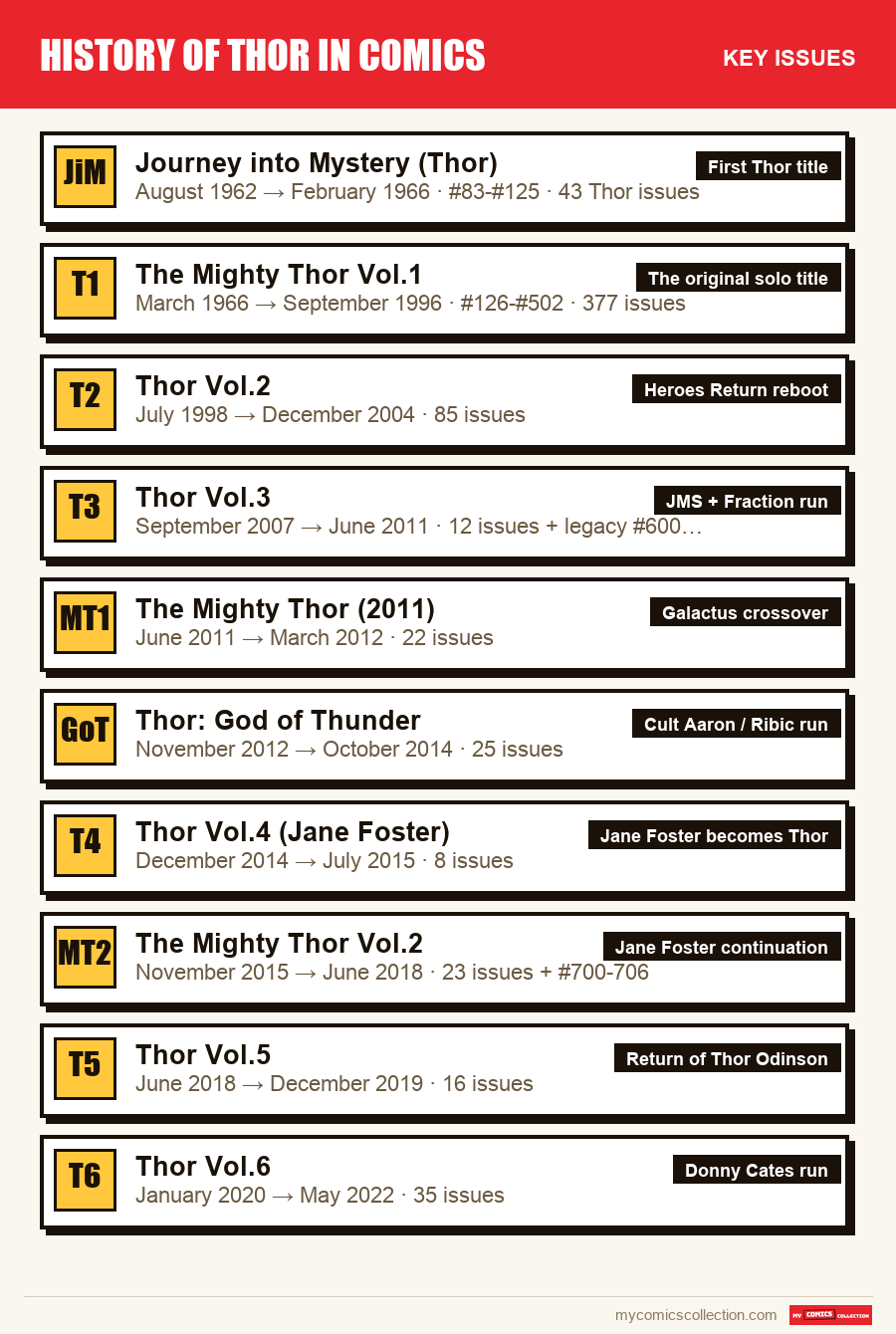
The Thor franchise has 11 main numbered series spread over 60+ years. Here are the principal ones in the order of their first issue:
Journey into Mystery (Thor)
The matrix series. Journey into Mystery had existed since 1952 as a horror/sci-fi anthology, but issue #83 (August 1962) brings Thor in for the first time. For 43 issues, the series carries this title while telling exclusively the Norse god's adventures. First Loki (#84), Heimdall and Tyr (#85), Asgard (#93), modern Odin (#97), Hulk vs Thor (#112), Absorbing Man (#114). Larry Lieber wrote most of these episodes under Stan Lee's directions, Jack Kirby drew.
The Mighty Thor Vol.1
Thor's main run, over 30 uninterrupted years. The Mighty Thor #126 picks up the legacy numbering after Journey into Mystery #125 . Major turning points: #154 (1st Mangog), #160-162 (Galactus), #337-340 (Walter Simonson, Beta Ray Bill, Stormbreaker), #380 (Hela kills Thor), #400 , #432 (end of the Simonson run), #500 (anniversary). The Walter Simonson run (1983-1987, #337-#382) is considered the definitive Thor run, the equivalent of Frank Miller on Daredevil or Chris Claremont on X-Men.
Thor Vol.2
Post-Heroes Reborn launch by Dan Jurgens (#1-79, virtually the entire run) and concluded by Michael Avon Oeming (#80-85). Jurgens introduces the Maestro arc, the temporary female Loki, and Asgard's fall onto Earth in Manhattan. Oeming closes things out with Ragnarok (#80-85), a devastating arc where Thor accepts Asgard's cyclical end. The volume ended in December 2004 with the symbolic death of the god of thunder, Marvel went without a Thor series for 3 years.
Thor Vol.3
Thor's renaissance under J. Michael Straczynski and Olivier Coipel. Thor #1-12 pick up a destroyed Asgard, set down hovering above an Oklahoma plain. Starting with #600, the numbering picks up the legacy (Vol.1 + Vol.2 + Vol.3). Matt Fraction then takes over the series from #608 to #621, before the Marvel NOW reboot. An important period because it lays the visual foundations for Kenneth Branagh's Thor (2011) film.
The Mighty Thor (2011)
A direct sequel to the Fraction run, under the title The Mighty Thor. 22 issues that culminate with the Galactus Seed arc and the Everything Burns event (crossover with Journey into Mystery, Loki's title). A quick run that prepares the transition to Marvel NOW.
Thor: God of Thunder
Marvel NOW launch with Jason Aaron on script and Esad Ribic on art. A run unanimously considered one of the three best Thor runs of all time alongside Lee/Kirby and Simonson. The God Butcher arc (#1-11) introduces Gorr the God Butcher, a major antagonist popularized by Thor: Love and Thunder (2022). Followed by Godbomb and The Last Days of Midgard.
Thor Vol.4 (Jane Foster)
A historical turning point: Jane Foster replaces Thor Odinson as the wielder of Mjolnir. Run by Jason Aaron and Russell Dauterman . The Thor Vol.4 #1 issue (December 2014) is one of the most collected key issues of the 2010s decade, popularized by Thor: Love and Thunder (2022) where Natalie Portman takes on this role.
The Mighty Thor Vol.2
A direct continuation of Thor Vol.4 Jane Foster, still by Aaron / Dauterman. Includes the major arc The Unworthy Thor (where Odinson goes off looking for a new Mjolnir) and The Death of the Mighty Thor which sees Jane Foster sacrifice her life to defeat Mangog. Issue #700 (October 2017) picks up the legacy numbering.
Thor Vol.5
Conclusion of Jason Aaron's mega-run (started in 2012). Thor Odinson regains his dignity and his hammer. The series culminates with the War of the Realms event (2019), a cosmic war where Malekith invades the Nine Realms. Aaron's run on Thor stretches over 7 years and around 90 issues across all titles, one of the longest Thor solo runs in history.
Thor Vol.6
Thor becomes king of Asgard. Donny Cates and Nic Klein orchestrate the The Black Winter arc (#1-6), a cosmic threat that even outpaces the Ancients. Followed by God of Hammers , Revelations , and the Banner of War crossover (#25-30) where Thor takes on Hulk in a cosmic war. Thor #750 (February 2022) celebrates the anniversary with an anthology of authors.
Thor Vol.7
A new launch by Torunn Grønbekk, an author who'd made her name on Mighty Valkyries and Strange Academy. The current run continues through 2026 with a focus on authentic Norse mythology, the Valkyries, and the post-Cates stakes. Recent issues are in heavy demand on variant covers from modern collectors.
All parallel Thor series in chronological order
Alongside the main volumes, Marvel has published dozens of Thor spin-off series. Here's the chronology of the principal titles to understand the Asgardian ecosystem:
- Thor Annual (1966 → ongoing): annual issues outside the main series, often reserved for extended cosmic arcs. More than 30 annuals since 1966.
- Journey into Mystery (Loki relaunch) (2011-2013, #622-#655): the original series picks up its legacy numbering but this time centered on Kid Loki . A cult run by Kieron Gillen that reinvents Loki as a tragic character. Direct connection to the Disney+ Loki series.
- Thor & Hercules: Encyclopedia Mythologica (2009, one-shot): an official guide to Marvel mythologies, published during the JMS run.
- Thor: Vikings (2003, 5 issues): a Garth Ennis / Glenn Fabry maxi-series, published under the MAX label (adult). Vampiric Vikings attack modern New York. An ultra-violent tone, very atypical in the Thor canon.
- Thor: Loki (2004, 4 issues): a Robert Rodi / Esad Ribic maxi-series, focused on Loki before he becomes fully evil.
- Loki: Agent of Asgard (2014-2015, 17 issues): a cult run by Al Ewing / Lee Garbett. Loki becomes a teenager again and works for Asgard. A reference for fans of the Disney+ series.
- Thor: Ragnarok (various mini-series): adaptations of the Ragnarok arcs to set up the 2017 Marvel Studios film.
- Thor: God of Thunder, Esad Ribic variant volumes (2012-2014): heavily sought-after deluxe and hardcover editions of the Aaron run.
- War of the Realms (2019, 6 issues + tie-ins): a major event orchestrated by Jason Aaron, the conclusion of his Thor run begun 7 years earlier. Malekith ignites a cosmic war across the Nine Realms.
- Asgardians of the Galaxy (2018-2019, 10 issues): an Asgard / cosmos team-up by Cullen Bunn. A spin-off with Cosmic Ghost Rider + Valkyrie + Skurge.
- Beta Ray Bill (2020-2021, 5 issues): a Daniel Warren Johnson maxi-series centered on the horse-Thor hero, after the Cates run.
- The Unworthy Thor (2016-2017, 5 issues): an Aaron / Olivier Coipel maxi-series on Odinson's quest after losing Mjolnir.
- Thor: God of Thunder Reborn (2018, mini): a narrative bridge between Mighty Thor Jane Foster and Thor Vol.5.
- Mighty Valkyries (2021, 5 issues): Torunn Grønbekk / Jane Foster Valkyrie.
- Loki Disney+ tie-in series (2021-2024): multiple mini-series published alongside the TV show.
Thor key issues in chronological order
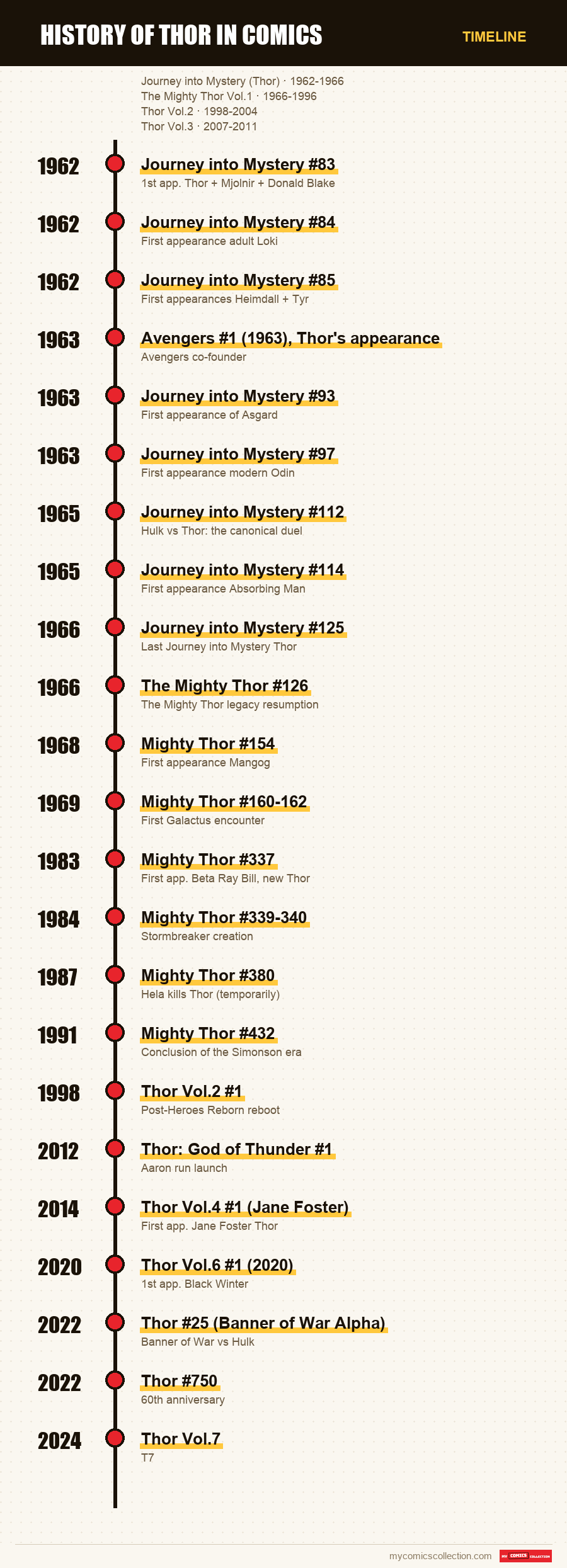
Here are the most important issues to know in chronological order:
Journey into Mystery #83
The founding issue. Three firsts in a single comic: Thor , Mjolnir and Donald Blake . 13-page story " The Stone Men from Saturn". A CGC 9.0 copy sold for over $350,000 in 2021. Top 10 of Marvel's most valuable Silver Age comics.
Journey into Mystery #84
First appearance of Loki in his adult version (in his god-of-mischief form). Thor's main antagonist starts here. Loki will also be the trigger for the formation of the Avengers in Avengers #1 (1963), trying to take out Thor with traps that inadvertently brought together Iron Man, Hulk, Wasp and Ant-Man.
Journey into Mystery #85
First appearance of Heimdall (guardian of the Bifrost) and Tyr. The first issue to introduce the idea of a complete Asgardian pantheon, beyond just Thor. An often undervalued issue, whose value spiked massively after Thor (2011) where Idris Elba plays Heimdall.
Journey into Mystery #93
Thor's first journey into Asgard, the realm of the gods. Until now, Thor had been operating on Earth and only mentioned Asgard in dialogue. Kirby unleashes all of his cosmic architecture here: Odin's palace, Bifrost, impossible gilding. The visuals of Asgard would be carried over into all of the Marvel Studios films.
Journey into Mystery #97
First appearance of Odin in his definitive visual version: golden throne, cape, eyepatch, ravens Hugin and Munin. The All-Father stabilized for 60 years of continuity. Odin had appeared earlier in mention, but the canonical design dates from this issue.
Journey into Mystery #112
First true Hulk vs Thor duel over 18 pages, one of the most legendary fights of the 60s. Stan Lee and Kirby orchestrate a god vs. monster face-off whose lines became cult favorites. This confrontation would be revisited in every form afterwards (Avengers, Banner of War 2022, MCU).
Journey into Mystery #114
First appearance of Crusher Creel / Absorbing Man, created by Loki to defeat Thor. A recurring villain who would become one of Marvel's most-used secondary antagonists (Hulk, Avengers, X-Men). Screen appearance in Agents of S.H.I.E.L.D..
Journey into Mystery #125
The last issue of the series under the title Journey into Mystery . The next will be The Mighty Thor #126. A transitional issue sought after by collectors looking to round out the JiM Thor run (#83-#125, 43 consecutive issues).
The Mighty Thor #126
First issue under the canonical title The Mighty Thor. The numbering continues from #125 (JiM) to #126 (Mighty Thor), preserving the legacy. A founding issue of the new Thor era. Stan Lee fully takes over the script from his brother Larry Lieber, who had written most of #83-#125.
Mighty Thor #154
First appearance of Mangog, one of the most powerful cosmic threats in the Marvel multiverse. Mangog embodies the rage of "billions upon billions" of souls annihilated by the Asgardians. An antagonist reused by Jason Aaron in his final run to wrap up Jane Foster's death.
Mighty Thor #160-162
The first true Thor vs Galactus face-off. A cosmic crossover with the world-eater after his appearances in Fantastic Four #48-50 (1966). Issue #160 is particularly sought after for the Kirby cover that became iconic of the cosmic-Marvel period.
Mighty Thor #337
The issue that changes everything. Walter Simonson arrives as writer-artist and launches his 4-year run. Beta Ray Bill, a horse-warrior alien, lifts Mjolnir, proving he's worthy. He briefly becomes the new Thor. The first time anyone other than Thor Odinson wields Mjolnir. Iconic cover: Bill brandishing Mjolnir, Thor on the ground. A CGC 9.8 is worth $1,500-2,000 in 2026.
Mighty Thor #339-340
Odin forges a new hammer specifically for Beta Ray Bill: Stormbreaker. Beta Ray Bill keeps his own legendary weapon, and Thor gets Mjolnir back. Stormbreaker would return in the MCU with Avengers: Infinity War (2018) where Thor himself forges it on Nidavellir.
Mighty Thor #380
Hela, goddess of death, breaks Thor's bones without being able to kill him (Thor already being blessed). An issue made entirely of splash pages, one of Walter Simonson's most celebrated graphic feats. The absolute reference for the Hela-Thor sequence, revisited in Thor: Ragnarok (2017) with Cate Blanchett.
Mighty Thor #432
Walter Simonson's run actually ended with #382 (1987), but it's #432 that closes off the open arcs from that period. Tom DeFalco takes over and steers Thor toward the "Thor Corps" run. The Simonson run remains, for most fans, the best Thor run ever published.
Thor Vol.2 #1
Launch of Volume 2 after the Heroes Reborn / Heroes Return event. Dan Jurgens writes, John Romita Jr. draws. The first Thor issue in 4 years (since the last Mighty Thor #502 in 1996). A heavily collected issue, considered "ground floor" by fans of the 90s.
Thor: God of Thunder #1
First issue of the Jason Aaron mega-run on Thor (2012-2019). Introduction of Gorr the God Butcher, an antagonist who would define the decade. The Aaron run is considered one of the three greatest Thor runs of all time alongside Lee/Kirby and Simonson. Skottie Young and Ribic variants are in heavy demand.
Thor Vol.4 #1 (Jane Foster)
Founding issue of the Jane Foster Thor era. For the first time in main Marvel canon, a woman wields Mjolnir and becomes the god of thunder. Identity revealed in #8. An extremely collected modern key issue, especially since the adaptation in Thor: Love and Thunder (2022) with Natalie Portman. CGC 9.8 valued at $60-100 in 2026.
Thor Vol.6 #1 (2020)
Launch of the Donny Cates run. Thor becomes king of Asgard. First appearance of the Black Winter, a cosmic threat predating any known existence. Heavily collected issue with variants by Olivier Coipel, Adi Granov, Skan, etc.
Thor #25 (Banner of War Alpha)
Launch of the Banner of War crossover between Thor Vol.6 (#25-30) and Hulk Vol.5 (#7-9). Donny Cates orchestrates the ultimate Thor vs Hulk fight in a cosmic war. A modern revisit of the legendary face-off in Journey into Mystery #112 (1965).
Thor #750
Anniversary issue celebrating Thor's 60 years (1962-2022). An anthology of major authors (Cates, Aaron, Walter Simonson returning, Tom DeFalco). Including a Walter Simonson story that picks up his characters 35 years after his original run. Heavily collected variant covers.
Avengers #1 (1963), Thor's appearance
Although it's not a Thor solo issue, Avengers #1 is essential in the Thor chronology: it's here that Thor becomes co-founder of the Avengers with Iron Man, Hulk, Wasp and Ant-Man. Loki is the antagonist who inadvertently brings the team together. CGC 9.0 exceeds $200,000 in 2026.
The major Thor story arcs in order
Surtur Saga (1983-1985)
Walter Simonson's first mega-arc. Surtur, a fire giant, threatens the Nine Realms. The absolute reference.
Beta Ray Bill arc (1983)
The horse-alien lifts Mjolnir. The first time anyone other than Thor wields the hammer.
The Casket of Ancient Winters (1984)
The trigger for the Surtur Saga. Malekith releases the Asgardian casket.
Ragnarok (1985, Simonson)
The first major Ragnarok of the Simonson run. Foreshadows Asgard's cyclical ends.
The Hela Saga (1987)
Hela breaks Thor's bones. The visual and emotional climax of the Simonson run.
Ragnarok (Oeming, 2004)
Conclusion of Vol.2. Thor accepts Asgard's cyclical end. A 3-year pause before Vol.3.
Worldengine / Asgard reborn (2007-2008)
JMS picks up Thor. Asgard rebuilds itself in levitation above Oklahoma.
God Butcher (2012-2013)
Launch of the Aaron run. Gorr the god butcher. A run unanimously embraced.
Godbomb (2013)
A direct sequel to God Butcher. Three Thors (past, present, future) team up against Gorr.
The Last Days of Midgard (2014)
Aaron / Esad Ribic. Thor faces the ecological destruction of Earth by Roxxon.
The Unworthy Thor (2016-2017)
Odinson, unworthy, sets out into space looking for a new Mjolnir.
The Death of Mighty Thor (2017-2018)
Jane Foster sacrifices her life to defeat Mangog. A historic heroic death.
War of the Realms (2019)
Jason Aaron's major event. Malekith invades the Nine Realms. A conclusion 7 years after God Butcher.
Black Winter (2020)
Donny Cates launch. A cosmic threat predating any existence.
God of Hammers (2021)
Cates continues. Thor discovers that Mjolnir has its own consciousness.
Banner of War (2022)
Thor / Hulk crossover. Cates orchestrates the ultimate cosmic duel.
AXIS (Avengers / X-Men, 2014)
A Marvel event where Thor (now unworthy) takes part in a cosmic battle with an inverted team.
Thor Goes to Hell (2009-2010)
Loki, dead, refuses Hell. Thor descends into Hel to find him.
Original Sin: Thor & Loki (2014)
During Original Sin, Loki loses his redemption. A preface to Loki: Agent of Asgard.
Thors (Battleworld / Secret Wars, 2015)
During Secret Wars, multiple Thors become Battleworld's police force. Aaron mini-series.
Beta Ray Bill (Daniel Warren Johnson, 2020)
A Beta Ray Bill solo maxi-series, after the Cates run. A very atypical style.
Loki: Agent of Asgard (2014-2015)
Al Ewing redefines Loki. Fully foreshadows the Disney+ series.
How to start a Thor collection in 2026
Set a clear goal
"I want all of Thor" is a bad goal (700+ legacy issues + 50+ spin-off mini-series). "I want the complete Walter Simonson run (Mighty Thor #337-#382, so 46 issues)" or "the Jason Aaron God of Thunder + Mighty Thor + Vol.5 run (around 90 issues)" are excellent starting points.
Import the catalog into My Comics Collection
With My Comics Collection, import Journey into Mystery, The Mighty Thor Vol.1-2, Thor Vol.3-7, Thor: God of Thunder, Mighty Thor (the two Jane Foster volumes), Loki: Agent of Asgard and all the spin-off series. Each issue and volume is distinctly identified, particularly useful for Thor where the legacy numbering picks up several times (#600 in 2009, #700 in 2017, #750 in 2022).
Prioritize the key issues
The 22 key issues listed make up 80% of the historical value. See our dedicated top 10 Thor for a focus on key issues + CGC values, notably Journey into Mystery #83 and Mighty Thor #337.
Organize by run rather than by issue
Thor is collected by run (Lee/Kirby, Simonson, Jurgens, JMS, Aaron, Cates, Grønbekk) rather than by strict chronological issue. It makes for easier reading and gives the collection meaning. The Simonson run 1983-1987 and the Aaron run 2012-2019 are the two absolutely essential runs.
Track eBay valuation
Journey into Mystery #83 is now expensive (CGC 9.0 exceeds $350,000), but plenty of Thor key issues remain affordable. Mighty Thor #337 CGC 9.8 stays below $2,000, Thor Vol.4 #1 below $100. My Comics Collection updates values based on real sales.
Why Thor is still massively collected in 2026
Alongside Spider-Man, Hulk and Iron Man, Thor is one of Marvel's most active franchises in monthly sales in 2026. Several reasons:
- Triple MCU impact: Chris Hemsworth played Thor in 8 Marvel Studios films between 2011 and 2022 (Thor, Avengers 1-2-3-4, Thor: Dark World, Thor: Ragnarok, Thor: Love and Thunder). No other actor has carried his character across that many films over 13 years. Thor: Love and Thunder (2022) notably revived interest in Jane Foster Thor and Gorr the God Butcher from the Aaron run.
- Disney+ Loki series (2021-2024, 2 seasons + spin-offs): a massive critical hit that sent sales of Loki: Agent of Asgard and Journey into Mystery (Kid Loki relaunch by Kieron Gillen) through the roof.
- Cult Walter Simonson run: 46 issues published in 1983-1987, considered the definitive version of Thor by comics nerds. Beta Ray Bill, Surtur Saga, death by Hela. An unmatched reference.
- Aaron God of Thunder run: 7 years of continuity (2012-2019), a coherent mega-arc that redefined Thor for the 2010s decade and provided the source material for Thor: Love and Thunder.
- Jane Foster Thor: a modern key issue : Thor Vol.4 #1 (2014) remains one of the most heavily collected modern comics, especially since the screen adaptation. The temporary "feminization" of Thor remains one of the most discussed moments of the decade.
- Asgardian galaxy: Loki, Beta Ray Bill, Hela, Odin, Heimdall, Sif, Valkyrie, Balder, Skurge, Enchantress, Mangog, Surtur, Malekith… 50+ supporting characters who each have their own fanbase and their own sub-collections.
Biography of Thor Odinson (Thor)
Thor is a character of Marvel Comics created by Stan Lee, Larry Lieber and Jack Kirby. His first appearance is in Journey into Mystery #83 , published in August 1962.
Thor Odinson's identity sheet
- Real name: Thor Odinson (aka Donald Blake)
- Date of birth: August 1962 (creation): fictional: age greater than 1000 years (Asgardian)
- Place of birth: Asgard (realm of the Norse gods)
- First appearance : Journey into Mystery #83 (August 1962)
- Creators: Stan Lee (writer), Larry Lieber (writer) and Jack Kirby (artist)
- Editor: Marvel Comics
- Memberships: Avengers, Asgardians, Warriors Three, God Squad
Character origins
Thor is the son of Odin, king of Asgard, and the crown prince of the kingdom of the Norse gods. Banished to Earth by his father to teach him humility, he takes the form of Donald Blake, a disabled doctor. By hitting his staff against a stone, he transforms into Thor and retrieves his hammer Mjolnir. Over the centuries, he battles his brother Loki, frost giants, and cosmic threats, becoming a founding member of the Avengers.
Powers and Abilities
- Divine Strength (can lift 100+ tons)
- Mjolnir Hammer: worthy to wear, lightning control
- Flight via Mjolnir (by spinning it)
- Almost total invulnerability
- Near-immortal longevity (Asgardian)
- Weather and lightning control
- Mastery of Hammer and Sword Combat
Costume and visual identity
Golden Asgardian armor with red cape, winged helmet, Megingjord belt of force. The hammer Mjolnir is his main weapon and symbol.
Build your Thor collection with method
Import the 700+ Thor issues + Journey into Mystery + Mighty Thor + spin-offs in one click, identify your missing key issues, track eBay value. Free 7-day trial.
🚀 Start your free 7-day trialGo further
- Thor Reading Order: The Complete Guide to Every Run and Era
- Best Thor Comic Runs: The Essential Guide for Collectors
- Best Thor Story Arcs: The Definitive Collector's Reading List
- Top 10 Thor Key Issues Every Collector Must Own
- Thor's First Appearance in Journey into Mystery #83: Collector's Guide & CGC Values
- Thor Comics Collection Guide: Essential Runs, Key Issues & Smart Buying Strategy
FAQ, History of Thor
Other comic character histories to discover
Our complete "Comics history" article series covers the 20 biggest Marvel and DC franchises. Each article follows the same format: birth, full chronology of volumes, parallel series, key issues sorted chronologically, major arcs and collection method.
→ See all "History" articles on the blog