
Captain America was born in March 1941 in Captain America Comics #1 , written by Joe Simon and drawn by Jack Kirby at Timely Comics (the future Marvel Comics). The iconic cover, Cap throwing a punch at Adolf Hitler, hit newsstands 9 months before Pearl Harbor, at a moment when part of American public opinion was still preaching neutrality. The issue sold close to a million copies almost immediately, making Cap one of the biggest hits of the Golden Age. Cap has 9 main volumes plus a cult comeback as a backup feature in Tales of Suspense (1964-1968) following his "resurrection" in Avengers #4 (March 1964). This article walks through the full origin story, gives you the chronology of the series in order, and lists the key issues you need to know to build a structured collection.
Alongside Spider-Man and Iron Man, Captain America is one of Marvel Comics' three symbolic pillars. But where Spidey was born with Stan Lee in 1962 and Iron Man in 1963, Steve Rogers arrives much earlier, in the middle of World War II, at a publishing house that wasn't even called Marvel yet but Timely. Created to lift the spirits of a country divided over entering the war, Cap has spanned more than 85 years of American comics: patriotic Golden Age hero (1941-1949), symbolic death during the 1950s, iconic resurrection in 1964 with Avengers #4, existential depression of the 1970s (#176, abandoning his identity), the carnage of the civil war in 2007 (death of Steve Rogers), Bucky's return as the Winter Soldier, the shield handed to Sam Wilson, the "Hydra Cap" controversy in 2017, and a modern resurrection under J. Michael Straczynski in 2023.
This guide will give you everything you need to know to understand the birth of Captain America , follow the complete list of Cap comics in chronological order , and identify the key issues and major arcs to prioritize in a structured collection. We'll cover 85+ years of the character, from Captain America Comics #1 (1941) through to the current run by Straczynski and Tochi Onyebuchi in 2026, distinguishing the main volumes, the parallel ongoings (Sam Wilson Captain America, Steve Rogers Captain America, Symbol of Truth, Sentinel of Liberty, Captain Carter), and the many cult mini-series (White, Reborn, Theater of War, Patriot).
The birth of Captain America: Timely in 1941
To understand how Captain America was born, you have to go back to fall 1940. Hitler had just invaded Poland (September 1939), France had fallen (June 1940), London was under the Blitz, and yet American public opinion was still divided: the isolationist America First movement, led notably by Charles Lindbergh, was pushing back against any intervention. In this tense context, two young Jewish New York creators, Joe Simon (27) and Jack Kirby (24), decided to create an explicitly anti-Nazi superhero for publisher Timely Publications. Joe Simon had the original idea: an American soldier, draped in the flag, punching Hitler on the cover. Kirby executed it. The result hit newsstands in December 1940.
Captain America Comics #1 (cover-dated March 1941) was a publishing thunderclap. The cover, Cap throwing a right hook into Adolf Hitler's face, with Nazi spies attacking an American military plant, came out 9 months before Pearl Harbor. At that moment, the United States was officially neutral, and the image was deliberately provocative. Simon and Kirby received death threats from American pro-Nazi groups (the German American Bund), to the point that New York Mayor Fiorello La Guardia provided them with police protection. Sales exploded: nearly one million copies sold of that first issue, making it one of the biggest commercial hits of the Golden Age. Captain America instantly became Timely's flagship character, ahead of Sub-Mariner and the Human Torch (the original version).
Joe Simon & Jack Kirby: the creative origin
The Simon-Kirby duo was one of the most prolific of the Golden Age. Joe Simon wrote the scripts and shaped the mythology; Jack Kirby drew. In Captain America Comics #1, they established the entire canon in a single issue: Steve Rogers, a frail young man rejected by the army for physical weakness, agrees to serve as a guinea pig for the top-secret Project: Rebirth . The German scientist Dr. Reinstein (alias Abraham Erskine, later renamed) injects him with the Super-Soldier Serum. Rogers becomes a superhuman. Erskine is immediately assassinated by a Nazi spy, and the formula vanishes with him, making Cap the only Super-Soldier in history. Rogers receives his shield, his uniform in the colors of the flag, and sets off to hunt Nazis. In the same issue, Bucky Barnes appears: a young military camp mascot who discovers Cap's identity and becomes his sidekick. Red Skull also appears in #1, as the main Axis collaborator.
Over time, Simon and Kirby would write the first 10 issues (March 1941 - January 1942) before leaving Timely over a royalty dispute (a Golden Age classic, creators got virtually nothing on their most profitable characters). Stan Lee, then an 18-year-old editorial assistant, wrote his very first published story in Captain America Comics #3 (May 1941, "Captain America Foils the Traitor's Revenge", 2-page text piece). It was the start of an 80-year career. Captain America Comics then ran with various teams (Al Avison, Vince Alascia, Syd Shores) until 1949, when the post-war decline of the superhero genre forced Timely to convert the series into Captain America's Weird Tales (1949-1950), a horror title that no longer used Cap in his traditional role.
The 1950-1964 hibernation and the return in Tales of Suspense
Between 1950 and 1964, Captain America almost disappeared from publication. A brief 1953-1954 revival attempt, "Captain America: Commie Smasher" in Young Men #24-28 and Captain America Comics #76-78 (Atlas Comics) put Cap into the role of communist hunter during the Cold War, a commercial failure, and an episode that was later officially decanonized (Steve Englehart resolved this contradiction in 1972 with a retroactive rewrite: that 1950s Cap was an impostor).
The real comeback arrived in March 1964. Avengers #4 (Stan Lee & Jack Kirby), one of the most important issues in Marvel history, sees the Avengers (Iron Man, Thor, Giant-Man, Wasp, Hulk) pull a frozen body from the Arctic: Steve Rogers, in hibernation since 1945 after an explosion that killed Bucky. Cap immediately joins the Avengers and becomes their narrative leader for the next 60 years. Six months later, in September 1964, Cap got his own 12-13 page backup feature in Tales of Suspense #59, sharing the title with Iron Man (who had the lead). This backup feature ran for 40 issues (Tales of Suspense #59 to #99, September 1964 - March 1968), mostly written by Stan Lee and Jack Kirby, then Jim Steranko on the final issues. With Tales of Suspense #99, the title officially split: Iron Man inherited Iron Man and Sub-Mariner #1 then his own series, and Cap took back the legacy numbering with Captain America Vol.1 #100 (April 1968), which is actually the 100th Cap issue if you count Tales of Suspense as continuous.
The numbering trick: Many collectors are surprised to learn that Captain America Vol.1 #1 (1968) doesn't exist, the series starts directly at #100 in April 1968 because it continues the numbering from Tales of Suspense #59-99 . That's why Tales of Suspense #59 is a major key issue (1st modern solo Cap feature) and Tales of Suspense #98 is the last Cap issue in that series before the split.
The main Captain America series in chronological order
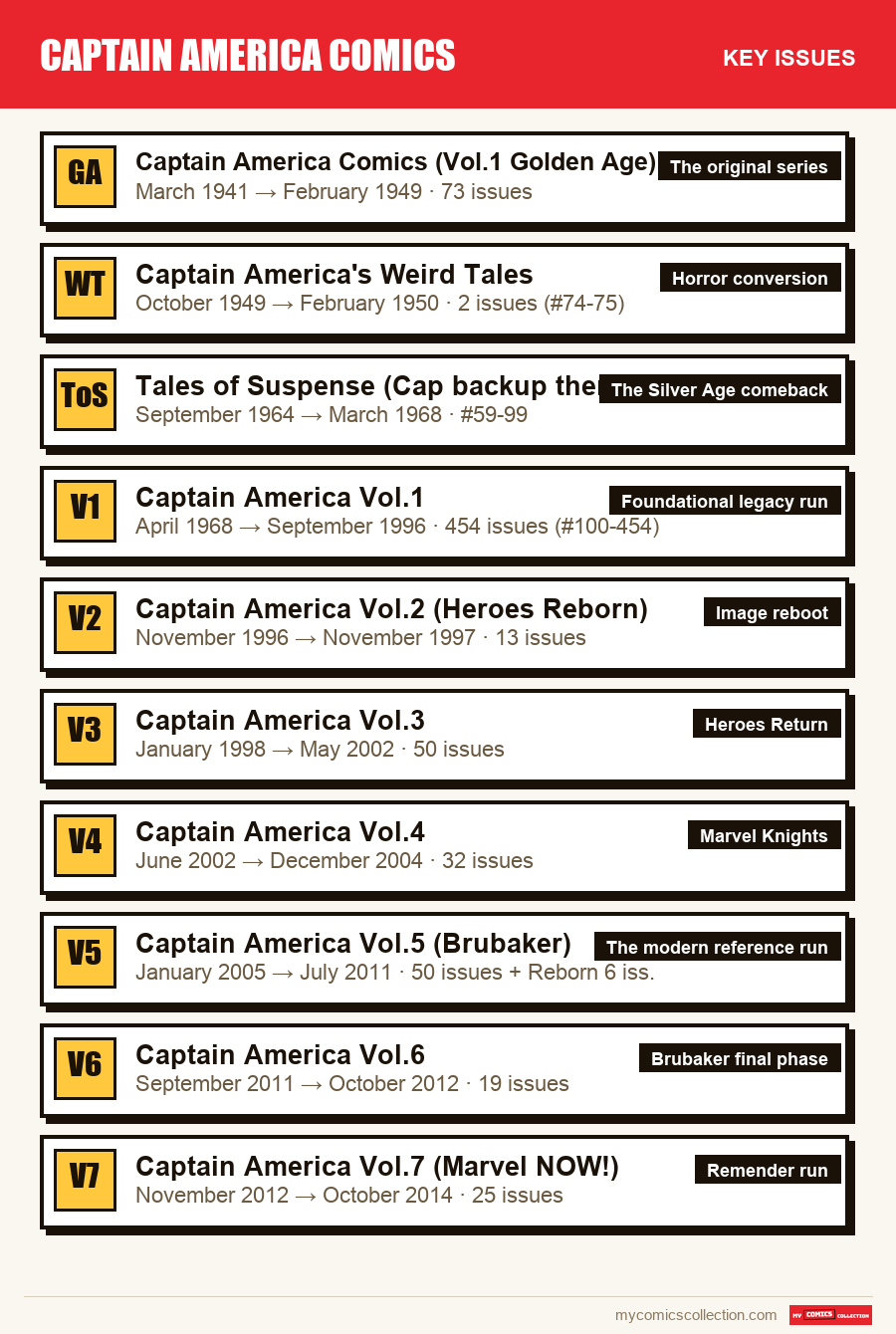
The Captain America franchise is one of Marvel's most structured, with real continuity between the Golden Age and the modern era. Here are the main solo series in the order of their first issue:
Captain America Comics (Vol.1 Golden Age)
The foundational series by Joe Simon & Jack Kirby (#1-10), then handled by Al Avison, Syd Shores, Vince Alascia. 73 consecutive issues over 8 years. A Golden Age treasure chest: #1 (1st Cap, 1st Bucky, 1st Red Skull, March 1941), #2 (1st Sando), #3 (1st story credited to Stan Lee), #7 (1st Golden Age Black Widow, different from the modern one), #16 (1st Father Time). The title went into hibernation in 1949 when the superhero market collapsed.
Captain America's Weird Tales
When the post-war superhero fad collapsed, Timely converted Captain America Comics into a horror title. The series simply changed its name: #74 and #75 came out under the title Captain America's Weird Tales, but Cap barely appears in them anymore. #74 contains one last Cap story, and #75 is purely horror tales. The character then officially entered hibernation.
Tales of Suspense (Cap backup then lead)
After his iconic return in Avengers #4, Cap got a 12-page backup feature in Tales of Suspense, sharing the title with Iron Man. Lee & Kirby wrote most of the run, with Steranko taking over on #95-99. It's in ToS #63 that we get the historical retcon: Cap is credited as an Avengers Founding Member despite his late "discovery". Tales of Suspense #99 is the last issue in which Cap appears in this title, the numbering jumps directly to Captain America Vol.1 #100 in April 1968.
Captain America Vol.1
Cap's main solo series, a direct continuation of Tales of Suspense . 454 issues over 28 years, spanning Silver Age, Bronze Age, Modern Age. Major turning points: #100 (legacy resumption April 1968), #110 (Steranko run, famous cover), #117 (1st Falcon, September 1969), #176 (Cap renounces identity, 1974, Englehart run), #180 (1st Nomad alias, December 1974), #193-200 (Madbomb arc by Kirby, Kirby's return to Marvel), #332 (Cap leaves identity, John Walker takes over), #354 (1st U.S.Agent, 1989), #444 (Heroes Reborn launch). Mark Gruenwald's record-setting run is the high point (137 consecutive issues, #307-443).
Captain America Vol.2 (Heroes Reborn)
As part of the Heroes Reborn event, Marvel outsourced Captain America (and Avengers, Iron Man, Fantastic Four) to Rob Liefeld and Jim Lee, two Image Comics founders. 13 issues that reboot Cap into an alternate reality. Liefeld wrote the first 6 issues, Lee took over. Major controversy (notably Liefeld's #1 cover, which became a meme). The run ended with Heroes Return and the launch of Vol.3.
Captain America Vol.3
Return to main continuity after Heroes Reborn. Mark Waid and Ron Garney opened the series with a very well received run (#1-23, "American Nightmare", "Twisted Tomorrows"). Dan Jurgens took over next, followed by Joe Casey. Vol.3 wrapped with #50 (May 2002), legacy numbering picked up under Vol.4.
Captain America Vol.4
Launched under the Marvel Knights imprint, Vol.4 opens with John Ney Rieber and John Cassaday on the The New Deal arc (#1-6), a post-9/11 reflection on Cap's role in 2000s America. Robert Morales followed, then Robert Kirkman. The series ran for 32 issues before the Brubaker reboot in 2004.
Captain America Vol.5 (Brubaker)
The most acclaimed run of the modern era. Ed Brubaker and Steve Epting redefined Cap over 7 years. Major innovations: return of Bucky Barnes as the Winter Soldier (Vol.5 #1-14), death of Steve Rogers (Vol.5 #25, March 2007, iconic cover), Bucky becomes Captain America (Vol.5 #34), Captain America: Reborn (6-issue mini-series 2009, Steve's resurrection). The run won several Eisner Awards. Captain America Vol.5 #25 has become a must-have modern key issue.
Captain America Vol.6
Short post-Fear Itself reboot. Brubaker continues, joined by Steve McNiven then Alan Davis. 19 issues that close out the Brubaker era on Cap. Steve Rogers is back as the main lead after Reborn, Bucky returns to Winter Soldier solo.
Captain America Vol.7 (Marvel NOW!)
Under the Marvel NOW! initiative, Rick Remender and John Romita Jr. took the reins. A sci-fi run that goes the opposite direction from Brubaker: Cap is shipped off to Dimension Z where he lives 12 years (#1-10). Rosalind Solomon and Iron Nail are introduced. The run is split toward the end: Steve Rogers ages prematurely (#22-25) and passes the shield to Sam Wilson in conclusion.
Captain America: Sam Wilson
Sam Wilson (formerly Falcon) officially takes the shield after All-New Captain America (2014, 6 issues). Solo series by Nick Spencer and Daniel Acuña. 24 issues that explore a Black Cap navigating a tense political climate. Cult covers, the first true solo series for an African-American Cap in main continuity.
Captain America: Steve Rogers
Series running parallel to Sam Wilson Cap, by Nick Spencer and Jesús Saiz. Steve Rogers regains his youth, but issue #1 (May 2016) drops a bombshell: the final panel reveals that Steve is supposedly a sleeper agent for Hydra ("Hail Hydra"). The #1 controversy exploded worldwide. The run leads directly into Secret Empire (2017), the crossover that sees Cap-Hydra take over the United States.
Captain America Vol.9 (Coates)
Post-Secret Empire reboot. Ta-Nehisi Coates (essayist, novelist, Black Panther) takes the reins with Leinil Francis Yu. An intellectual run on American identity, Cap's legitimacy after Hydra, the role of the symbol. 30 issues (#1-30) that wrap up in 2021. Legacy numbering celebrates Captain America #750 in 2023 (overlapping the launch of Vol.10).
Captain America Vol.10 (Straczynski)
The current run by J. Michael Straczynski (Babylon 5, Spider-Man Vol.2) with Jesús Saiz . In parallel, Tochi Onyebuchi writes Captain America: Symbol of Truth (Sam Wilson) until mid-2024, then the books merge. The current run leans back toward the fundamentals: Steve Rogers as main lead, return of classics (Red Skull, Crossbones), the Out of Time arc in 2024-2025. Recent issues are in heavy demand on variant covers tied to the film Brave New World (2025).
All parallel Captain America series in chronological order
Alongside the main volumes, Marvel has published dozens of spin-off series on Cap and his extended team. Here's the chronology of the main titles to understand the ecosystem:
- Captain America and the Falcon Vol.1 (1971-1978, integrated into Cap Vol.1 #134-222): starting with Captain America #134, the title officially became Captain America and the Falcon. Reflects the importance Sam Wilson had taken on screen and in the comics.
- Captain America Annuals (1971-2001, around 13 issues): classic annuals with longer stories. Annual #8 (Jim Starlin, 1986, vs Wolverine) and Annual #13 (1994, "Truth or Consequences") are the most sought after.
- Captain America: The Adventures of Captain America (1991-1992, 4 issues): prestige-format origin mini-series by Fabian Nicieza and Kevin Maguire.
- Captain America and the Falcon Vol.2 (2004-2005, 14 issues): by Christopher Priest, a Falcon solo series shared with Cap.
- Captain America: Theater of War (2008-2010, 7 one-shots): an anthology by Paul Jenkins and Howard Chaykin on Cap during World War II.
- Captain America: White (2008/2015, 5 issues): a Jeph Loeb / Tim Sale maxi-series on Cap and Bucky during World War II, in the same vein as their other color series (Daredevil: Yellow, Spider-Man: Blue, Hulk: Gray).
- Captain America: Reborn (2009-2010, 6 issues): a Brubaker / Bryan Hitch maxi-series that resurrects Steve Rogers after Death of Captain America.
- Captain America: Patriot (2010-2011, 4 issues): a Karl Kesel / Mitch Breitweiser mini-series on Jeff Mace, the 3rd Captain America (1940s-1950s).
- Captain America: Forever Allies (2010, 4 issues): Roger Stern / Marko Djurdjevic.
- Captain America Corps (2011, 5 issues): a Roger Stern mini-series bringing together all the Caps from different eras.
- Captain America: Living Legend (2014, 4 issues): an Andy Diggle / Adi Granov mini-series.
- All-New Captain America (2014-2015, 6 issues): the Steve Rogers → Sam Wilson transition, by Rick Remender / Stuart Immonen.
- U.S.Avengers (2017-2018, 12 issues): an Al Ewing series with Sam Guthrie as "Citizen V Captain America".
- Avengers 1941 (2024, 5 issues): a Roy Thomas / Chad Hardin mini-series on the Invaders / Golden Age Cap.
- Captain America: Sentinel of Liberty (Vol.2 2022-2023, 13 issues): Jackson Lanzing / Collin Kelly / Carmen Carnero, on Steve Rogers and Bucky alongside Vol.9.
- Captain America: Symbol of Truth (2022-2023, 14 issues): a Sam Wilson solo series by Tochi Onyebuchi / R.B. Silva, parallel to Sentinel of Liberty.
- Captain Carter (2022, 5 issues): a Jamie McKelvie mini-series following What If…? (Disney+), Peggy Carter as an alternate Captain Britain.
- The United States of Captain America (2021, 5 issues): a Christopher Cantwell mini-series that introduces Aaron Fischer (LGBTQ+ Cap) and several regional Caps.
- U.S.Agent (2001 Vol.1 6 issues, 2020 Vol.2 5 issues, 2024 Vol.3 5 issues): recurring solo series for John Walker.
- Sam Wilson Captain America (2017-2018, follow-up to Vol.10 nostalgia tour) and Falcon Vol.4 (2017-2018).
- Invaders Vol.1-2-3 (1975-1979, 1993, 2019): Cap, Bucky, Sub-Mariner, Human Torch as a team during World War II, created by Roy Thomas.
Captain America key issues in chronological order
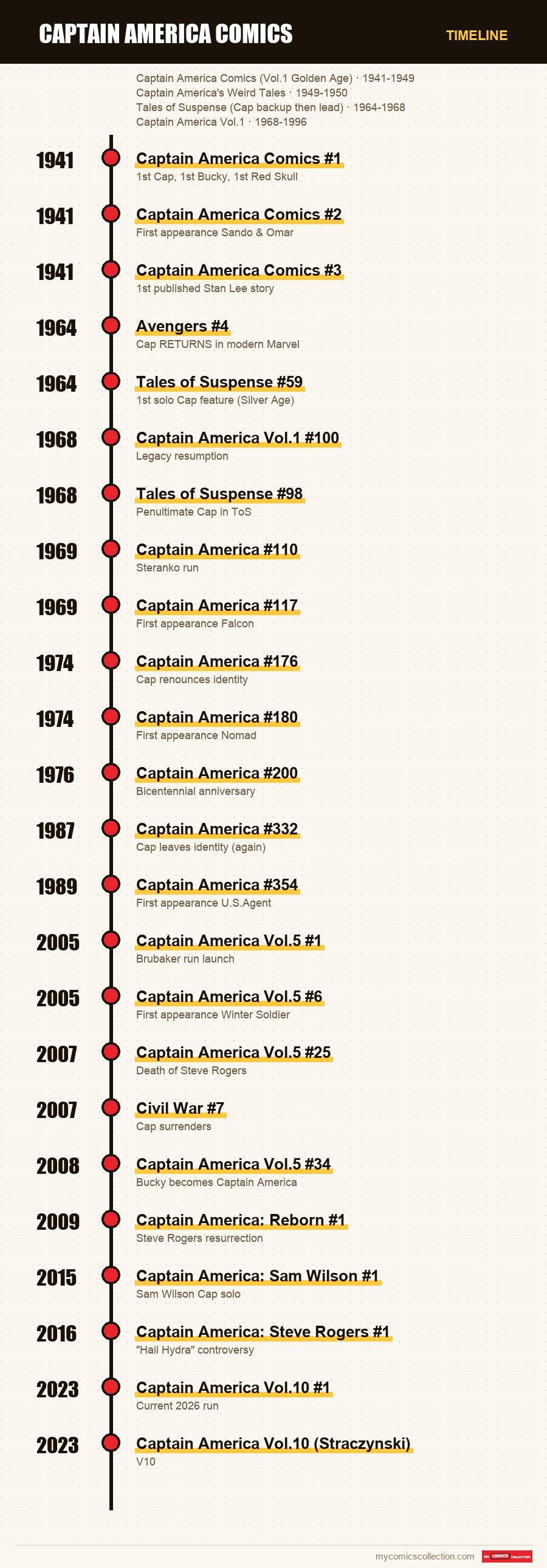
Here are the most important issues to know in chronological order:
Captain America Comics #1
The founding issue. Three firsts in one comic: Captain America , Bucky Barnes , Red Skull, plus Steve Rogers on the legendary cover punching Hitler. Sold close to a million copies in 1941. Today, top 10 of the most expensive comics in the world: a CGC 9.4 sold for over $3.1 million in a record sale. Practically inaccessible in high grade (fewer than 5 known CGC 9.0 and up copies).
Captain America Comics #2
First recurring villain after Red Skull. Sando & Omar appear in #2, followed by other Golden Age antagonists. A very rare issue, fewer than 200 known CGC copies. A secondary target for Golden Age collectors.
Captain America Comics #3
Stan Lee (then 18, an editorial assistant) writes his very first story: "Captain America Foils the Traitor's Revenge", a short 2-page text piece. The start of an 80-year career. A very sought-after issue for Stan Lee collectors.
Avengers #4
One of the most important issues in all of Marvel history. Iron Man, Thor, Giant-Man, Wasp and Hulk pull a frozen Steve Rogers from the Arctic. Cap immediately joins the Avengers and becomes their leader. First return of Cap since 1949, first Cap in Silver Age continuity. A major key issue: a CGC 9.6 sold for over $270,000. A must-have for any serious Marvel collector.
Tales of Suspense #59
The first issue where Cap got his own backup feature in Tales of Suspense, sharing the title with Iron Man. This feature ran until ToS #99 before becoming Captain America Vol.1 #100. A Silver Age key issue, still reasonably priced compared to Avengers #4.
Tales of Suspense #98
A legendary Jim Steranko cover. Cap facing a global Hydra. The penultimate Cap issue in Tales of Suspense, the split arrives with #100 (transition to Captain America Vol.1 #100). In high demand among Steranko fans.
Captain America Vol.1 #100
The Captain America title picks up the legacy numbering from Tales of Suspense. Cap gets his solo series back after 18 years away (1949 → 1968 if you count the old Cap Comics). Double-sized issue with origin recap + a Kirby cover. An accessible Silver Age key issue to anchor a Cap collection.
Captain America #110
Steranko fully takes over for 3 issues (#110-111 + #113). The #110 cover is considered one of Cap's most beautiful, a revolutionary photo-engraving design. A short but cult run that would inspire every artist who followed.
Captain America #117
First appearance of Sam Wilson / Falcon, Marvel's first African-American superhero in a mainstream series (Black Panther appeared earlier but didn't have a solo yet). The title would become Captain America and the Falcon starting at #134. An MCU key issue (Anthony Mackie becomes Cap in Captain America: New World Order 2025).
Captain America #176
Coming out of Watergate, Cap discovers that the President of the United States is the head of a criminal organization. Steve Rogers abandons the costume and the Captain America identity in #176. A cult Englehart run, the first "Cap quits" moment, the concept will return (Vol.1 #332 with John Walker, Vol.5 #25 with the death).
Captain America #180
Steve Rogers gets back in the field but under a new identity: Nomad, "the man without a country". Blue/yellow costume, no flag. Identity used for 4 issues before returning to Cap (#184). A secondary key issue but important for understanding the Englehart arc.
Captain America #200
200th issue published for the United States bicentennial (1776-1976). Kirby's run (the co-creator returns for 30 issues, #193-222) culminates with the Madbomb arc. A major celebration issue, with an iconic Kirby cover of Cap and the flag. The Kirby run was polarizing at the time, reassessed as cult today.
Captain America #332
The U.S. government asks Cap to become an official federal agent. Steve refuses and gives up his identity for the 2nd time (after #176). John Walker becomes the new Captain America. Gruenwald's monumental run (#307-443, 137 consecutive issues, the absolute record on Cap).
Captain America #354
John Walker, stripped of the Captain America title (Steve takes the costume back at #350), officially becomes U.S.Agent in Captain America #354. Red/white/black costume mirroring Cap. A recurring character through to today (West Coast Avengers, solo series, MCU in Falcon and Winter Soldier).
Captain America Vol.5 #1
Launch of the most important run of the modern era. Brubaker / Epting open with a new adult direction: espionage, conspiracy. The Out of Time arc (#1-6) then Winter Soldier (#1-14) redefine Cap. A must-have modern key issue for 2000s collectors.
Captain America Vol.5 #6
First full reveal of Bucky Barnes as the Winter Soldier (cameo in #1, full reveal in #6). Bucky didn't die in 1945, recovered by the Soviets, brainwashed, turned into an assassin. A central character in modern comics and the MCU (Captain America: Winter Soldier, 2014). An ultra-sought-after modern key issue.
Civil War #7
Conclusion of Civil War. Cap voluntarily surrenders to Iron Man to stop the bloodshed. Cliffhanger that leads directly into Captain America Vol.5 #25 and Steve's death. See our dedicated Civil War guide.
Captain America Vol.5 #25
Steve Rogers is assassinated on the steps of the federal courthouse after surrendering in Civil War. Shooter: Sharon Carter under Red Skull / Dr. Faustus mind control. Iconic black-and-white cover. The issue made the front page of the New York Times and CNN. Sold out, multiple reprints. The most heavily covered modern key issue of the 2000s.
Captain America Vol.5 #34
Bucky Barnes officially takes the shield and becomes Captain America after Steve's death. Modified costume (gun, visible metal arm). The first "armed" Cap, breaking with tradition. Bucky-Cap would last until Reborn (2009-2010) and Steve's return.
Captain America: Reborn #1
A 6-issue maxi-series that resurrects Steve Rogers. The plot reveals that Steve isn't dead but "displaced in time" by Red Skull. Brubaker wraps up his 2-year Death of Captain America arc. Hitch on art delivers blockbuster visuals.
Captain America: Sam Wilson #1
Launch of the first solo series dedicated to Sam Wilson as Captain America. Steve Rogers ages prematurely (Remender run) and passes the shield. An MCU key issue, Anthony Mackie becomes Cap in Falcon and Winter Soldier (2021) and the film Brave New World (2025).
Captain America: Steve Rogers #1
Steve Rogers regains his youth, but the final panel reveals he's a Hydra sleeper agent. Worldwide controversy: Time Magazine cover, debate on the political meaning of a fascist Cap. The issue went through several reprints, the first print became a collector's item.
Captain America Vol.10 #1
Launch of the current post-Coates run. Straczynski (Babylon 5, ASM Vol.2) brings Steve Rogers back as the lead with a return to fundamentals. Variant covers tied to the launch of Captain America: Brave New World (2025) are in heavy demand. The run is ongoing in 2026 with Tochi Onyebuchi as co-pilot.
The major Captain America story arcs in order
Madbomb (1976)
Jack Kirby returns to Cap for the bicentennial. Cap faces an anti-America psychic bomb.
Captain America: Bicentennial Battles (1976)
Treasury Edition by Kirby, time travel through United States history.
Captain America: White (2008/2015)
Loeb / Sale maxi, Cap and Bucky during World War II.
Operation: Rebirth (1995)
Mark Waid / Ron Garney. Dead Cap returns thanks to a Red Skull plot. Major run reboot.
Streets of Poison (1990)
Cap accidentally drugged by Crack-Bullets. Mark Gruenwald run.
Fighting Chance (1994)
The Super-Soldier Serum turns on Steve. Gruenwald run climax.
Heroes Reborn (1996-1997)
Liefeld / Lee reboot in an alternate reality. 13 issues of Cap Vol.2.
The Winter Soldier (2005-2006)
Brubaker / Epting. The return of Bucky Barnes as a Soviet assassin. A cult arc.
The Death of Captain America Saga (2007-2008)
Brubaker / Epting. Death of Steve, Bucky becomes Cap, Sharon Carter manipulated.
Captain America: Reborn (2009-2010)
A 6-issue maxi-series that resurrects Steve Rogers.
Two Americas (2010)
Steve and Bucky face off against a 1950s Cap who has resurfaced.
Standoff! (2016)
Cap + Avengers + Uncanny Avengers crossover. Steve Rogers regains his youth.
Hydra Cap / Secret Empire (2017)
Cap-Hydra takes control of the United States. 10 issues + tie-ins. Heavily controversial.
Out of Time (2024)
Straczynski run. Cap faces the ghosts of his Golden Age past.
Captain America: Cold War (2023)
Sentinel of Liberty + Symbol of Truth crossover. Steve and Sam united against Hauptmann Deutschland.
Empire of Eyes (2024-2025)
Onyebuchi arc. Sam Wilson faces a global surveillance plot.
How to start a Captain America collection in 2026
Set a clear goal
"I want all of Cap" is a bad goal (700+ legacy issues). "I want the complete Brubaker run (Vol.5 #1-50 + Reborn)" or "the 5 Loeb/Sale and equivalent maxi-series (White, Reborn, Theater of War, Patriot)" are excellent starting points.
Import the catalog into My Comics Collection
With My Comics Collection, import Captain America Comics, Tales of Suspense, Vol.1-10, Sam Wilson Captain America, Steve Rogers Captain America, Sentinel of Liberty, Symbol of Truth, and all the spin-off mini-series. Each issue and volume is distinctly identified.
Prioritize the key issues
The 23 key issues listed make up 80% of the historical value. See our dedicated top Captain America key issues for a focus on key issues + CGC values.
Organize by run rather than by issue
Cap is collected by run (Simon-Kirby, Englehart, Kirby return, Gruenwald, Waid, Brubaker, Remender, Spencer, Coates, Straczynski) rather than by strict chronological issue. It makes for easier reading and gives the collection meaning.
Track eBay valuation
Captain America Comics #1 (1941) is out of reach, but plenty of other key issues move constantly. My Comics Collection updates values based on real sales.
Why Captain America is still collected in 2026
Alongside Spider-Man, Iron Man and Wolverine, Captain America is one of Marvel's most active characters in monthly sales in 2026. Several reasons:
- Long continuity: Cap has been running since 1941, spanning 9 main volumes and 700+ legacy issues. Only Spider-Man and X-Men have comparable Marvel continuity.
- MCU Chris Evans 2011-2019: Chris Evans played Steve Rogers in 11 MCU films (from The First Avenger 2011 to Avengers: Endgame 2019). A massive visibility boost on classic key issues (Avengers #4, Cap #117, Cap #176).
- Falcon and Winter Soldier (Disney+ 2021): the Disney+ mini-series relaunched Sam Wilson Cap, U.S.Agent and Bucky / Winter Soldier. Cap #117 (1st Falcon) and Cap #354 (1st U.S.Agent) tripled in value.
- Captain America: Brave New World (2025): Anthony Mackie becomes Captain America on screen. Released February 14, 2025. A major boost on Sam Wilson Cap and Symbol of Truth comics.
- Captain America Comics #1 (1941): record Golden Age value. Top 10 of the most expensive comics in the world, over $3 million in CGC 9.4.
- Cult Brubaker run: Vol.5 (2005-2011) is considered one of the best modern Marvel runs, with constant demand on omnibuses and single issues.
- Versatility of the character: Steve Rogers, Bucky-Cap, Sam Wilson Cap, John Walker U.S.Agent, the 1950s Cap, Captain Carter (Disney+), Aaron Fischer, Jeff Mace… several Caps to collect at the same time.
Biography of Steven "Steve" Rogers (Captain America)
Captain America is a character of Marvel Comics (formerly Timely Comics) created by Joe Simon and Jack Kirby. His first appearance is in Captain America Comics #1 , published in March 1941.
Identity sheet of Steven "Steve" Rogers
- Real name:Steven “Steve” Rogers
- Date of birth: July 4, 1918 (fictional date): March 1941 (creation)
- Place of birth: Brooklyn, New York, USA
- First appearance : Captain America Comics #1 (March 1941)
- Creators: Joe Simon (screenwriter) and Jack Kirby (cartoonist)
- Editor: Marvel Comics (formerly Timely Comics)
- Memberships: Avengers (founding member), S.H.I.E.L.D., Howling Commandos, Invaders
Character origins
Steve Rogers, a frail young man from Brooklyn rejected for the army during World War II, volunteers for Dr. Abraham Erskine's Rebirth Project. The Super-Soldier serum transforms him into human perfection. During the war, he fought the Nazis and HYDRA until he was frozen in the Arctic in 1945. Found by the Avengers in 1964 (Avengers #4), he returned to modern life and became the unwavering symbol of American heroism.
Powers and Abilities
- Super Soldier Serum: strength, agility, endurance at the peak of human perfection
- Vibranium-steel shield: indestructible, can be thrown and bounced
- Distinguished fighter: boxing, judo, jiu-jitsu, various martial arts
- Elite military strategist
- Leadership and inspiration: capable of uniting the Avengers
- Increased longevity: Steve Rogers preserved in ice from 1945 to 1964
Costume and visual identity
Blue, red and white costume inspired by the American flag. White star on the chest, stylized white wings on the helmet (signature). Round red, white and blue shield with a central star, made of vibranium alloy and steel.
Build your Captain America collection with method
Import the 700+ Cap issues + Tales of Suspense + spin-offs in one click, identify your missing key issues, track eBay value. Free 7-day trial.
🚀 Start your free 7-day trialGo further
- Captain America Reading Guide: Every Era, Every Arc, Every Route
- The Best Captain America Comic Runs: Top 7 Essential Collections
- Best Captain America Story Arcs: Rankings & Key Issues for Collectors
- Top 10 Captain America Key Issues Every Collector Must Own
- Captain America Comics #1: First Appearance, History & Collector's Value Guide
- Captain America Comics: The Complete Collector's Guide to Key Issues, Essential Runs & Budgets
FAQ, History of Captain America
Other comic character histories to discover
Our complete "Comics history" article series covers the 20 biggest Marvel and DC franchises. Each article follows the same format: birth, full chronology of volumes, parallel series, key issues sorted chronologically, major arcs and collection method.
→ See all "History" articles on the blog