
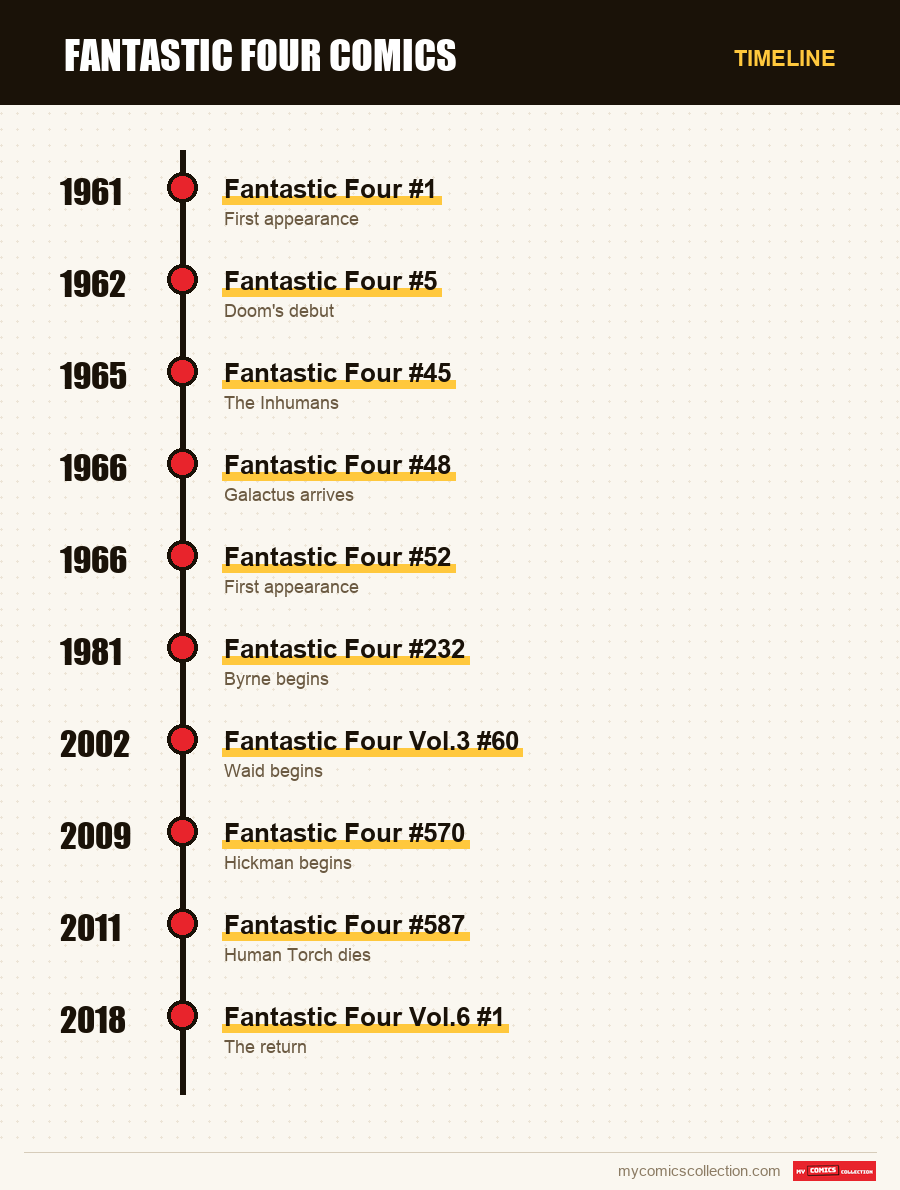
THE Fantastic Four were born in November 1961 in FF #1 by Stan Lee and Jack Kirby: the comic that launched the Marvel Universe. The founding duo produced 102 groundbreaking issues (1961-1970), followed by the Roy Thomas era, John Byrne era (#232-293, 1981-1986), the exile Heroes Reborn (1996-1997), the triumphant return of Mark Waid (vol.3 #60-524, 2002-2005), and the redefinition by Jonathan Hickman (vol.1 #570-611 + FF #1-23, 2009-2012). In total, the main series counts more than 700 numbers spread over 7 volumes, making the FF the longest continuously running Marvel franchise.
Marvel's first family, the Fantastic Four are the big bang of the modern Marvel Universe. When Stan Lee and Jack Kirby published Fantastic Four #1 in November 1961, they weren't just creating a superhero team: they were inventing a new narrative paradigm: heroes with personal problems, complex family dynamics, and inter-title continuity that would become Marvel's trademark. Reed Richards, Sue Storm, Johnny Storm and Ben Grimm were the first, and everything that followed (Spider-Man, X-Men, Avengers) flowed from their success.
This guide traces the entire editorial history of the Fantastic Four, from #1 in 1961 to the most recent relaunches. We will follow each major creative era chronologically, identify the key issues to know and their ratings, and give the collector the necessary benchmarks to navigate more than 60 years of continuous publication. The FF has had its peaks (Kirby, Byrne, Hickman) and troughs (the 90s, Heroes Reborn), but its place in the history of the medium remains steadfast.
The Lee/Kirby era: the genesis (FF #1-102, 1961-1970)
Stan Lee and Jack Kirby signed the first 102 issues of the Fantastic Four together, creating a significant part of the Marvel universe in the process. This run is considered one of the most important in the history of American comics. Kirby deploys a limitless cosmic imagination while Lee humanizes his characters through naturalistic dialogues and internal conflicts.
The founders’ key issues
Fantastic Four #1 (November 1961): the birth of Marvel. First appearance of the FF and the Mole Man. In CGC 9.0+, it's a six-figure grail. Even at low-grade (CGC 1.0-2.0), it represents a considerable but symbolically invaluable investment. FF #2 (January 1962) introduced the Skrulls. FF #4 (May 1962) brings Namor back to the Marvel era. FF #5 (July 1962) introduces Doctor Doom, Marvel's greatest villain, and is a major key issue at any level.
FF #12 (March 1963): first FF/Hulk meeting. FF #25-26 (1964): Thing vs. Hulk confrontation. FF #45-48 (1965-1966): introduction of the Inhumans (#45), Black Bolt (#45), and especially the arrival of Galactus and the Silver Surfer (#48-50, the “Galactus Trilogy”): absolute peak of the Kirby run. FF #48 is one of the most expensive and sought-after Silver Age comics in the world.
FF #52 (July 1966): First appearance of Black Panther, Marvel's first black superhero. Key culturally historical issue whose popularity has exploded since the 2018 film. FF #67 (1967): first appearance of Him (future Adam Warlock). Kirby issues beyond #50 remain more financially accessible while offering exceptional artistic quality.
Post-Kirby and the 70s (FF #103-236, 1970-1981)
After Kirby left for DC in 1970, the series went through a period of transition. Roy Thomas, Gerry Conway, Len Wein and Marv Wolfman take turns writing the screenplay. The quality is uneven but some numbers stand out: FF #112 (1971) offers a cult Thing vs. Hulk fight drawn by John Buscema. George Pérez draws #164-167 (1975-1976) with already dazzling talent.
This period is paradoxically ideal for the collector: prices are low (excluding key issues), numbers are available, and several bows deserve attention. FF #176 (1976) presents the Impossible Man returned, and the issues drawn by Pérez then Keith Pollard offer good value for money.
The John Byrne era: the second golden age (FF #232-293, 1981-1986)
John Byrne arrived on Fantastic Four in 1981 and had one of the most acclaimed runs in the title's history. As a screenwriter AND designer, he has total creative control and takes the opportunity to reinvent the title while respecting the Lee/Kirby legacy. His run of 61 issues is unanimously considered the best post-Kirby FF.
FF #232 (July 1981): "Back to Basics", Byrne's first issue, clear statement of intent. FF #236: the 20th anniversary of the series, special meta issue. FF #242-244 (1982): Galactus returns to Earth. FF #258 (1983): an entire issue centered around Doom alone in his castle: considered one of the best single issues ever written. FF #267 (1984): Sue Richards has a miscarriage, a remarkably mature act for the time.
FF #284 (1985): invisible Girl becomes Invisible Woman, a major symbolic transformation of the character. Byrne leaves after #293 (1986). His complete run is available at very reasonable prices and is an exceptional narrative investment for any FF collector.
The years of transition (FF #294-416, 1986-1996)
After Byrne, the series passed into the hands of Steve Englehart, Walt Simonson and Tom DeFalco. The Simonson run (#334-354, 1989-1991) deserves attention: Simonson brings his cosmic sensitivity and introduces a new temporary formation (Spider-Man, Wolverine, Hulk and Ghost Rider, #347-349). DeFalco has a long run (#356-416) which suffers from the market crisis of the 90s but contains interesting moments.
For the collector, this era offers very low priced issues. The Simonson run is underrated and a great deal. DeFalco numbers, despite their mixed reputation, complete a comprehensive collection at a lower cost.
Heroes Reborn: Exile (vol.2, #1-13, 1996-1997)
In 1996, Marvel handed the Fantastic Four (and other titles) to Jim Lee and his Wildstorm Studios as part of the Heroes Reborn initiative. The characters are transferred to a parallel universe and the series is relaunched from #1. Jim Lee draws the first 6 issues before handing over. This period is generally considered a creative low point, but the Lee issues have speculative value related to their artistic quality.
Fantastic Four vol.2 #1 (November 1996) by Jim Lee is a minor key issue but sought after for its speculative-era variant covers. The series ends after 13 issues and the FF returns to the main Marvel Universe.
Heroes Return and the Waid era (vol.3, 1998-2005)
The FF return to the main universe with Fantastic Four vol.3 #1 (January 1998) by Scott Lobdell and Alan Davis. The series searches for its identity until the arrival of Mark Waid at #60 (2002, renumbered #489). Waid, accompanied by designer Mike Wieringo, signs one of the most celebrated runs in modern FF.
Waid reinvents exploration as a narrative engine: the FF no longer just fight villains, they explore the unknown: the micro-universe, Paradise, parallel dimensions. The "Unthinkable" arc (#67-70/496-499) where Doom uses magic rather than science is a high point. “Authoritative Action” (#503-508) sees Reed Richards overthrow Doom and take control of Latveria: a bold and controversial arc. The Waid/Wieringo run (#60-524, or 36 issues) is affordable and an ideal entry point for new FF collectors.
The Hickman era: the intellectual renaissance (2009-2012)
Jonathan Hickman arrives on Fantastic Four with the #570 (October 2009) and transforms the series into a science fiction epic of unprecedented ambition. His run spans Fantastic Four #570-588 then #600-611 (31 issues) and the parallel series FF #1-23 (2011-2012), launched after the "death" of Johnny Storm in the controversial FF #587.
FF #587 (March 2011): death of the Human Torch, sold in a sealed black sleeve: event number that has become a modern key issue. FF #1 (May 2011): the "Future Foundation" replaces the Fantastic Four, with Spider-Man replacing Johnny. Hickman weaves storylines about the Reed Richards Council, the Celestials, the Kree-Inhuman war, and the scientific founding of tomorrow.
The Hickman run is today considered the third creative peak of the FF after Lee/Kirby and Byrne. Its numbers are constantly increasing and represent a solid investment for the discerning collector. The whole thing (54 issues between the two series) offers a complete and autonomous arc.
Modern era and relaunches (2013-present)
After Hickman, the series had its ups and downs. Matt Fraction signs a short and quirky run (FF vol.2 #1-16, 2013) with Mike Allred on the drawing: a pop-art title centered on a team of replacements which appeals to fans of a light tone. James Robinson wrote the final issues of the original vol.1 (#642-645, 2015), concluding the historic numbering before Marvel put the FF on hiatus for three years.
This absence (2015-2018) is linked to tensions between Marvel and 20th Century Fox over film rights. With no Marvel Studios film in sight, the parent company limited the FF's editorial exposure: a controversial strategy that frustrated fans but created a temporary scarcity in the market.
The triumphant return comes with Fantastic Four vol.6 #1 (October 2018) by Dan Slott and Sara Pichelli. The reunion of the Richards family after three years of absence is a major editorial event. The Slott run (#1-46, 2018-2022) brings the FF back to the forefront with ambitious arcs (Empyre, Reckoning War). Ryan North takes over in 2022 with a more humorous and scientifically inventive tone, unanimously praised by critics: his "scientific problem by number" approach redefines the potential of the franchise.
Summary of volumes and numbering
The numbering of the FF is one of the most complex in Marvel. Here is the essential guide to not getting lost:
- Vol.1: #1-416 + #500-645 (1961-2015, with renumbering to #500 in 2003)
- Vol.2: #1-13 (Heroes Reborn, 1996-1997)
- Vol.3: #1-70 then renumbered #500 and merged with vol.1 (1998-2003)
- Vol.4: #1-16 (2013, Fraction/Bagley)
- Vol.5: #1-14 (2014-2015, Robinson)
- Vol.6: #1-46 (2018-2022, Slott)
- Vol.7: #1+ (2022-present, North)
- Parallel series FF: #1-23 (2011-2012, Hickman) then FF vol.2 #1-16 (2013, Fraction/Allred)
For the collector, the key tip: vol.3 numbers #60-70 also correspond to #489-499 in legacy numbering. From #500 (formerly vol.3 #71), the numbering returns to that of the historical vol.1. My Comics Collection automatically manages these matches to avoid any confusion in your tracking.
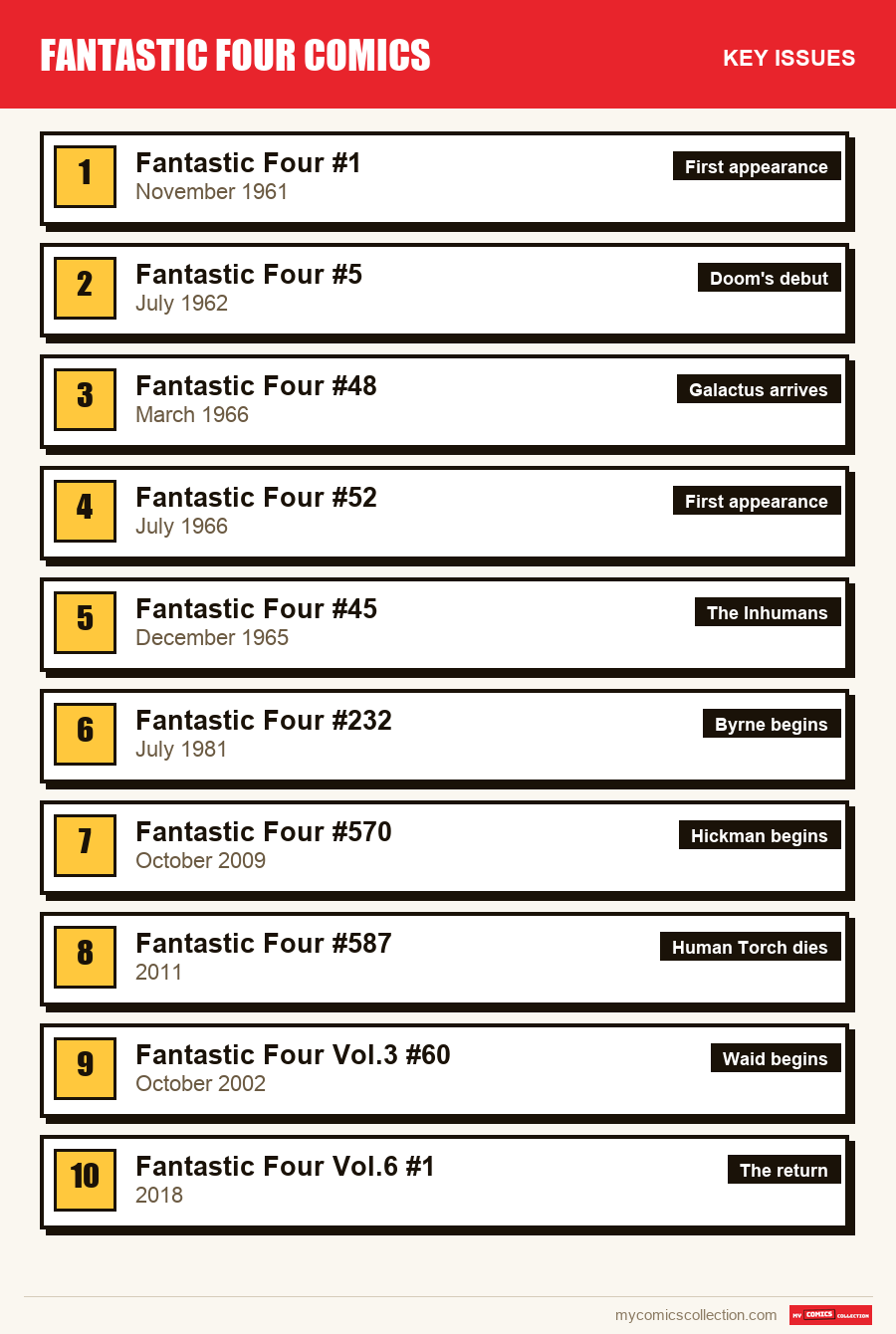
The 10 key issues to remember
For any FF collector, here is the absolute hierarchy by historical importance and market value:
- FF #1 (1961): birth of Marvel Comics, the publisher's most important comic book
- FF #5 (1962): first appearance of Doctor Doom, the ultimate Marvel villain
- FF #48 (1966): arrival of Galactus and the Silver Surfer, summit of the cosmic Kirby
- FF #52 (1966): first appearance of Black Panther, major cultural significance
- FF #45 (1965): first appearance of the Inhumans and Black Bolt
- FF #67 (1967): first appearance of Him (future Adam Warlock)
- FF #112 (1971): Thing vs. Hulk by Buscema, Bronze Age classic
- FF #232 (1981): start of the Byrne run, revival of the title
- FF #587 (2011): death of Human Torch, event issue in black cover
- FF vol.6 #1 (2018): return of the First Family after 3 years of absence
This list covers 60 years of history and every budget: from six-figure grail (FF #1) to accessible modern (vol.6 #1). For a detailed collecting guide with budget buying strategy, see our Fantastic Four collector's guide. Also find the FF key numbers with updated odds.
Biography of Reed Richards (Fantastic Four)
Fantastic Four is created by Stan Lee and Jack Kirby and published by Marvel Comics. His first appearance is in Fantastic Four #1 in November 1961.
Identity sheet
- Full name: Reed Richards, Susan Storm-Richards, Johnny Storm, Ben Grimm
- Date of birth: November 1961 (creation)
- Place of birth: Baxter Building, New York, USA
- First appearance : Fantastic Four #1 (November 1961)
- Creators: Stan Lee (writer) and Jack Kirby (artist)
- Editor: Marvel Comics
- Memberships: Avengers (ally), Future Foundation, Inhumans (allies)
Origins
Reed Richards, Susan Storm, Johnny Storm and Ben Grimm are exposed to cosmic rays during an experimental space flight. When they return to Earth, they discover that they have each gained spectacular superpowers. They decide to put their gifts at the service of humanity by forming the Fantastic Four. This team launched Marvel's Silver Age and established the "dysfunctional family" tone that distinguished Marvel from DC.
Powers and Abilities
- Mr. Fantastic (Reed Richards): unlimited body elasticity, super intelligence (IQ 350+)
- Invisible Woman (Sue Storm): invisibility, psionic force fields
- Human Torch (Johnny Storm): pyrokinesis, flight, fire immunity
- The Thing (Ben Grimm): superhuman strength, indestructible rocky skin
- Headquarters: Baxter Building (35th floor, New York)
- First Marvel Team of the Silver Age (launches "Marvel Age")
- The Fantasticar: team's signature flying vehicle
Costume and visual identity
Tight blue jumpsuits with high collar and the "4" symbol on the torso (white circle with black 4). For The Thing, costume adapted to his rocky body shape. Negative costumes (black and white) in certain periods.
Manage your Fantastic Four collection efficiently
With My Comics Collection, import all FF volumes, track your progress through 60 years of publication and instantly identify your missing ones among the 700+ issues of Marvel's First Family.
Free trial 7 days, No obligationThe key issues to know
Fantastic Four #1
Stan Lee and Jack Kirby bring together Reed Richards, Sue and Johnny Storm and Ben Grimm, transformed by cosmic rays during an experimental space flight. The issue also introduces the Mole Man, the team's first opponent. It is the starting point of the modern Marvel Universe.
Fantastic Four #5
Doctor Doom makes his entrance in "Prisoners of Doctor Doom!". A former college classmate of Reed Richards, he captures the team and sends Reed, Ben and Johnny back in time. He instantly becomes the First Family's arch-enemy.
Fantastic Four #48
"The Coming of Galactus!" opens the Galactus Trilogy, which runs through #50. The Silver Surfer, herald of the world-devourer, finds Earth and summons his master: both characters appear here for the first time. It is the peak of Kirby's cosmic storytelling.
Fantastic Four #52
T'Challa, the Black Panther, invites the team to Wakanda, an African nation with highly advanced technology, then puts them to the test as soon as they arrive. Lee and Kirby create a character destined to become one of the pillars of the Marvel Universe.
Fantastic Four #45
"Among Us Hide... The Inhumans" reveals the Inhumans' royal family, a people hidden among humanity. Black Bolt, Karnak, Triton, Crystal and Lockjaw make their first appearance here. An entire branch of the Marvel Universe is born in this issue.
Fantastic Four #232
John Byrne takes over writing, pencils and inks with "Back to the Basics!", in which the team faces Diablo's potions. This first issue opens a run that lasts until #293 in 1986 and remains the benchmark after Lee and Kirby.
Fantastic Four #570
Jonathan Hickman and Dale Eaglesham launch their run: Reed Richards discovers the Interdimensional Council of Reeds, a gathering of his counterparts from other realities. This issue lays the foundations of the science-fiction epic Hickman will continue in the FF series.
Fantastic Four #587
The conclusion of Jonathan Hickman and Steve Epting's "Three" arc: Johnny Storm sacrifices himself in the Negative Zone to hold back the invasion coming from that realm. The series pauses shortly afterwards in favour of FF, and Johnny only returns in #600.
Fantastic Four Vol.3 #60
Mark Waid and Mike Wieringo take the helm of the series. This issue, which corresponds to #489 in the legacy numbering, opens a run that puts exploration of the unknown and family spirit back at the heart of the title.
Fantastic Four Vol.6 #1
Dan Slott and Sara Pichelli relaunch the title after three years without a Fantastic Four series. The Richards family, scattered since the end of Secret Wars, reunites and returns to the forefront of the Marvel Universe.
Go further
- Fantastic Four Reading Guide: Where to Start and How to Order the Essential Runs
- Best Fantastic Four Runs: Lee/Kirby, Byrne, Hickman and Beyond
- Best Fantastic Four story arcs: a collector's guide
- Top 10 essential Fantastic Four key issues
- Fantastic Four #1 (1961): First Appearance, CGC Census & Current Market Value
- Fantastic Four Collection Guide: How to Collect FF Comics