
Tier list Fantastic Four 2026 prioritizes key issues by value, collector demand and appreciation potential. Tier S includes FF #1 (Nov 1961), FF #4 (May 1962, Sub-Mariner return), FF #5 (July 1962, first Doctor Doom) and the Galactus Trilogy FF #48-50 (March-May 1966). Tier A targets budgets 1000-5000 dollars. Tier B and C target sleepers under $500 with MCU 2025-2027 catalysts.
The Fantastic Four saga spans 65 years of Marvel continuity since the Stan Lee/Jack Kirby kickoff in November 1961. For a 2026 collector, navigating 645 volume 1 issues, plus six major relaunches (volumes 2 to 7), requires a clear reading grid. A tier list orders the key issues according to four criteria: absolute rarity, catalogable first appearances, market demand verified by recent CGC sales and future catalysts (cinema release, Disney+ series, Marvel editorial events).
This tier S/A/B/C method transposes the logic of competitive wargaming to comic collecting: Tier S brings together blue-chip pieces with stable historical appreciation, Tier A the first secondary appearances with strong MCU traction, Tier B the undervalued sleepers that databases like Heritage Auctions or GoCollect report as dormant, Tier C pure speculation linked to 2025-2030 announcements. The release of Fantastic Four First Steps in July 2025 and the arrival of Avengers Doomsday in May 2027 redraw the hierarchy. This analysis prioritizes each tier with exact dates, bibliographic references and price ranges observed during 2026.
Fantastic Four tier list methodology: criteria and evaluation grids
Building a comics tier list requires a rigor different from pop culture rankings. Four weighted criteria structure this ranking: current market value (40 percent), relative rarity in grade CGC 9.0+ (25 percent), Marvel Universe narrative relevance (20 percent) and identified future catalysts (15 percent). This weighting avoids purely speculative bias and integrates the historical depth specific to Fantastic Four.
The market value is based on sales reports from Heritage Auctions, ComicConnect and GoCollect covering the period January 2024 to May 2026. For each issue, a minimum of three CGC sales must confirm the displayed range. Rarity uses public CGC censuses: a comic with less than 50 copies in grade 9.4 is systematically considered Tier A minimum, subject to verified demand. Narrative relevance weighs the first definitive appearances: Doctor Doom in FF #5 surpasses even a rare late re-appearance.
Future catalysts open up the speculative dimension. The Fantastic Four First Steps released in July 2025 took FF #1 (November 1961), FF #5 (July 1962) and FF #48-50 to new levels. The Doomsday announcement for May 2027 activates the Doctor Doom mechanic and the potential return of Galactus. The grid therefore crosses editorial history and the Disney/Marvel Studios calendar. To measure these signals, the Comics Manager guide details tracking by tagging, with price alerts handled through eBay saved searches.
A fifth implicit criterion verifies traceability: an issue without a public CGC census or without documented sales history remains classified in Tier C by default. The methodology excludes modern retailer variants (post-2010) except in exceptional cases, and excludes 1/100 sketch covers which are more of an artist collectible than a Marvel key issue. This grid produces a stable ranking: an FF in Tier S on this list remains in Tier S over five years, barring an editorial revolution or major loss of inventory (distributor fire, provenance scandal).
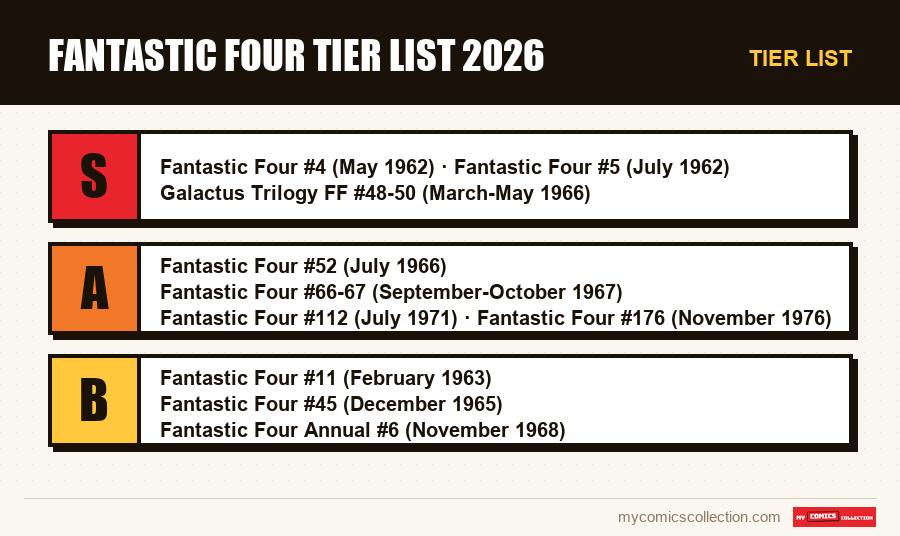
Tier S Fantastic Four: the four blue-chip pillars of the collection
Tier S brings together key issues with verified historical appreciation, inelastic demand and structural scarcity. Four comics make up this summit: FF #1, FF #4, FF #5 and the Galactus Trilogy FF #48-50. These pillars define the grammar of Silver Age Marvel collecting and resist general market corrections.
Fantastic Four #1 (November 1961, Stan Lee and Jack Kirby) opens the modern Marvel era. First appearance of Reed Richards, Sue Storm, Johnny Storm and Ben Grimm, first appearance of Mole Man. The CGC census lists less than 25 examples in grade 9.0 and only one in 9.6 (Heritage 2022 sale at 1.5 million dollars). Range observes 2025-2026: $4,500 to $8,000 in CGC 4.0, $35,000 to $55,000 in CGC 7.5, six figures beyond 8.5. The coupling with the First Steps release maintained a low 18 percent increase over 18 months.
Fantastic Four #4 (May 1962) marks the return of Namor the Sub-Mariner after his Golden Age hiatus. First effective crossover between the Timely era and the Marvel era. Range CGC 6.0: $3,500 to $5,200. CGC 9.0: $28,000 to $42,000. The 2026 context adds the Disney+ Sub-Mariner potential, not officially confirmed but signaled by several trades. For historical depth on Namor, check out Sub-Mariner comics story.
Fantastic Four #5 (July 1962) introduces Doctor Doom. No Marvel villain has generated as much cumulative market value on its original issue. Range CGC 5.0: $4,800 to $6,800. CGC 8.0: $28,000 to $38,000. CGC 9.4 reaches $175,000 (2025 sales). The Doomsday 2027 arc serves as the main accelerator. See Doctor Doom comics story for the complete mapping of the antagonist.
Galactus Trilogy FF #48-50 (March-May 1966) introduces Silver Surfer (FF #48) and Galactus (FF #48 partial, FF #49 full). Three consecutive issues sold separately or as a set. FF #48 remains the most hunted: CGC 7.0 at 4,200 dollars, CGC 9.0 at 14,000 dollars, CGC 9.6 at more than 65,000 dollars. FF #49 and FF #50 follow a parallel dynamic at 60 percent of the value of #48 on average. THE Silver Surfer course contextualizes the evolution of the character post-FF.
Tier A Fantastic Four: first secondary appearances in high demand
Tier A lists the first secondary appearances of major characters and the outcomes of historical battle confrontations. Budget range 800 to 5,500 dollars for collector grades (CGC 7.0 to 9.0). Four numbers stand out: FF #52, FF #66-67, FF #112 and FF #176.
Fantastic Four #52 (July 1966) features the first appearance of Black Panther, T'Challa. This key issue benefits from the dual dynamic Wakanda Forever post-2022 and the planned MCU reactivation. CGC 6.0 range: $1,100 to $1,600. CGC 9.0: $4,800 to $6,800. CGC 9.6 exceeds $18,000 on 2025 sales. The 10-year increase exceeds 380 percent. For T'Challa narrative depth, check out Black Panther comics story.
Fantastic Four #66-67 (September-October 1967) presents the appearance of Him, future Adam Warlock, in his genetic cocoon created by the Enclave. #66 shows the cocoon, #67 reveals Him. Range CGC 6.5: 380 to 580 dollars each. CGC 9.0: $2,200 to $3,400. The Warlock potential in Phase 6 MCU activates this diptych. See the story Adam Warlock comics to map multiple versions of the character.
Fantastic Four #112 (July 1971) contains the Hulk versus Thing fight, drawn by John Buscema. Cover battle iconography reference from the Bronze Age Marvel. Range CGC 7.0: 220 to 340 dollars. CGC 9.4: $1,400 to $2,200. Demand crosses Hulk and FF collectors, which maintains a solid floor even without the cinema catalyst. The number appears in most monthly CGC tracker want lists.
Fantastic Four #176 (November 1976) presents the first appearance of Impossible Woman and the return of Impossible Man, in a meta plot where Stan Lee and Jack Kirby appear in the Marvel bullpen. Sleeper Bronze Age which benefits from a 2024-2026 rise. Range CGC 8.0: 95 to 145 dollars. CGC 9.6: 380 to 580 dollars. The coupling with FF #11 (first Impossible Man) creates a cherent thematic mini-collection.
Tier A absorbs approximately 35 percent of the capital allocated to a complete FF collection. Most issues are purchased in two to three quarters via raw books CGC-gradable, then sent grading. THEguide key issues Silver Agedetails the cover variations and the chronological sequence of the first appearances.
Tier B Fantastic Four sleepers: three undervalued gems for 2026
Tier B identifies comics that are undervalued based on their narrative importance or grade-stratified rarity. Three sleepers stand out in 2026: FF #11, FF #45 and FF Annual #6.
Fantastic Four #11 (February 1963) introduces Impossible Man, cosmic character from the planet Poppup. Structural sleeper because Impossible Man does not appear in the announced MCU arcs, which maintains an accessible entry price. Range CGC 5.0: 280 to 420 dollars. CGC 8.0: $1,100 to $1,600. CGC 9.4 reached $4,500 on 2025 sales but remains rare with 12 examples recorded. The sleeper logic is based on three factors: membership in the canonical Lee/Kirby run, high-grade rarity, and non-zero probability of Disney+ animation appearance. Median buying range 2026: CGC 6.0 at $580.
Fantastic Four #45 (December 1965) brings the first appearance of the Inhumans: Medusa, Karnak, Triton, Crystal and Lockjaw. The number historically suffers from the additional cost requested for neighboring FF #48, which maintains an evaluation differential favorable to the collector. Range CGC 6.0: 380 to 520 dollars. CGC 8.5: $1,800 to $2,800. CGC 9.4: $6,500 to $9,200. After the critical failure of the 2017 Inhumans series, the value corrected by 22 percent, but the 2025-2026 rebound resumes 8 to 12 percent per quarter. The Inhumans sleeper is positioned as a long-term exhibition: if Marvel Studios re-activates the franchise in Phase 7 or 8, FF #45 becomes Tier A again.
Fantastic Four Annual #6 (November 1968) brings together two major first appearances: Annihilus, cosmic antagonist taken up in Annihilation, and Franklin Richards, son of Reed and Sue. Double key issue rare in Annual format. Range CGC 6.5: 380 to 580 dollars. CGC 9.0: $2,200 to $3,200. CGC 9.6 reaches $8,500. The Annihilus sleeper is active with rumors of an Annihilation arc for Phase 7 MCU. Franklin Richards constitutes the second lever, a probable candidate for a future multiverse Marvel storyline.
Tier B requires patience: these sleepers are built up over 12 to 36 months via quality raw book purchases, CGC submissions in batches, and resale of a quarter of the stock once the value has doubled. The Tier B risk/return ratio is among the most favorable on the Silver Age market, provided that first appearances catalogable by the CGC database are selected, and not second appearances or late returns. For overall portfolio strategy, see the comics investment strategy 2027.
Tier C Fantastic Four spec 2026-2027: bet Marvel Studios calendar
Tier C concentrates pure spec: modern comics linked to Marvel Studios announcements, Fantastic Four First Steps release and Doomsday arc. Budget range 30 to 250 dollars. High risk, multiple potential x3 to x10 over short window 6-18 months.
Fantastic Four First Steps (cinema release July 25, 2025) activated a wave of spec on modern comics linked to the design of the film. The Ultimate Fantastic Four #1 (February 2004) variants, which introduced the young Reed Richards version visually reprized by Matt Shakman, saw their prices increase from $18 to $95 CGC 9.8 between June 2024 and June 2025. The post-release spec typically corrects 30 to 40 percent within six months, but maintains a base higher than the pre-announcement price. The 2026 window therefore offers a possible return after correction, aiming for 45 to 65 dollars CGC 9.8.
Avengers Doomsday (release scheduled for May 7, 2027) activates the modern Doctor Doom spec. Several targets: FF Wedding Special (March 2018, first appearance of the modern Doom version under the Iron Man helmet at Marvel Two-in-One), FF #587 (March 2011, death of the Human Torch), and FF vol 7 #1 (November 2022, start of the Ryan North run). Entrance range 25 to 85 dollars CGC 9.8. The risk lies in the precise casting of Doom: if the film is mainly inspired by the classic version, these moderns will fall. If the film incorporates Hickman Secret Wars 2015 elements, some issues will explode.
The Galactus MCU bet remains open: since the appearance in First Steps, modern Galactus comics have followed high volatility. Galactus Lifebringer arc (FF #649-651, 2017) tripled in grade 9.8 between February and October 2025. The 2026 return is probable but uncertain. The Tier C prudential rule: do not invest more than 8 to 12 percent of the total collection budget in this category. THE guide spec keys 2027 lists targets by release schedule.
Tier C requires resale discipline: spec that has not materialized within 90 days post-release must be liquidated at 50 percent to limit exposure. The rest is kept as a long-term call option. This discipline distinguishes the spec collector from the emotional speculator.
Strategy by budget: allocate 1,500, 5,000 or 15,000 euros on Fantastic Four
Three standard envelopes structure the FF approach for 2026. Each budget imposes clear trade-offs between Tier S blue-chip and Tier A/B/C diversification.
Budget 1,500 euros aims at the pedagogical base. Recommended allocation: 60 percent Tier A, 30 percent Tier B, 10 percent Tier C. Target acquisitions: FF #52 CGC 4.0 (450 euros), FF #112 CGC 7.0 (250 euros), FF #45 CGC 4.5 (220 euros) or FF #11 raw VG (180 euros), FF Annual #6 raw VG (160 euros), 2 modern Tier C issues CGC 9.8 (150 euros). This envelope constitutes a coherent collection covering Silver and Bronze Age, without Tier S. The Tier S jump requires a subsequent budget increase or consolidation by partial resale.
Budget 5,000 euros includes a first Tier S piece. Allocation: 45 percent Tier S, 30 percent Tier A, 20 percent Tier B, 5 percent Tier C. Target Tier S: FF #4 CGC 4.0 (1,800 to 2,200 euros) or FF #5 CGC 3.5 (1,900 to 2,400 euros). Rest: FF #52 CGC 6.5 (1,100 euros), FF #112 CGC 9.0 (550 euros), FF #45 CGC 6.5 (450 euros), FF #11 CGC 6.0 (380 euros), 3 Tier C issues (250 euros). This envelope covers a creme of Silver Age FF and exposed to the MCU 2027 lever.
Budget 15,000 euros aims for a confirmed collector's collection. Allocation: 60 percent Tier S, 25 percent Tier A, 12 percent Tier B, 3 percent Tier C. Target Tier S: FF #5 CGC 5.5 (5,800 euros) plus FF #48 CGC 6.5 (3,400 euros). Tier A: FF #52 CGC 8.0 (2,200 euros), FF #66 CGC 7.5 (520 euros), FF #67 CGC 7.5 (580 euros), FF #112 CGC 9.2 (650 euros). Tier B: FF #11 CGC 7.5 (820 euros), FF #45 CGC 7.0 (650 euros), FF Annual #6 CGC 7.0 (380 euros). Tier C: selection of 4-5 modern exits (350 euros). This envelope positions the collector on the MCU levers and resists direction corrections.
To estimate the current value of your parts or refine the purchasing strategy, the free estimate mycomicscollection provides a point of reference. The catalog comics and the base key issues comics feed market monitoring by character tag and editorial period.
Collecting this series?
Track what you own, what you are missing and what your collection is worth. 7 day trial.
Start my trial →Pitfalls of the FF tier list: multiple volumes, reprints and false key issues
Fantastic Four has accumulated seven main volumes since 1961, not counting annuals, specials, miniseries and crossovers. This layering creates several classic traps for the 2026 collector.
Trap number one: confusing volume 1 and volume 3. The original run 1961-1996 (FF vol 1, 416 issues) remains the Silver-Bronze-Modern reference. In 1998, volume 3 began, which returned to legacy numbering in 2003 (volume 1 started again #500). A FF #1 vol 3 (January 1998) has no key value compared to FF #1 vol 1 (November 1961). Systematically check the indicia notice (copyright date and legal volume number) before any major purchase. The trap repeats itself with FF vol 4 (November 2012), FF vol 5 (March 2014), FF vol 6 (August 2018) and FF vol 7 (November 2022).
Trap number two: Marvel Milestone and Marvel Masterworks reprints. Several reprints exist for FF #1, FF #4, FF #5 and the Galactus Trilogy. The Marvel Milestone Edition reprints (1991, 1992) feature the original covers with a modern date insert. Without checking cover at top right (original date and price 12 cents for Silver Age), a purchase may turn out to be reprinted at 95 percent less in value. CGC clearly distinguishes between reprint and original in its labeling. For raw books, require high resolution photo from indicia.
Trap number three: false key issues wrongly attributed. Several unverified sources attribute first appearances to numbers that are actually second appearances. Common example: the first appearance of Crystal from the Inhumans is sometimes claimed to be in FF #44, while she officially appears in FF #45. Systematically check the Marvel Comics Database (marvel.fandom.com), an online collaborative database and the CGC census. This discipline avoids overpayments and resale disappointments.
Trap number four: modern variant covers without real rarity. The 1/25, 1/50 and 1/100 variants have exploded in number since 2018. Most post-2020 FF variants have no relative rarity because the actual print runs far exceed the announced ratios. Distinguish direct market variants (rare, sketch cover type 1/200 confirmed by publisher) from standard incentive variants (widely available to retailers). The resale value of an unconfirmed variant drops to less than 20 percent of the purchase price within six months post-release.
Trap number five: neglecting the geographical origin of the edition. The UK pence versions (prices in British pence) of the Silver Age Marvel FF are circulating on European markets. CGC grades them distinctly and the market value remains 25 to 40 percent lower than the US cent versions for equivalent grades. The opposite is true for certain key issues: an FF #1 pence in CGC 5.0 can reach 75 percent of the US value if the recorded rarity is lower.
Monitoring 2026-2030 Fantastic Four: MCU calendar and editorial checkpoints
The 2026 tier list must be updated at each major checkpoint. Five windows structure the 2026-2030 calendar for an FF collector.
Checkpoint 1: September 2026, post-blu-ray First Steps. The home video release generally stabilizes the spec linked to the initial film. Verification of the FF #1, FF #48 and Ultimate FF #1 levels. If 4K Blu-ray sales exceed 2 million units, collector traction continues. In the event of a significant fall, rebalancing towards more stable Tier A and Tier B.
Checkpoint 2: December 2026, Doomsday trailer. The appearance of the first Avengers Doomsday trailer triggers the main phase of Doctor Doom spec. FF #5 will likely see a peak in CGC grades 7.0 to 9.0. Modern Doom comics will see market activity increase 3-5x in monthly volume. This is the Tier C partial resale window to lock in capital gains.
Checkpoint 3: May 2027, Avengers Doomsday release. Peak demand Doctor Doom and potentially Galactus if the film incorporates a cosmic connection. Verification three months post-release to identify key issues with lasting appreciation. Recommended strategy: do not sell within the 90-day post-release window unless there is an urgent need for liquidity.
Checkpoint 4: November 2027, potential Avengers Secret Wars. If the Secret Wars sequel confirms the 2015 Hickman arc, expect a massive rise in Hickman FF comics (FF vol 1 #570 to #588, period 2009-2011). These issues, currently Tier C, could migrate to Tier A in the event of cinema fidelity to the source material. There Fantastic Four 2025 analysis before film documents the comics situation at the time of First Steps release.
Checkpoint 5: 2028-2030, editorial anniversaries. 2031 will mark the 70th anniversary of FF #1. Marvel traditionally celebrates these anniversaries with deluxe reissues, omnibuses and editorial events. These moments create a wave of media attention which benefits Tier S issues. Anticipation advises: increase CGC grade on pieces already owned rather than multiply acquisitions at low grade. There Fantastic Four story complete contextualizes past editorial milestones to anticipate future ones.
The checkpoint discipline requires a quarterly logbook: estimated value, CGC comparisons, allocation by tier. This rigor transforms a collection into a monitored portfolio. The tool Comics Manager centralizes these metrics and keeps the history of your collection's value, so significant price variations show up at each checkpoint.
FAQ: Fantastic Four 2026 tier list
What is the most profitable key issue Fantastic Four to buy in 2026?
FF #5 (July 1962, first appearance Doctor Doom) features the most relevant combination of rarity, demand and 2027 catalyst. The release of Avengers Doomsday on May 7, 2027 activates the Doom market. Range CGC 4.0 to 5.0: $2,800 to $4,500. Range CGC 8.0: $28,000 to $38,000. The progression over 24 months until the cinema release offers clear MCU leverage. Acquisition recommended in the January-June 2026 window to avoid the spec peak at the end of 2026.
How to tell an original Fantastic Four #1 from a Marvel Milestone Edition reprint?
Three clues distinguish the original (November 1961) from the reprint Marvel Milestone Edition (1991). First clue: cover price. The original displays 10 cents, the reprint displays a modern price insert. Second clue: internal indicia (page 1 or credits page) which explicitly mentions reprint and date 1991 for the Milestone Edition. Third clue: paper quality. The original uses yellowed newsprint, the reprint uses modern white paper. A raw book without indicia verification should never be purchased above 200 dollars. CGC slabe systematically reprinted on the label.
FF #48 or FF #49 for the Galactus Trilogy: which one to prioritize?
FF #48 (March 1966) remains priority because it contains the first appearance Silver Surfer and the first partial appearance Galactus (final silhouette). FF #49 (April 1966) reveals Galactus in full reveal but its market value remains 35 to 50 percent lower than FF #48 in equivalent grades. FF #50 (May 1966) closes the arc and offers a third price level. Classic strategy: acquire FF #48 in CGC 6.0+ first, then FF #49 and FF #50 raw books to complete the trilogy without immediate grading costs.
Which modern Fantastic Four (post-2000) are in Tier A or Tier B?
Three FF moderns cross the Tier A/B threshold in 2026. Ultimate Fantastic Four #1 (February 2004, first appearance FF version Ultimate visually taken over by First Steps). FF #587 (March 2011, death of the Human Torch, major editorial event). FF Wedding Special (March 2018, first appearance of modern Doom in Iron Man type armor). These three titles rank Tier B with Tier A potential if MCU integrates the corresponding versions. Range CGC 9.8: 45 to 180 dollars depending on the outcome.
How to protect a Fantastic Four Tier S collection against market corrections?
Three measures protect blue-chip parts. First measure: systematic CGC or CBCS grading for pieces above 1,000 dollars. Grading locks in authenticity and standardizes resale value. Second measure: air-conditioned storage (humidity 45 to 55 percent, temperature 18 to 22 degrees) and acid-free long-term storage boxes. Third measure: insurance dedicated specifically to comics or inclusion in a home contract with detailed inventory. For Tier S parts above $5,000, scanning or photographing in high resolution constitutes essential additional proof.
Related articles
- Key issues Fantastic Four Silver Age 1961-1970
- Fantastic Four comics history: 65 years of Marvel
- Fantastic Four 2025: comics before film First Steps
- Comics investment strategy 2027 pillar
- Spec keys 2027 Marvel DC films series