
The Marvel comics universe brings together nearly 90 years of publications (Timely 1939, Atlas 1951, Marvel 1961) structured around major events (Secret Wars 1984, Civil War 2006, House of 1975-1991, Miller Daredevil 1979-1983). For a FR 2026 collector, the gateway is through Panini Comics (Deluxe, Marvel Now, Omnibus) with a budget between €25 (a Deluxe) and €800 (a collector's Omnibus).
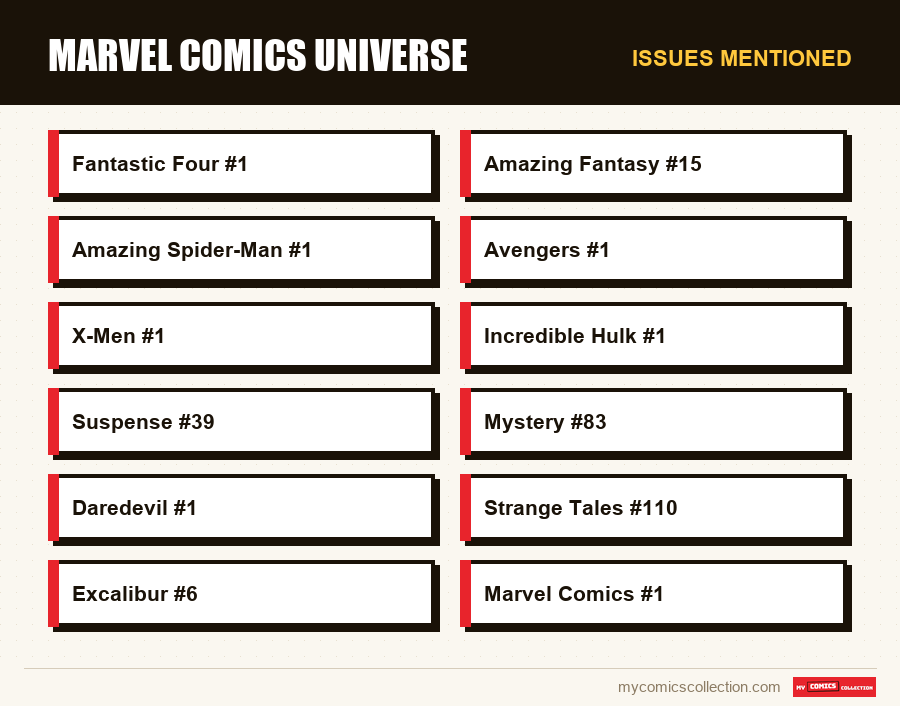
The Marvel comics universe is not a simple superhero publishing house, it is a continuous cosmology built over nearly 90 years, since the creation of Timely Publications by Martin Goodman in October 1939. Modern Marvel, the one that French-speaking collectors know and collect today, was born in November 1961 when Stan Lee and Jack Kirby published Fantastic Four #1 with what was then called Atlas Comics. In 26 months (November 1961 to February 1964), Lee, Kirby, Steve Ditko and their collaborators created Spider-Man (Amazing Fantasy #15 August 1962, Amazing Spider-Man #1 March 1963), the Avengers (Avengers #1 September 1963), the X-Men (X-Men #1 September 1963), Hulk (Incredible Hulk #1 May 1962), Iron Man (Tales of Suspense #39 March 1963), Thor (Journey into Mystery #83 August 1962), Daredevil (Daredevil #1 April 1964) and Doctor Strange (Strange Tales #110 July 1963). This creative explosion became the basis of the Marvel Shared Universe, identified by the numbering Earth-616 that screenwriter Alan Davis popularized in 1989's Excalibur #6.
For a French collector in 2026, navigating this universe requires a clear framework. Who are the canon characters? Which runs to read first? What major events structure continuity? How to articulate the imprints (MAX, Knights, Icon, Ultimate, Absolute) with the mainstream? What does this have to do with the MCU (Marvel Cinematic Universe) which is releasing Thunderbolts, Fantastic Four First Steps and Avengers Doomsday in 2026-2028? Which Panini editions to choose (Deluxe, Marvel Now, Omnibus) and at what price? This Pillar 2026 guide answers these ten questions by synthesizing editorial sources (Marvel.com, Panini France), databases (online collaborative databases, Marvel Database), secondary market sales (GoCollect, eBay sold, Heritage Auctions) and reference works (Sean Howe "Marvel Comics: The Untold Story" 2012, Reed Tucker "Slugfest" 2017).
The Marvel VF 2026 market is going through a good period. Panini Comics, exclusive licensee since 1997 then 2010, publishes around fifty Omnibuses, 80 Deluxes and more than 200 annual newsstand booklets. Omnibus print runs range between 1,500 and 3,500 copies depending on the titles, with some OABs (Omnibus Anniversary Boxes) at 4,500-6,000 copies. The Deluxe Marvel has a print run of 4,000-8,000 copies. This dense editorial offering is accompanied by an acceleration in the secondary market: out-of-print Omnibuses (Daredevil Bendis, Civil War Mark Millar, Old Man Logan) go for €150 to €400 on Le Bon Coin and eBay France compared to €60-90 at the new price. Understanding the Marvel universe therefore becomes both a cultural exercise and a reasoned investment process. This guide structures the nine major chapters which allow you to master the Marvel comics universe and decide on your purchases as an informed collector.
Marvel Comics 1939-2026: complete timeline Timely, Atlas, Marvel
Marvel wasn't always called Marvel. The story begins on August 31, 1939 when Martin Goodman, a pulp publisher based at 330 West 42nd Street in New York, launched Timely Publications. The first issue to appear, Marvel Comics #1 dated October 1939, contained the first appearances of Sub-Mariner (Bill Everett) and the original Human Torch (Carl Burgos). This comic was sold for $6.5 million in March 2022 on Heritage Auctions, becoming the most expensive comic in the world ahead of Action Comics #1 (1938). Captain America Comics #1, created by Joe Simon and Jack Kirby and published in March 1941, shows Cap punching Hitler on the cover nine months before Pearl Harbor. This issue fetches $3.1 million in CGC 9.4 according to the 2022 Heritage sale.
The Timely period (1939-1951) corresponds to the Golden Age Marvel: Human Torch, Sub-Mariner, Captain America, Whizzer, Miss America, Bucky, Toro. The Comics Code Authority established in 1954 and the fall of the superhero genre forced Goodman to pivot. From 1951 to 1961, the company was called Atlas Comics and mainly published westerns, romances, monster stories (Tales to Astonish, Strange Tales, Tales of Suspense) and science fiction. This Atlas decade is often considered a creative trough but it paradoxically forms the breeding ground for modern Marvel: Stan Lee has assumed the editorial reins since 1941, Jack Kirby returned in 1958 after his time at DC, and Steve Ditko joined the team in 1955. Monster anthologies like Strange Tales stylistically prefigured the science fiction of the Fantastic Four.
The Marvel turning point came in November 1961 with Fantastic Four #1 by Lee and Kirby. The company legally retained the name Magazine Management Company until 1968 but displayed the "Marvel Comics Group" logo on its covers from 1963. The period 1961-1972 forms the Silver Age Marvel: creative explosion, revolutionary soap opera narration (personal drama of the heroes), introduction of the entire main pantheon. The Bronze Age Marvel (1973-1985) marked a maturation: Roy Thomas replaced Lee as editor-in-chief in 1972, the Comics Code relaxed in 1971, and darker series appeared (Tomb of Dracula, Werewolf by Night, Master of Kung Fu). Compared to the story of Spider-Man in comics, this period saw Wolverine debut in Incredible Hulk #180-181 (October-November 1974) and Punisher in Amazing Spider-Man #129 (February 1974).
The Copper Age Marvel (1985-1991) began with Secret Wars I (1984-1985) and culminated with X-Men #1 by Chris Claremont and Jim Lee (October 1991), the best-selling comic of all time at 8.1 million copies. The Modern Age (1992-2010) covers the founding of Image Comics by Marvel defectors in February 1992, the Marvel bankruptcy of December 1996, the takeover by Toy Biz in 1998, and the creative renaissance under Joe Quesada (editor-in-chief 2000-2011) who launched Marvel Knights, Ultimate, MAX, and Icon. The modern period 2010-2026 sees Disney buy Marvel for $4.24 billion in August 2009, the launch of the MCU with Iron Man in May 2008, and editorial consolidation around prestige runs (Hickman Avengers, Aaron Thor, Coates Black Panther, Ewing Immortal Hulk).
Top 10 iconic Marvel characters: collector's pantheon
The Marvel pantheon is structured around ten canon characters whose first appearances concentrate the heritage value of the market. Spider-Man (Peter Parker) debuts in Amazing Fantasy #15 dated August 1962 by Stan Lee and Steve Ditko. This comic fetches $3.6 million in CGC 9.6 according to the September 2021 Heritage sale. Amazing Spider-Man #1 (March 1963) is the second appearance and the launch of the regular series. Spider-Man remains commercially Marvel's most profitable character with more than 100 spin-off films and series and merchandise revenue estimated at $1.3 billion annually according to Forbes 2024.
The X-Men began in X-Men #1 dated September 1963 by Lee and Kirby. The title stagnated until Giant-Size X-Men #1 (May 1975) by Len Wein and Dave Cockrum which introduced Wolverine, Storm, Nightcrawler, Colossus, Thunderbird and relaunched the franchise. The Claremont run that followed (Uncanny X-Men #94-279, 1975-1991) formed the basis of the entire mutant universe. The Fantastic Four (Fantastic Four #1 November 1961 by Lee and Kirby) are historically the pivot of the Marvel universe but commercially the least profitable of the major franchises since the 2000s. The film Fantastic Four First Steps, released in July 2025, with Pedro Pascal as Mr. Fantastic relaunches the franchise for phase 6 of the MCU.
Avengers Avengers are born in Avengers #1 (September 1963), Doctor Strange in Strange Tales #110 (July 1963, Lee and Ditko), and Daredevil in Daredevil #1 (April 1964, Lee and Bill Everett). These ten characters constitute the narrative and commercial backbone of Marvel. To compare the dynamics of the other characters, the analysis of Avengers Bronze Age key numbers details the key issues 1973-1985.
Beyond the top 10, two secondary strata complete the pantheon. The stratum of "B-list become A-list" via the MCU: Black Panther (Fantastic Four #52 July 1966 by Lee and Kirby, first mainstream black superhero), Black Widow (Tales of Suspense #52 April 1964), Hawkeye (Tales of Suspense #57 September 1964), Vision (Avengers #57 October 1968), Scarlet Witch (X-Men #4 March 1964). The cosmic and mystical layer: Silver Surfer (Fantastic Four #48 March 1966), Galactus (Fantastic Four #48 March 1966), Adam Warlock (Fantastic Four #66-67 September-October 1967 under the name Him, then Marvel Premiere #1 April 1972 under the name Adam Warlock), Thanos (Iron Man #55 February 1973), Drax the Destroyer (Iron Man #55 February 1973). The market for MCU supporting roles is very volatile: Black Panther #1 1966 multiplied its rating by 8 between 2014 and 2018 with the film Coogler, then stabilized.
Top 10 essential runs Marvel: the literary canon 1961-2025
The hierarchy of Marvel runs is established according to three criteria: narrative impact on continuity, formal quality recognized by critics (Eisner Awards, Harvey Awards), lasting influence on live action adaptations. The Lee/Kirby run Fantastic Four #1-102 (November 1961 to September 1970) remains the founding run of the Marvel universe. In 102 issues, Lee and Kirby created Silver Surfer, Galactus, Black Panther, Inhumans, Mole Man, Doctor Doom, modern Sub-Mariner, proto Adam Warlock, Latveria. The run is available in Omnibus Panini seven volumes (published 2010-2018, new price €70-90 each, secondary market €120-200 for out-of-print volumes 1-3).
The Claremont/Cockrum/Byrne run Uncanny X-Men #94-279 (August 1975 to August 1991) has 17 years of continuity. Chris Claremont is writing this entire run alone, with Dave Cockrum (Giant-Size X-Men #1 and Uncanny X-Men #94-107), John Byrne (Uncanny Major arcs include Dark Phoenix Saga (#129-138, 1980), Days of Future Past (#141-142, 1981), Mutant Massacre (#210-211 1986), Fall of the Mutants (1988), Inferno (1988-1989). Panini is publishing this run in three formats: Marvel Gold hardback (out of print, €60-120 secondary market), Marvel Now Deluxe (in progress), Omnibus X-Men by Chris Claremont (seven volumes published 2018-2024, €70-95 new).
The Miller Daredevil run #158-191 (May 1979 to February 1983) transformed street-level Marvel. Frank Miller goes from designer to co-writer then sole screenwriter from #168 (January 1981). He introduces Elektra (#168), reconfigures Kingpin as the central antagonist (#170), invents Stick and the ninja mentor, rewrites Bullseye's ninja origin. This run inspires the Netflix series Daredevil 2015-2018 and the MCU Born Again return in March 2025. Panini publishes the complete Omnibus Daredevil by Frank Miller (two volumes, 2017 and 2019, new price €70-85, secondary market €120-180 out of print). To understand the context, compare with the Batman story in comics and the contemporary Miller run Batman Year One (1987) shows the author's creative continuity.
The Bendis run New Avengers #1-64 and Mighty Avengers #1-21 (January 2005 to August 2010) restructures the post-Disassembled Avengers. Brian Michael Bendis recruits Spider-Man, Wolverine and Luke Cage to the main team, writes House of M (2005), Secret Invasion (2008), Dark Reign (2009) and Siege (2010). This five-year run lays the narrative foundations of the MCU Avengers. The Hickman House of X / Powers of X run (July to October 2019, 12 issues) recasts the mutant universe. Jonathan Hickman with R.B. Silva and Pepe Larraz introduces Krakoa as a sovereign mutant nation, the Quiet Council, mutant resurrection via Five, and the entire Dawn of X / Reign of X / Destiny of X continuity that structures the X-Men 2019-2024. For the key issues House of X Powers of, see the dedicated guide.
Other canon runs include Walt Simonson Thor #337-382 (1983-1987, introduction of Beta Ray Bill), Peter David Incredible Hulk #331-467 (1987-1998, twelve years), Jason Aaron Thor #1-25 and Mighty Thor #1-23 and Thor #1-32 (2012-2022, ten years), Ta-Nehisi Coates Black Panther #1-25 and Captain America #1-30 (2016-2021), Donny Cates Venom #1-35 and Thor #1-19 (2018-2022), Al Ewing Immortal Hulk #1-50 (2018-2021, considered the most notable Marvel horror run of the 2010s).
Major Marvel Events: Secret Wars, Civil War, Infinity, Secret Invasion
The Marvel Universe structures its continuity around crossover events called "crossovers" or "events". The first modern Marvel event was Secret Wars I (May 1984 to April 1985), 12 issues written by Jim Shooter and drawn by Mike Zeck then Bob Layton. This event follows the main Marvel heroes teleported to Battleworld by the Beyonder. Commercially, Secret Wars I was a huge success (estimated print runs of 750,000-900,000 per issue). Narratively, it introduces Spider-Man's black symbiote which will become Venom (Amazing Spider-Man #252, May 1984, published alongside Secret Wars #8). The DC equivalent is Crisis on Infinite Earths (1985-1986) which consolidates the DC multiverse. Marvel does not do a reset comparable to Crisis and maintains its continuity.
Secret Wars II (1985-1986, 9 issues) follows the Beyonder visiting Earth-616 and critically disappoints. Inferno (1988-1989) and Acts of Vengeance (1989-1990) continue the Bronze/Copper Age event vein. Infinity Gauntlet (July to December 1991, 6 issues) by Jim Starlin, George Pérez and Ron Lim becomes the model for the Marvel cosmic event. Thanos collects all six Infinity Gems, eliminates half the universe with a snap of his fingers, and the crossover serves as a direct basis for the storyline of Avengers Infinity War (2018) and Endgame (2019). The Omnibus Infinity Gauntlet Panini (published 2014, reissued 2021) costs €75-110 on the secondary market for out-of-print copies.
Civil War (May 2006 to February 2007, 7 issues) by Mark Millar and Steve McNiven pits Iron Man (Registration Act) against Captain America (resistance). This event redefines the Marvel political tone and inspires Captain America Civil War (2016). Monster prints for the time (Civil War #1 sold 230,000 copies on the first day). Secret Invasion (April to December 2008, 8 issues) by Bendis and Leinil Yu follows the Skrull invasion infiltrating the Marvel heroes. The Disney+ series Secret Invasion (2023) with Samuel L. Jackson as Nick Fury adapts this event. To anticipate the phase 6 of the MCU, understanding the reference events gives the right framework.
Post-2010 Marvel events include Avengers vs. (2020-2021), Judgment Day (2022) and Blood Hunt (2024). The Marvel cadence under Disney has moved to a major annual event plus X-Men, Spider-Man, Avengers themed events. This saturation is criticized by part of the fandom but remains commercially effective: each event resets the numbering and boosts single sales from 20 to 40% according to ICv2.
Marvel Imprints: MAX, Knights, Icon, Ultimate, Absolute
Marvel has experimented with several imprints (sub-brands) to separate differentiated content from the mainstream. Marvel Knights was launched in November 1998 under Joe Quesada and Jimmy Palmiotti to relaunch Daredevil, Punisher, Black Widow and Inhumans with a more adult tone and prestige authors. The Smith/Quesada Daredevil #1-15 run (1998-2000) and the Bendis/Maleev Daredevil #16-81 run (2001-2006) were born under Marvel Knights. Imprint was deactivated in 2010 but its runs remain references. Panini publishes these runs in Omnibus Daredevil Marvel Knights (Smith/Quesada, Bendis/Maleev, Brubaker, Diggle).
Marvel MAX was launched in April 2001 to target an adult audience with explicit content (graphic violence, sexuality, crude language) outside the Comics Code. Notable titles include Alias (2001-2004, Jessica Jones with Bendis and Michael Gaydos), Punisher MAX (2004-2008, Garth Ennis and Goran Parlov then Steve Dillon), Howard the Duck (2002-2003, Steve Gerber). Punisher MAX by Ennis is considered the definitive version of the character, brutal, without superheroes, anchored in post-Vietnam reality. The Omnibus Punisher MAX by Garth Ennis (two Panini volumes 2019-2021, new €75-90) has become a collector's reference.
Marvel Icon was launched in November 2004 as a creator-owned imprint for featured authors: Powers (Bendis and Michael Avon Oeming), Kabuki (David Mack), Criminal (Brubaker and Phillips), Casanova (Matt Fraction). These titles do not fit into Earth-616 and legally belong to the authors. Ultimate Marvel launched in October 2000 as a modern and accessible parallel universe. Ultimate Spider-Man #1 by Bendis and Mark Bagley (October 2000) recast the character as a contemporary high school student, and the series ran for 160 issues until 2009. Ultimate X-Men, Ultimate Fantastic Four and The Ultimates followed. The Ultimate universe is destroyed in Secret Wars III (2015) and merges with Earth-616.
The new Ultimate Universe is relaunched in November 2023 by Hickman, with Ultimate Spider-Man (Hickman/Checchetto), Ultimate Black Panther (Bryan Hill), Ultimate X-Men (Peach Momoko) and Ultimates (Deniz Camp). This relaunch is enjoying considerable critical and commercial success: Ultimate Spider-Man #1 (January 2024) sold more than 250,000 copies in the first month according to ICv2, the most relevant Marvel launch since Star Wars #1 in 2015. Panini starts VF publication with Ultimate Spider-Man Marvel Now in June 2024. Absolute Marvel does not exist (Absolute is DC Comics since 2024 with Absolute Batman, Absolute Superman, Absolute Wonder Woman by Scott Snyder).
MCU tie-in 2026-2028: Thunderbolts, Fantastic Four First Steps, Avengers Doomsday
The Marvel Cinematic Universe enters phase 6 (2025-2027) with three structuring films which directly impact original and French comic book sales. Thunderbolts (release May 2, 2025 in the United States, April 30, 2025 in France) brings together Yelena Belova, Bucky Barnes, Red Guardian, Ghost, Taskmaster and US Agent. The film draws from the Warren Ellis run Thunderbolts #110-121 (2007-2008) which transforms the team into a group of supervillains managed by Norman Osborn. The original Thunderbolts comics (1997-2003 by Kurt Busiek and Mark Bagley) remain the founding references. For the speculation Thunderbolts comics MCU 2027, see the dedicated guide.
Fantastic Four First Steps is released on July 25, 2025 in the United States and July 23, 2025 in France. The cast brings together Pedro Pascal (Reed Richards), Vanessa Kirby (Sue Storm), Joseph Quinn (Johnny Storm), Ebon Moss-Bachrach (Ben Grimm) and Julia Garner (Silver Surfer Shalla-Bal). The film draws from the Lee/Kirby run Fantastic Four #45-67 (1965-1967) including the Galactus trilogy (#48-50) and the Inhumans arc (#45-48). The Fantastic Four 1965-1967 market has already grown by 40-60% between January 2024 and June 2025 on GoCollect. To anticipate comic book valuations before release, see Fantastic Four 2025 comics before the film.
Avengers Doomsday (initially scheduled for May 2026, since moved to December 18, 2026) officially introduces Robert Downey Jr. as Doctor Doom (San Diego Comic-Con announcement July 2024). This casting marks the narrative break: Doom takes Kang's place as the main antagonist of the Multiverse Saga. The film draws from Secret Wars I (1984) and Secret Wars III (2015 by Hickman) where Doom becomes God Emperor of Battleworld. The Secret Wars comics VF (Omnibus Marvel France 2017 for Hickman, Comicpunk OAB 2024 for Shooter 1984) saw their rating increase from 30 to 50% between 2024 and 2026. Avengers Secret Wars (scheduled for May 2027) closes phase 6 and completes the post-Endgame trilogy.
Beyond the three flagship films, phase 6 MCU includes two major Disney+ series for comics: Daredevil Born Again (March-May 2025, nine episodes) which adapts the Frank Miller/David Mazzucchelli run (1986) with Charlie Cox as Murdock and Vincent D'Onofrio as Kingpin, and Ironheart (June-July 2025, six episodes) which introduces Riri Williams in its own series after her appearance in Black Panther Wakanda Forever (2022). To anticipate the Riri Williams odds, see Ironheart comics Disney pre-order. Captain America Brave New World (released February 14, 2025) has already boosted Sam Wilson Captain America comics (Captain America Sam Wilson #1 October 2015) by 60% in six months post-release according to GoCollect. See the analysis speculation comics Captain America Brave New World.
Collecting this series?
Track what you own, what you are missing and what your collection is worth. 7 day trial.
Start my trial →Cosmic Marvel: Guardians of the Galaxy, Eternals, Adam Warlock
The Marvel cosmic pan is organized around four major franchises: Silver Surfer / Galactus, Adam Warlock / Thanos, Guardians of the Galaxy, Eternals / Celestials. Silver Surfer appears in Fantastic Four #48 (March 1966, Lee and Kirby) as a herald of Galactus who has come to consume Terra. The Galactus trilogy FF #48-50 remains Marvel's founding cosmic moment. Silver Surfer gets his solo series Silver Surfer #1-18 (August 1968 to September 1970, Lee and John Buscema). The Steve Englehart run on Silver Surfer (1987-1991) and Jim Starlin (1988-1990 then 1995-1996) modernizes the character and connects him to cosmic events.
Adam Warlock is introduced as "Him" in Fantastic Four #66-67 (September-October 1967 by Lee and Kirby) and then renamed and expanded by Roy Thomas in Marvel Premiere #1 (April 1972). The Jim Starlin run Strange Tales #178-181 then Warlock #9-15 (1975-1976) and Avengers Annual #7 / Marvel Two-in-One Annual #2 (1977) introduced Magus, the Soul Gem, and pitted Adam against Thanos for the first time. Thanos himself debuts in Iron Man #55 (February 1973) by Mike Friedrich and Jim Starlin. The Infinity Gemstones/Gauntlet mythos structures the entire Marvel cosmic up to Infinity Gauntlet (1991) and beyond.
Guardians of the Galaxy 2008 version by Dan Abnett and Andy Lanning (bringing together Star-Lord, Gamora, Drax, Groot, Rocket Raccoon) recasts the original 1969 team (Vance Astro, Yondu, Charlie-27, Martinex). The DnA run Annihilation (2006), Annihilation Conquest (2007) and Guardians of the Galaxy #1-25 (2008-2010) form the direct plot of the James Gunn film (2014). Cinematic success boosted Marvel Preview #4 (January 1976, first Star-Lord) from €50 in 2013 to €800-1,200 in 2024 according to GoCollect. For the key numbers Avengers Bronze Age related, the cosmic pan also goes through the Annual Avengers 1977 introducing the Korvac Saga.
Eternals begins in Eternals #1 (July 1976 by Jack Kirby) as Kirby's late creation at Marvel. The concept of Celestials, Eternals and Deviants influence the entire Marvel cosmology but remains niche until the Chloé Zhao film in November 2021. The Al Ewing Eternals series (2021-2022) relaunches the franchise with critical success. Cosmic Marvel 2025-2026 sees the return of Cosmic Avengers (2025) and the preparation of the Galactus / Silver Surfer film post-Doomsday. Cosmic remains a premium collector's segment: lower print runs, rare key issues, high valuation on Heritage 2024-2025 sales.
Marvel Knights street level: Daredevil, Punisher, Moon Knight, Heroes for Hire
The Marvel street level brings together urban heroes without cosmic powers, anchored in New York (mainly Hell's Kitchen, Harlem, Lower East Side). The central character is Daredevil (Matt Murdock), a blind lawyer with hyperdeveloped senses, created by Lee and Bill Everett in April 1964. The Daredevil canon was built through five major runs: Miller screenwriter #168-191 (1981-1983), Miller/Mazzucchelli Born Again #226-233 (1986), Bendis/Maleev #16-81 (2001-2006, Marvel Knights), Brubaker/Lark #82-119 (2006-2009), Waid/Samnee #1-36 (2011-2015). Charles Soule (#1-28, 2015-2018) and Chip Zdarsky (#1-36 then 2019-2024) continue the tradition.
Punisher (Frank Castle) debuts in Amazing Spider-Man #129 (February 1974) by Gerry Conway and Ross Andru. The character was created as an antagonist of Spider-Man but became a full-fledged anti-hero in his 1986 limited series by Steven Grant and Mike Zeck. The Punisher canon includes Garth Ennis Punisher #1-37 Marvel Knights (2000-2001), Ennis Punisher MAX #1-60 (2004-2008), and the 2018-2024 return under Jason Aaron, Matthew Rosenberg, Frank Tieri. The Netflix series Punisher (2017-2019) with Jon Bernthal boosted ASM #129 from €200 to €1,500 between 2016 and 2020 according to GoCollect.
Moon Knight (Marc Spector) debuts in Werewolf by Night #32 (August 1975) by Doug Moench and Don Perlin. The seminal run is Moench/Sienkiewicz Moon Knight #1-30 (1980-1984). The Warren Ellis run Moon Knight (2014, six issues with Declan Shalvey) radically modernizes the character with an influential minimalist style. Jeff Lemire (2016) and Jed MacKay (2021-2024) extend. The Disney+ series Moon Knight (March-May 2022) with Oscar Isaac boosted Werewolf by Night #32 from €150 to €800 according to Heritage Auctions. Compared to the story of Spider-Man in comics, the street level shares the New York anchorage but shifts more quickly towards noir crime.
Heroes for Hire (1972 in Power Man #1-44, Luke Cage and Iron Fist merger 1978) covers Luke Cage Hero for Hire #1 (June 1972, John Romita Sr. and George Tuska) and Iron Fist (Marvel Premiere #15, May 1974, Roy Thomas and Gil Kane). The Netflix series Luke Cage (2016-2018) and Iron Fist (2017-2018) boosted these key issues. Jessica Jones (Alias #1 November 2001, Bendis and Gaydos) completes the modern street level, with the Netflix series Jessica Jones (2015-2019). The street level 1972-1978 key issues remain affordable (€50-300 depending on CGC condition), constituting a reasonable entry point for a targeted comics investment.
Marvel collector strategy by budget: €100 to €50,000
For an annual Marvel comics budget under €100, the 2026 strategy targets one Deluxe Panini per quarter (€25-30 each) on a heritage series. The priority choices are Daredevil by Frank Miller Deluxe (two volumes), Hickman Avengers Deluxe (in progress), Spider-Man by Donny Cates Deluxe (one volume), Hulk by Peter David Deluxe (six volumes published). At this level, the objective is cultural and reading pleasure, without investment aim. The resale of a current Deluxe Panini does not exceed €35-45 on Le Bon Coin after two years, a moderate discount.
Annual budget €250-500, aim for one Panini Omnibus per semester (€70-95 new) on heritage runs and complete in Deluxe on current series. Priority Omnibus 2026: Daredevil by Frank Miller (volumes 1-2 if still available), Hickman Fantastic Four Omnibus, Hickman Avengers Omnibus, Bendis Daredevil Omnibus, Ewing Immortal Hulk Omnibus. This strategy makes it possible to build in five years a Marvel library of 25-30 Omnibuses forming the complete canon. The average potential resale of an Omnibus sold out after five years is +50 to +80% compared to the new price depending on the title.
Annual budget €1,000-3,000, switch to the Omnibus VO Marvel ($90-150 new on Amazon US) and the key Bronze Age single issues (Wolverine first appearance Incredible Hulk #181 October 1974, first Punisher ASM #129 February 1974, first Ghost Rider Marvel Spotlight #5 August 1972). The VO Marvel Omnibuses have the advantage of more regular editorial production and larger print runs (5,000-12,000 copies) with a stable rating. Bronze Age single issues in CGC 7.0-8.0 remain in the €200-800 per unit range and offer a solid 5-10 year investment horizon.
Budget €5,000-20,000 and more, aim for the Silver Age key issues Marvel in CGC 5.0-7.0: Amazing Fantasy #15 (first Spider-Man), X-Men #1 (first X-Men), Avengers #1, Fantastic Four #1, Daredevil #1, Iron Man first Tales of Suspense #39, Hulk #1. These issues start at €3,500-8,000 in CGC 4.0-5.0 and rise to €20,000-80,000 in CGC 8.0. To structure this approach, the service free estimate My Comics Collection evaluates the parts before purchase or resale. The €20,000-50,000 segment affects the Golden Age (Marvel Comics #1 1939, Captain America Comics #1 1941) and remains reserved for advanced collectors with a verifiable transaction history.
Sources VF Panini: Deluxe, Marvel Now, Omnibus, OAB
Panini Comics has been the exclusive Marvel licensee in France since 1997 (initially Marvel France, Panini brand since 2010). The publisher publishes in four main formats. The Marvel Now Deluxe format (24 x 17 cm hardback, 200-280 color pages, new price €25-30) covers current runs 2010-2025 with high editorial regularity: Hickman Avengers, Aaron Thor, Coates Black Panther, Slott Spider-Man, Cates Venom. The Deluxe format has become the accessible reference and the majority of FR collectors start there.
The Omnibus format (28 x 19 cm hardback, 600-1,200 color pages, new price €70-95) covers the complete heritage runs. Panini published 80+ Marvel Omnibus between 2010 and 2025: Lee/Kirby Fantastic Four (seven books), Claremont X-Men (seven books), Miller Daredevil (two books), Bendis Daredevil (two books), Ennis Punisher MAX (two books), Hickman Avengers (six books), Aaron Thor (five books). Print runs vary between 1,500 and 3,500 copies per volume, with stock shortages often occurring 12-24 months after release. To compare Panini Deluxe and Marvel Now Edition, see Panini Deluxe vs. Marvel Now Edition.
The Omnibus Anniversary Box (OAB) format launched in 2022 by Panini celebrates editorial anniversaries with a cardboard box containing two to four Omnibuses. The OABs published include Spider-Man 60 Years (2022, 4 volumes), New price OAB €250-380 depending on the box, print run 4,500-6,000 copies. Out-of-print OABs cost €400-650 on the 2026 secondary market. The newsstand format (monthly booklets Spider-Man, Newsstand booklets do not hold their value on the secondary market.
To discover the complete comics catalog before purchase, the comics section My Comics Collection aggregates VO and VF references. The 2026 strategy recommended for a Marvel FR collector is: 70% of the budget in heritage Panini Omnibus (runs Lee/Kirby, Claremont, Miller, Bendis, Hickman), 20% in Deluxe Panini on current series (Cates, Ewing, MacKay, Zdarsky), 10% in original Marvel Omnibus for runs not available in French (Englehart Avengers, Stern Avengers, Englehart Doctor Strange). This distribution balances reading pleasure, collector's heritage and exposure to cosmic novelties.
FAQ: Universe Marvel comics collector FR 2026
Where to start to discover the Marvel comics universe in 2026?
For a 2026 beginner, the optimal entry point is the Lee/Kirby run Fantastic Four #1-50 available in Omnibus Panini volume 1 (published 2010, reissued 2023, new price €75-85) or in Marvel Gold hardback. This 1961-1966 run introduces the essentials of Marvel cosmology (Doctor Doom, Sub-Mariner, Silver Surfer, Galactus, Black Panther, Inhumans, Mole Man, Latverie). At the same time, the Lee/Ditko run Amazing Spider-Man #1-38 available in Omnibus Panini completes the Earth-616 foundation. Once this foundation is laid, switch to Claremont X-Men (Omnibus volume 1 2018) or Miller Daredevil (Omnibus volume 1 2017) depending on your affinities. The initial budget for five Discovery Omnibuses is around €350-450.
What are the most historically valuable Marvel comics?
The top 5 historical Marvel valuation 2026 includes Marvel Comics #1 (October 1939, first Sub-Mariner and Human Torch) sold for $6.5 million on Heritage in March 2022, Captain America Comics #1 (March 1941, first Cap) sold for $3.1 million in CGC 9.4, Amazing Fantasy #15 (August 1962, first Spider-Man) sold for 3.6 million in CGC 9.6 in September 2021, Incredible Hulk #181 (October 1974, first Wolverine) sold for $86,000 in CGC 9.8 in 2024, and X-Men #1 (September 1963, first free estimate evaluates based on GoCollect, Heritage and eBay sold sales.
Which Marvel runs should you read first to understand the universe?
Five canon runs cover 80% of the Marvel Universe: Lee/Kirby Fantastic Four #1-102 (1961-1970), Lee/Ditko Amazing Spider-Man #1-38 and Spectacular Spider-Man #2 (1963-1966), Claremont Uncanny X-Men #94-279 (1975-1991), Miller Daredevil #158-191 (1979-1983), Hickman House of X / Powers of X and Dawn of X (2019-2021). These cumulative 35 years of continuity form the Marvel narrative and visual grammar. Complete with Walt Simonson Thor #337-382 (1983-1987), Bendis New Avengers #1-64 (2005-2010), Brubaker Captain America #1-50 (2004-2008), and Ewing Immortal Hulk #1-50 (2018-2021) to capture modern inflections. All available in Omnibus Panini or Marvel.
How to integrate the MCU into a Marvel comics collection?
The 2026 reasoned approach is to collect key source material from MCU adaptations without giving in to speculative FOMO. For phase 6 (2025-2027), prioritize Tales of Suspense #39 (first Iron Man, source Iron Man 2008), Captain America Comics #1 (source Captain America First Avenger), Avengers #1 (source The Avengers 2012), Daredevil #1 (source Born Again 2025), Fantastic Four #48-50 Galactus trilogy (source First Steps 2025), Secret Wars I and III (source Avengers Doomsday 2026 and Secret Wars 2027). These 6-8 references cover 90% of MCU phase 6 films. Anticipate increases 12-18 months before film release via phase 6 MCU analysis.
What is the difference between Omnibus, Deluxe and Panini booklet?
The Panini Omnibus is the prestige cardboard format 28x19 cm 600-1,200 color pages (new price €70-95) which compiles a complete or partial heritage run. Editions 1,500-3,500 copies, high-end editorial quality. The Deluxe Panini is the intermediate format cardboard 24x17 cm 200-280 pages (new price €25-30) which cuts recent runs into volumes. Editions 4,000-8,000 copies, comfortable reading. The newsstand booklet is the flexible monthly format 26x17 cm 96-128 pages (new price €4.50-6.50) which follows recent single issues. Print runs 6,000-15,000 copies, very low resale value. The 2026 collector's strategy favors Omnibus for heritage and Deluxe for current monitoring.