Since the MCU went past the Infinity Saga, every Marvel Studios announcement triggers a chain reaction in the comics market. Phase 4 made values explode on Shang-Chi #1 and Ms.
Since the MCU went past the Infinity Saga, every Marvel Studios announcement triggers a chain reaction in the comics market. Phase 4 made values explode on Shang-Chi #1 and Ms. Marvel #1. Phase 5 propelled Kang key issues to peaks. With Phase 6 taking shape around the Fantastic Four film, a reconfigured Avengers: The Kang Dynasty and probably major character introductions, a question imposes itself on every collector: can we anticipate the next key issues that will take off?
The honest answer is: yes and no. Yes, we can identify probable characters with analytical eyes. No, no one can guarantee that an investment in such-and-such issue will be profitable, and this guide is here to help you think like a savvy collector, not a blind speculator. Here's our analysis of the characters most likely to appear in Phase 6 and the associated key issues, with the necessary nuances.
Financial warning: Information in this article is provided for documentary purposes and in no way constitutes investment advice. Comic prices can fluctuate strongly both up and down. Any comic purchase for speculative purposes carries significant loss risks. Always buy first what passionate you as a collector.
Lessons from previous phases: what worked, what failed
Before analyzing Phase 6, it's essential to draw lessons from what the MCU has taught the comics market since 2019. Some bets were winners, others turned out to be real collector traps.
What worked: quick confirmations
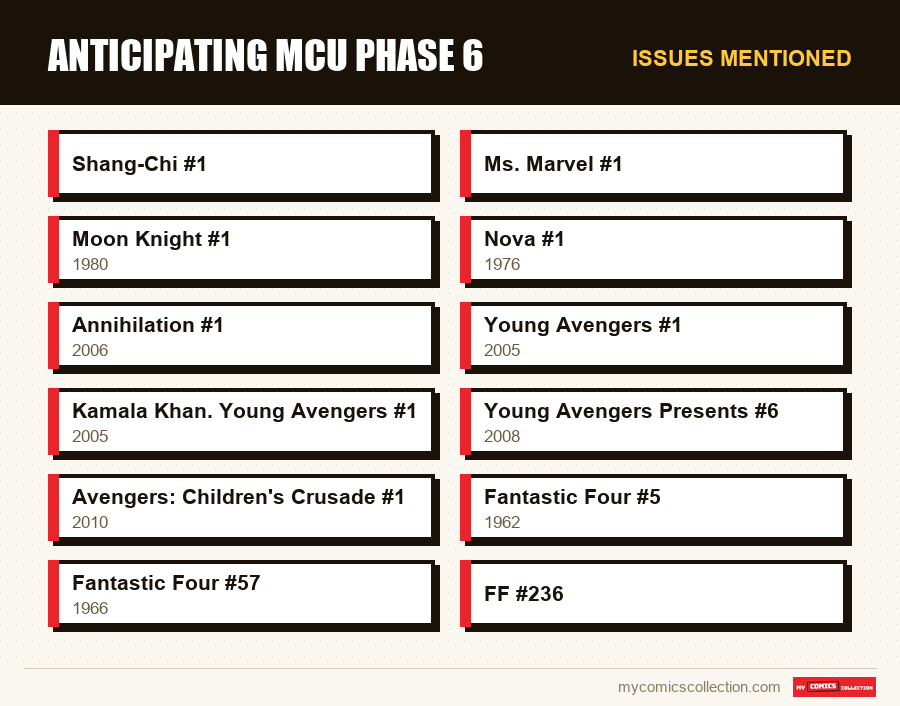
The key issues that performed best during previous phases were those whose character was confirmed quickly after an initial interest spike. Ms. Marvel #1 (Kamala Khan, 2014) already had a solid fan community before the Disney+ show announcement. When the announcement dropped, pre-existing demand amplified the rise. Same for Moon Knight #1 (1980), whose value held because the character had a real comics fan base.
Conversely, some speculative bets collapsed. Issues bought en masse anticipating a film that didn't come out, or that disappointed at box office, saw their values drop as fast as they rose. The MCU speculative bubble syndrome is well documented: a leak, a rumor, a simple mention on a podcast is enough to push a comic from $20 to $150, only to see it fall back to $25 three months later if the announcement isn't confirmed.
What failed: anticipations too broad
Buying all of a character's key issues as soon as a rumor circulates is the riskiest strategy. In Phase 5, many collectors stocked issues hoping for an adaptation that didn't materialize in expected timeframes. Lesson: limit yourself to characters whose MCU presence is confirmed or very strongly anticipated by multiple independent sources, and buy issues you'd be happy to own even if value doesn't move.
Create your MCU Phase 6 watchlist
Organize your key issues to watch, track their value and give each one a target price with My Comics Collection. Your collection always up to date, issue by issue.
Create my watchlistNova (Richard Rider), Nova #1 (1976)
Richard Rider, the human Nova Corps member, is one of the characters most regularly cited for a Phase 6 adaptation. Introduced in 1976 in Nova #1 by Marv Wolfman and John Buscema, Richard Rider is a Queens high-schooler (like Peter Parker) who receives powers from a dying Nova Corps member. The character has been relaunched several times, notably in the Annihilation series (2006) where he becomes one of Marvel's most important cosmic heroes.
Nova key issues to watch from this analytical angle would be: Nova #1 (1976) for Richard Rider's first appearance, and Annihilation #1 (2006) for the modern warrior version of the character: the one that would likely be adapted if an MCU project were confirmed. These issues could be considered for collection purposes, with no guarantee whatsoever of value evolution.
Young Avengers, Young Avengers #1 (2005)
MCU Phase 6 should logically lead to the formation of a Young Avengers team, after Phase 4 and 5 introductions of Kate Bishop (Hawkeye ), America Chavez ( Doctor Strange 2 ), Cassie Lang ( Ant-Man 3), Eli Bradley and Kamala Khan. Young Avengers #1 (2005), written by Allan Heinberg with Jim Cheung art, is the team's first collective appearance and introduces several key members simultaneously.
This issue is particularly interesting because it introduces Patriot (Eli Bradley), Iron Lad, Hulkling and Asgardian (Wiccan) in a single issue. In 2026, this comic remains relatively accessible compared to Silver Age key issues. Individual first appearances of members:Young Avengers Presents #6 (2008) for America Chavez or Avengers: Children's Crusade #1 (2010): are also documented in the community.
Doctor Doom, Fantastic Four #5 (1962) and accessible issues
Doctor Doom is one of Phase 6's most anticipated characters, potentially as long-term antagonist after the Fantastic Four. His full first appearance, Fantastic Four #5 (July 1962), is a Silver Age issue whose value ranges from several thousand to tens of thousands of dollars depending on condition, well out of reach for most collectors.
More accessible alternatives would document interest in the character: Fantastic Four #57 (1966) with the iconic "Steal the Silver Surfer's Power!" cover, John Byrne run issues (FF #236-279) where Doom is central to several major arcs, or Triumph and Torment (1989), the Roger Stern/Mike Mignola graphic novel considered the best Doom story. These issues have artistic and narrative value independent of any MCU speculation.
Hercules, Journey Into Mystery #1 (1965) and Thor #126
Hercules is a character whose MCU integration rumors have circulated for years, reinforced by his cameo appearance in Thor: Love and Thunder. His first appearance goes back to Journey into Mystery Annual #1 (1965), a rare and expensive issue. His first appearance in a regular issue is Thor #126 (1966), more accessible but still significant in pricing terms.
If Hercules were to appear in a confirmed Phase 6 project, these issues could see their interest grow. But we should recall that anticipations around Hercules have existed for years without major materialization: perfect illustration of speculative risk tied to MCU rumors.
Sentry, New Avengers #1 (2005, Bendis)
Sentry, Marvel's Superman created by Paul Jenkins, is one of the most regularly cited characters for MCU adaptation. His modern first appearance in New Avengers #1 (2005) by Brian Michael Bendis is an early-2000s key issue that remains accessible. The original miniseries Sentry #1 (2000) by Paul Jenkins is his canonical introduction point and is a rarer piece.
The Sentry character presents a fascinating duality between his all-powerful hero persona and his destructive alter ego, the Void, making him an excellent antagonist or ambiguous ally for a Phase 6 with cosmic stakes. His arc in Dark Avengers and Siege (2009-2010) would be a natural narrative source for the MCU.
Collecting this series?
Track what you own, what you are missing and what your collection is worth. 7 day trial.
Start my trial →How to build a Phase 6 watchlist without speculating blindly
The best approach for a collector wanting to anticipate Phase 6 without falling into pure speculation is applying a multi-step method:
List only already-confirmed or very strongly anticipated characters
Only interest yourself in characters whose MCU Phase 6 presence has been confirmed by Marvel Studios, or mentioned by multiple reliable independent sources. Filter out unverified rumors: they represent the main loss source for amateur speculators.
Identify key issues at multiple budget levels
For each character, identify: the absolute first appearance (often out of price), the first appearance in an accessible regular issue, and narratively important but more affordable issues. Document the three levels in your watchlist.
Only buy what you'd be happy to own forever
The savvy collector's fundamental rule: if the film is never announced and value doesn't move, would you be happy to have this comic in your collection for its narrative and artistic interest? If the answer is no, abstain.
Catalog and track value evolution
Use a collection management tool to document your acquisitions, their condition, purchase price and track market value evolution. A well-maintained watchlist lets you make informed rather than reactive decisions.
Important reminder: Prices mentioned in this article are estimates based on market data available in June 2026 and are given for indicative purposes only. The comics market is volatile and values can evolve significantly. Consult specialized platforms (Heritage Auctions, eBay sold listings, GPAnalysis) before any significant purchase. This article doesn't constitute investment advice.
The Phase 6 key issues to watch: recap
Here's our analytical recap of issues to document in your watchlist, classified by character and accessibility:
- Nova #1 (1976): First appearance of Richard Rider. Accessible in average condition.
- Annihilation #1 (2006): Modern Nova version, reference cosmic story.
- Young Avengers #1 (2005): First collective appearance of the Young Avengers team.
- Fantastic Four #5 (1962): Full first appearance of Doom. Expensive Silver Age.
- Fantastic Four #247 (1982): Doom sovereign of Latveria, accessible issue.
- Journey into Mystery Annual #1 (1965): First appearance of Hercules. Rare issue.
- Thor #126 (1966): Hercules in a regular issue, more accessible.
- Sentry #1 (2000): First appearance of Sentry by Paul Jenkins.
- New Avengers #1 (2005): Sentry in the Bendis era, very accessible.
- Dark Avengers #1 (2009): Sentry in Dark Reign context, affordable modern issue.
FAQ, MCU Phase 6 Key Issues
Track your MCU speculation value
My Comics Collection lets you catalog your MCU Phase 6 key issues, track their value evolution and organize your watchlist of issues to acquire.
Track my MCU key issues