
The collectible comics market has been through major upheavals in recent years. After the spectacular boom of 2020-2022, driven by the MCU, lockdowns and a massive wave of new speculator-collectors, the market entered a significant correction between 2022 and 2024.
The collectible comics market has been through major upheavals in recent years. After the spectacular boom of 2020-2022, driven by the MCU, lockdowns and a massive wave of new speculator-collectors, the market entered a significant correction between 2022 and 2024. In 2026, the market enters a new phase: more mature, more selective, and segmented like never before.
Understanding these trends is essential for any collector who wants to make informed purchases, protect the value of an existing collection or identify new opportunities. This article gives you our complete and honest analysis of the market in 2026, without excessive optimism or unjustified pessimism.
Financial warning: The analyses in this article are based on observable market data and do not constitute guaranteed forecasts or investment advice. Collectible markets are inherently unpredictable and past performance doesn't predict future performance. Don't make financial decisions based solely on this article.
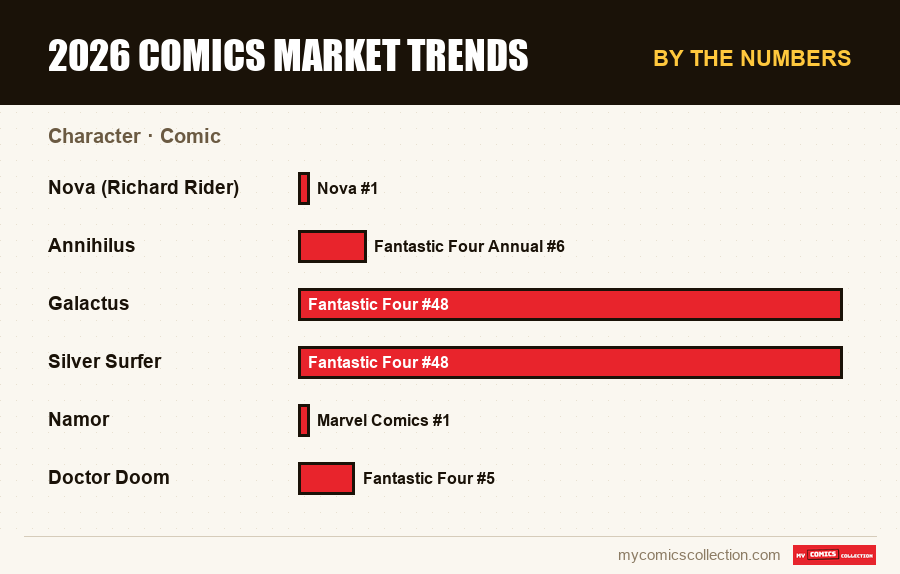
| Character | Comic | Year | Significance |
|---|---|---|---|
| Nova (Richard Rider) | Nova #1 | 1976 | First appearance; often cited as next in the MCU for years |
| Annihilus | Fantastic Four Annual #6 | 1968 | First appearance; linked to the Fantastic Four's arrival in the MCU |
| Galactus | Fantastic Four #48 | 1966 | "The Coming of Galactus" major key issue independent of the MCU |
| Silver Surfer | Fantastic Four #48 | 1966 | Same issue as Galactus; double key issue of major historical importance |
| Namor | Marvel Comics #1 | 1939 | First appearance; extremely rare Golden Age; already appeared in Black Panther Wakanda Forever |
| Doctor Doom | Fantastic Four #5 | 1962 | First appearance with armor and hood; very important Silver Age key issue |
The post-MCU-boom correction (2020-2024): the reckoning
To understand 2026, you have to understand what happened between 2020 and 2024. The collectible comics market saw its most spectacular boom since the 90s between 2020 and mid-2022. The factors were multiple and reinforcing:
- The colossal success of MCU Phase 4 and 5 (WandaVision, Loki, Hawkeye, Moon Knight, She-Hulk) generated massive demand for the first appearances of new characters.
- Lockdowns brought an influx of new collectors with available time and sometimes money.
- Low interest rates and abundant liquidity pushed alternative investors toward collectibles.
- Social networks (YouTube, TikTok, Instagram) democratized information on key issues and created a culture of large-scale speculation.
During this boom, comics like Amazing Spider-Man #300 CGC 9.8 doubled or tripled in price, obscure issues containing first appearances of secondary MCU characters were speculated to absurd prices, and CGC submission volume exploded.
Then the correction arrived. Between mid-2022 and 2024, the most speculative comics lost 40 to 70% of their peak value. First appearances of secondary MCU characters (Ms. Marvel, Moon Knight, She-Hulk) corrected massively. 1:10 variants of modern issues fell to values close to zero. Comics that had been speculated solely on film rumor often lost nearly all their premium.
The 2025-2026 stabilization: a market getting its structure
In 2025-2026, the market entered a stabilization phase. Irrational prices were corrected and the market is finding healthier fundamentals. Here's what we observe:
Prices stabilize on major key issues
The great first appearances (Amazing Fantasy #15, X-Men #1 (1963), Incredible Hulk #1, Fantastic Four #1, Amazing Spider-Man #1) have resumed a slow and steady upward trajectory after a light correction. These issues represent the irreplaceable heritage of American comics history. Their demand is global, structural and doesn't depend on MCU releases.
On the Copper Age (1984-1993), issues like Amazing Spider-Man #300 CGC 9.8 , New Mutants #98 CGC 9.8 (first Deadpool appearance) and Batman Adventures #12 CGC 9.8 (first Harley Quinn appearance) have found more reasonable levels after correction and appear stabilized.
CGC grading normalizes
During the boom, CGC turnaround times had exploded to 12-18 months. In 2025-2026, times have normalized (2-4 months for standard services) and submission volumes have returned to more reasonable levels. This means the pricing pressure from CGC scarcity has dissipated.
Track the evolution of YOUR collection day by day
In a market that's segmenting and evolving rapidly, knowing the exact value of your collection is more important than ever. My Comics Collection gives you daily-updated tracking based on current eBay listings.
7-day free trial, no commitmentSegments holding strong in 2026
Golden Age (1938-1956): indestructible heritage value
Golden Age remains one of the rare categories whose prices barely corrected after the boom. The reasons are structural: these comics are 70 to 90 years old, their survival in good condition is statistically rare, and they represent unique pieces of cultural history. A Captain America Comics #1 (1941), a Batman #1 (1940), or even a Detective Comics #27 (1939) doesn't suffer the same fluctuations as speculative modern comics.
Demand for Golden Age comes from institutional collectors, museums, major private fortunes: an audience that doesn't react to MCU film rumors. This segment is long-term by nature.
Silver Age (1956-1969): the serious collector's safe haven
Silver Age (generally defined by the first appearance of the modern Flash in Showcase #4 in 1956) represents Marvel and DC's most iconic period. Amazing Fantasy #15, X-Men #1, Fantastic Four #1, Avengers #1, Daredevil #1, Iron Man #1 (Tales of Suspense #39): these issues make up the collectible comics pantheon.
In CGC 8.0 or above condition, Silver Age key issues maintained or slightly appreciated in 2024-2026 despite the general market correction. Their absolute scarcity (few copies graded CGC 9.0+ exist) ensures demand structurally exceeds supply.
CGC 9.8 on recognized key issues
The CGC 9.8 grade has become a market reference standard. On recognized Copper Age key issues (ASM #300, New Mutants #98, Batman Adventures #12, Teenage Mutant Ninja Turtles #1), CGC 9.8s continue to attract the most serious buyers and hold solid prices after correction.
Collecting this series?
Track what you own, what you are missing and what your collection is worth. 7 day trial.
Start my trial →Segments that corrected and are slow to recover
Secondary MCU first appearances
This is the segment that suffered most. Comics like Ms. Marvel #1 (Kamala Khan) , Moon Knight #1 (1980) , She-Hulk #1 (1989) , or Hawkeye #1 (1983) hit absurd prices in 2021-2022 on the strength of Disney+ adaptations. Most have corrected 50 to 80% from their peak and struggle to recover because enthusiasm for Disney+ shows has faded.
1:10 variants and modern alternate covers
1:10 variants (one copy per ten regular copies ordered) of modern issues have lost almost all premium value. During the boom, even 1:10 variants of minor issues sold for $20-30. In 2026, they return to their real value: little or no premium over the regular edition. Only 1:25, 1:50 or 1:100 ratio variants on important issues retain interest.
Pure speculative comics: bought solely for speculation
Comics bought only because a character was "MCU rumored" without their own narrative interest have almost all corrected. The lesson is clear: comics that hold long-term value are those with intrinsic importance in the medium's history (first appearance of a major character, legendary author's run, milestone issue) not those merely tied to passing film news.
New trends: manga key issues and non-English-language comics
The rise of manga key issues
One of the most significant trends of 2024-2026 is the emergence of a genuine collection market for manga key issues. First Japanese editions of Dragon Ball (Weekly Shonen Jump, 1984), One Piece (1997), Naruto (1999) and Berserk now attract an international collector community and record prices.
CGC launched a specific grading service for Japanese manga, creating infrastructure similar to the American comics market. Heritage Auctions achieved record sales on first Dragon Ball editions. This segment is still young, which can represent an opportunity for early entrants, but also carries the risks inherent to any forming market.
Mangas to watch in 2026: Dragon Ball Vol. 1 first Jump Comics edition (1985), One Piece Vol. 1 first edition (1997), Berserk Vol. 1 first edition (1990), and original Weekly Shonen Jump issues containing the first serializations of these series.
Non-English-language comics
An even more niche but developing segment: European editions of American superheroes published in the 1960s-1980s. French Lug editions, Italian Mondadori editions, Spanish Bruguera editions: all these golden-age translated comics generate growing local collector interest.
MCU Phase 6 characters to watch in 2026
With all due MCU speculation caveats, here are the characters whose first appearances are drawing interest in 2026:
First appearances to watch, Phase 6 MCU and beyond
- Nova (Richard Rider): Nova #1 (1976), first appearance. Often cited as next in the MCU for years.
- Annihilus: Fantastic Four Annual #6 (1968), first appearance. Linked to the Fantastic Four's arrival in the MCU.
- Galactus: Fantastic Four #48 (1966), "The Coming of Galactus." Major key issue independent of the MCU.
- Silver Surfer: Fantastic Four #48 (1966), same issue. Double key issue of major historical importance.
- Namor: Marvel Comics #1 (1939), first appearance. Extremely rare Golden Age, already appeared in Black Panther Wakanda Forever.
- Doctor Doom: Fantastic Four #5 (1962), first appearance with armor and hood. Very important Silver Age key issue.
Warning: several of these characters are expected in the MCU "for years" without official confirmation. Buy these comics because they have intrinsic value as historical key issues, not just for MCU speculation.
Tips for navigating the current market
In this context of a stabilized and selective market, here are the principles guiding the savviest collectors in 2026:
Favor quality over quantity
A single CGC 9.8 of a recognized key issue beats ten speculative modern comics. The 2024-2026 market confirmed that quality (excellent condition, historically important issue) resists corrections far better than mass speculation.
Focus on intrinsic value
Before buying a comic "for value," ask: would this comic have value if no film or show was in production? If the answer is no, it's pure speculation, not collecting. Real key issues have narrative and historical importance beyond their media moment.
Follow real sales data
GoCollect, GPAnalysis, Heritage Auctions archives and eBay "Sold listings" are your best allies. Never base buying or selling decisions on estimates: only on recent real sales. In 2026, market data is accessible: use it.
Diversify segments
Holding only speculative modern comics or only unreachable Golden Age isn't a balanced strategy. Savvy collectors blend: a few quality Silver/Bronze Age key issues, well-chosen Copper Age pieces, and attention to new trends (manga, non-English) for a limited portfolio portion.
Long-term perspective: The collectible comics market follows, long-term, the same logic as other cultural-object collection markets: proven historical pieces in excellent condition continue to appreciate over decades. It's short-term speculation on media news that generates the biggest losses. Collect for passion, not short-term speculation.
For deeper analysis of historical price evolution, see our article on the 10-year evolution of comic values. To understand which comics were overvalued in the correction, read our article on overvalued comics in 2026.
FAQ, 2026 Comics Market Trends
Anticipate trends with precise tracking
In a constantly evolving market, follow your collection's value day by day and make informed decisions based on real data, not intuition. My Comics Collection reads current eBay listings for you.
7-day free trial, no commitment