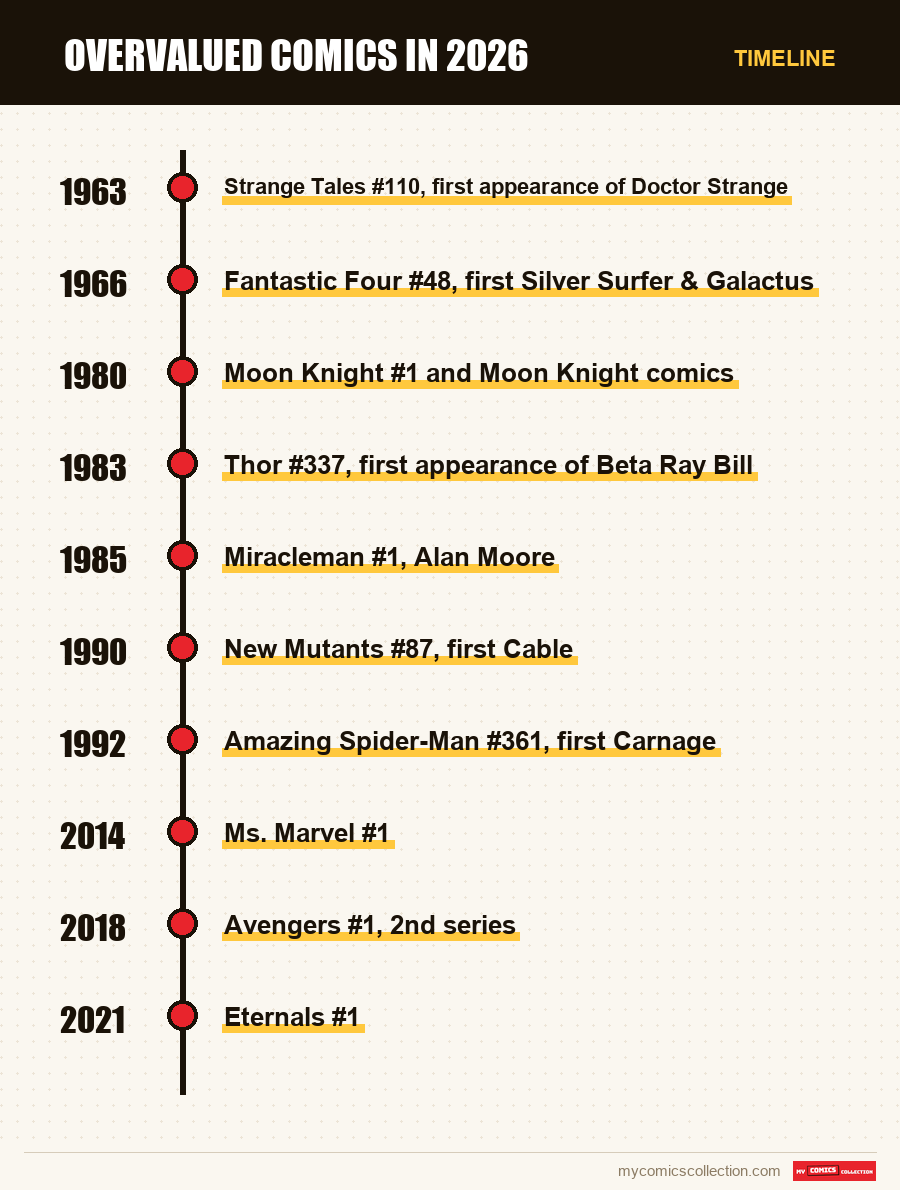
The overvalued comics of 2026 are those whose prices exploded in 2020-2021, driven by lockdowns, US economic stimulus and an avalanche of film and series announcements, before collapsing. The clearest cases are Eternals #1 (2021), Thor #337 (first appearance of Beta Ray Bill), Moon Knight #1 (1980) and Miracleman #1 (1985). The common lesson: never buy on an announcement or a rumor, and always compare with the pre-bubble value.
⚠️ For informational purposes only: This information is provided for educational purposes only. My Comics Collection is not an investment advisor. Values vary with condition, scarcity and market trends. Always check recent eBay and GoCollect sales before any buying decision.
Between 2020 and 2021, the comics market went through an unprecedented speculative bubble in the medium's modern history. Fueled by lockdown, US stimulus checks and a cascade of MCU/Disney+ announcements, values of hundreds of comics exploded: sometimes multiplied by 5, 10, even 20 in a matter of weeks.
Many collectors bought at the top of this bubble, convinced values would keep rising. Three to four years later, reality is harsh: most of these comics lost 40 to 80% of their peak value. Some never recovered. Others are slowly stabilizing at levels well below the peak.
This article is an honest assessment. Not to mock those who bought at the wrong time: everyone makes mistakes on overheated markets. But to extract lessons and never end up in that situation again.
Methodology note: Prices cited are estimates based on eBay sales data and public price guides (CGC Census, GoCollect, MyComicShop). Values vary with comic condition (CGC grade), recent sales and region. These figures are indicative to illustrate trends, not absolute market prices.
The 10 comics whose bubble most clearly burst
Eternals #1 (2021, Gillen/Esad Ribic)
Marvel's Eternals film, released November 2021, triggered a speculative fever on all Eternals-related comics: including this 2021 series, recent and printed in large quantities. Before the film's release, speculators bought en masse hoping for a rapid rise.
The film received divided reviews, underperformed at box office, and Marvel didn't announce a sequel. The comics series ended without a confirmed sequel. The value collapsed. Buyers who paid $170-200 for a CGC 9.8 copy find themselves today with a comic worth $18-22 raw.
Thor #337, first appearance of Beta Ray Bill (1983)
Beta Ray Bill, the character who holds Thor's hammer on Walt Simonson's iconic cover, saw his value explode following persistent rumors of his MCU appearance. His first appearance in Thor #337 went from $45-70 to over $550 for a Very Fine copy in a few months.
Beta Ray Bill has never appeared in a Marvel film to date. Rumors weren't confirmed. The value corrected to $90-135: about twice pre-bubble value, still a residual speculation premium not justified by any real appearance.
Moon Knight #1 (1980, Sienkiewicz) and Moon Knight comics
The 2021 announcement of the Moon Knight Disney+ series (with Oscar Isaac) triggered a fever on all character-linked comics. Moon Knight #1 in Very Fine/Near Mint reached delirious peaks. The series was positively received, but not enough to sustain values above $1,100 on a comic that's certainly rare but not as foundational as Silver Age key issues.
Moon Knight #1 keeps real value: it's a Bronze Age comic with Sienkiewicz, the character's first solo. But buyers who paid $1,300-1,650 at the 2022 peak lost 60-70% of their investment.
Miracleman #1 (Eclipse, 1985), Alan Moore
The announcement of Marvel acquiring Miracleman rights and new editions being published triggered a fever on Eclipse original editions. Speculators bet on original scarcity vs. the new editions. The logic seemed solid, but Marvel republished the complete collection, making content easily accessible. Demand for originals collapsed.
Miracleman remains an Alan Moore masterpiece, but its market value is now closer to its pre-speculation value.
Collecting this series?
Track what you own, what you are missing and what your collection is worth. 7 day trial.
Start my trial →Target prices to never buy at the peak
My Comics Collection shows the market estimate of each comic in your wishlist next to the target price you set. Buy when prices are low, sell at the right time, with up-to-date data: not intuitions.
Start my 7-day trial →No charge during the trial
Ms. Marvel #1 (2014, first Kamala Khan)
Kamala Khan, the first Muslim Ms. Marvel, is a genuinely important character in comics history. Her first appearance in Ms. Marvel #1 (2014) had real collection value even before the MCU announcement. But the 2020 Disney+ show announcement multiplied prices by 5 to 8.
The Ms. Marvel Disney+ show was well received but didn't trigger the enthusiasm speculators hoped for. Value stabilized reasonably, but those who bought at $880-1,100 are still largely underwater.
Avengers #1 (2018, Jason Aaron), 2nd series
This case is particularly telling: a 2018-printed comic, printed in hundreds of thousands of copies, worth $5-9 on the market. During the bubble, CGC 9.8 copies traded at $110-130 solely because the "issue 1" of the series combined with the word "Avengers" attracted uninformed buyers.
Thousands of Near Mint copies exist in collector boxes worldwide. This comic is worth its original cover price, no more.
Strange Tales #110, first appearance of Doctor Strange (1963)
More complex case: Strange Tales #110 is a real Silver Age key issue, Doctor Strange's first appearance in a 1963 comic. It's always had value. But the 2022 release of Doctor Strange in the Multiverse of Madness catapulted values to the stratosphere.
Since then, value has corrected 60-70% from peak but remains clearly above pre-MCU levels. This comic has real intrinsic value, but buyers who acquired it at the top still lost thousands of dollars.
Fantastic Four #48, first Silver Surfer & Galactus (1966)
Galactus and Silver Surfer MCU rumors have circulated since the Fox/Disney acquisition announcement. Each new rumor relaunches FF #48's value. After hitting peaks during the 2021-2022 peak, the comic has corrected about 70% from highs.
Fantastic Four #48 remains a foundational Silver Age comic and holds real collection value. But buyers who entered at the $4,400-6,600 peak still have ground to recover.
Amazing Spider-Man #361, first Carnage (1992)
The Carnage film announcement (in the Sony/Venom universe) triggered a spike on the villain's first appearance. ASM #361 decupled its value in a few months. The Venom: Let There Be Carnage film was a commercial success but insufficient to sustain $330 values on a 90s comic printed in hundreds of thousands of copies.
This is the classic 90s comics pitfall: huge print runs, millions of copies in circulation, so supply structurally too abundant for values to stay high durably.
New Mutants #87, first Cable (1990)
Cable in Deadpool 2, then hope of a solo Cable film, relaunched interest in NM #87. Rob Liefeld's cover is emblematic of 90s X-Men. But 1990 print runs were already massive: the comic is far from rare. Value has corrected 80-85% from bubble peaks.
Transversal lessons from these 10 cases
Analyzing these 10 comics, several clear patterns emerge:
1. Print runs from 1985-2010 are structurally unfavorable
The comics industry had its highest print runs in the 90s, with some issues printed at 1 to 5 million copies. No MCU demand can durably absorb such massive supply. Speculative values on these comics always return to natural levels.
2. MCU announcements create peaks, not floors
When Marvel announces a film or series, associated comic values rise quickly: often in days or weeks. This is the time to sell, not buy. After film release, values systematically return to a level between pre-announcement value and peak.
3. Real Silver/Bronze Age key issues resist better
Amazing Fantasy #15, Incredible Hulk #181, X-Men Giant-Size #1 also saw significant peaks during the bubble, but their correction was far less severe. Fundamental collector demand for these comics is structurally supported, regardless of MCU.
4. Daily-updated value tracking is the only effective protection
All these peak purchases were made by collectors who didn't have access to complete price history. Seeing a comic multiply 8x in 3 months should have triggered alarm, not a buying reflex.
Buy at the right time, at the right price
My Comics Collection keeps your comics' estimated values up to date and charts the total over time. Pair it with eBay saved searches for alerts, and spot the buying opportunity at the trough or the chance to sell at the peak.
Try it for 7 days →7-day trial · Cancel anytime