
Between 2014 and 2024, the collectible comics market lived through an extraordinary and tumultuous decade. Spectacular rises driven by the MCU, an unprecedented explosion during the pandemic, followed by a sometimes brutal correction that left many speculators with significant losses.
Between 2014 and 2024, the collectible comics market lived through an extraordinary and tumultuous decade. Spectacular rises driven by the MCU, an unprecedented explosion during the pandemic, followed by a sometimes brutal correction that left many speculators with significant losses. Behind these general trends, real numbers tell a more nuanced story: with durable winners, ephemeral bubbles, and essential lessons for collecting intelligently today.
This article analyzes the real numbers of comic values over ten years: not to predict the future, but to understand the mechanisms driving prices up or down, and to extract principles applicable to your collection.
The decade timeline: the major phases
MCU Phase 2 and early Phase 3. Marvel film announcements trigger regular rises on first appearances of characters who will appear on screen. The market rises organically with moderate corrections after each film release.
Avengers: Infinity War (2018) and Endgame (2019) propel the MCU to cultural peaks. Comics linked to MCU star characters (Iron Man, Thor, Captain America) hit new records. CGC 9.8 modern age comics become a recognized asset class.
COVID-19 and global lockdowns create an explosive confluence: individuals with forced savings, free time and an appetite for collectibles. Values explode by 200 to 500% on some comics. It's the largest speculative bubble in modern comics history.
End of government stimulus, return of real spending, global inflation. Speculative comics correct brutally. Many comics bought at inflated prices in 2021 lose 50 to 80% of value in 18 months. Fundamental comics hold up better.
The market finds a healthier equilibrium, with demand concentrated on rare comics and authentic key issues. Quality collections hold their value. Short-term speculation retreats. Serious collectors take back the reins.
The comics that appreciated most over 10 years
The data below is based on real sales documented on the major platforms (Heritage Auctions, ComicConnect, eBay), compared in CGC 6.0 or the most available grade on the market for each title.
Amazing Fantasy #15 (1962), first appearance of Spider-Man
+850% over 10 yearsNew Mutants #98 (1991), first appearance of Deadpool
+600% netIncredible Hulk #181 (1974), full first appearance of Wolverine
+400% netVenom #3 (2018), first appearance of Knull
SpeculativeThe lesson from the numbers: Golden Age and Early Silver Age comics recorded the most durable net gains. Speculative modern comics saw explosive gains but brutal corrections. Over 10 years, structural scarcity (age + low print runs) systematically beats short-term speculation.
The MCU effect: how Hollywood changed values
The Marvel Cinematic Universe became the most powerful, and unpredictable, valuation driver in the collectible comics market. Understanding its mechanism is essential for any collector.
The typical MCU rise pattern
The scenario has repeated since 2008 with near-mechanical regularity:
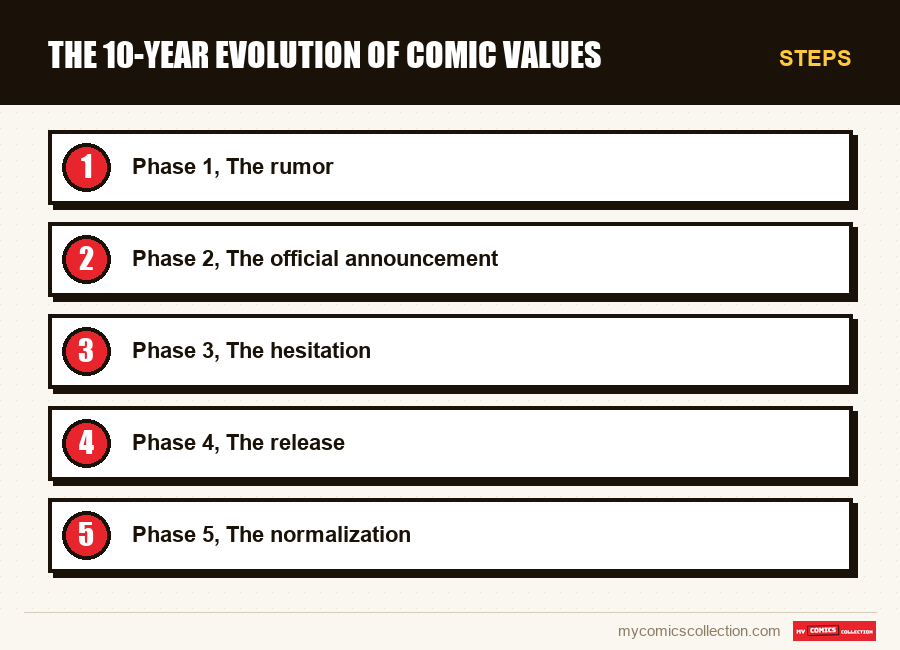
- Phase 1, The rumor: Information (often leaks or casting statements) circulates about a new character's inclusion in an MCU film or series. First appearances of this character start rising quietly.
- Phase 2, The official announcement: Marvel confirms the character. Values explode in days or weeks. Speculators buy massively.
- Phase 3, The hesitation: In the months before film release, values stabilize or start mildly correcting ("buy the rumor, sell the news").
- Phase 4, The release: If the film is a success and the character popular, values hold. If the film disappoints or the character is underused, correction is fast and severe.
- Phase 5, The normalization: 6 to 12 months after release, values find a new equilibrium: generally below peak but above pre-announcement value.
The most striking concrete examples
Iron Man (2008): Before the first film, Tales of Suspense #39 (first Iron Man, 1963) in CGC 5.0 was worth about $2,000. After the film, about $8,000. In 2024, about $35,000. The progression here is sustained by durable cultural interest in the character.
Guardians of the Galaxy (2014): Marvel Super-Heroes #18 (first Gamora appearance) decupled. Strange Tales #180 (first Gamora) went from hundreds to thousands in CGC. The GotG franchise created durable interest in previously obscure characters.
Moon Knight (Disney+ show, 2022): Werewolf by Night #32 (first Moon Knight appearance, 1975) went from $2,000 (CGC 9.0) to over $15,000 during the peak, before correcting around $5,000 to $8,000. The show created real interest but post-airing correction was strong.
Namor in Black Panther: Wakanda Forever (2022): Sub-Mariner #1 (1941) and Fantastic Four #4 exploded on casting announcement. But post-film correction was significant because the character didn't have the cultural impact expected.
Track your comics' evolution
My Comics Collection lets you track each issue's valuation in your collection, see market trends and know when your comics hit their best selling price.
Track my values →7-day trial, start in 60 seconds.
Collecting this series?
Track what you own, what you are missing and what your collection is worth. 7 day trial.
Start my trial →The 2020-2021 pandemic bubble: anatomy of an excess
The 2020-2021 period was the most extraordinary in recent comics market history. And one of the most dangerous for uninformed investors. Here are the real numbers of this bubble.
The amplifying factors
- Government stimulus checks (United States): Billions of dollars injected directly into American citizens' pockets, a significant portion landing on eBay, Heritage Auctions and GoCollect.
- Lockdown and closure of usual spending venues: No more restaurants, vacations, concerts: money needed somewhere to go.
- Popularization of alternative investments: Crypto, NFTs, sneakers, Pokémon cards and collectible comics all exploded simultaneously under the same "alternative refuge value" logic.
- Social media and FOMO: TikTok, YouTube and Instagram amplified "I bought this comic for $50 two years ago and it's worth $5,000 today" stories, creating massive bandwagon effect.
The measured excesses
In 2021, Amazing Spider-Man #1 (1963) in CGC 9.6 sold for $1.38 million at Heritage Auctions: an all-time record for this title. Comics worth $100 in 2019 sold for $2,000 in 2021. First appearances of secondary characters from obscure series reached $500 because someone tweeted they might appear in a future Disney+ show.
These excesses couldn't last. And they didn't.
The 2022-2023 correction: who suffered, who resisted
Starting mid-2022, the correction was fast and selective. Not all comics suffered equally. The market's bifurcation became very clear.
Comics that corrected most (-60% to -90%)
- Speculative modern comics bought at inflated prices (minor character first appearances)
- 1990s-2000s comics bought on MCU speculation that never materialized
- Common A/B cover variants bought as "investment"
- CGC 9.8 modern age comics on non-key series
Comics that resisted best (-10% to -30% from peak)
- Amazing Fantasy #15, Action Comics #1, Detective Comics #27: the comics "blue chips"
- Fantastic Four #1, Incredible Hulk #1, Amazing Spider-Man #1: Silver Age foundational
- Key issues with structural scarcity (few high-grade copies exist)
- CGC 9.8 modern key issues with real demand (New Mutants #98, Incredible Hulk #181)
Correction resistance comparison (2021 peak → late 2024)
- Amazing Fantasy #15 CGC 6.0: from $250K to ~$100K (-60%) but still +400% vs 2014
- Incredible Hulk #181 CGC 9.0: from $40K to ~$20K (-50%) but still +300% vs 2014
- New Mutants #98 CGC 9.8: from $8K to ~$2.5K (-68%) but still +400% vs 2014
- Venom #3 CGC 9.8: from $800 to ~$100 (-87%), typical pure speculation case
- Generic 90s comics: back to pre-bubble prices (-80 to -95%)
2024 trends and lessons to draw
In 2024, the collectible comics market shows a healthier and more selective face than in 2021. Short-term speculators largely left the market after correction losses. Passionate collectors and long-term investors took back the reins.
Trend 1: Quality trumps quantity
Comics in CGC 9.8 on foundational key issues continue to attract premium prices. The value gap between a 9.6 and a 9.8 has widened further. On Amazing Fantasy #15, a 5.0 is interesting but the market pays a disproportionate premium for a 7.0 or 8.0. Higher quality is increasingly valued relatively.
Trend 2: Return to Golden Age and Silver Age fundamentals
Pre-1970 comics resisted correction better and continue to appreciate steadily. The reason is simple: their scarcity is structural and growing. Each year, copies are destroyed, lost, or permanently removed from the market into permanent collections. Supply constantly decreases against growing global demand.
Trend 3: Caution on "anticipated" MCU first appearances
The collector community learned from the pandemic bubble. MCU announcements still trigger rises on affected key issues, but far less frenzied than in 2021. Collectors now wait for tangible confirmation (character visible in a trailer) before getting excited, which reduces early speculation.
Trend 4: Growing interest in "pre-code" comics and Pulps
A niche of sophisticated collectors shows increasing interest in EC Comics (Tales from the Crypt, Weird Science) and horror/crime pre-Comics Code Authority comics (before 1954). These comics combine absolute scarcity, artistic value, and catch-up potential vs. better-known superhero comics. It's still an affordable segment compared to golden-age supers.
Lessons for collecting intelligently
Ten years of data converge on the same principles. These aren't investment advice: they're observations based on what the market has demonstrated.
- Authentic scarcity always beats artificial scarcity. A 70-year-old comic in good condition is structurally rare. A 1:50 variant of a modern comic printed at tens of thousands of total copies is only artificially rare.
- Collect what you love, invest with discipline. The collectors who best navigated the decade are those who bought comics they wanted to keep, not comics they planned to resell in 6 months.
- Condition is the most underestimated value factor. The value gap between a 7.0 and a 9.8 on the same key issue can be 500 to 2000%. Investing in condition (protection, optimal storage, certification) is often more profitable than buying more titles.
- Diversify across eras. A collection balanced between Golden Age, Silver Age, Bronze Age and a few modern key issues is more resilient than a monolithic collection on a single period.
- Document and track your collection. Without precise data on what you own, in what condition, and at what price you bought it, you're navigating blind. A rigorous catalog is your first valuation tool.
FAQ, Comic values evolution
Your valuation dashboard, continuously updated
My Comics Collection centralizes your inventory, integrates current values and gives you a clear view of your collection's real value: issue by issue, updated daily. Stop navigating blind.
Create my dashboard →7-day trial.