
Since their creation in 1963 by Stan Lee and Jack Kirby , the X-Men have represented one of the richest and most collectible franchises in the Marvel universe. A powerful metaphor for difference, exclusion and the quest for acceptance, the X-Men series has spanned several decades of radical transformations, bold reboots and historic moments that redefined American comics.
Since their creation in 1963 by Stan Lee and Jack Kirby , the X-Men have represented one of the richest and most collectible franchises in the Marvel universe. A powerful metaphor for difference, exclusion and the quest for acceptance, the X-Men series has spanned several decades of radical transformations, bold reboots and historic moments that redefined American comics. From the Silver Age years with the original X-Men to the revolution of Giant-Size X-Men #1 , from Chris Claremont's epics to Jim Lee's graphic experiments and Grant Morrison's bold reinterpretations: each era produced key issues that have become centerpieces of any serious collection.
This guide lists the 10 essential X-Men and Uncanny X-Men key issues, with their historical context, their meaning for the franchise, and their estimated CGC 9.8 value. Whether you're a beginning collector trying to identify priorities, or a seasoned collector filling run gaps, this ranking gives you all the keys.
The history of the X-Men series: from origins to today
The X-Men franchise at Marvel is one of the most complex to grasp, as it has gone through many volumes, spin-offs and major relaunches over the decades:
- X-Men Vol. 1 (1963-1981): the original founding series, retroactively renamed Uncanny X-Men from issue #142 onward
- Giant-Size X-Men #1 (1975): the oversized issue that rebooted the franchise and introduced the new team
- Uncanny X-Men (1963-2011, then 2012-2016): the flagship title, 544 issues total in its original run
- X-Men Vol. 2 (1991-2001): the parallel series launched after Jim Lee's success, joining Uncanny
- New X-Men (2001-2004): the revolutionary Grant Morrison run
- Astonishing X-Men (2004-2013): the classic Joss Whedon run, then continued by other authors
- All-New X-Men (2012-2015) and Extraordinary X-Men (2015-2017): the Brian Michael Bendis era
- Dawn of X / Krakoa Era (2019-2024): the Jonathan Hickman revolution with House of X / Powers of X
Completing a full Uncanny X-Men run is one of the most ambitious projects in comic collecting. The Collection tracking feature in My Comics Collection lets you map your progress across each volume and precisely identify missing issues.
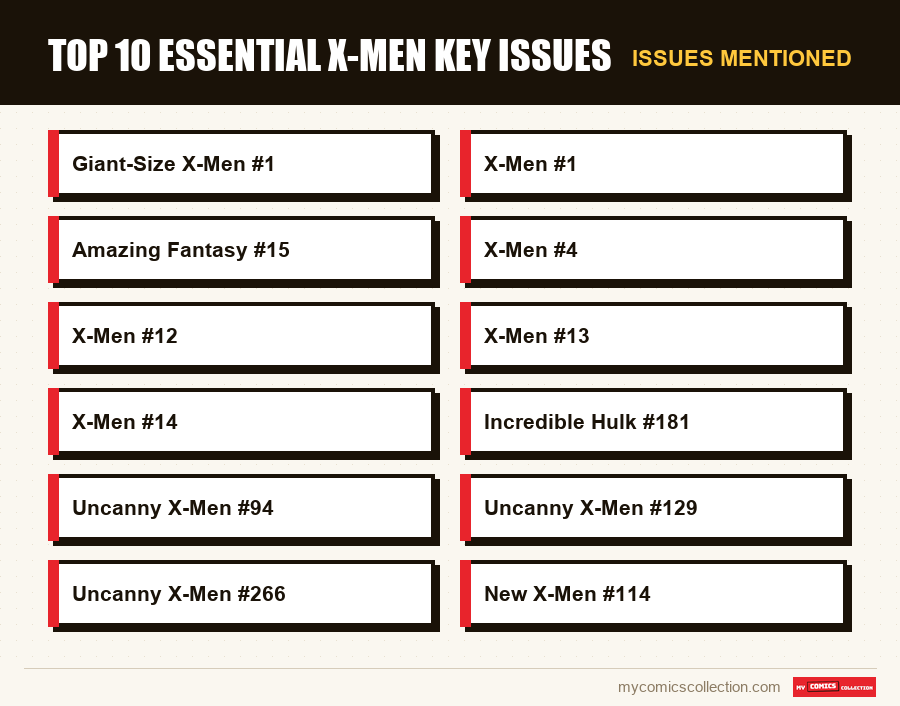
Top 10 X-Men key issues
Here are the ten absolutely essential issues for any X-Men collector, across all volumes.
X-Men #1
X-Men #1 marks the birth of one of the most important franchises in comic history. This first issue simultaneously introduces all the original X-Men : Cyclops / Scott Summers , Marvel Girl / Jean Grey , Beast / Hank McCoy , Iceman / Bobby Drake and Angel / Warren Worthington III , all united under Professor Xavier. That same issue also introduces Magneto, the franchise's main antagonist, whose moral complexity and tragic past make him one of Marvel's most fascinating supervillains. An absolutely essential founding issue: equivalent for the X-Men to what Amazing Fantasy #15 is for Spider-Man.
X-Men #4
X-Men #4 is a doubly important key issue: it marks the first appearance of Scarlet Witch / Wanda Maximoff and her brother Quicksilver / Pietro Maximoff, two mutants who would become among Marvel's most popular and on-screen characters. Introduced here as members of Magneto's Brotherhood of Evil Mutants, their evolution into heroic roles: notably within the Avengers: testifies to the richness of the Marvel universe. Wanda Maximoff's popularity thanks to MCU adaptations (WandaVision , Doctor Strange in the Multiverse of Madness) has significantly increased this issue's value in recent years.
X-Men #12
X-Men #12 introduces one of the franchise's most formidable adversaries: the Juggernaut / Cain Marko , half-brother of Charles Xavier. This explosive family relationship gives an intimate and tragic dimension to the conflict. The Juggernaut, whose strength is nearly unlimited once in motion, has become one of the iconic figures in Marvel comics thanks to his mythical war cry "I'm the Juggernaut, b***h" popularized by internet culture. This issue should be read alongside X-Men #13, which concludes his first introduction arc, to fully appreciate the character's threat.
X-Men #14
X-Men #14 introduces the Sentinels, the giant mutant-hunting robots created by Dr. Bolivar Trask . The Sentinels have become one of the most powerful symbols in the X-Men series, representing humanity's fear and hatred of mutants. They appear in nearly every major franchise arc, notably in Days of Future Past where they dominate a dystopian world. This issue is also the thematic foundation of numerous film adaptations. The Sentinels' importance in X-Men mythology makes this an essential Silver Age key issue.
Giant-Size X-Men #1
Giant-Size X-Men #1 is one of the most important Marvel comics of all time. After several years of reprinted issues, this 1975 publication completely reboots the franchise by introducing a new international team of mutants: Wolverine / Logan (previously appeared in Incredible Hulk #181 ), Storm / Ororo Munroe , Colossus / Piotr Rasputin , Nightcrawler / Kurt Wagner , Thunderbird / John Proudstar , Banshee and Sunfire. This revolutionary lineup, with its international diversity, gives a whole new dimension to the difference metaphor at the heart of the X-Men. The launch of Uncanny X-Men #94 that directly follows this issue marks the start of the series' classic era.
Uncanny X-Men #129
Uncanny X-Men #129 is an exceptional double key issue: it simultaneously introduces Kitty Pryde / Sprite: the teenager with phasing powers who would become one of the most beloved X-Men characters, and Emma Frost / White Queen, the telepathic Hellfire Club leader who, decades later, would join the X-Men. This issue also marks the start of the Dark Phoenix Saga arc, one of the most important stories in comic history. The Claremont/Byrne duo at the peak of their creativity, with characters who would become absolute franchise pillars for decades.
Uncanny X-Men #266
Uncanny X-Men #266 marks the first full appearance of Gambit / Remy LeBeau, one of the most popular 1990s X-Men characters. A Cajun thief with kinetic-energy-charged cards, Gambit brings a mysterious charm and moral ambiguity that contrasts with classic X-Men. His romantic relationship with Rogue is one of the most tragic and popular love stories in Marvel comics. The 1990s X-Men animated series propelled the character to icon status for an entire generation. Note that #264 and #265 contain partial appearances; the three together form an interesting key-issue trio.
X-Men #1 (Volume 2)
X-Men #1 from 1991 drawn by Jim Lee entered history as the best-selling comic of all time, with more than 8 million copies sold. Marvel's marketing strategy with 5 different covers (4 individual variants + 1 gatefold cover assembling all 4) triggered a speculative fever that alone symbolizes the 1990s comic spirit. Despite this massive print run, CGC 9.8 copies with the variant covers remain actively collected. This issue marks the peak of X-Men popularity and represents a key era in the comic market. The gatefold cover is particularly sought-after.
New X-Men #114
New X-Men #114 (formerly X-Men vol.2, renamed for the occasion) marks the start of Grant Morrison's legendary run: one of the boldest and most influential comic runs of the early 2000s. With Frank Quitely's artwork, Morrison abandoned spandex costumes for movie-inspired black leather uniforms, reinvented mutant mythology with radically new concepts (reinvented Magneto, Cassandra Nova, the Mummudrai, Sentinel evolution…) and radically modernized the series. This run, which runs until issue #154, is now considered one of the absolute essentials for understanding X-Men evolution in the 21st century.
All-New X-Men #1
All-New X-Men #1 launches one of the most ambitious early series of Brian Michael Bendis's era at Marvel. The concept is bold: Beast , desperate about Cyclops's drift after Avengers vs. X-Men, travels to the past to bring the five original X-Men into the present, hoping that seeing their future will push them toward better choices. This issue introduces the modern version of the original Jean Grey and places young Cyclops face to face with his adult self turned revolutionary. A series that reconnects with the origins while creating a fresh narrative perspective on the franchise. The 5 launch variant covers are particularly sought-after.
Collecting this series?
Track what you own, what you are missing and what your collection is worth. 7 day trial.
Start my trial →Essential X-Men story arcs
The X-Men / Uncanny X-Men series has produced some of the most important story arcs in comic history. Here are the runs every serious collector should own to understand the franchise as a whole:
Dark Phoenix Saga
The founding arc by Chris Claremont and John Byrne where Jean Grey transforms into Phoenix then Dark Phoenix, with devastating cosmic consequences. The arc that defined tragedy in superhero comics.
Days of Future Past
The two-part dystopian tale where Kitty Pryde travels to the past to prevent a future dominated by the Sentinels. One of Marvel's most influential comics, the basis for numerous film adaptations.
Age of Apocalypse
The 1995 event crossover offering an alternative Marvel universe vision where Apocalypse has conquered the world. An event that suspended all X-Men series for 4 months, replaced by their "Age of Apocalypse" equivalents.
God Loves, Man Kills
The Chris Claremont and Brent Anderson graphic novel that addresses discrimination against mutants head-on. Considered one of the best X-Men comics ever published, out of official continuity but thematically essential.
Joss Whedon's Astonishing X-Men
The Joss Whedon and John Cassaday run that reconnects with the classic X-Men essence while exploring new directions. Essential reading to understand Cyclops , Emma Frost and the resurrection of Colossus.
House of X / Powers of X
The Jonathan Hickman revolution that redefines everything we know about mutants with the creation of Krakoa, the mutant nation. The run that resurrected the X-Men franchise over the past decade with unprecedented narrative ambition.
To organize tracking of these complex arcs spanning multiple parallel series, use the Story Arcs feature in My Comics Collection: it lets you create custom lists and follow your progression arc by arc.
How My Comics Collection handles your X-Men run
Collecting the X-Men is one of the most complex adventures in Marvel comics. The multiplicity of volumes (Uncanny X-Men , X-Men Vol.2 , New X-Men , Astonishing X-Men , All-New X-Men , Extraordinary X-Men…), the event crossovers (Age of Apocalypse , House of X …) and the spin-offs ( Wolverine , X-Force , Generation X…) make the X-Men collection particularly difficult to organize without a dedicated tool.
My Comics Collection gives you a complete overview:
- Import every volume of the X-Men franchise from a worldwide comics catalogue
- Mark your owned copies by volume, identify the missing key issues with the Missing comics feature
- Create custom story-arc lists to track multi-series crossovers like Age of Apocalypse
- Manage your CGC-graded copies with grade and individual value
- Estimate the total value of your X-Men collection with daily-updated valuation
- Share your wishlist with other collectors to fill your gaps
See also our guide on Amazing Spider-Man key issues to compare with another essential Marvel franchise.
FAQ: X-Men key issues
Start managing your X-Men collection
Track your key issues, organize your story arcs and estimate the value of your X-Men run. 7-day free trial.
Start free 7-day trialNo commitment · Cancel anytime · Instant access