There are moments in comic history when everything changes. July 2019: Marvel publishes simultaneously the first issues of House of X (writer Hickman, artist Pepe Larraz) and Powers of X (writer Hickman, artist R.B.
There are moments in comic history when everything changes. July 2019: Marvel publishes simultaneously the first issues of House of X (writer Hickman, artist Pepe Larraz) and Powers of X (writer Hickman, artist R.B. Silva). In twelve weeks, six issues of each series published in alternation, Jonathan Hickman rewrote the complete history of the X-Men (past, present and future) and laid the foundations of a new era that would occupy Marvel for several years.
For collectors, House of X / Powers of X represents one of the most solid investments of the decade. These 12 issues concentrate an exceptional number of first appearances, major revelations and concepts that will continue to unfold for years. This guide explains why, issue by issue, and gives you the 2026 market state.
The HoX/PoX revolution: what changed everything
Before House of X / Powers of X, the X-Men were in a difficult transition period. The film rights were still at Fox, and Marvel had progressively reduced the mutants' visibility in their comics to favor the Inhumans (whose rights Marvel fully owns). Disney's March 2019 acquisition of Fox changed everything at once, and Marvel immediately entrusted the X-Men to Hickman to restore their central status.
The result exceeded all expectations. HoX/PoX redrew the X-Men world from the ground up: Krakoa as a sovereign mutant nation, collective resurrection as a superweapon, Moira MacTaggert revealed as a mutant with multiple lives, and a narrative structured across several timelines (Year One, Year One Hundred, Year One Thousand) that simultaneously illuminates the mutants' past and future.
For regular readers, this miniseries had the effect of a revelation. For collectors, it represented a rare opportunity: a run that changes everything, published at the start of an MCU era for the X-Men, with issues still accessible at their release.
The reading order: why alternation is essential
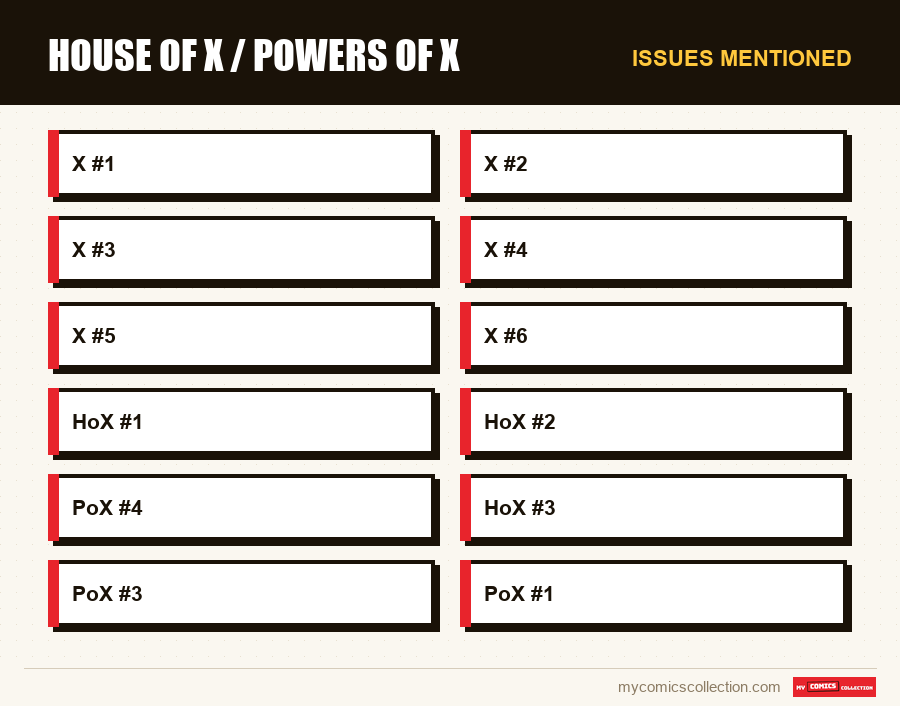
House of X and Powers of X are not two parallel series that can be read independently. Hickman designed a precise alternation system where each issue of one series answers, complements or illuminates the corresponding issue of the other. Reading the 6 HoX issues then the 6 PoX issues, or vice versa, deprives you of a fundamental narrative experience.
The recommended order, designed by Hickman, is as follows:
Official HoX/PoX reading order
- House of X #1
- Powers of X #1
- House of X #2
- Powers of X #2
- House of X #3
- Powers of X #3
- House of X #4
- Powers of X #4
- House of X #5
- Powers of X #5
- House of X #6
- Powers of X #6
This order matches exactly the original publication: one issue per week for 12 weeks. This publishing cadence was itself a strong editorial choice: Marvel wanted readers to experience this revolution in real time, week after week, without being able to skip steps.
House of X: issue-by-issue analysis
House of X #1. The new mutant world
The first issue sets the scene: Krakoa, a living island, has become the mutant nation. Charles Xavier distributes mutant passports, the X-Men patrol the borders, and a Krakoa flower lets mutants create interdimensional gates anywhere in the world. It's one of the most important issues in recent X-Men history and an absolute must-have for any collector.
In CGC 9.8, HoX #1 is now worth between $65 and $110 for the regular cover. The blank variant and "Design" variant are sought-after by specialized collectors. The regular cover, with Xavier holding a Krakoa flower against a grandiose landscape drawn by Pepe Larraz, is already iconic.
House of X #2. The Moira revelation: the most important issue
HoX #2 is, in the eyes of most readers and collectors, the most important issue of the entire miniseries. It reveals that Moira MacTaggert, long presented as a simple human ally of the X-Men, is actually a mutant with reincarnation power. At each death, she awakens in her past with full memory of her previous life.
This retroactive revelation retrospectively upends the entire X-Men history from the origins. Every X-Men "mistake", every continuity "reboot" suddenly makes sense in this context. It's a plot twist of an ambition rarely seen in superhero comics. In CGC 9.8, this issue is worth between $85 and $140 and its value keeps rising.
House of X #3 and #4. The Orchis mission and the sacrifice
These two issues develop the Orchis threat (a secret organization aiming to eradicate mutants) and culminate in a suicide mission where a group of X-Men sacrifice their lives to prevent the creation of a proto-Nimrod. Characters die (really, in a narratively significant way) giving these issues exceptional dramatic weight. In raw NM, they can be found between $16 and $33.
House of X #5: Resurrection and the Five protocol
This issue introduces the mutant resurrection protocol: five mutants with complementary powers (Goldballs, Proteus, Hope, Elixir and Tempus) can recreate a body and restore the consciousness of a deceased mutant. It's one of the most important concepts introduced by HoX/PoX, which will have repercussions across the entire Krakoa era. In CGC 9.8, it's worth between $45 and $75.
House of X #6. The Parliament of Krakoa and the mutant world order
The conclusion of House of X definitively establishes Krakoa as an internationally recognized sovereign nation, with its own government (the Krakoa Council including the Twelve), its own laws (the Three Laws of Krakoa) and its own economy (based on mutant pharmaceuticals). It's the perfect conclusion to a revolution.
Powers of X: issue-by-issue analysis
Powers of X #1. The four-level timeline
Powers of X #1 introduces the series' temporal structure: Year One (the X-Men's beginnings), Year Ten (the current era), Year One Hundred (a dystopian future) and Year One Thousand (an even more distant future dominated by the Machines). This complex narrative architecture, supported by Hickman's signature graphics and "data pages", is immediately recognizable. In CGC 9.8, this issue is worth between $45 and $75.
Powers of X #2: Magneto and Xavier: the secret genesis
This issue revisits the origins of the relationship between Charles Xavier and Magneto by integrating Moira MacTaggert as a third founding partner. The scene where the three meet around a table and together decide the mutant strategy for the decades to come is a historic moment in Marvel comics. This issue is often underrated collectibly but its narrative importance is critical.
Powers of X #4: Nimrod, the future and technological horror
PoX #4 is the darkest and most fascinating issue of the series. It depicts Year One Hundred: a future where the Sentinels have evolved into Nimrod the Greater, a near-divine entity that has reduced mutants to a handful of survivors. This issue's "data pages", coldly analyzing the technological evolution of the Sentinels, are among the most striking pages in the entire miniseries. In CGC 9.8, it's worth between $55 and $90.
Powers of X #5: Mister Sinister and the secret Moira
This issue reveals Mister Sinister's crucial role in Moira and Xavier's long-term strategy. It also develops the Omega Level Mutants concept in a strategic context. For Sinister collectors, this issue is an important secondary key issue. In raw NM, it can be found between $11 and $22.
Powers of X #6. The conclusion that opens everything
The conclusion of Powers of X closes the four-level timeline and confirms that the entire Krakoa era is, in a way, Moira's "tenth life": the mutants' last chance before the dystopian future materializes. It's a conclusion that opens as much as it concludes, which perfectly set the stage for the dozens of Krakoa-era series that followed.
Why HoX/PoX is a long-term investment: These 12 issues are the "ground zero" of the entire X-Men Krakoa era. Every X-Men series published between 2019 and 2024 (Marauders, Excalibur, X-Force, Hellions, X-Men, Immortal X-Men, etc.) derives directly from HoX/PoX. With the X-Men's integration into the MCU, these foundational issues will be increasingly sought-after.
Collecting this series?
Track what you own, what you are missing and what your collection is worth. 7 day trial.
Start my trial →Track your HoX/PoX in your collection
Catalogue your 12 HoX/PoX issues, note your grades, track values, updated daily, and identify missing issues. My Comics Collection is the tool you need.
Track your HoX/PoX in your collection7-day trial
Key issues to remember: 2026 ranking and values
Among the 12 issues, not all have the same collectible value. Here's a clear ranking based on narrative importance, first-appearance status and current market values.
Tier 1: The absolute must-haves
- House of X #1: First issue of the Krakoa era, presentation of the new mutant status. CGC 9.8: $65-110
- House of X #2: Moira MacTaggert revelation as mutant. The most important issue. CGC 9.8: $85-140
- Powers of X #1: Introduction of the four-level timeline. CGC 9.8: $45-75
Tier 2: Important issues for the complete run
- House of X #5: Five protocol and collective resurrection. CGC 9.8: $45-75
- Powers of X #4: Nimrod the Greater and dystopian future. CGC 9.8: $55-90
- Powers of X #2: Secret Xavier/Magneto/Moira genesis. Raw NM: $16-28
Tier 3: Run completion issues
The six remaining issues (HoX #3, #4, #6 and PoX #3, #5, #6) are important issues for the run's coherence but whose individual collectible value is more modest. In raw NM, they can be found between $9 and $22 each. For a collector who wants the complete run, which is the right strategy, these issues are easy to find and affordable.
Variants: which ones are really worth something
HoX/PoX was published with many variants, some highly sought-after. The "Design" variants (white covers with character logos) form a complete 12-issue set very popular with collectors who like visually coherent sets.
The most valuable variants are the low-print-run variants of both series' #1 issues. The 1:50 variant of House of X #1 by Pepe Larraz exceeds $220 in CGC 9.8. The 1:100 variant of Powers of X #1 is in a similar range. These rare variants are already out of reach for the general market.
For most collectors, the regular cover in NM or CGC 9.8 is the best value for money. Intermediate-ratio variants (1:10, 1:25) offer an interesting compromise between rarity and accessibility.
HoX/PoX and the MCU: the expected multiplier effect
With the X-Men's official integration into the MCU, confirmed by several Marvel Studios announcements since 2023, the foundational issues of the Krakoa era have considerable valuation potential. Even if the MCU doesn't directly adapt HoX/PoX, the MCU X-Men will have their own origin, the concepts Hickman introduced are too solid not to influence the adaptation.
Krakoa, the resurrection protocol, Moira MacTaggert as mutant: all elements that could appear in MCU X-Men films or series. Every casting announcement or MCU project tied to the X-Men raises HoX/PoX values. It's a long-term valuation lever few other runs can claim.
Frequently asked questions about House of X / Powers of X
Manage your X-Men runs with precision
From origins to the Krakoa era, My Comics Collection lets you manage your entire X-Men collection, track your run progress and never lose sight of your key-issue values.
Manage your X-Men runs with precisionFree trial, 30-second registration