Magneto is the most complex villain: the most nuanced and most collected: in the entire Marvel universe. Created in 1963 by Stan Lee and Jack Kirby in the very first issue of the X-Men, Max Eisenhardt, aka Erik Lehnsherr, aka Magneto, is far more than an antagonist: he's a Holocaust survivor whose worldview, extreme as it may be, has an implacable internal logic.
Magneto is the most complex villain, the most nuanced and most collected, in the entire Marvel universe. Created in 1963 by Stan Lee and Jack Kirby in the very first issue of the X-Men, Max Eisenhardt, aka Erik Lehnsherr, aka Magneto, is far more than an antagonist: he's a Holocaust survivor whose worldview, extreme as it may be, has an implacable internal logic. It's precisely this complexity that makes his collection one of the richest and most fascinating in Marvel comics.
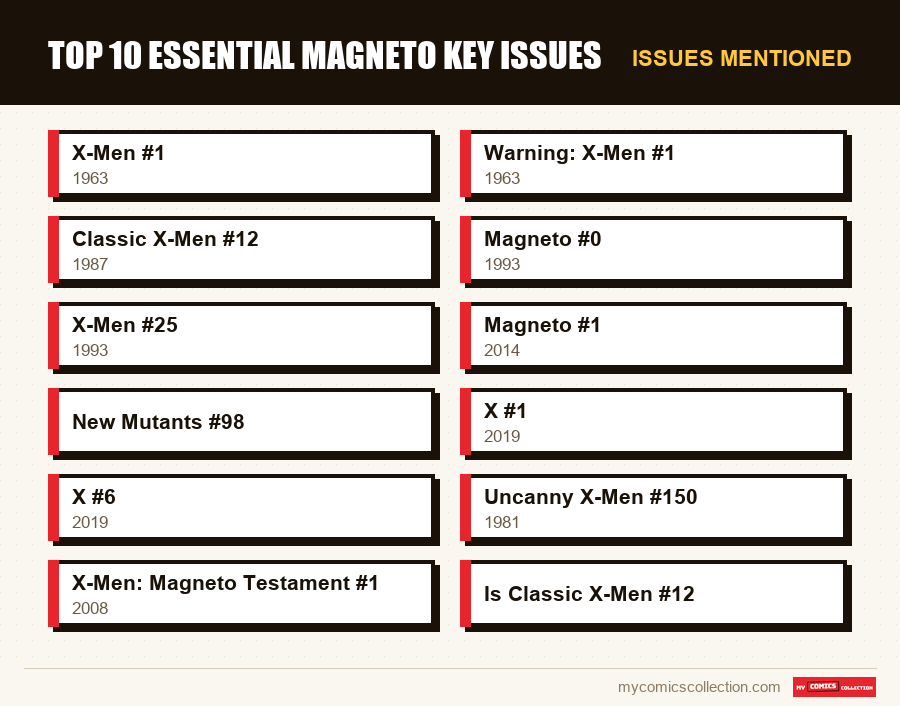
This guide lists the 10 absolutely essential Magneto key issues: from the historic 1963 first appearance to the narrative revolution of House of X (2019), including the origin explorations that transformed our perception of the character. Each issue is analyzed for its historical value, rarity and potential in an MCU X-Men market currently being structured.
Magneto in the MCU: The X-Men's integration into the MCU is underway. Magneto, inseparable from the X-Men since 1963, will be one of the first characters to benefit from a massive MCU effect on his key issues. The time to anticipate is now.
1. X-Men #1 (1963). The birth of Magneto and the X-Men
X-Men #1 (September 1963), by Stan Lee and Jack Kirby, is the most important issue in the entire Magneto collection. This comic simultaneously introduces the original X-Men (Cyclops, Jean Grey, Beast, Iceman, Angel), Professor Xavier AND Magneto as main antagonist: an exceptional narrative and historical density for a first issue. Magneto is immediately established as a force of fearsome power, controlling metal on a planetary scale.
In collection-value terms, X-Men #1 (1963) is in a category of its own. In CGC 9.0 it can reach $150,000 to $300,000. In CGC 6.0, prices still sit around $15,000 to $40,000. Even a CGC 2.0 copy (heavily worn but complete) is worth several thousand dollars. For most collectors, this issue is a career goal rather than an immediate purchase, but its absolute reference position is undisputed.
Warning: X-Men #1 (1963) is one of the most frequently restored Silver Age comics on the market. Always demand CGC certification with a blue label (non-restored). Undeclared restorations can cause a 60-80% loss of value.
2. X-Men #1. The 25-cent edition subtlety (1963)
There's an important subtlety for X-Men #1 collectors: the original 1963 issue was reprinted and sold at reduced price in the following years. The "25 cents" version (actually identical to the original but sold at reduced price in distribution bags) is sometimes confused with the original. The original cost 12 cents: it's the cover price that lets you identify the true first printing.
This technical point is critical in collecting: a "12 cents" copy in identical condition is worth significantly more than a "25 cents" copy. If you're acquiring an X-Men #1, systematically verify the cover price before any purchase, even on a CGC-graded copy (the information is mentioned in the grade description).
3. Classic X-Men #12 (1987). The Holocaust survivor origin
Classic X-Men #12 (August 1987) is one of the most important issues for understanding Magneto beyond his villain status. This issue contains a backup story detailing Magneto's origins as a Holocaust survivor: his murdered parents, his time in the concentration camps, his discovery of his magnetic powers in a context of extreme violence. This story, often attributed to Chris Claremont, radically transformed the character's perception.
Classic X-Men #12 directly inspired Bryan Singer's X-Men films, notably the opening scene of X-Men (2000) in the camps. This issue is relatively accessible (between $30 and $150 depending on condition) but its narrative importance is critical. In CGC 9.8, it trades around $100 to $300.
4. Magneto #0 (1993). The anti-hero takes center stage
Magneto #0 (1993) is a special issue serving as prologue to the period when Magneto leads the New Mutants and X-Men in Professor Xavier's place. This issue explores Magneto's psychology as an anti-hero, his sincere conviction of protecting mutants, his doubts, and the tension between his ideals and his methods. It's one of the first comics to treat Magneto as protagonist rather than antagonist.
In collecting, this issue remains very accessible (under $30 in good condition, under $100 in CGC 9.8). It's an excellent entry point for collectors who want to add a historically significant Magneto-centered issue without a major investment.
Complete your Magneto collection
Organize your X-Men key issues, track Magneto collection prices and build a custom wishlist with My Comics Collection.
Complete my Magneto collection →7-day trial · No commitment
5. X-Men #25 (1993): Magneto rips Wolverine's adamantium
X-Men #25 (October 1993) is the most dramatic issue of the "Fatal Attractions" saga: Magneto rips the adamantium directly from Wolverine's bones during an epic confrontation. It's one of the most striking moments in X-Men history, demonstrating Magneto's absolute power and laying the groundwork for Logan/magnetism reunions that would continue to fascinate fans. The Jim Lee holo-chromium cover is among the most collected in the Chrome Age.
In CGC 9.8 (holo cover), this issue exceeds $200. The standard version sits between $20 and $60. It's an important key issue for both Magneto and Wolverine fans: this dual appeal guarantees constant, solid demand.
Note on values: Collectible comic prices vary significantly with market conditions, MCU announcements and recent sales. All estimates mentioned in this article are indicative. Consult Heritage Auctions, GoCollect or ComicLink for the most recent data.
Collecting this series?
Track what you own, what you are missing and what your collection is worth. 7 day trial.
Start my trial →6. Magneto #1 (2014, Cullen Bunn). The modern solo anti-hero
Magneto #1 (2014), written by Cullen Bunn and drawn by Gabriel Hernandez Walta, is one of the best solo series ever dedicated to Magneto. This issue launches a 21-episode series in which Magneto, separated from the X-Men and mutant institutions, tracks enemies of mutants across the United States alone. The tone is dark, the art expressionist, and the character reaches a rarely matched depth.
In CGC 9.8, Magneto #1 (2014) remains under $80, making it one of the most undervalued modern Magneto key issues on the market. The series' reputation in the fan community is excellent, and its MCU potential, if Magneto is introduced into a Marvel film as a complex solitary character, is considerable.
7. House of X #1 (2019). The Hickman revolution
House of X #1 (2019), by Jonathan Hickman and Pepe Larraz, is the most important X-Men editorial event in decades. In this issue, Magneto, alongside Professor X, is revealed as co-founder of Krakoa, the mutant island-nation. The opening scene where Magneto receives ambassadors from around the world, asserting that mutants no longer have to ask humans for permission, has exceptional narrative power.
House of X #1 in CGC 9.8 still remains under $100, making it an obvious strategic buy. This issue's importance for Magneto mythology is immense, and when the MCU adapts this arc, demand for this comic will explode. Pepe Larraz's cover showing Magneto in his red helmet dominating a lush island is one of the most beautiful of Marvel's modern era.
8. Powers of X #6 (2019). The final Magneto revelation
Powers of X #6, final issue of House of X's sister series, contains a major revelation about the exact nature of Magneto's role in Professor Xavier's and Moira MacTaggert's plans. This issue retroactively recontextualizes Magneto's entire career in the Marvel universe: a narrative revelation of rare audacity in superhero comic history.
Powers of X #6 is still very accessible (under $30 in good condition, under $80 in CGC 9.8). It's the essential narrative complement to House of X #1 for any collector who wants to own the complete Krakoa arc in its key issues.
9. Uncanny X-Men #150 (1981): Magneto against all of humanity
Uncanny X-Men #150 (October 1981), by Chris Claremont and Dave Cockrum, is one of the most spectacular issues of the Bronze Age X-Men. This anniversary issue (#150) sees Magneto threaten to plunge the world into a new Ice Age if humanity doesn't recognize mutant supremacy: a show of force underscoring how the character has evolved from ordinary villain to global-scale threat.
This issue is also important because it marks a turning point in the relationship between Magneto and the X-Men, particularly with Kitty Pryde, whose humanity he tries to protect despite his convictions. In CGC 9.8 it trades between $200 and $500. In 9.4, prices drop to $80-$150.
10. X-Men: Magneto Testament #1 (2008). The definitive origin
X-Men: Magneto Testament #1 (2008), a 5-issue miniseries by Greg Pak and Carmine Di Giandomenico, is Magneto's definitive origin story. Entirely devoted to his years as a Jewish prisoner in Nazi Germany and in the concentration camps, this series received exceptional praise, including from the Simon Wiesenthal Center, for the accuracy and respect of its historical treatment.
This first issue remains very accessible (between $10 and $40 depending on condition) but represents essential reading for understanding who Magneto really is. In CGC 9.8, it sits under $80. For any collector who wants to own a Magneto issue with recognized literary and humanist value well beyond the comic world, it's the obvious choice.
Magneto MCU strategy: Position yourself on House of X #1 and Magneto #1 (2014) now. These two issues offer the best rise potential / acquisition price before the official MCU X-Men announcement. X-Men #1 (1963) remains the long-term goal across decades of your collector journey.
FAQ: Your questions about Magneto key issues
Track your X-Men key issues
Manage your Magneto collection and all your X-Men key issues with My Comics Collection. Updated values, target prices and custom wishlist.
Start for free →Join the X-Men collector community