
Remy LeBeau, aka Gambit, is one of the most beloved and collected Marvel characters of the 1990s. A Cajun thief with glowing red eyes, a master of kinetic energy and Rogue's desperate romantic: since his first appearance in 1990, he has captivated generations of X-Men fans.
Remy LeBeau, aka Gambit, is one of the most beloved and collected Marvel characters of the 1990s. A Cajun thief with glowing red eyes, a master of kinetic energy and Rogue's desperate romantic: since his first appearance in 1990, he has captivated generations of X-Men fans. And today, with the mutants' progressive integration into the MCU, the Gambit key-issue market is seeing activity that savvy collectors can no longer ignore.
This complete guide lists the 10 absolutely essential Gambit key issues: from the first appearance in Uncanny X-Men #266 to the 1990s solo series, and the key issues that define his relationship with the X-Men and his cinematic potential. Each issue is analyzed for its rarity, current value and importance in the character's mythology.
Gambit's moment has arrived. With an MCU X-Men film in development, Gambit key issues have begun their ascent. Collectors who position themselves now, before any official casting, capture the best opportunities.
1. Uncanny X-Men #266 (1990): Gambit's first appearance
Uncanny X-Men #266 (August 1990) is THE essential Gambit key issue: it's the very first appearance of Remy LeBeau in the Marvel universe. Written by Chris Claremont and drawn by Mike Collins, this issue introduces Gambit as a mysterious ally of Storm (then temporarily a child due to a spell) in the bayous of New Orleans. His Cajun personality, accent, kinetic cards and red-on-black eyes: everything is there from this first issue.
On the collection market, UXM #266 is clearly the issue to prioritize above all. In CGC 9.8 it regularly exceeds $500 and can reach $800 to $1,000 depending on sales. In CGC 9.4 it sits between $150 and $300. Raw Near Mint copies remain between $40 and $100, making it still an accessible issue for collectors wanting to position themselves before the MCU effect.
Beware of overrated conditions: UXM #266 is often offered in overstated condition by non-specialist sellers. Rusted staples and yellowed pages are common on 1990s copies. For any purchase over $50, prefer CGC-certified copies.
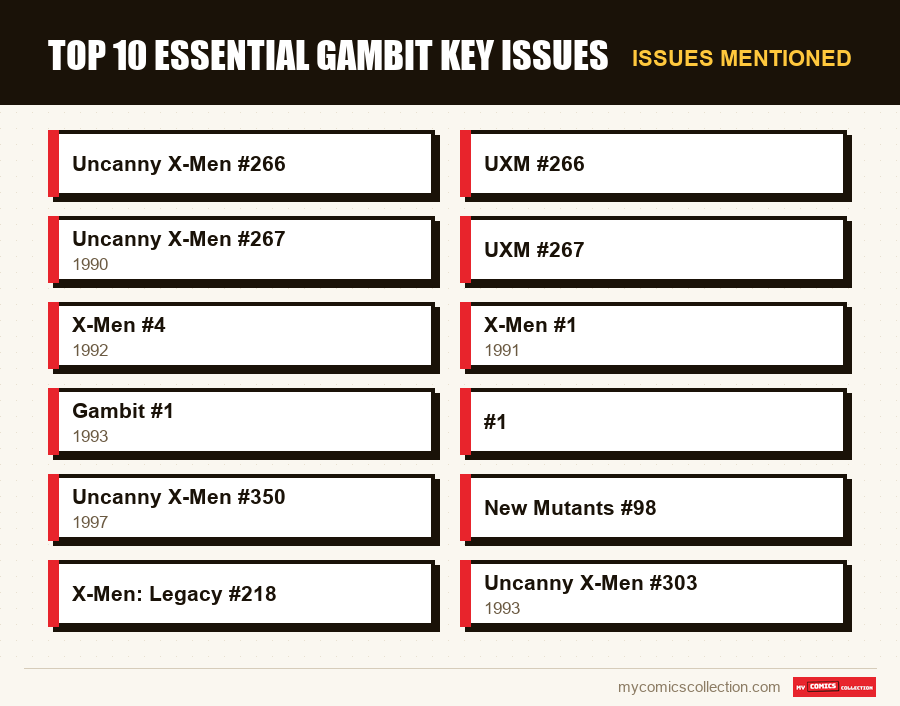
2. Uncanny X-Men #267 (1990). The second full appearance
Uncanny X-Men #267 (September 1990) is the direct sequel to #266 and constitutes Gambit's second appearance. In this issue the character is fully active and his story with Storm develops. In collecting, "second appearances" are often overlooked by collectors focused on firsts: which makes them strategic buying opportunities at prices far below #266.
In CGC 9.8, UXM #267 trades between $100 and $200. It's an ideal complement to #266 for collectors who want to own the character's complete introduction in its most narratively coherent form.
3. X-Men #4 (1992): Gambit and Rogue, the foundational relationship
X-Men #4 (January 1992), in the newly relaunched series by Chris Claremont and Jim Lee, is a major emotional key issue for any Gambit fan. This issue significantly deepens the relationship between Gambit and Rogue, exploring the romantic tension between two characters whose powers make physical contact impossible. Jim Lee is at the peak of his art in this issue: his double-page spreads are breathtaking.
In CGC 9.8, X-Men #4 (1992) sits between $100 and $250. The X-Men series launched in 1991 by Jim Lee is one of the best-selling in American comic history (X-Men #1 (1991) still holds the sales record). Key issues from this series in top grades are systematically sought-after by Chrome Age collectors.
Your Gambit wishlist in one click
Organize your X-Men collection, track Gambit key-issue prices and set a target buy price on each one with My Comics Collection.
Create your Gambit wishlist →7-day trial
4. Gambit #1 (1993). The first solo miniseries
Gambit #1 (December 1993) is the first issue of the first solo miniseries exclusively dedicated to Gambit: a 4-issue mini written by Howard Mackie and drawn by Lee Weeks. This issue explores the character's New Orleans origins, his relationship with the Thieves Guild and the secrets of his mysterious past. It's the first comic where Gambit is the central character, not just an X-Men team member.
As the first solo, Gambit #1 (1993) benefits from a significant collector premium. In CGC 9.8 it sits between $80 and $200. Lee Weeks's cover, Gambit in trench coat holding his kinetic cards, is one of the most iconic in the character's short solo history.
Market note: The values shown are estimates based on observed trends. The collectible comic market is volatile. Consult recent sales on MyComicShop, eBay and Heritage Auctions before any significant purchase.
5. Gambit #1 (1999). The long-format series
Gambit #1 (February 1999) opens a far more ambitious series than the 1993 mini: a regular series running 25 issues, by Fabian Nicieza (writer) and Steve Skroce (artist). This series, the longest ever dedicated to the character until the modern era, considerably deepens Gambit's psychology, his links with the Thieves and Assassins guilds, and his complex relationship with the X-Men.
This #1 is more easily found than the 1993 #1, but its value in CGC 9.8 hovers around $60 to $150. For collectors who want the full Gambit solo collection, owning both first issues (1993 and 1999) is the foundation of any serious run dedicated to the character.
Collecting this series?
Track what you own, what you are missing and what your collection is worth. 7 day trial.
Start my trial →6. Uncanny X-Men #350 (1997): Gambit's betrayal revealed
Uncanny X-Men #350 is one of the most dramatic issues in all Gambit mythology: it's here that Gambit's past betrayal is revealed: his indirect role in the Morlocks Massacre, orchestrated by Mr. Sinister. This revelation upends his relationship with the X-Men and with Rogue, and forms the climax of several years of suspended narrative by Chris Claremont and his successors.
This issue exists in a foil cover version (metallic cover), a very collected format of the era. In CGC 9.8, the foil version trades between $100 and $250. It's an essential issue for any fan wanting to understand the character's moral complexity beyond his charmer image.
7. X-Men: Legacy #218-224 (2009): Gambit at the heart of Carey's saga
Mike Carey's run on X-Men: Legacy, particularly issues #218-224 (2009), marks an important renewal for Gambit. Carey deepens the character's psychology and his redemption after the #350 betrayal revelation. This run is often cited as the best treatment of the character since Claremont. For collecting, these issues are still very accessible (under $20 each in good condition), but their narrative quality makes them essential for fans who want to read the character's best.
8. Gambit #1 (2004). The Layman series
Gambit #1 (2004), written by John Layman and drawn by Georges Jeanty, opens a third solo series that would run 12 issues. This series is particularly appreciated for its lighter, more mischievous tone, close to the character's original humor and charm. John Layman depicts Gambit as a high-stakes thief whose adventures intersect with other Marvel characters in unpredictable and entertaining ways.
This first issue is very accessible (under $30 in excellent condition) and is an excellent entry point for young collectors who want a modern, readable Gambit series above all.
9. X-Men #1 (1991). The context that changed everything
Impossible to talk about Gambit without mentioning X-Men #1 (1991) by Jim Lee and Chris Claremont. This issue is primarily the X-Men series relaunch, but Gambit is a central cover and opening-pages character. This issue still holds the world sales record for an American comic (8.1 million copies printed), making it a unique market reference.
In CGC 9.8, X-Men #1 (1991) trades between $100 and $300 depending on variants. It exists in 5 cover variants (A, B, C, D and gatefold). Owning all five variants in NM+ is a classic goal for X-Men collectors of that era.
10. Gambit & Rogue: the relationship key issues
The Gambit-Rogue relationship is one of the most tragic and collected in all Marvel comics. Several issues have become key issues of this relationship: Uncanny X-Men #303 (1993, first implicit "I love you"), X-Men #41 (1995, first kiss), and X-Men: The End #3 (2004, alternative future). These issues, relatively accessible (between $10 and $60 each), together form a complete romantic narrative that holds immense sentimental value for longtime fans.
Gambit MCU strategy: Uncanny X-Men #266 in CGC 9.4-9.6 is currently the best value for anticipating the MCU effect. Under $200, it's a solid strategic position before any official casting announcement.
Gambit in the MCU: the investment opportunity to seize
Since Disney's acquisition of Fox, the X-Men's integration into the MCU is a certainty: the question is no longer "if" but "when" and "how". Deadpool & Wolverine (2024) already laid some groundwork. The X-Men projects in development at Marvel Studios potentially include several historic team members, and Gambit, one of the most popular 1990s characters, is a natural candidate for a quick appearance.
Recall that the Channing Tatum Gambit film project was so advanced at Fox that filming was announced multiple times. This audience (and major-actor) attachment to the character signals considerable latent demand. For collectors, it's a signal that Uncanny X-Men #266 is today the X-Men key issue offering the best potential/price ratio on the market.
FAQ: Your questions about Gambit key issues
Manage your X-Men key issues with precision
Track your Gambit key issues and your entire X-Men collection with My Comics Collection. Daily-updated values, wishlist and target prices.
Start for free →7-day trial, cancel anytime