
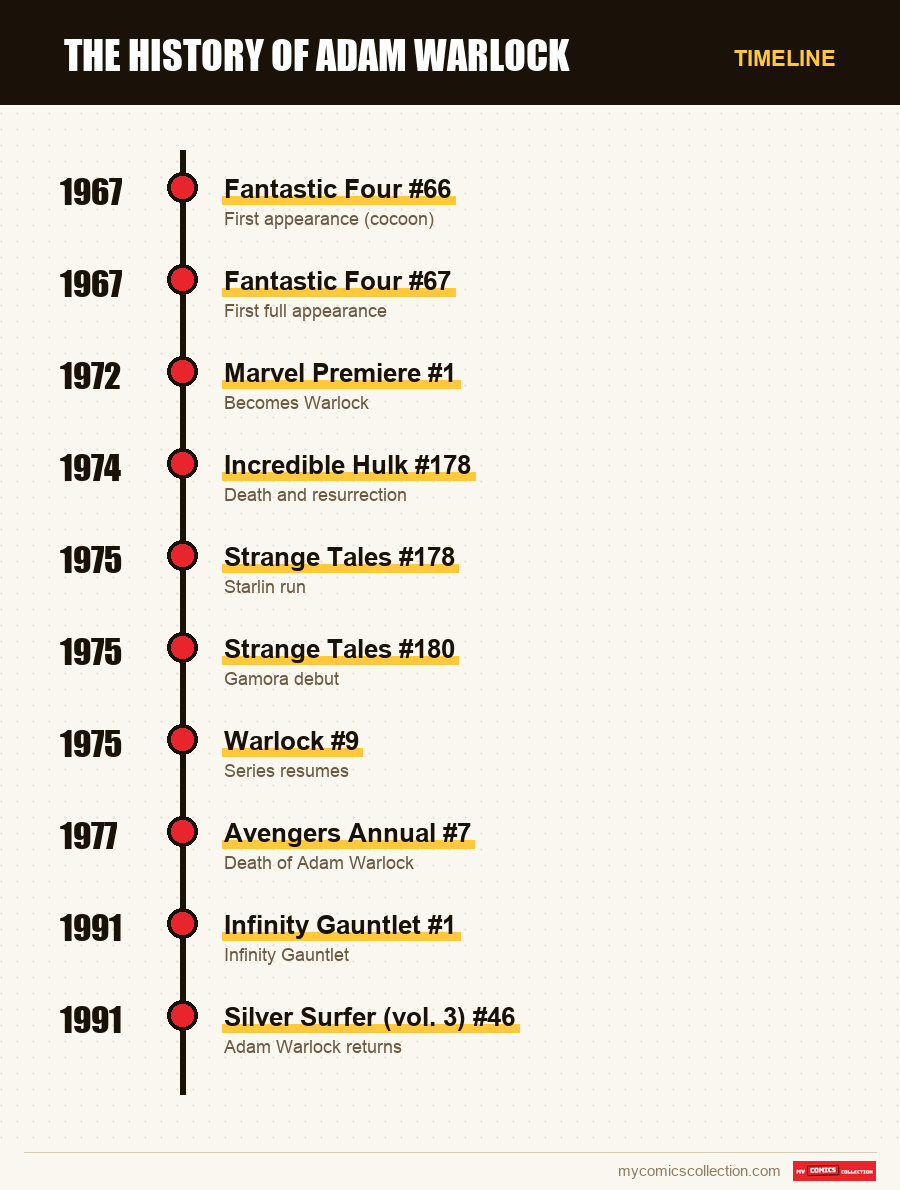
Adam Warlock was created by Stan Lee and Jack Kirby in Fantastic Four #66-67 (September-October 1967) under his original identity of "Him", a perfect being born from a genetic cocoon. Renamed Adam Warlock in Marvel Premiere #1 (April 1972) by Roy Thomas and Gil Kane, then launched into his own solo series with Warlock #1 (August 1972), the character was redefined by Jim Starlin in 1975 in an existential saga (Strange Tales #178-181, Warlock #9-15). He became the centerpiece of Infinity Gauntlet (1991) and finally arrived in the flesh in the MCU with Guardians of the Galaxy Vol. 3 (May 2023), played by Will Poulter.
Few Marvel characters carry as many narrative layers as Adam Warlock. Born from a scientific experiment in the pages of Fantastic Four in 1967, abandoned by his original creators for five years, rediscovered under a new name in 1972, reshaped into a cosmic Christ-figure parable by Jim Starlin in 1975, resurrected as the mastermind of the Infinity trilogy in 1991, and finally pulled out of mainstream obscurity in 2023 thanks to James Gunn and Will Poulter: Adam Warlock is one of the rare Marvel heroes to have crossed six decades while keeping his aura of existential mystery fully intact.
This guide traces the complete origins of Adam Warlock, from the cocoon in Fantastic Four #66 all the way to the 2026-2027 speculation about his next big-screen appearance. We lay out the precise publishing timeline (with exact dates), the key issues you need to know to build a collection, the decisive contribution of Jim Starlin to the character's mythology, his central role in Infinity Gauntlet, and the impact of the MCU on current values. More than sixty years of publishing history, from the late Silver Age to Modern Age runs, distinguishing creators, solo series, crossover events, and key appearances.
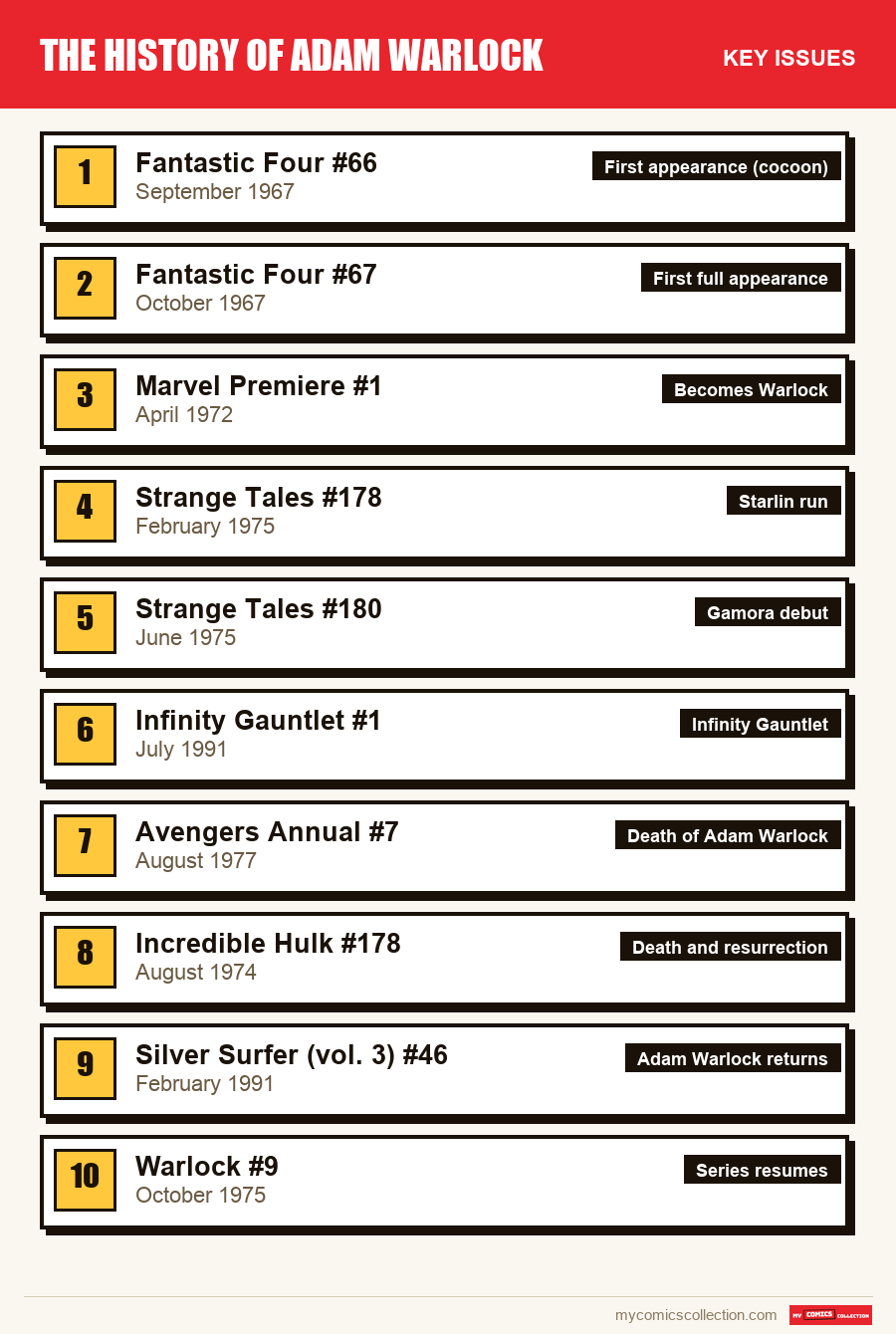
The creation by Stan Lee and Jack Kirby: Fantastic Four #66-67 (September-October 1967)
The story of Adam Warlock begins during the last great creative period of the Lee-Kirby team on Fantastic Four. In the fall of 1967, Stan Lee and Jack Kirby were 66 issues into their foundational series and dreamed up a two-part tale that would remain one of the strangest parables of the Silver Age: the "Him" arc. The publishing context is crucial to understanding how the character came to be. Marvel was barely out of the Galactus / Silver Surfer revolution (Fantastic Four #48-50, 1966), and Kirby was pushing his cosmic iconography further and further. At that point, Fantastic Four was the main laboratory for the concepts that would later feed the entire Marvel universe.
Fantastic Four #66, dated September 1967, is titled "What lurks behind the beehive?" and introduces the Enclave, a group of four renegade scientists (Maris Morlak, Jerome Hamilton, Carlo Zota, and Wladyslav Shinski) who have built a secret beehive-shaped base in Bonaire Bay. Their plan: to artificially create a perfect being, a superhuman with infinite physical and mental abilities, whom they intend to manipulate to conquer the world. The issue shows the genetic cocoon in gestation, still unnamed, referred to simply by the pronoun "Him." The inking is by Joe Sinnott, who brings that metallic polish so characteristic of the FF in this period.
Fantastic Four #67, dated October 1967, is titled "When opens the cocoon!". The cocoon hatches and reveals Him: a golden man of Kirby-esque aesthetic perfection, who immediately senses the malevolent nature of his creators. He violently rejects them, destroys the Enclave's base, and rises into the heavens in search of answers about his existence. Reed Richards, present in the issue, realizes the Enclave has created "something far greater than what it intended." The story ends without giving the character a proper name, and he vanishes into space.
The current values of these two issues reflect their status as historic first appearances. Fantastic Four #66 in CGC 9.4 trades between $1,500 and $2,800 based on 2024-2025 sales, with post-GotG Vol. 3 spikes. A copy in CGC 9.6 can reach $4,500-$7,000, and a rare CGC 9.8 easily tops $15,000 . The #67 follows a similar trajectory, slightly lower since it is considered the second part: CGC 9.4 between $1,000 and $1,800 , CGC 9.6 between $2,500 and $4,500. Mid-grade copies (CGC 5.0-6.5) remain accessible at around $200-$500 and are often the first sensible purchase for anyone who wants to own the character's origin. To understand the grading differences between companies, see our CGC vs CBCS vs PGX comparison.
One notable point: Lee and Kirby dropped the character immediately after these two issues. Him disappeared from Marvel's publications for nearly two years. He resurfaced briefly in Thor #165-166 (June-July 1969), still by Lee and Kirby, where he battles the God of Thunder in a fight remembered for its monumental artwork. But the character remained without a proper name, without a dedicated series, without any real mythology. It would take until 1972 and the arrival of a new editorial generation for him to find his definitive identity.
Marvel Premiere #1 (April 1972): the christening of Adam Warlock
Four and a half years after Fantastic Four #67, Marvel was looking to expand its roster with fresh headliners. Roy Thomas, who became editor-in-chief in 1972 after Stan Lee moved into a global editorial leadership role, identified the Him character as a relaunch opportunity. The context was a Marvel that was multiplying its "try-out books": anthology magazines used to test concepts before a potential ongoing series. The title Marvel Premiere, launched in April 1972, played exactly that role.
Marvel Premiere #1, dated April 1972, is a pivotal editorial moment. Roy Thomas (script) and Gil Kane (art) took over the Him character, renamed him Adam Warlock, and invented a complete mythology for him. The story, titled "And men shall call him… Warlock!" , introduces the High Evolutionary (created by Lee and Kirby in Thor #134, 1966) as the character's mentor. The High Evolutionary gives Adam a green gem set into his forehead: the future Soul Gem, which would become one of the six Infinity Stones of Marvel's cosmic mythology, and sends him to Counter-Earth, a mirror planet created artificially and placed in exact opposition to Earth on the far side of the Sun.
This reinvention also introduced Adam Warlock's main antagonist for the 1970s: the Man-Beast (an earlier Lee-Kirby creation from Thor #134-135, 1967), a creature mutated by the High Evolutionary and banished from Wundagore. On Counter-Earth, the Man-Beast sets himself up as a satanic figure while Adam Warlock is positioned as a cosmic Christ: an openly Christological allegory in which Thomas explicitly develops the parallels with Christian iconography. The names of Adam's disciples (the "Fellow Travellers") evoke the apostles, and the narrative arc would culminate, years later, in a symbolic death and resurrection.
The value of Marvel Premiere #1 makes it one of the most strategic Bronze Age key issues for Adam Warlock collectors. It is technically the first appearance of Adam Warlock under that name, the first time he wears the Soul Gem, and the first issue to present him as a full-fledged protagonist. 2024-2025 sales show a CGC 9.6 between $600 and $1,200 , and a CGC 9.8 topping $2,500 in the best condition. CGC 9.4 copies hover between $250 and $450, making it one of the most accessible cosmic Bronze Age books while still being a documented key issue. The initial print run was substantial for a Marvel book of that era, which keeps supply healthy on the secondary market. To identify other strategic back issues, see our undervalued comics 2026: sleeper issues selection.
This 1972 reinvention locked in the character's iconography for good: red-and-gold costume, cape, forehead gem, blond hair. It is this silhouette that would directly inspire Will Poulter's MCU design fifty-one years later, with a remarkable visual fidelity that James Gunn himself acknowledged in the promotional interviews for Guardians of the Galaxy Vol. 3.
Warlock #1 (August 1972) and Hulk #176-178 (1974): the Counter-Earth solo series
The commercial success of Marvel Premiere #1 and #2 justified launching an ongoing series. Warlock #1, dated August 1972, began just four months after Marvel Premiere #1. The series kept Roy Thomas on script and Gil Kane on art for the first issues, before Mike Friedrich took over the writing starting with Warlock #2 (October 1972). The tone remained that of an ambitious spiritual allegory: Adam Warlock roams Counter-Earth trying to save it from the Man-Beast, accompanied by his Fellow Travellers, on a path that explicitly foreshadows messianic sacrifice.
The Warlock vol. 1 series ran for eight issues, through Warlock #8 (October 1973), when it was canceled due to disappointing sales. Friedrich had tried to maintain the Christian allegory while folding in more conventional adventure elements, but the tone was too conceptual for Marvel's readership at the time and never found its audience. Issues 1 through 8 nonetheless remain sought after by collectors: a Warlock #1 CGC 9.4 trades between $180 and $350 , a CGC 9.6 between $500 and $900 , and a CGC 9.8 can top $1,800. The following issues (#2-8) are more affordable, between $50 and $150 in CGC 9.4-9.6, which makes completing the full run achievable on a reasonable budget.
After the cancellation of Warlock vol. 1, the character entered a crucial narrative transition. Writer Gerry Conway, assisted by Roy Thomas and then Tony Isabella, orchestrated a strategic appearance of Adam Warlock in Incredible Hulk #176-178 (June-August 1974). This three-issue sequence, drawn by Herb Trimpe, literally concludes the Counter-Earth arc opened in Marvel Premiere #1. Adam Warlock faces the Man-Beast in a final confrontation, and the story culminates in the death of Adam Warlock in Hulk #178: an overtly crucifixion-style staging, with sprawling splash pages, that carries the Christological iconography all the way to its conclusion.
This editorial death was meant to be a definitive ending. Marvel had no plans to resurrect the character at that point. And yet, exactly as in the Christian story, the resurrection would come: in a wholly unexpected form, in Bronze Age pages that would become the cornerstone of modern Marvel cosmic mythology. The value of Hulk #176 (CGC 9.4) sits around $120-$200 , #177 in the same range, and #178 slightly higher because of the narrative climax, between $180 and $350 in CGC 9.4. These three issues are regularly recommended in our analyses of modern comics to invest in 2020-2026 for their post-MCU upside potential.
If you would like to have a Bronze Age Adam Warlock copy in your collection appraised, our free appraisal tool can give you a realistic price range based on current eBay listings.
The Jim Starlin run (1975-1976): Warlock #9-15 and Strange Tales #178-181
The year 1975 marks the moment Adam Warlock stopped being a secondary character and became one of the pillars of Marvel's cosmic mythology. Jim Starlin, a young writer-artist who had just left his mark on Captain Marvel and Iron Man with his original creation Thanos (1973), took creative control of the character. Roy Thomas, who still oversaw editorial direction, gave him complete freedom. Starlin, a reader of existentialist philosophy and comparative mythology, was exactly the writer capable of unlocking the allegorical potential left dangling since 1972.
Starlin chose to use Strange Tales, another Marvel anthology title, as his relaunch vehicle. Strange Tales #178 (February 1975) resurrects Adam Warlock in a story titled "Who is… Adam Warlock?". Starlin immediately dropped the Counter-Earth elements to propel the character into a radically new existential dimension. Adam Warlock becomes the appointed champion against the Universal Church of Truth, a cosmic theocracy led by the Magus: who would turn out to be a future, corrupted version of Adam Warlock himself, in one of the most striking narrative twists of the 1970s.
The Strange Tales #178-181 sequence (February-August 1975) laid the foundations of the new mythology. Starlin introduced Pip the Troll, Adam Warlock's future recurring companion, and Gamora in Strange Tales #180 (June 1975): the "deadliest woman in the galaxy," raised by Thanos. Strange Tales #180 is one of the run's major key issues: the first appearance of Gamora, a character who would become central to the Infinity trilogy and then to the MCU. Values exploded after Guardians of the Galaxy (2014): a CGC 9.4 trades today between $250 and $450 , a CGC 9.6 between $600 and $1,100 , and a CGC 9.8 can reach $2,500. To explore other cosmic records, see our feature on the most expensive comics of 2026.
When Marvel decided to relaunch the Warlock vol. 1 series, canceled since late 1973, Starlin continued his story directly in Warlock #9 (October 1975), which picked up the interrupted numbering. The Starlin run on Warlock #9-15 (October 1975 - November 1976) is the creative culmination of the saga. Writing and drawing it himself, Starlin unleashes graphic virtuosity with psychedelic compositions, full-page cosmic meditation sequences, and an inventive narrative use of the Soul Gem: which gradually reveals its ability to absorb the souls of defeated enemies, turning Adam Warlock into a tragic savior.
Warlock #15 (November 1976) closes out the run with a story titled "Just a Series of Events!", which Adam Warlock survives. His death comes the following year in Avengers Annual #7 (1977), where Thanos mortally wounds him before his soul joins the Soul Gem; he re-emerges in Marvel Two-in-One Annual #2 (1977) to help the Avengers turn Thanos to stone. This "double death" (Adam's in Avengers Annual #7, Thanos's in MTIO Annual #2) held for thirteen years, until Starlin's 1990 revival.
The values of the Starlin run are particularly interesting for collectors looking for an accessible cosmic Bronze Age. Warlock #9 (CGC 9.4) goes for $80 to $150 , #10 (CGC 9.4) around $100-$180. The most sought-after issue of the run is paradoxically Warlock #10 (December 1975), which features a major Adam vs. Magus battle and key narrative revelations. A complete Warlock #9-15 run in CGC 9.4+ can be assembled for a total budget of $800-$1,500, which remains reasonable for seven Bronze Age issues by Starlin.
Infinity Gauntlet (July-December 1991): Starlin, Lim, Pérez and the breakthrough
Thirteen years after Adam Warlock's last significant narrative appearance, Jim Starlin returned to Marvel in 1990 with a colossal editorial plan: to resurrect Thanos and Adam Warlock simultaneously and build the biggest cosmic saga Marvel had ever published. The project kicked off in the pages of Silver Surfer vol. 3, of which Starlin took editorial control at #34 (February 1990), resurrecting Thanos, continued in the Thanos Quest #1-2 miniseries (September-October 1990) in which Thanos collects the six Infinity Gems, and culminated in the event of the year 1991: Infinity Gauntlet.
Infinity Gauntlet, a six-issue prestige miniseries published from July to December 1991, is the most important Marvel event of the 1990s and the direct source of Avengers: Infinity War (2018). On script, Jim Starlin . On art, George Pérez for issues #1 through #4, then Ron Lim for #4 through #6: Pérez having dropped out partway through for editorial reasons. Inking was shared between Joe Rubinstein , Tom Christopher , Bruce Solotoff, and several other collaborators. The format was prestige: six monthly issues of roughly 38 pages each.
The plot places Adam Warlock at the center of the narrative. Thanos, holding the six Gems set into the Infinity Gauntlet, wipes out half of all life in the universe with a snap of his fingers to win the favor of Death personified. The surviving heroes (Avengers, Fantastic Four, X-Men, Doctor Strange, Silver Surfer) attempt a frontal assault that ends in a massacre. It is Adam Warlock, back from the Soul Gem world in Silver Surfer vol. 3 #46 (February 1991) and present from #1, who devises the winning strategy. He reveals to the survivors that Thanos, unconsciously, wants to lose: that he will give up the gauntlet at a crucial moment for unspoken psychological reasons. The final resolution in #6 (December 1991) sees Adam Warlock recover the gauntlet and temporarily become the most powerful being in the universe, before redistributing the gems to reconstitute the Infinity Watch.
Infinity Gauntlet's values underwent a radical post-MCU transformation. Infinity Gauntlet #1 (July 1991), with its iconic George Pérez cover, Thanos brandishing the glowing gauntlet, went from $150-$300 (CGC 9.8) before 2018 to $1,200-$2,500 (CGC 9.8) in 2025-2026, with a peak above $4,000 during the post-COVID speculative bubble of 2021. CGC 9.6 copies hover between $250 and $600 , and CGC 9.4 copies between $100 and $250, which keeps the book accessible to beginning collectors. Issues #2 through #6 are also collected: a #4 CGC 9.8 (the height of the confrontation with the cosmic entities) trades between $200 and $450 , and #6 between $250 and $500 for the narrative resolution involving Adam Warlock.
The commercial success of Infinity Gauntlet paved the way for a complete trilogy. Infinity War #1-6 (June-November 1992), the direct sequel, sees Adam Warlock face the Magus: his own evil side extracted in Infinity Gauntlet. Infinity Crusade #1-6 (June-November 1993) introduces the Goddess, a feminine and "benevolent" version of Adam Warlock, as the antagonist. The complete trilogy redefines Adam Warlock as a tragic cosmic figure, condemned to swing back and forth between savior and tyrant. In parallel, Adam Warlock got his own ongoing series: Warlock and the Infinity Watch #1 (February 1992), which would run for 42 issues until August 1995, with Starlin on script. It is in this series that Adam assembles his team (Pip the Troll, Gamora, Drax, Moondragon, Maxam), each tasked with protecting one Infinity Gem. To build an investment strategy around these back issues, see our strategic comics investment guide.
Collecting this series?
Track what you own, what you are missing and what your collection is worth. 7 day trial.
Start my trial →MCU Guardians of the Galaxy Vol. 3 (May 2023) and 2027 speculation
Adam Warlock made his definitive mainstream entrance on May 5, 2023 with the release of Guardians of the Galaxy Vol. 3 , directed by James Gunn . The role went to Will Poulter, a British actor known for his performances in The Revenant (2015) and Midsommar (2019). The character had been teased as early as the post-credits scene of Guardians of the Galaxy Vol. 2 (2017): Ayesha, high priestess of the Sovereign, unveiled a cocoon in which she was preparing Adam, presented as the perfect weapon to destroy the Guardians.
The adaptation respects the character's core comic elements while bending the trajectory. The MCU Adam Warlock emerges from his cocoon prematurely, still emotionally immature, and becomes the main antagonist of the film's first half before a gradual redemption arc. The visual design (golden costume, cape, blond hair, cosmic gaze) is an almost pixel-perfect fidelity to Starlin's 1975-1976 iconography. James Gunn would state in several interviews that he wanted to honor Jim Starlin's work, going so far as to cite Warlock #15 and Infinity Gauntlet as direct references.
The impact on values was immediate. Fantastic Four #66-67 saw a first surge as soon as Will Poulter's casting was announced in October 2021, then an acceleration in April-May 2023 when the film came out. CGC 9.4 sales gained an average of 40 to 60% over the 2021-2023 period, before stabilizing in 2024-2025. Marvel Premiere #1 followed a similar path with an average rise of 30 to 50%. The more accessible issues:Warlock #1 (1972), Strange Tales #178 (1975), Strange Tales #180 (1st app Gamora): also benefited from a halo effect, particularly Strange Tales #180, which roughly doubled over the period. This post-film revaluation mechanic is classic, and we analyze it regularly in our comics selections.
The 2026-2027 speculation centers on the next film. Since James Gunn left Marvel Studios for DC Studios in 2022, Adam Warlock's future in the MCU is less certain. Three possibilities are regularly floated by editorial sources and fan-trackers: (1) an Adam Warlock appearance in Avengers: Doomsday (slated for May 2026) or Avengers: Secret Wars (slated for May 2027), where his historic connection to the Infinity Gems and the multiverse makes him narratively useful; (2) a new Guardians of the Galaxy Vol. 4 film without James Gunn, in which Adam Warlock could potentially take the lead of the team; (3) a Disney+ series centered on Adam Warlock exploring Marvel's pre-Infinity Gauntlet cosmic mythology. None of these scenarios is confirmed as of June 2026, but the secondary market is already reacting to every rumor. Collectors anticipating these announcements are positioning themselves in Fantastic Four #66-67, Marvel Premiere #1, and Warlock #1 as cosmic safe-haven assets. For a fuller look at the MCU calendar, see our feature on MCU Phase 6 comics.
Beyond film, Adam Warlock has also seen steady publishing activity in 2024-2026. Marvel has released several miniseries and arcs featuring the character: Warlock: Rebirth (March-August 2023) by Ron Marz and Ron Lim, bringing back the original Warlock and the Infinity Watch creative team; recurring appearances in recent Guardians of the Galaxy and Infinity Watch volumes; and an active presence in the 2025-2026 cosmic events. This editorial continuity stabilizes collector interest in the foundational back issues and supports values over the medium term. You can track your Adam Warlock collection issue by issue through our built-in catalog, accessible from the comics area.
Key issues to know
Fantastic Four #66
Stan Lee and Jack Kirby introduce the Enclave, four scientists bent on creating a perfect being to rule the world. Their creation, simply called Him, is still a cocoon in gestation. It is the starting point of Adam Warlock's whole story and the character's most sought-after issue.
Fantastic Four #67
The cocoon opens: Him, a golden being of sculpted perfection, turns on the Enclave scientists who wanted to use him, then leaves Earth. Lee and Kirby deliver the first full appearance of the future Adam Warlock, one of the last great creations of their Fantastic Four run.
Marvel Premiere #1
Roy Thomas and Gil Kane take up Him, rename him Warlock and make him the High Evolutionary's envoy to Counter-Earth, in an openly Christ-like allegory. The issue also introduces the Soul Gem, a future Infinity Stone. The first appearance under the Warlock name.
Strange Tales #178
Jim Starlin, as writer and artist, relaunches Adam Warlock in a cosmic, existential saga. The issue introduces the Universal Church of Truth and its leader, the Magus, later revealed to be a corrupted future version of Warlock. The start of the run that founds Marvel's modern cosmic mythology.
Strange Tales #180
Starlin brings in a still unnamed Gamora, who joins Warlock and Pip the Troll to see whether the hero can defeat the Magus, ready to kill him if he fails. The issue also tells of Warlock's rigged trial before Kray-Tor. A first appearance made major by the Guardians of the Galaxy.
Infinity Gauntlet #1
Jim Starlin (script) and George Pérez (art): master of the six Gems, Thanos wipes out half of all life in the universe to please Death. Adam Warlock, recently returned, becomes the strategist of the resistance. The first issue of the event that inspired Avengers: Infinity War.
Avengers Annual #7
Starlin wraps up his cycle: Warlock warns the Avengers that Thanos plans to snuff out the stars, then falls to the Mad Titan. A past version of himself then absorbs his dying spirit into the Soul Gem. The story continues in Marvel Two-in-One Annual #2, where Thanos is defeated.
Incredible Hulk #178
Written by Gerry Conway and drawn by Herb Trimpe, this issue closes the Counter-Earth arc: executed by the Man-Beast, Warlock reverts to a cocoon before coming back to life, in a direct allegory of the Resurrection. A key step between the 1972 series and the Starlin run.
Silver Surfer (vol. 3) #46
Jim Starlin and Ron Lim bring Adam Warlock back from the Soul Gem's world, along with Gamora and Pip, nearly fourteen years after their last appearance. The return sets up Infinity Gauntlet directly. A pivotal issue in Starlin's great cosmic comeback of the early 1990s.
Warlock #9
The Warlock series resumes its numbering and Starlin carries on his saga: Warlock refuses to believe he will become the Magus, while Gamora travels with him. The issue also brings in the In-Betweener. It opens the seven issues that form the heart of the Starlin run.
FAQ: Adam Warlock history
Who created Adam Warlock, and in which comic?
Adam Warlock was created by Stan Lee and Jack Kirby in Fantastic Four #66-67 (September-October 1967), under his original identity of "Him": a perfect being born from a genetic cocoon designed by the Enclave. The character was renamed Adam Warlock five years later in Marvel Premiere #1 (April 1972) by Roy Thomas and Gil Kane, who gave him the Soul Gem and sent him to Counter-Earth as a Christological allegory. It was Jim Starlin who, starting in 1975 (Strange Tales #178), reinvented the character as an existential cosmic figure and placed him at the center of Marvel's Infinity Gems mythology.
What is Adam Warlock's first appearance under that name?
The first appearance under the name "Adam Warlock" is Marvel Premiere #1 (April 1972), by Roy Thomas and Gil Kane. It is technically the first time the "Him" character (introduced in FF #66-67 in 1967) is named "Adam Warlock," which makes it a strategic key issue for collectors. Before 1972, the character appears in Fantastic Four #66 (Sept 1967), Fantastic Four #67 (Oct 1967), and Thor #165-166 (June-July 1969), but always under the name "Him." Marvel Premiere #1 is therefore the first appearance of Adam Warlock proper.
What is Adam Warlock's most significant run?
The Jim Starlin run of 1975-1976 remains the character's creative peak. It covers Strange Tales #178-181 (February-August 1975) and then Warlock #9-15 (October 1975 - November 1976), for a total of about eleven issues. Starlin introduces Pip the Troll, Gamora (Strange Tales #180), the Magus, the Universal Church of Truth, and redefines the Soul Gem as a soul-devouring entity. It is also the direct narrative foundation of Infinity Gauntlet (1991). For a complete collection, targeting the Strange Tales #178-181 + Warlock #9-15 run in CGC 9.0+ is an achievable goal (a $1,200-$2,500 budget depending on the grades).
What is Fantastic Four #66-67 worth today?
In 2025-2026, Fantastic Four #66 in CGC 9.4 trades between $1,500 and $2,800 , and a CGC 9.6 between $4,500 and $7,000 . The #67 sits slightly below: CGC 9.4 between $1,000 and $1,800 , CGC 9.6 between $2,500 and $4,500. Mid-grade copies (CGC 5.0-6.5) remain accessible between $200 and $500, which lets you acquire the character's origin on a sensible budget. The release of Guardians of the Galaxy Vol. 3 in May 2023 drove a 40 to 60% rise over the 2021-2023 period, with stabilization in 2024-2025.
Will Adam Warlock appear in Avengers: Doomsday or Secret Wars?
There is no official Marvel Studios confirmation as of June 2026 regarding Adam Warlock's presence in Avengers: Doomsday (slated for May 2026) or Avengers: Secret Wars (slated for May 2027). That said, Adam Warlock's historic connection to the Infinity Gems and the multiverse makes him very useful narratively for the Multiverse Saga. Will Poulter is under contract for several appearances according to industry sources, and James Gunn, now at DC Studios, had set the character up for sequels before his departure. The 2026-2027 speculation also centers on a possible Guardians of the Galaxy Vol. 4 or a Disney+ series focused on Adam Warlock.