Dave Gibbons, born April 14, 1949 in London, is the British cartoonist known for Watchmen (1986-1987) with Alan Moore, his long career with 2000 AD (Dan Dare, Harlem Heroes, Judge Dredd) and his notable stint on Green Lantern at DC Comics in the 1980s. The comics he drew or signed, in particular Watchmen #1 and Green Lantern #182, are among the most sought-after modern titles by collectors, with prices that remain strong on the graded sales market.
There are few artists whose name alone is enough to make a signing queue jump or increase the value of a box of comics forgotten in an attic. Dave Gibbons is one of them. While the generation of French readers discovered the 9th panel of Watchmen in bookstores at the turn of the 1990s, the British artist was constructing a much larger body of work from London, nourished by twenty years of popular English comic strips before even putting a pencil to the character who would make him world famous.
This article traces the real life journey of Dave Gibbons, from the black and white pages of 2000 AD to the hyper-structured plates of Watchmen, including his collaboration with Frank Miller on Martha Washington and his later work on Kingsman. He also explains, without ever inventing a figure, how this journey translates concretely into the collector's market today: which numbers to look for, why certain copies are worth significantly more than others, and how to calmly estimate what you may already own.
From the pages of horror at IPC to the revolution of 2000 AD
David Chester Gibbons was born on April 14, 1949 at Forest Gate Hospital in east London. His father, Chester, is an urban planner; his mother, Gladys, secretary. Nothing in this post-war British household predestined the child to become one of the most influential cartoonists in the history of American comic books. Gibbons discovered comics at the age of seven and began drawing his own stories very early on, completely self-taught: he never followed academic artistic training. His first career was unrelated to drawing, as he worked as a building surveyor before moving into publishing.
His entry into the industry was through the back door: he became a letterer for IPC Media, the British press and popular comics giant, before leaving his position as a surveyor to devote himself entirely to comics. His very first published works appeared in underground titles like The Trials of Nasty Tales and cOZmic Comics, far from the costumed superheroes that made him famous.
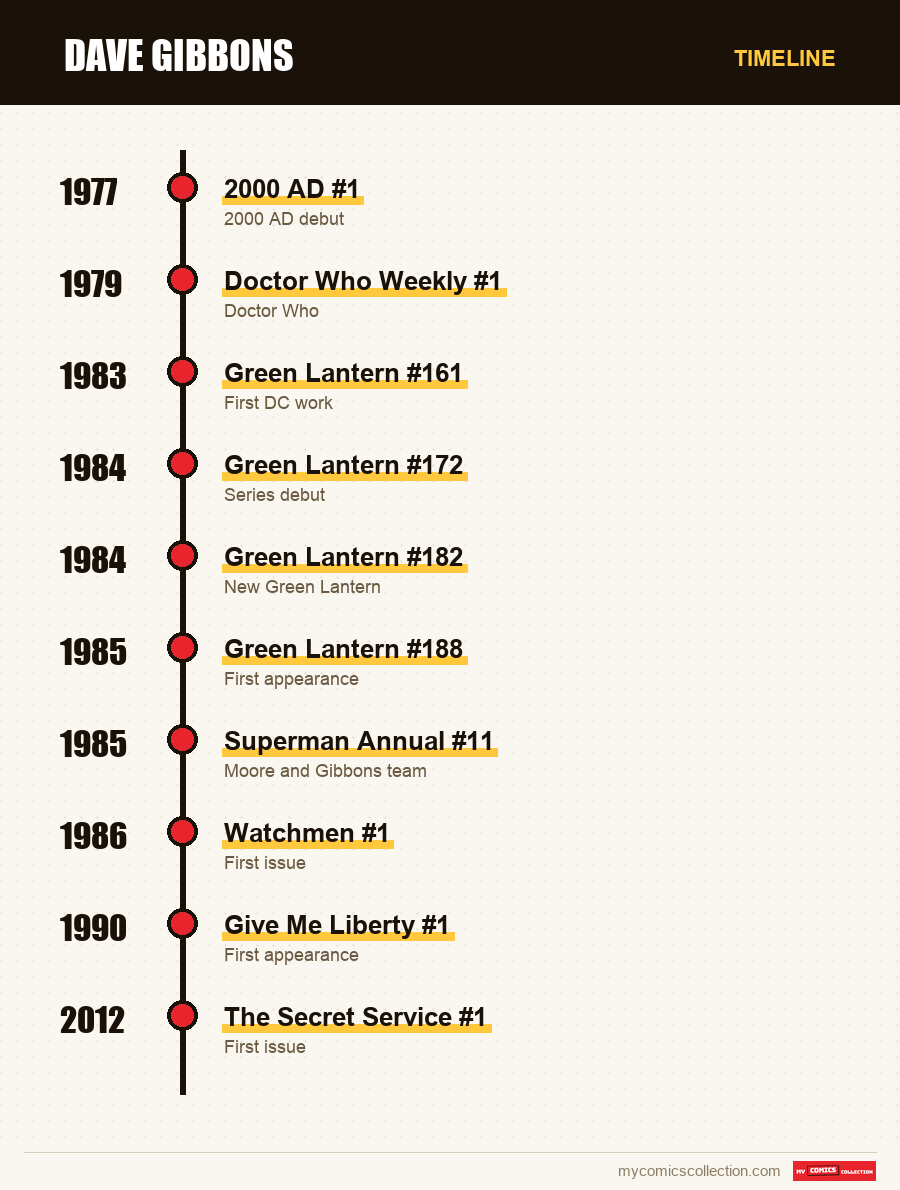
The turning point came in February 1977, with the launch of 2000 AD, the weekly science fiction anthology that would redefine British comics for an entire generation. Gibbons contributed from the very first issue, Prog 01, and became one of the magazine's most prolific artists: he illustrated no less than 108 of the first 131 issues. He draws the first twenty-four episodes of Harlem Heroes, one of the founding stories of the title, then resumes during the year the series that is most close to his heart, Dan Dare, in homage to Frank Hampson, original designer of the character in the 1950s and one of the major influences cited by Gibbons himself, alongside Frank Bellamy, Don Lawrence and Ron Turner. He then continues with Ro-Busters alongside screenwriter Pat Mills, then created Rogue Trooper with Gerry Finley-Day in the early 1980s, without forgetting several stories of Judge Dredd, including “The Neon Knights” from 1977.
Between 1979 and 1982, Gibbons temporarily left 2000 AD to become the lead artist for Doctor Who Weekly Then Doctor Who Monthly, drawing the main strip from issue 1 through issue 69, missing only four deliveries in that entire period. This parenthesis is important for understanding the rest of his career: it proves to the American industry, which is beginning to look across the Atlantic to recruit new talent, that Gibbons is capable of maintaining a sustained monthly production pace on a license with strong narrative requirements.
Arrival at DC Comics and the Green Lantern era
It was editor Len Wein who spotted Gibbons and identified him as one of the British talents to bring to DC Comics, as part of what American comic book history would later call the "British Invasion", a movement that saw Alan Moore, Grant Morrison, Neil Gaiman and other English authors transform the American publishing landscape during the 1980s. Gibbons made his debut at DC with a complementary story devoted to the Green Lantern Corps in Green Lantern #161, dated February 1983, then draws a two-part story about the Creeper in The Flash #318-319.
His collaboration with Len Wein on the main series of Green Lantern really begins with issue 172, in January 1984. Together, the two men make a decision that will lastingly mark the mythology of the character: making the architect John Stewart, until then occasional wearer of the ring, the central protagonist of the title from issue 182. Gibbons remains on the series until issue 186 in March 1985, before returning occasionally for the episode "Mogo Doesn't Socialize" at issue 188, this time written by a certain Alan Moore, who had already encountered the previous year on another project which would lastingly shake up the medium.
This project is “For the Man Who Has Everything”, published in Superman Annual #11 in 1985. This story, where Superman confronts his own regrets under the influence of an alien parasitic plant, is praised for the sophistication of its storytelling and earned Moore and Gibbons a nomination for the Kirby Award for best single issue in 1986. It is this story that truly sealed the creative duo Moore/Gibbons, a year before their most famous collaboration.
Watchmen: the nine-box grid that changed the grammar of the comic book
Published in twelve monthly issues between 1986 and 1987 by DC Comics, Watchmen is today considered one of the most accomplished works ever produced in the medium. The project was born from an initial proposal from Alan Moore to use characters purchased from Charlton Comics (Captain Atom, the Question, Peacemaker...), before DC preferred to keep these figures for its own shared universe. Moore and Gibbons then rework the concept with entirely new characters, but constructed as distorted mirrors of the Charlton heroes: Doctor Manhattan echoing Captain Atom, Rorschach echoing the Question, Ozymandias echoing Peacemaker.
Gibbons' contribution goes far beyond simple drawing. He is also the letterist for the entire series, a rare performance for an artist of this stature, and his handwritten calligraphy served as a reference for Vincent Connare when designing the Comic Sans font in 1994, an anecdote that Gibbons himself commented on with wry humor, regretting that the digital font was never able to restore the finesse of his original lettering. On a strictly graphic level, Watchmen is also the laboratory of a formal rigor unprecedented in mainstream comics: the grid of nine equal panels, used almost systematically, imposes a deliberately slowed reading tempo and allows Moore and Gibbons to weave complex visual correspondences between panels, pages and even numbers.
The series won two Kirby Awards in 1987, for Best New Title and Best Writer-Artist Duo, and also received nominations for Best Single Issue for Episodes #1 and #2. In 1988, it won a special award in the “Best Other Forms” category of the Hugo Awards, an extremely rare recognition for a comic strip in the world of literary science fiction. It would later become the only graphic novel to appear in the magazine's list of "100 Best Novels". Time, alongside works by Faulkner, Orwell and Nabokov.
After Watchmen: an all-terrain career as a cartoonist-screenwriter
Contrary to popular belief, Dave Gibbons has never rested on the success of Watchmen. His post-1987 bibliography is as dense as it is eclectic. At Dark Horse Comics, he illustrates Give Me Liberty (1990-1991), story by Frank Miller, then extends this collaboration over the entire cycle Martha Washington between 1994 and 1998, including Martha Washington Goes to War , Happy Birthday, Martha Washington and Martha Washington Saves the World. This political science fiction series, carried by drawings of almost documentary precision, is today considered by specialists as one of the little-known peaks of Gibbons' career.
At DC, he also became a screenwriter in his own right: he wrote the very first crossover Batman vs. Predator (1991-1992), drawn by Andy and Adam Kubert, then the mini-series World's Finest (1990) with artist Steve Rude. In 1995, he illustrated Superman: Kal, an Elseworld by José Luis García-López which transposes the Arthurian legend into the mythology of Superman. In 2004-2005, he wrote and drew alone The Originals for the Vertigo label, a black and white graphic novel set in the near future but nourished by the mod imagery of the 1960s that Gibbons himself experienced as a young adult in London with a passion for scooters and club life. He also returns to the Green Lantern universe as a screenwriter, with the mini-series Green Lantern Corps: Recharge (2005) co-written with Geoff Johns, then the regular series Green Lantern Corps with designer Patrick Gleason from 2006.
His last notable foray into mainstream comic books came in 2012, when he illustrated The Secret Service, the seven-issue miniseries written by Mark Millar for the Icon Comics label, which will become the basis for the film Kingsman: Secret Service the following year. This project clearly illustrates Gibbons' unique trajectory: fifty years after his beginnings as a letterist at IPC, he remains one of the rare artists of his generation capable of attracting a new readership to an original project, far from any pure nostalgia.
The impact of adaptations on the rating
Watchmen has undergone two major adaptations that have had a measurable effect on collecting interest in the original work. Zack Snyder's film, released in 2009, was preceded by the publication of the book Watching the Watchmen, directed by Gibbons himself in 2008 to accompany the release of the feature film. Gibbons also acted as a consultant on the set, saying he was publicly satisfied with the end result. This cinema release generated a peak in notoriety which brought the series closer to a non-comic book reading public, mechanically increasing demand for reissues in bookstores as much as for period copies on sale on the secondary market.
A second wave arrived in 2019 with the television series Watchmen produced by HBO, intended as a sequel rather than a direct adaptation of the original plot. This type of narrative extension has a habit of rekindling attention to the source comic, a phenomenon recurrently observed on the collector's market each time a comic book intellectual property returns to the forefront of the audiovisual scene. The movie Kingsman: Secret Service (2014), adapted from the comic drawn by Gibbons, produced a similar effect on a smaller scale on copies of The Secret Service.
On a strictly numerical level, the CGC census of Watchmen #1 (September 1986) gave 631 copies graded at the maximum level 9.8 in February 2025, with no copy listed above, which indicates a comfortable original print run but a proportion of copies in almost perfect condition which remains, as is often the case for comics from the 1980s preserved without much precaution at the time, relatively restricted. The Overstreet 2024 guide placed the catalog value of a copy in NM- (9.2) condition at around $95, a reference figure which serves as a basis but which does not necessarily reflect the prices achieved during very high grade sales, the latter evolving according to current demand and the exact condition of the copy.
Collecting this series?
Track what you own, what you are missing and what your collection is worth. 7 day trial.
Start my trial →Understanding the price of comics by Dave Gibbons
For a collector who discovers a box of comics from the 1980s, a few simple points of reference allow you to sort them before going any further. The name of Dave Gibbons appears on three main families of titles, with very different rating logics.
The first family groups together the key numbers of Watchmen, led by number 1, which marks the first appearance of Rorschach, Doctor Manhattan, Nite Owl, Silk Specter and Ozymandias, as well as the death of the Comedian which opens the plot. It is the most sought-after copy of Gibbons' entire production, ahead of subsequent issues in the series, which retain a solid but significantly lower value outside of the very first issues. The state of conservation plays a disproportionate role here: the difference in value between an example in average condition and an example graded in very high grade can be considerable, which justifies systematically authenticating and grading any example suspected of being in excellent condition rather than relying on a simple visual inspection.
The second family concerns its passage at 2000 AD and on Doctor Who Weekly/Monthly. These British titles circulate in a smaller and more specialized market than American comics, with a collector base concentrated mainly in the United Kingdom. Prog 01 of 2000 AD (1977) and number 1 of Doctor Who Weekly (1979) remain reference pieces for any fan of British comics, regardless of Gibbons' presence in the contents, but his involvement adds an additional layer of interest for collectors specializing in his work.
The third family brings together its American runs outside Watchmen : number 182 of Green Lantern, which establishes John Stewart as the central character of the series, Superman Annual #11 for “For the Man Who Has Everything”, or the first issues of Martha Washington. These stocks generally do not reach the peaks of Watchmen, but benefit from a stable demand driven by thematic collectors, in particular those who follow the editorial evolution of John Stewart as Green Lantern.
Buying guide
Before investing in a Dave Gibbons comic, a few concrete checks allow you to avoid unpleasant surprises and buy at the right price.
- Check the exact edition of Watchmen #1. The market includes several printings and reissues of number 1 since 1986; only the very first printing from September 1986 with its original printing mention corresponds to the number really sought after by collectors of vintage comics.
- Distinguish the work of a designer and the work of a screenwriter. On titles like Batman vs. Predator or World's Finest, Gibbons only signed the screenplay, the drawing being provided by other artists; the collector's value of an issue then depends as much, if not more, on the associated designer.
- Favor professional grading for old examples in good condition. An ungraded Watchmen #1, even apparently impeccable, systematically sells for less than a CGC certified copy or equivalent, due to lack of objective guarantee on the condition of the pages and corners.
- Don't overlook British comics from the 2000 AD period. Often undervalued on the French-speaking market due to lack of visibility, the early Progs and the first issues of Doctor Who Weekly drawn by Gibbons constitute a more affordable entry point into his bibliography.
- Systematically cross-reference the issue with the editorial history. A copy of Green Lantern advertised as "first John Stewart on the cover" must be checked: the character's first appearance dates back to issue 87, well before the arrival of Gibbons, who only intervenes from issue 182 to make him the main protagonist.
- Use a comparison tool based on actual sales rather than a fixed list price. The annual rating guides give a useful order of magnitude, but the prices actually observed during sales evolve continuously depending on the available supply and the latest licensing news.
To organize a collection that mixes British and American comics, with sometimes confusing numbering formats (Progs, annuals, one-shots), a dedicated application makes it easier to track what you already have and what you still have to find; this is notably one of the common uses of our comic collection management application.
The key issues to know
Watchmen #1
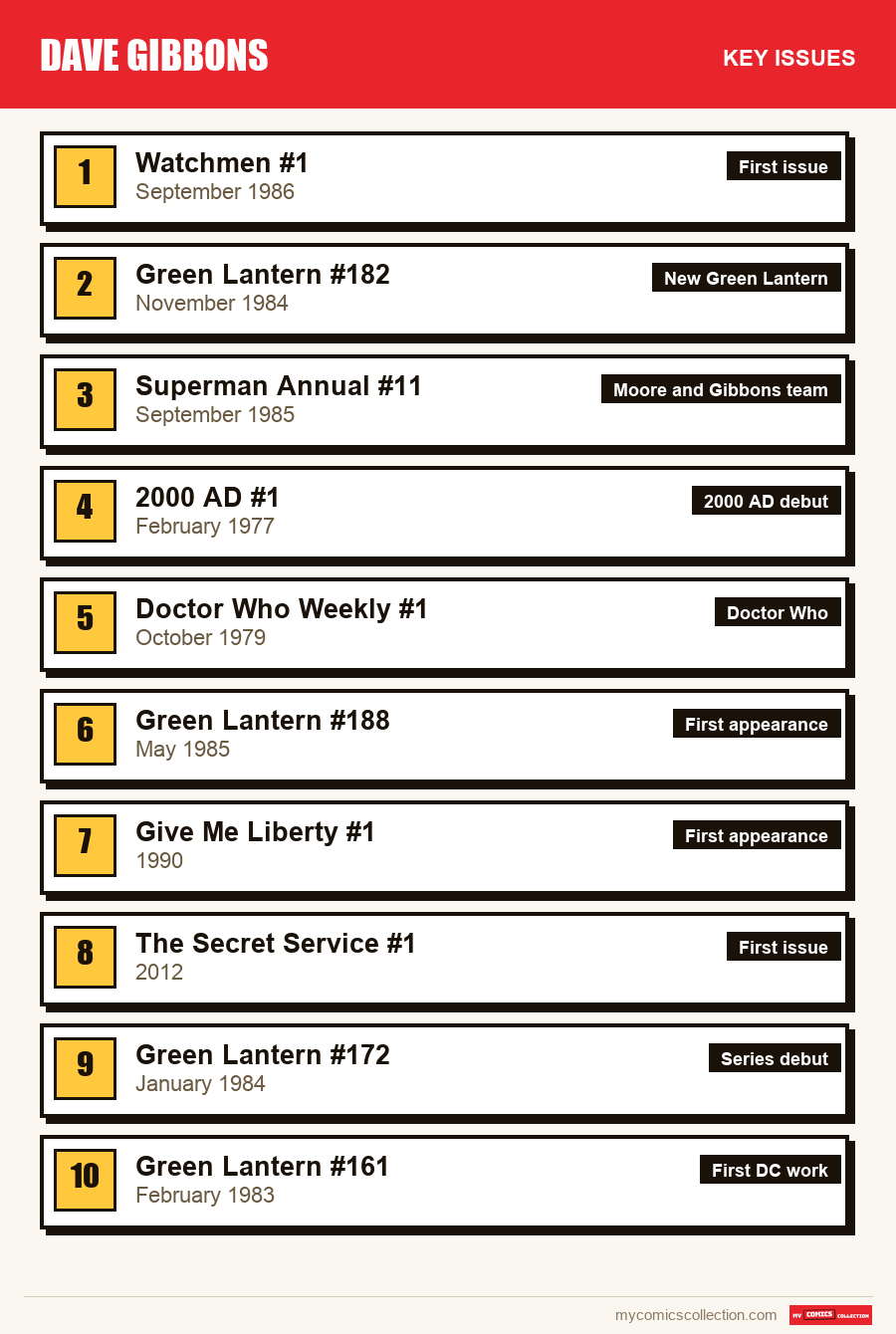
Dave Gibbons draws and letters the whole series written by Alan Moore, building on a nine-panel grid that deliberately slows the reading. The issue introduces Rorschach, Doctor Manhattan, Nite Owl, Silk Spectre and Ozymandias around the Comedian's death. The centerpiece of his bibliography.
Green Lantern #182
With Len Wein writing, Gibbons draws the issue in which architect John Stewart becomes the series' main Green Lantern: Hal Jordan finds him in uniform, charging his ring. A lasting turning point for the character. A key followed by John Stewart collectors.
Superman Annual #11
"For the Man Who Has Everything...": arriving for Superman's birthday, Batman, Robin and Wonder Woman find him motionless, an alien plant clinging to his chest, before Mongul shows up. Gibbons forms with Alan Moore the duo that would create Watchmen the following year. A story that became a classic.
2000 AD #1
The first issue of the British science fiction anthology, featuring Harlem Heroes, a strip co-created by Pat Mills and Dave Gibbons. Gibbons would become one of the magazine's most prolific early artists, contributing to 108 of the first 131 issues. A benchmark piece for collectors of British comics.
Doctor Who Weekly #1
The first issue of the magazine devoted to the TV series, where Gibbons becomes lead artist: he draws the main strip from issue 1 to issue 69, missing only four. That consistency convinced the American industry he could sustain a demanding schedule. A British milestone in his career.
Green Lantern #188
In the backup story "Mogo Doesn't Socialize", written by Alan Moore and drawn, inked and lettered by Gibbons, Mogo, a Green Lantern who is an entire planet, appears for the first time. The tale is told by Tomar-Re. A classic of Green Lantern Corps mythology.
Give Me Liberty #1
The first of four issues of the miniseries written by Frank Miller and drawn by Gibbons at Dark Horse, introducing Martha Washington. The pair would go on to continue the heroine's adventures over several series. An underrated high point of Gibbons's career.
The Secret Service #1
Gibbons draws the series written by Mark Millar, in which a young man is recruited by his uncle, a secret agent. It became the basis for the film Kingsman: The Secret Service. A late-career outing that introduced his art to a new audience.
Green Lantern #172
Gibbons's first issue as main artist on Green Lantern, alongside writer Len Wein, with "Judgment Day!". He also provides the cover and the backup story. The start of the run that would make John Stewart the title's hero.
Green Lantern #161
Spotted by Len Wein, Gibbons makes his DC debut with "Storm Brother", a Green Lantern Corps backup story. It is the British artist's entry into the American market. A complementary issue for anyone following his career in order.