Ozymandias, aka Adrian Veidt, first appears in Watchmen #1 (DC Comics, cover-dated September 1986), written by Alan Moore and drawn by Dave Gibbons. Its full origin is revealed in Watchmen #11 (“Look on My Works, Ye Mighty”), the key number for any collector of the character. The initial prints remain sought after in high grade: the CGC census in 9.8 went from 254 copies in 2012 to 631 in 2025, a sign of a rarity which erodes over time but which remains real on the very first impressions.
In the highly codified landscape of superhero comics, Ozymandias occupies a special place: that of the most intelligent antihero in the world, the one who is fundamentally right but whose means make the blood run cold. Few secondary characters in the history of comics have had such an impact on popular culture while remaining, on the collectible market, relatively accessible compared to the icons of the Silver Age. Understanding Ozymandias’ rating means first understanding that of Watchmen itself, a work that changed the way the industry viewed the medium.
This file traces the editorial history of the character, issue by issue, from the origins at DC Comics in 1986 to the facsimile reissues announced for the 40th anniversary of the series. It also details what CGC census data actually says about the title's rarity, and how screen adaptations have influenced collector demand over the decades.
Whether you are looking to identify a copy of Watchmen #1 lying around in a family box, to understand why Watchmen #11 is the true origin number to have, or to evaluate the interest of a prequel like Before Watchmen: Ozymandias, this guide relies only on verifiable editorial facts: publication dates, credits, circulations, and publicly viewable CGC population data.
We must also remember why the series that saw it born occupies such a unique place in the history of comics: Watchmen received a Hugo Award in 1988, a distinction usually reserved for science fiction literature, and Time magazine ranked it among the hundred best English-language novels published since 1923: all formats combined, not just comics. This hybrid status, between popular culture and literary recognition, explains why the demand for the original issues has never completely died down since 1986, unlike many commercially comparable series of the same decade.
Ozymandias: the creation of an antihero in 1986's Watchmen
Adrian Alexander Veidt, known as Ozymandias, was born under the pen of Alan Moore and the pencil of Dave Gibbons in Watchmen #1, published by DC Comics on May 13, 1986 (cover-dated September 1986). This 36-page first issue, sold for $1.50 at the time, introduced the entire main cast of the series in one fell swoop: Rorschach, Doctor Manhattan, Silk Spectre, Nite Owl, the Comedian, and Ozymandias. This shows the editorial importance of this issue in the construction of the entire story to come.
The choice of name is not trivial. “Ozymandias” is the Greek name given to Ramesses II, and it refers directly to the poem by Percy Bysshe Shelley published in 1818, an extract of which also serves as an epigraph to one of the chapters of the series. The poem deals with the vanity of empires and the inevitable decadence of all human greatness-a theme that Moore consciously pursues until the denouement of Watchmen, where Ozymandias' plan, as grandiose as it may be, carries the seeds of its own moral fragility.
The series, published in twelve monthly issues between September 1986 and October 1987, had a commercial and critical impact disproportionate to its maxi-series format. Its sales contributed, for a time, to making DC Comics overtake Marvel in the direct comic shop market: an extremely rare occurrence in the history of superhero publishing in the 1980s, dominated without sharing by Marvel. This commercial success largely explains why the very first printings of Watchmen #1 are now actively sought after by modern comic collectors, a category where “native” rarity is rarer than on Golden or Silver Age titles.
A character thought of as a distorting mirror
In Moore's narrative construction, Ozymandias is not conceived as a simple antagonist. He is the most intelligent man in the world according to the very diegesis of the story, a former masked vigilante converted into a philanthropic industrialist, and above all the only one of the main characters to never wear a costume in the present of the plot, except during flashbacks of his past as an active hero. This visual choice by Gibbons, discreet but systematic, signals from the reading that Veidt has left the world of costumed superheroes to invest a more insidious power: that of money, the media and corporate influence. This dimension fueled, well after publication, readers' interest in everything that documented its editorial genesis: hence the particular importance given by collectors to the following issue.
Watchmen #11: the issue that reveals the complete origins of Ozymandias
Si Watchmen #1 is the number of the first appearance, Watchmen #11: entitled “Look on My Works, Ye Mighty”, cover-dated August 1987: is the one that character specialists consider to be Ozymandias' true origin number. It is in these pages that Adrian Veidt recounts for the first time, to his own staff, his entire journey: a childhood with ordinary parents despite exceptional and unexplained intelligence, the loss of both his parents at 17, the inheritance he received then chose to give entirely to charity, and his fascination with Alexander the Great, whose own success he wanted to measure in terms of the conquest of the ancient world.
The story then follows Veidt in the footsteps of Alexander through Turkey, until his last night in Egypt, where a use of hashish triggers what he describes as an epiphany: he will adopt the Greek name Ramses II and devote his life to eradicating the evils of humanity according to his own, unified and ruthless vision. The issue closes with the quote that gives its title to the chapter, taken from Shelley's poem: “My name is Ozymandias, king of kings: Look on my works, ye mighty, and despair! » This passage is central in the symbolic economy of the entire series, since it implicitly announces the outcome of Veidt's plan: a grandeur which aims to be eternal but which, like the statue in the poem, is doomed to the erosion of time and collective memory.
For collectors who are building a thematic run around Ozymandias rather than a simple quest for the first appearance, Watchmen #11 is therefore a number not to be overlooked: it completes the character's original narrative much more than his simple appearance in the background in number 1 does, and it is structurally essential to understanding the final twist of the series in number 12.
Before Watchmen: Ozymandias (2012): the prequel by Len Wein and Jae Lee
Twenty-five years after the conclusion of the original series, DC Comics launched the editorial initiative in 2012 Before Watchmen, a set of prequels focused on each of the main characters, released without the participation of Alan Moore. The title dedicated to Adrian Veidt, Before Watchmen: Ozymandias, is a mini-series of six issues, the first episode of which, cover-dated September 2012, was released on newsstands and in comic shops on July 4, 2012.
The screenplay is by Len Wein: a signature that has particular resonance for series purists, since Wein was the original editor of Watchmen at DC before being replaced during publication. The drawing is entrusted to Jae Lee, whose stylized and very contrasting style deliberately contrasts with the clinical and grilled line of Dave Gibbons on the parent series. Each issue of the miniseries also includes a companion story, “Crimson Corsair,” written by Wein and drawn by John Higgins: the historical colorist of Watchmen: which runs implicitly through all the titles Before Watchmen.
In terms of collection, this prequel occupies a different place from the original series: it is more of a collector's item of narrative exploration than of an appreciation grail, insofar as its publication is recent (2012) and its print run is large, typical of a DC editorial event widely anticipated and heavily pre-ordered by comic shops of the time. It nevertheless remains relevant for any collection devoted specifically to Ozymandias, since it develops entire sections of his youth, including his passage through left-wing activist movements in the 1960s, which are only mentioned in the original series.
Rarity and value: what the CGC census reveals
Contrary to popular belief, Watchmen #1 is not a rare comic in the sense that Golden Age collectors understand it. It is a maxi-series title from the 1980s, produced in significant commercial quantities for the time, and a significant proportion of which has been carefully preserved by readers aware, from the moment of publication, of holding in their hands an extraordinary work. The CGC census directly attests to this: in April 2012, the population recorded in grade 9.8 (Near Mint/Mint) stood at 254 examples. In January 2019, this figure had increased to 352. In February 2025, it reached 631 copies in 9.8, without any higher grade having ever been assigned to this issue.
This continued increase in the population is not the sign of a multiplication of physical copies, the 1986 print run has been frozen for a long time, but of a constant influx of new shipments in gradation, driven by the growing notoriety of the title and by the peaks of interest linked to the screen adaptations. For a buyer, this has a concrete consequence: the more time passes, the less the relative rarity of a very high grade copy is a valuation argument in itself, and the more the real condition, the freshness of the pages and the provenance of the pedigree make the difference between two theoretically identical copies on the slab.
On the valuation side, the historically available data shows a gradual appreciation rather than a sudden speculative surge: a market analysis carried out in 2018 noted an average of $420 over the last 75 recorded sales of Watchmen #1 in CGC 9.8, while the Overstreet 2024 guide indicated a reference value of $95 for an example in NM- (grade 9.2) ungraded condition. Copies bearing an authenticated dedication constitute a separate subcategory: a CGC Signature Series 9.8 copy signed by Dave Gibbons, resulting from an exclusivity linked to the promotion of the film at New York Comic Con 2009, was for example offered at $2,600 on the secondary market: a price level which illustrates the premium brought by the direct authentication of one of the two creators, rather than a market value generalizable to all signed copies.
To precisely locate the value of a copy that you own or that you are considering acquiring, it is better to rely on current eBay listing data rather than on dated averages: this is exactly what our free estimator, which calculates a low, middle and high range from current eBay listings, series by series and issue by issue.
Collecting this series?
Track what you own, what you are missing and what your collection is worth. 7 day trial.
Start my trial →The impact of adaptations on the rating
Two major adaptations directly influenced the demand for the original comics of Watchmen, and by extension for everything related to Ozymandias. The first is the film directed by Zack Snyder, released in 2009, in which Matthew Goode plays Adrian Veidt / Ozymandias. The film faithfully follows the plot of the series, although Alan Moore requested the removal of his name from the credits, as he systematically does for adaptations of his work. Its release coincided with a peak in commercial interest in the original comic: Watchmen ranked number one in annual graphic novel sales in 2008 and again in 2009, buoyed by the anticipation and then release of the film.
The second defining adaptation is the television series broadcast by HBO in 2019, conceived by Damon Lindelof as a thematic sequel rather than a direct adaptation of Moore and Gibbons' series. Its critical and public success once again propelled Watchmen topped the graphic novel sales charts that year: a third time at the top of the annual rankings since 1991, a notable achievement for a title published more than three decades previously. This increased demand was reflected very concretely in commercial reissues: the price of the deluxe edition of the collection increased from $19.99 to $29.99, and that of the standard edition from $19.99 to $24.99, an increase partly justified by reduced price elasticity due to the popularity revived by the HBO series.
More recently, DC Comics announced the republishing of all twelve issues of Watchmen in the form of monthly facsimile editions, to mark the 40th anniversary of the original series. The first issue of this program is scheduled for September 23, 2026, with monthly publication of the following eleven issues: which ultimately includes a facsimile reissue of Watchmen #11, the original number of Ozymandias. DC also offers a so-called “Works in Progress” edition, featuring the original art of Dave Gibbons in an enlarged 11 x 17 inch format, modeled on similar initiatives carried out for The Dark Knight Returns #1. This type of anniversary program, by bringing media attention back to the series, historically tends to revive collectors' interest in period copies rather than replacing them: facsimiles being, by nature, reissues clearly identified as such and not rare collector's items.
Buying guide
Before investing in a copy linked to Ozymandias, whether the original series or its editorial derivatives, a few concrete points of vigilance allow you to avoid the most common errors:
- Check that it is indeed the original print from 1986 For Watchmen #1: the series has seen numerous reprints over the decades (up to around twenty printings listed according to an online collaborative database), and only the original cover-dated September 1986 edition is of significant collector's interest; the “New Printing” type notices appearing on certain covers explicitly indicate a reissue.
- Don't confuse Watchmen #1 and Watchmen #11 from a collection perspective centered on Ozymandias: the first is the number of the first appearance, the second is the origin number which develops the entirety of his past. The two are complementary, not interchangeable.
- Distinguish future 40th anniversary facsimile editions (from September 2026) vintage prints: the facsimiles faithfully reproduce the original model but are new objects with low immediate resale value, unlike the copies from 1986-1987.
- For Before Watchmen: Ozymandias, favor the first print of issue 1 (cover-dated September 2012), identifiable by the absence of any mention of reprinting on the cover or in the interior legal notices.
- Beware of visually inflated grades: on a title so manipulated during its initial reading (many readers bought it to read it, not to keep it), spine creases, yellowing of the pages and micro-tears at the corners are common; switching to CGC grading remains the most reliable way to obtain an objective evaluation before any significant purchase.
- Always compare several recent real sales rather than a single displayed price, because the difference between an average rough copy and a high grade copy can be considerable on this specific title.
- Carefully catalog your collection as acquisitions progress: our collection management application allows you to track the status, origin and estimated value of each number without repeated manual re-entry.
Key issues to know
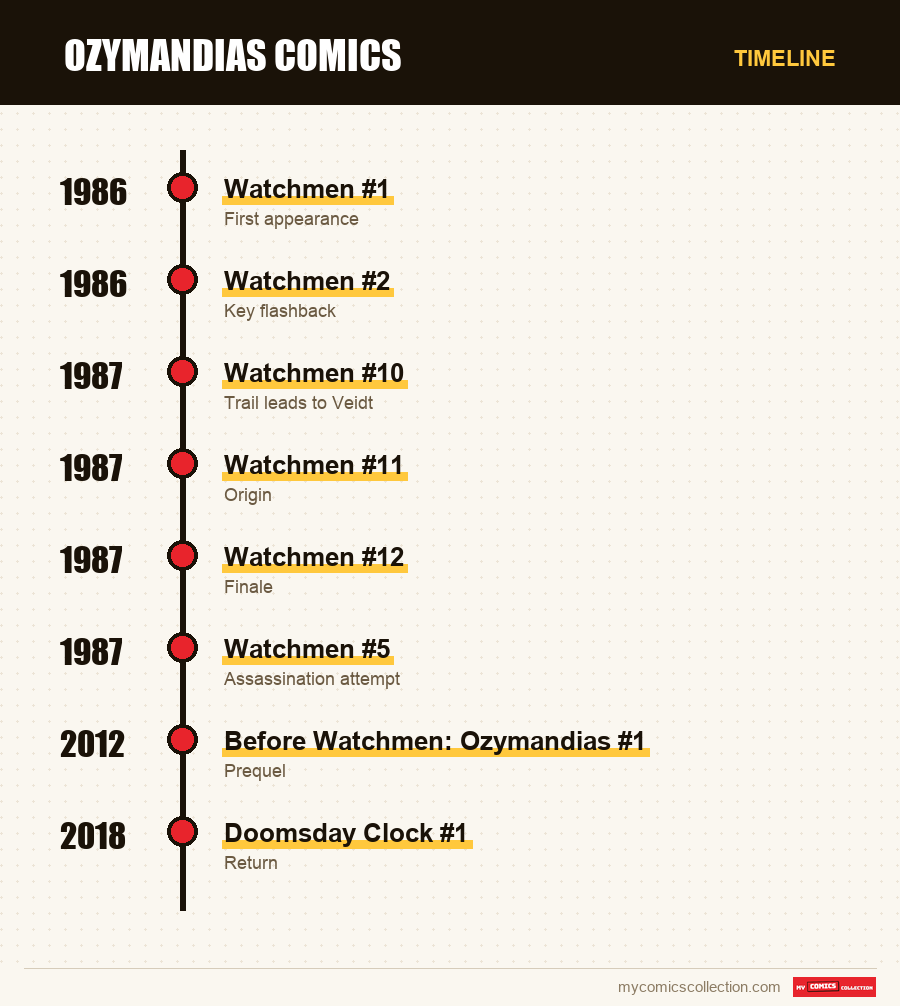
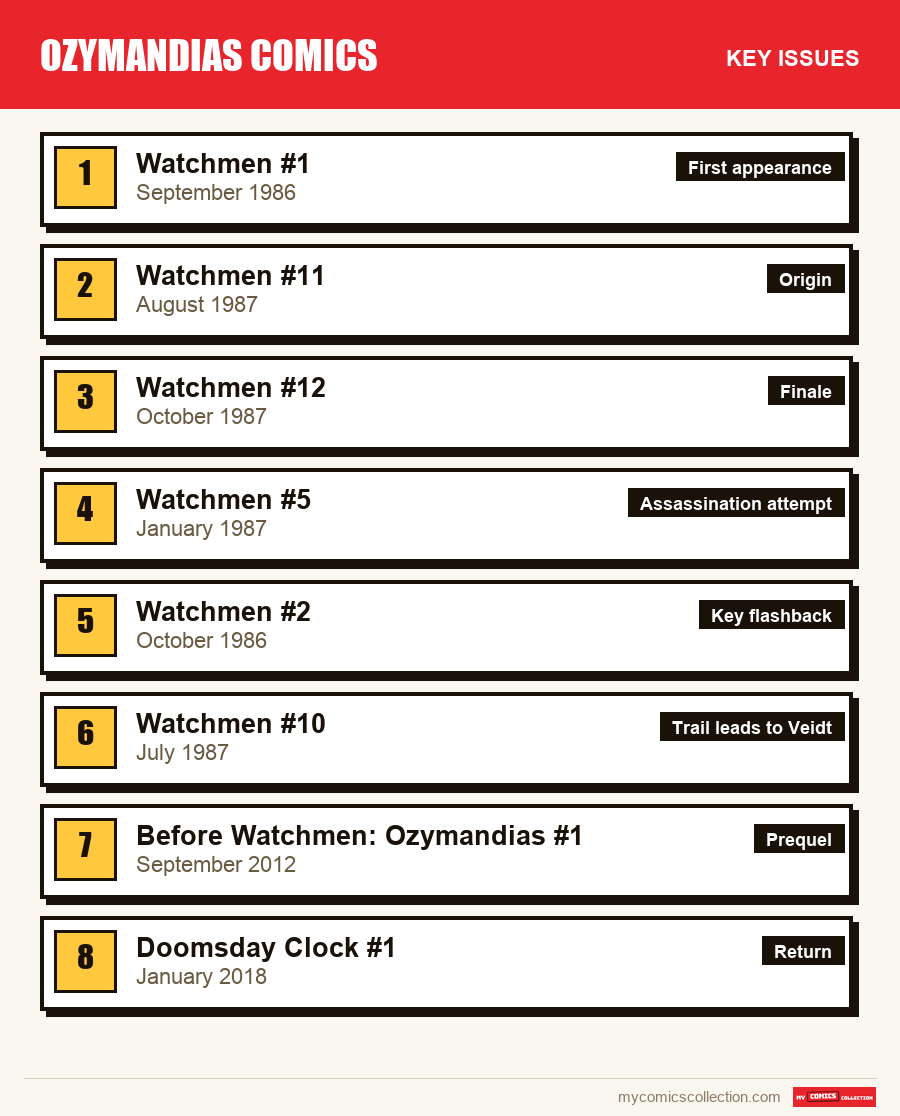
Watchmen #1
Alan Moore and Dave Gibbons introduce the whole Watchmen cast in this first issue, including Adrian Veidt, a former vigilante turned industrialist. Rorschach comes to warn him about the Comedian's murder: it is Ozymandias's first appearance.
Watchmen #11
"Look on My Works, Ye Mighty...": in his Antarctic retreat, Veidt recounts his youth, his journey in the footsteps of Alexander the Great and the birth of Ozymandias. He also tells Rorschach and Nite Owl that his plan has already been carried out.
Watchmen #12
New York is devastated by the fake alien threat devised by Veidt, and the superpowers unite against it. The heroes agree to keep quiet, except Rorschach: the issue seals the character's moral ambiguity.
Watchmen #5
"Fearful Symmetry": a gunman tries to shoot Adrian Veidt in the lobby of his tower and kills his secretary. Veidt subdues him, but the man bites a poison capsule: this apparent attack sends the whole investigation down a false trail.
Watchmen #2
At Edward Blake's funeral, Veidt recalls the first meeting of the Crimebusters in 1966, where the Comedian mocks his ambitions in the face of nuclear threat. This scene plants the seed of Ozymandias's plan.
Watchmen #10
Veidt withdraws to his Antarctic base while Rorschach and Nite Owl trace the gunman back to a company within his empire. The issue turns Ozymandias from victim into suspect.
Before Watchmen: Ozymandias #1
Len Wein, the original editor of Watchmen, and Jae Lee open a six-issue miniseries that develops Adrian Veidt's childhood and formative years. Each issue also carries a short backup story, "Crimson Corsair".
Doomsday Clock #1
Geoff Johns and Gary Frank pick up the story seven years after the events of Watchmen: Veidt's scheme has been exposed and he is on the run. Ozymandias resurfaces and becomes one of the driving forces of a story that crosses into the DC Universe.