
Dr. Manhattan (Jon Osterman) first appears in Watchmen #1, published by DC Comics in September 1986, written by Alan Moore and drawn by Dave Gibbons. He is the only character in the group to possess real superpowers, born from a laboratory accident in 1959 which transformed him into being capable of manipulating matter on a subatomic scale. Its collector's rating is based above all on Watchmen #1 in first printing, on derivative series like Before Watchmen: Dr. Manhattan (2012) and Doomsday Clock (2017-2019), as well as the attention revived by the Zack Snyder film (2009) and the HBO series (2019).
Few comic book characters have had as much impact on superhero comics as Dr. Manhattan. Neither a masked vigilante nor a simple strong man, he is the only inhabitant of the universe of Watchmen to possess powers beyond human understanding, making him both the most fascinating and disturbing element of Alan Moore and Dave Gibbons' tale. His blue silhouette, his progressive detachment from humanity and his non-linear perception of time made him a textbook case in the way of telling a superhero differently.
For collectors, Dr. Manhattan occupies a special place: it is inseparable from Watchmen, one of the rare comics to have lastingly changed the perception of the medium among the general public and literary critics. Understanding his editorial history, his key appearances and the series which extended his story allows us to better locate the issues that really matter when we seek to complete or evaluate a collection around the character.
This article retraces the genesis of the character at DC Comics, his role in the original mini-series, his subsequent editorial extensions, as well as the practical elements to know before purchasing an issue concerning him.
Watchmen (1986-1987): the editorial birth of Dr. Manhattan
Dr. Manhattan makes his very first appearance in Watchmen #1, whose cover is dated September 1986. The mini-series, published by DC Comics over twelve issues until October 1987, is by Alan Moore on the screenplay and Dave Gibbons on the drawing, with John Higgins on the colors. This inaugural issue simultaneously introduces Rorschach, the Comedian, Ozymandias, the second Nite Owl, the second Silk Specter, and Dr. Manhattan, before each chapter develops one of them in depth.
The origin of the project is less known than one might think: DC Comics had just purchased the Charlton Comics catalog (Captain Atom, Blue Beetle, The Question, Peacemaker, Nightshade...) and the initial intention was to entrust these characters to Alan Moore for a dark and definitive story. Editor Dick Giordano, however, deemed the project too destructive for characters that DC wanted to continue to exploit in shared continuity. Moore and Gibbons then created original analogues: Dr. Manhattan is thus the direct counterpart of Captain Atom, a physicist transformed into a super-powered being by an accident linked to the American army. This editorial choice allowed DC to maintain the total narrative freedom that the story required, while providing the DC universe with a new character, without any constraints of previous continuity.
Alan Moore, Dave Gibbons and John Higgins: a trio at the top of their game
By the mid-1980s, Alan Moore had already made a name for himself at DC with his work on Swamp Thing, while Dave Gibbons is renowned for his time on 2000 AD and Green Lantern . Their collaboration on Watchmen is based on a very strict formal structure, the famous grid of nine boxes per board, which serves as a visual spine for the entire story. John Higgins, dressing the whole thing in a deliberately dull and desaturated palette (apart from the luminous blue of Dr. Manhattan, precisely designed to contrast with the rest), fully participates in the visual identity of the series.
This formal care earned Watchmen a rare recognition for a comic book of the time: the series received a special Hugo Award in 1988 and was, the only comic book in the ranking, among the hundred best English-language novels according to Time magazine in 2005. This critical recognition largely explains why collector demand around issue 1 and the original editions remains so strong four decades later.
The Origin of Jon Osterman: From Trenton Watchmaker to Quantum God
The story of Dr. Manhattan is told in detail in Chapter IV of Watchmen, titled "Watchmaker", one of the most admired chapters of the series for its non-linear construction. Jon Osterman was born in 1929 into a Jewish-American family of German origin. His father, Josef Osterman, is a watchmaker and wants Jon to return to his profession. The bombing of Hiroshima in 1945 radically changed the family trajectory: judging watchmaking to have become obsolete in the face of the atomic age, the father pushed his son towards studies of nuclear physics. Jon obtained a doctorate in atomic physics at Princeton, then joined the Gila Flats research base in 1959, where experiments were carried out on the "intrinsic fields" of matter.
On August 20, 1959, Jon Osterman accidentally found himself trapped in the main chamber of a device called the "Intrinsic Field Subtractor" and literally disintegrated when the process could not be interrupted. During the months that followed, partial apparitions of his body manifested within the Gila Flats complex itself, until he managed to reconstitute himself entirely in a new form: a blue-skinned being capable of perceiving and manipulating matter at the subatomic level, of teleporting, of splitting himself and, gradually, of perceiving his own existence in a non-linear manner in time. The American government then renamed it "Doctor Manhattan", in direct reference to the Manhattan Project, in order to make it a strategic deterrent tool comparable to the atomic weapon itself, a choice of name loaded with meaning in the context of the Cold War which runs through the entire mini-series.
An extraordinary character: powers, philosophy and role in the story
What sets Dr. Manhattan apart from other "masked heroes" of Watchmen, it is precisely that it is not one in the classic sense. Most of the characters in the series are vigilantes without superpowers, operating in a world where vigilantism has come to be outlawed by the Keene Act. Dr. Manhattan is a true omnipotent being on a terrestrial scale: he can disintegrate an opponent with a gesture, multiply, grow to a colossal size or simultaneously observe several points on his own timeline. This asymmetry of power is at the heart of the political reflection of the story, since its mere existence is enough to modify the balance of forces of the Cold War in the universe of the series, by permanently tilting the military advantage to the American side.
The character also wears, very early in the series, a distinctive symbol affixed to his forehead: a black circle containing a stylized representation of a hydrogen atom, designed by the character of Ozymandias as a visual identifier of the "superman". His assumed frontal nudity throughout the mini-series also contributed to the notoriety and sometimes controversy surrounding the character: few mainstream comics of the time assumed such representation, which contributed to the status of Watchmen as a work intended for an adult readership, well before the generalization of “Mature Readers” labels at DC.
A fragmented narrative around a non-linear consciousness
Chapter IV, centered on Dr. Manhattan exiled to Mars after leaving Earth, remains a frequently cited reference in comics studies for its way of bringing together several eras of the character's life within the same sequence of panels, without a traditional flashback effect. This construction literally translates the way in which Dr. Manhattan experiences time: for him, past, present and future unfold simultaneously, which makes his choices, his emotional distances and his progressive detachment from humans much more understandable for the reader. It is also this chapter which permanently establishes the image of the character sitting on the edge of a Martian crater, which has become one of the most used illustrations in all of Gibbons' work.
After Watchmen: the editorial continuation of Dr. Manhattan at DC
Contrary to popular belief, the character's story does not end on the last page of issue 12 of 1987. DC Comics extended his journey on two major occasions, in very different editorial contexts.
Before Watchmen: Dr. Manhattan (2012)
In February 2012, DC announced seven prequel miniseries under the "Before Watchmen" label, covering Rorschach, the Minutemen, Dr. Manhattan, the Comedian, Silk Specter, Nite Owl and Ozymandias. The mini-series Before Watchmen: Dr. Manhattan, published from August 2012, has four issues written by J. Michael Straczynski and drawn by Adam Hughes. The story explores the multiple branches of reality that the character simultaneously perceives and enriches his family past, in particular by revealing European paternal origins linked to the flight from the Nazi regime. Alan Moore, fiercely opposed to the "Before Watchmen" project which he neither wrote nor approved, requested that his name be dissociated from all this production, a position he has consistently maintained with respect to all exploitations derived from his original work.
DC Rebirth and Doomsday Clock (2017-2019)
Dr. Manhattan's most significant return to the DC Universe comes with the "DC Rebirth" initiative launched in 2016. The one-shot DC Universe: Rebirth #1 suggests for the first time that Dr. Manhattan was involved in the continuity upheavals that led to the 2011 "New 52" reboot, a lead confirmed by the crossover event "The Button" (2017) bringing Batman and Flash together. This framework finds its culmination in Doomsday Clock, mini-series in twelve issues published between November 2017 and December 2019, written by Geoff Johns and drawn by Gary Frank with colors by Brad Anderson. This is the very first official crossover between the universe of Watchmen and the DC Shared Universe, with a central thematic clash between Superman and Dr. Manhattan, presented as mirror images of each other: an alien deeply attached to humanity versus a human who has become totally detached from it. The series was praised by critics, with an average of around 8.5/10 on the aggregator Comic Book Roundup following its publication.
Editions and prints to know for collectors
For anyone interested in Dr. Manhattan from a collection perspective, a few editorial references help avoid the frequent confusion between first printings, reissues and compilations.
Watchmen #1 (September 1986): the absolute key issue
Number 1 of the original mini-series remains, unsurprisingly, the reference number for any collection centered on Dr. Manhattan and all the characters of Watchmen. According to the population report published by CGC, approximately 631 copies of this issue were graded 9.8 in February 2025, making it the highest rating recorded to date for this issue; this figure has increased significantly over the years (309 copies in 9.8 recorded in 2018, 511 in February 2022), sign of a continuous influx of new copies subject to gradation as the cultural rating of the title has strengthened. The glossy paper used for the cover of this issue is known to be particularly sensitive to handling marks and "color breaks" on the edge, an important point of vigilance when evaluating a copy.
Reissues, multiple printings and compilations
Given the immediate success of the series from 1986-1987, several issues of Watchmen have undergone reprints over the decades, then integrated into compilations regularly reissued by DC (bound collection, then collector's editions such as the Absolute Edition in large format with supplements). These reissues, very accessible and widely distributed, do not have the same collector's value as the very first printings from 1986-1987, but remain the most common gateway to discovering the original work before becoming interested in the floppy issues themselves.
Another useful point to place a copy in its editorial context: the original mini-series appeared in twelve monthly issues between September 1986 and October 1987. For a complete set focused specifically on Dr. Manhattan, two chapters stand out for their narrative content: chapter IV ("Watchmaker"), entirely devoted to his origin and his transformation, and chapter IX, which takes place on Mars and features his decisive face-to-face with Laurie Juspeczyk (the second Silk Specter). These two issues are, with number 1, the most sought after by collectors who build their set around the character rather than around the series in its entirety.
Collecting this series?
Track what you own, what you are missing and what your collection is worth. 7 day trial.
Start my trial →The impact of adaptations on the rating
As with many comic book characters, audiovisual adaptations have regularly revived collectors' interest in the original issues featuring Dr. Manhattan.
The Zack Snyder Movie (2009)
The movie Watchmen, directed by Zack Snyder and released in 2009, adapts the entire original miniseries starring Billy Crudup as Jon Osterman / Dr. Manhattan. The character is entirely created in computer-generated images, based on a motion capture performance by the actor, a notable technical feat for the time which largely contributed to popularizing the character among an audience who had never read the original comic strip. The release of the film mechanically revived secondary market interest in original issues and first bound editions.
The HBO series (2019) and the return of Dr. Manhattan to the screen
Ten years later, the mini-series Watchmen produced by Damon Lindelof for HBO takes a radically different approach: rather than a new literal adaptation, it presents itself as a sequel taking place several decades after the events of the original comic, integrating the latter as an established fact of its own continuity. Dr. Manhattan is played by Yahya Abdul-Mateen II, under the disguised identity of Cal Abar, a performance which earned him a Primetime Emmy Award. This critically acclaimed reinterpretation has once again shone the spotlight on the character and, in turn, on the issues of the original mini-series as well as on Doomsday Clock, published almost in parallel with the broadcast of the series.
It should be noted that Alan Moore, long opposed to any derivative exploitation of his work, has systematically asked not to be credited or publicly associated with these adaptations, whether the 2009 film, the HBO series or the comic book extensions like Before Watchmen and Doomsday Clock. Only Dave Gibbons has, according to the projects, agreed to be associated with it.
Buying guide
- Systematically check whether it is a first printing of Watchmen #1 (1986) or a later reprint: the clues appearing on the inside cover (printing details, printer's code) make it possible to decide, the simple cover date "September 1986" not being sufficient in itself to guarantee a first printing.
- Carefully inspect the spine and corners of issue 1: the glossy paper of this cover is particularly prone to "color breaks" (color bursts on the folds), a frequent defect which directly impacts the gradation rating.
- Consult the CGC population report before purchasing an already graded copy, in order to situate the real rarity of the grade displayed in relation to all the copies submitted to date.
- For derived series (Before Watchmen: Dr. Manhattan , Doomsday Clock), favor the first issues of each mini-series, generally the most sought after, while keeping in mind that these are much more recent prints and therefore naturally more abundant than those of 1986-1987.
- Do not confuse current editions (standard hardcover collection, regular reprints from DC) with collector's editions like the Absolute Edition: the latter have a use and reading value, but do not replace a period floppy for a collector specifically looking for a key issue.
- Before making any significant purchase, compare several recent sales actually concluded rather than a single displayed price, as the differences can be significant depending on the precise condition and authenticity of the print.
- To organize and track the numbers in your collection as you acquire them, the collection management application allows you to easily list each copy, its condition and its origin.
Key issues to know
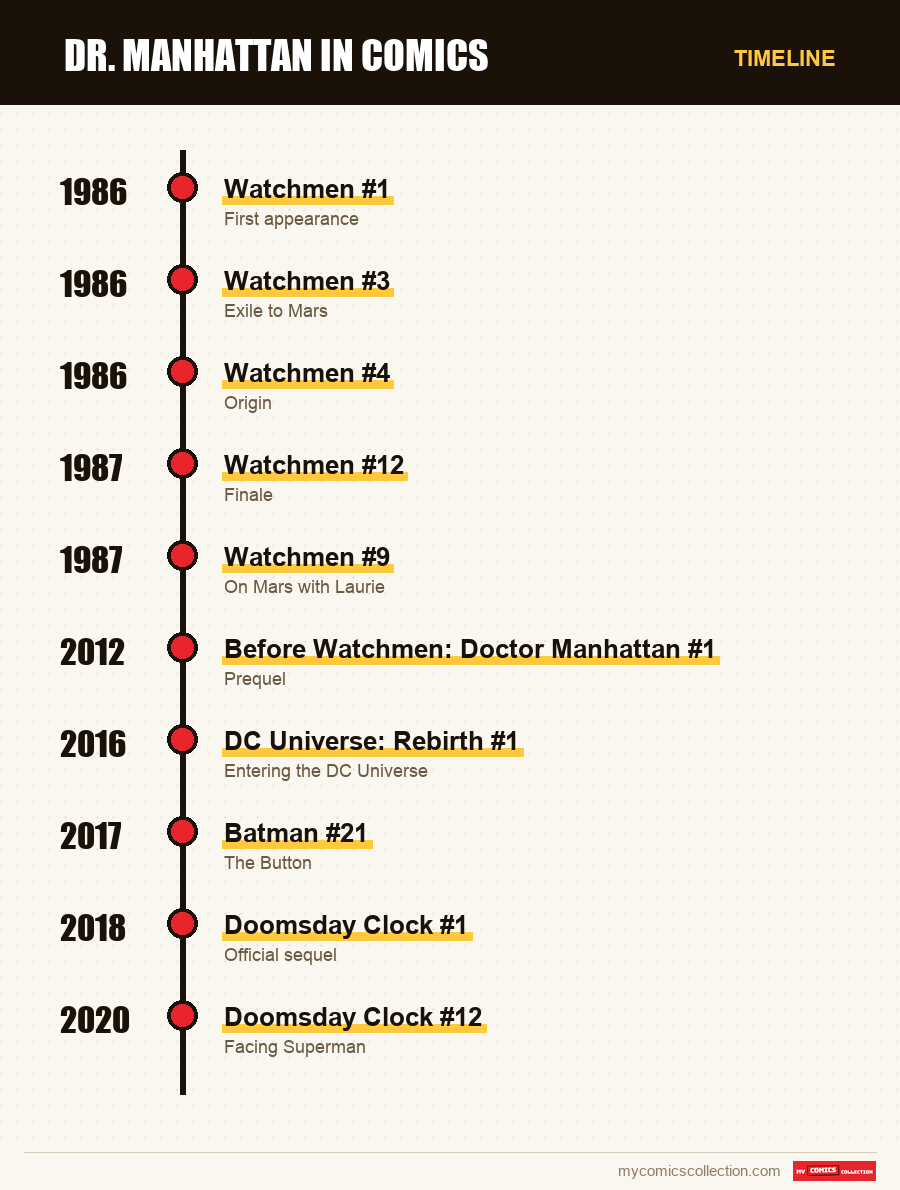
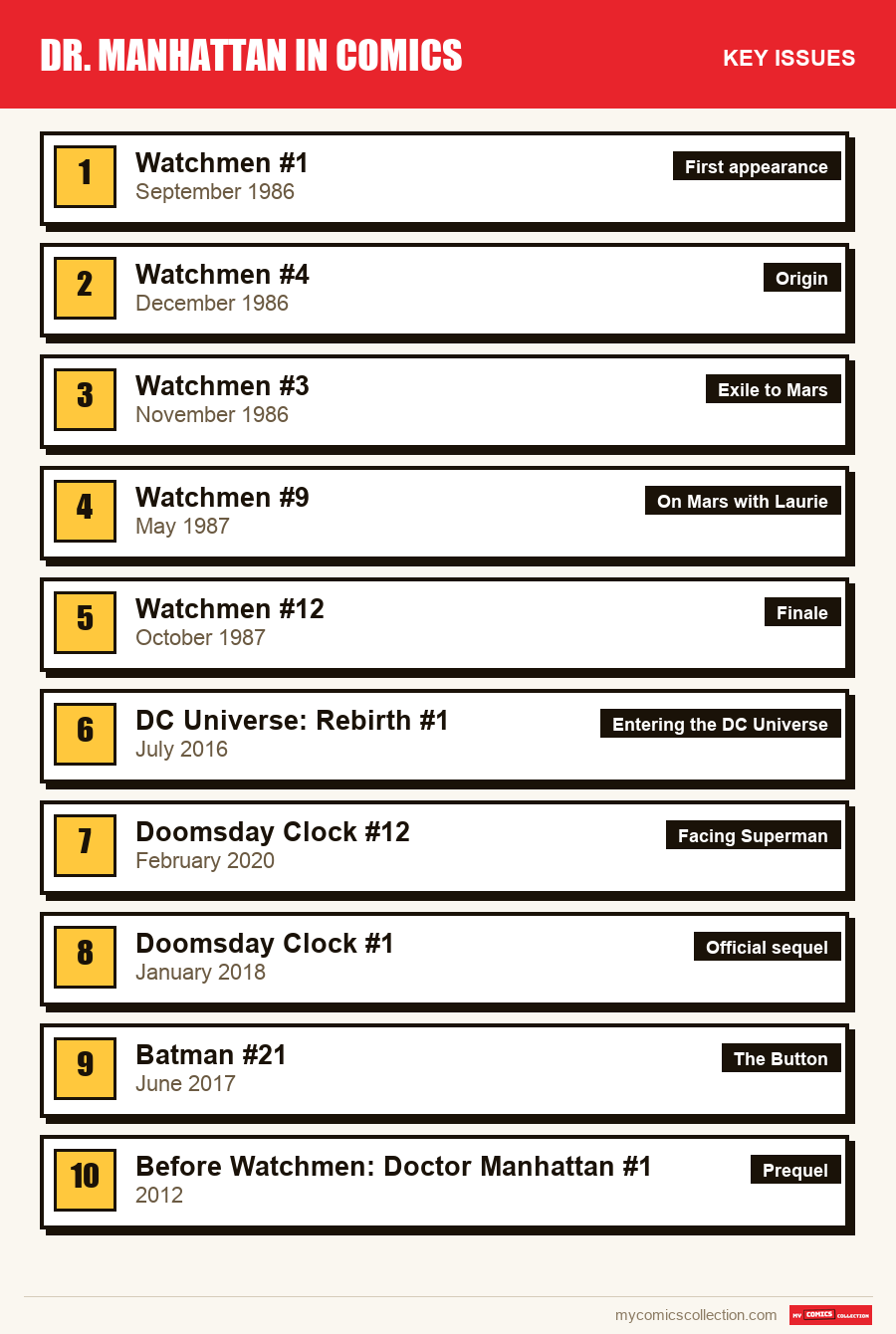
Watchmen #1
Alan Moore and Dave Gibbons open Watchmen with the Comedian's murder and introduce the whole cast, including Doctor Manhattan, the only character in the series with real superpowers, then in a relationship with Laurie Juspeczyk.
Watchmen #4
Watchmaker tells Jon Osterman's life out of order, from Mars: a watchmaker's son turned physicist, disintegrated in 1959 in the intrinsic field chamber at Gila Flats, then reassembled as a blue being the government names Doctor Manhattan.
Watchmen #3
During a TV interview, Doctor Manhattan is accused of giving cancer to people close to him, including his former partner Janey Slater. Shaken, he leaves Earth for Mars, upsetting the Cold War balance in the story.
Watchmen #9
Laurie Juspeczyk joins Doctor Manhattan on Mars to convince him to save humanity. Reliving her memories, she discovers that the Comedian is her father, and Manhattan, moved by what he calls a thermodynamic miracle, agrees to return.
Watchmen #12
After Ozymandias' plan, Doctor Manhattan disintegrates Rorschach, who refuses to keep the secret. He then leaves our galaxy, hinting to Veidt that he might create life there.
DC Universe: Rebirth #1
Geoff Johns hints for the first time that Doctor Manhattan has altered the history of the DC Universe. Batman finds the Comedian's badge and the epilogue on Mars features Manhattan's voice.
Doomsday Clock #12
Geoff Johns and Gary Frank's final issue: Doctor Manhattan finally meets Superman and chooses to give back to the DC Universe the Justice Society and the Legion of Super-Heroes he had erased. The character dies after this act.
Doomsday Clock #1
Seven years after Watchmen, a sick Ozymandias on the run sets out to find Doctor Manhattan, the only one he believes can save the world. Geoff Johns and Gary Frank thus launch the twelve-issue maxi-series that brings the character into the DC Universe.
Batman #21
Tom King and Jason Fabok open The Button crossover with the Flash, investigating the Comedian's badge. Doctor Manhattan acts behind the scenes, setting up Doomsday Clock.
Before Watchmen: Doctor Manhattan #1
J. Michael Straczynski and Adam Hughes devote a four-issue mini-series to Jon Osterman, exploring the multiple realities he perceives. It is one of the Before Watchmen prequels published without Alan Moore's approval.