Rorschach is created by screenwriter Alan Moore and artist Dave Gibbons for DC Comics: he appears for the first time in Watchmen #1, on newsstands May 13, 1986 (cover date September 1986). The character, inspired by The Question and Mr. A by Steve Ditko, was then entitled to two extensions in comics: the mini-series Before Watchmen: Rorschach (2012, Azzarello/Bermejo) and the maxi-story Rorschach (2020-2021, Tom King/Jorge Fornés) at DC Black Label. On the collectible market, Watchmen #1 remains a modern title widely available in high grade: the CGC census counted 631 copies in 9.8 (none higher) at the start of 2025, and the Overstreet 2024 guide values an NM-9.2 copy at $95.
Few comic book characters have had as much impact on the collective imagination as a vigilante whose face is covered in a white latex mask, with black ink stains permanently sliding across it. Rorschach is not, however, a hero in the classic sense: he is an unlicensed vigilante, morally absolute, physically abused, whom his own camp views with suspicion. Its creation responds to a specific editorial project, that of Watchmen, the DC Comics maxi-series that redefined what the medium could tell about power, surveillance, and the failure of the Masked Superman.
Understanding Rorschach means understanding why Watchmen occupies a special place in American publishing history: a story conceived as a closed work in twelve issues, with no intention of a sequel, which nevertheless generated prequels, an independent mini-series, a film and a television series almost forty years later. This article traces the complete editorial history of the character, from the origins at DC Comics to the most recent publications, drawing on available circulation, rating and census data.
Editorial origins: Rorschach, the black conscience of Watchmen
Rorschach is born from a very supervised project. In 1985, DC Comics entrusted Alan Moore and Dave Gibbons with a twelve-issue maxi-series initially designed to recycle characters purchased from Charlton Comics: the Question, Captain Atom, Blue Beetle, Peacemaker, Nightshade and Thunderbolt. The publisher ultimately gave up using these existing figures, judging Moore's scenario too radical for characters intended to reappear elsewhere in the DC universe, and requested the creation of an entirely original cast. Every hero of Watchmen thus becomes a transformed analogue of a Charlton character: Rorschach is directly built on Steve Ditko's Question, with reinforcement from a second influence assumed by Moore, that of Mr. A, another Ditko character known for his binary and intransigent morality.
Watchmen #1 hit newsstands on May 13, 1986, with a cover date of September 1986: common editorial practice at the time to extend shelf life. The series spread over twelve monthly issues until October 1987. Rorschach plays a central role: it is through his diary, read in voice-over from the first page, that the reader enters the plot of the Comedian's assassination, the starting point of the entire story. The commercial success was immediate and went beyond the usual framework of comic books: sales of Watchmen contributed, during the time of its publication, to causing DC Comics to occasionally overtake its rival Marvel on the direct market, a rare event in the 1980s.
Who is Rorschach? From Walter Kovacs to the uncompromising vigilante
Under the mask, Rorschach is Walter Joseph Kovacs, son of a New York prostitute and a father never identified in the story. His violent childhood, his passage through a social home then through a job as a ladies' tailor are all elements that Moore distills in flashbacks throughout the series rather than in a classic origin story in one issue. The costume itself was born from a workplace accident: Kovacs made a dress for a client, Kitty Genovese: a direct reference to the real news story of 1964 where a New York woman was attacked without any witnesses intervening, a founding event of Rorschach's ethics of collective indifference. The fabric ordered, a thermosensitive latex that reacts to body heat in changing ink designs, is refused by the customer; Kovacs recovers it and makes it his mask.
A morality without gray area
What sets Rorschach apart from other masks Watchmen, it is the total absence of moral compromise. Where Ozymandias justifies a mass massacre through utilitarian calculation, where Doctor Manhattan gradually detaches himself from all human empathy, Rorschach remains faithful until the end to a binary reading grid: good and evil exist, without nuance, and no end justifies making a pact with the second. This intransigence, which pushes him to refuse any complicit silence in the face of the truth, even if it means dying for it in the last pages of the series, has made him a case study regularly cited in analyzes of the comic on the question of the fascist superman, the vigilante beyond the laws, and the reliability of the narrator.
An antihero at the heart of the “grim and gritty” turn
The release of Watchmen in 1986 coincides, almost issue for issue, with that of another pivotal work of the same year at DC Comics: Batman: The Dark Knight Returns by Frank Miller. Critics and historians of the medium regularly combine these two publications to designate the shift in American superhero comics towards a darker, more adult tone, commonly described as "grim and gritty". Rorschach, with his total absence of humor, his assumed violence towards criminals and his rejection of any police or judicial authority, became one of the most cited examples of this turning point, alongside the aging and brutal Batman imagined by Miller the same year. This editorial proximity partly explains why the two works are so often taught and compared together in studies devoted to the evolution of the superheroic genre.
The nine-box grid: the graphic signature of Dave Gibbons
It is impossible to tell the editorial history of Rorschach without mentioning the work of Dave Gibbons, a British designer who built with Alan Moore a visual structure that has become a reference in the medium: the regular grid of nine boxes per page, rigorously respected over most of the twelve issues. This formal constraint, far from impoverishing the narration, forces a clockwork precision in the cutting: each box counts, each page split responds to a visual echo elsewhere in the story. The sequences linked to Rorschach's diary, where the handwritten text is superimposed on nocturnal urban scenes tinted with yellow and blood red, are among the most cited pages in all contemporary American comics, notably for their use of color, provided by John Higgins, as a narrative vector in its own right.
The ink stain mask: anatomy of a cult object
The Rorschach mask owes its name to the projective test by Swiss psychiatrist Hermann Rorschach, invented in 1921, which consists of having a patient interpret symmetrical ink spots. In fiction, the fabric of the mask constantly changes pattern in contact with body heat, without ever repeating itself identically: a principle that Dave Gibbons materialized panel after panel by drawing dozens of different configurations by hand rather than reusing a fixed pattern. This conception has a metaphorical significance assumed by Moore: the mask becomes a mirror onto which each character, and each reader, projects their own moral reading of the vigilante, like the psychological test from which it takes its name. It has also become one of the most recognizable accessories and the most reproduced in goodies, cosplay and derivative products in the entire DC catalog, well beyond the original readership of the comic book.
Rorschach after Watchmen: prequels and sequels in comics
Although Watchmen was conceived by Alan Moore as a closed story, with no intention of following it up, DC Comics exploited the character twice in distinct editorial formats, each with a different creative team and narrative positioning.
Before Watchmen: Rorschach (2012)
In February 2012, DC Comics announced Before Watchmen, an event composed of seven prequel mini-series covering each of the main characters of the original work, with a host of writers and artists including J. Michael Straczynski, Darwyn Cooke, Len Wein, J.G. Jones, Adam Hughes, Andy Kubert, Joe Kubert and Amanda Conner. The section devoted to Rorschach, written by Brian Azzarello and entirely drawn and inked by Lee Bermejo, has four issues. The story takes place in New York in 1977 and follows Kovacs battling an underworld kingpin controlling drugs and prostitution in a still sordid Times Square, before the neighborhood was cleaned up. The series was praised for Bermejo's graphic work, capable of restoring the grimy and grainy atmosphere of 1970s New York with a photorealistic rendering very far from Gibbons' clinical grid: an aesthetic choice which underlines, by contrast, to what extent the visual style imprints the reading of the same character.
Rorschach (2020-2021), the rereading of Tom King and Jorge Fornés
Eight years later, DC entrusted Tom King (screenplay) and Jorge Fornés (drawing), accompanied by colorist Dave Stewart and letterer Clayton Cowles, with a maxi-story of twelve issues under the DC Black Label label, an editorial range reserved for an adult readership (17 years and over). Published from October 2020 until its final issue in September 2021, this series does not tell a prequel but an indirect sequel: it takes place thirty-five years after the disappearance of Rorschach and follows a detective investigating a political assassination attempt whose ramifications refer to the violent legacy left by the masked vigilante. A notable editorial feature, this Rorschach of 2020 is one of only two comics, with Doomsday Clock, to claim direct continuity with Moore and Gibbons' original work, and the only one to also share continuity with the HBO television series broadcast the previous year.
Watchmen, an extraordinary critical success which established Rorschach
The critical recognition of Watchmen goes far beyond the scope of comics fandom and largely explains the editorial longevity of Rorschach. The series received the Hugo Award in 1988, the most prestigious science fiction and fantasy award, in the “Other Forms” category: an extremely rare distinction for a comic book. In 2005, Time magazine included it in its list of the hundred best English-language novels published since 1923, the only comic book work to appear there alongside novels by Fitzgerald, Nabokov or Orwell. This double recognition, literary and popular, has built around the character of Rorschach an iconic status which goes far beyond that of a simple recurring comic book hero: he has become, over time, a reference cited in debates on the morality of the masked vigilante, both in comics culture and in cinematographic and academic culture.
Collecting this series?
Track what you own, what you are missing and what your collection is worth. 7 day trial.
Start my trial →The impact of adaptations on the rating
Two major adaptations have directly influenced collector demand around Watchmen and Rorschach: Zack Snyder's 2009 film and the 2019 HBO television series.
The feature film Watchmen, released in 2009 and directed by Zack Snyder, entrusts the role of Walter Kovacs / Rorschach to actor Jackie Earle Haley. The casting anecdote remained famous among fans: Haley, who had a black belt in kenpō, got the role after filming himself, in the living room and kitchen of his house, an amateur audition tape wearing an improvised Rorschach costume for Halloween: tape sent directly to Snyder, who validated it. This adaptation introduced the character to a much wider audience than that of the original comic, leading to renewed interest in bookstore reissues of the collection. Watchmen.
Ten years later, the series Watchmen broadcast on HBO in 2019 caused a second peak of interest, even more marked on a commercial level. Buoyed by criticism and the news of its announcement, the comic strip Watchmen once again became the best-selling graphic novel of the year in the United States in 2019, surpassing much more recent releases: an effect directly attributed by industry observers (Comichron) to the broadcast of the series. The original art market also reacted: in February 2019, at the very time of the announcement of the HBO project, the original cover designed by Dave Gibbons for Watchmen #1 sold for $228,000 at auction, compared to $155,350 when it was acquired by the same seller in 2013: an increase in value which, however, concerns a unique piece of original art, and not a printed copy of the comic book.
On the printed comic market itself, however, the effect of the adaptations remains to be qualified for the investor. Watchmen #1 is a title from 1986, a period when circulations remained high compared to the post-crash comics of the 1990s, and the CGC census attests to this: 631 copies were graded 9.8 (the maximum grade reached on this issue, no 10.0 recorded) at the time of the February 2025 survey, a volume which reflects an abundant supply of very high grade. The Overstreet 2024 guide accordingly values a copy of NM-9.2 at $95: a reader-collector rating rather than investment rarities, consistent with a comic print run that was already popular upon release. The two more recent series, Before Watchmen: Rorschach (2012) and Rorschach (2020-2021), are modern productions printed in standard quantities for the current direct market, available without difficulty in almost any condition from specialist resellers, with no print rarity identified to date.
Buying guide: collect Rorschach with confidence
Before purchasing a Rorschach-related copy, whether it is the Watchmen #1 original or an issue of the derived series, a few concrete checks allow you to avoid unpleasant surprises and buy at the right price.
- Distinguish between drawing and re-drawing on Watchmen #1: the original 1986 issue has undergone several subsequent reprints (including a “New Printing” identifiable by the mention on the back or on the title page); systematically check the printing notice before purchasing a copy advertised as “first printing”.
- Check the status of the yellow/white pages: on a 1986 comic, the oxidation of the paper (cream to yellow pages rather than white) greatly varies the rating apart from graded copies; Always ask for photos of the interior pages, not just the cover.
- Locate the exact CGC grade rather than the general mention: on a print run as abundant in 9.8 as Watchmen #1, the value gap between a 9.6 and a 9.8 may be disproportionate to the actual rarity gap; Always compare several recent completed sales before bidding.
- Do not confuse variant cover and standard edition on modern series ( Rorschach 2020, Before Watchmen: Rorschach): signed or limited edition variant covers trade at very different premiums from the classic newsstand edition: the title of the ad must specify the variant artist, not just the number.
- Favor complete runs for mini-series : Before Watchmen: Rorschach (4 numbers) and Rorschach 2020 (12 issues) read like complete stories; a mismatched lot loses a lot of its reading and resale value compared to a complete series in homogeneous condition.
- Log your collection as you purchase it: precisely track the numbers, editions and states already in your possession via the collection management application avoids duplicate purchases on a series as often reissued as Watchmen.
Key issues to know
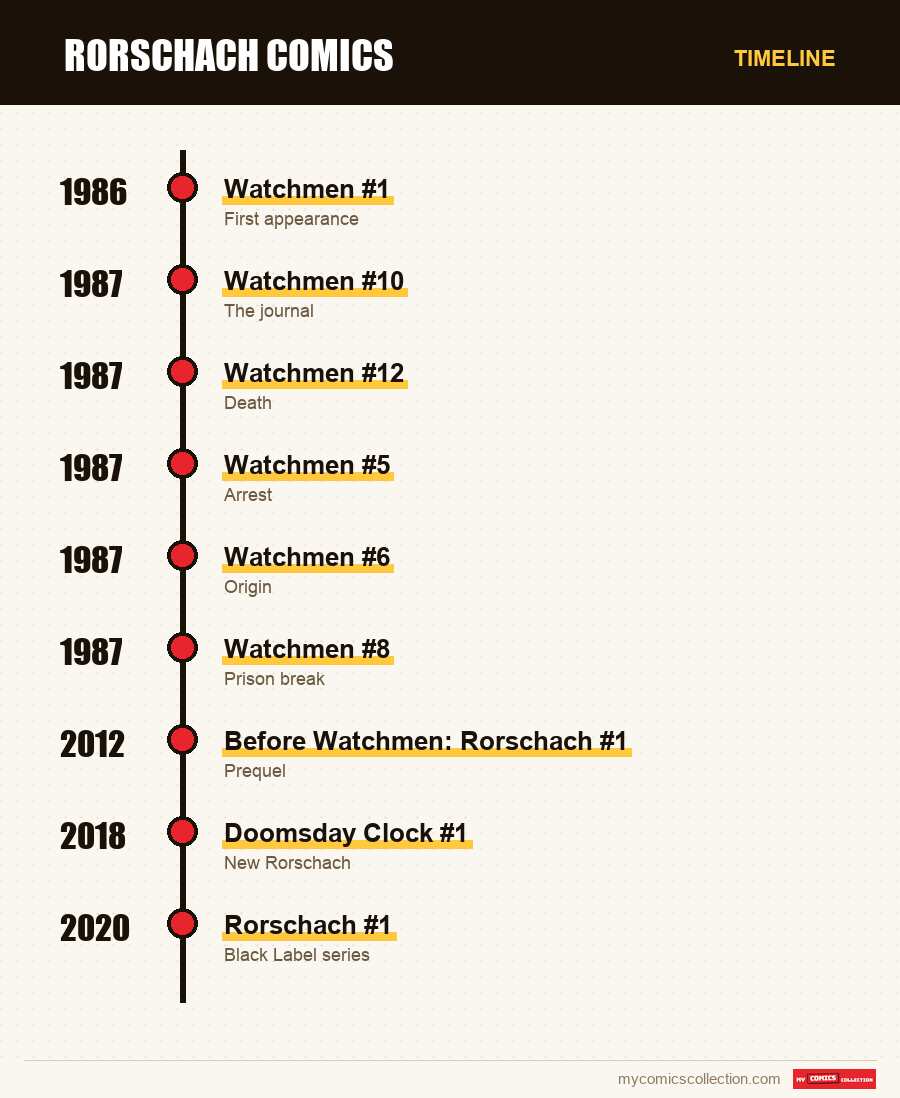
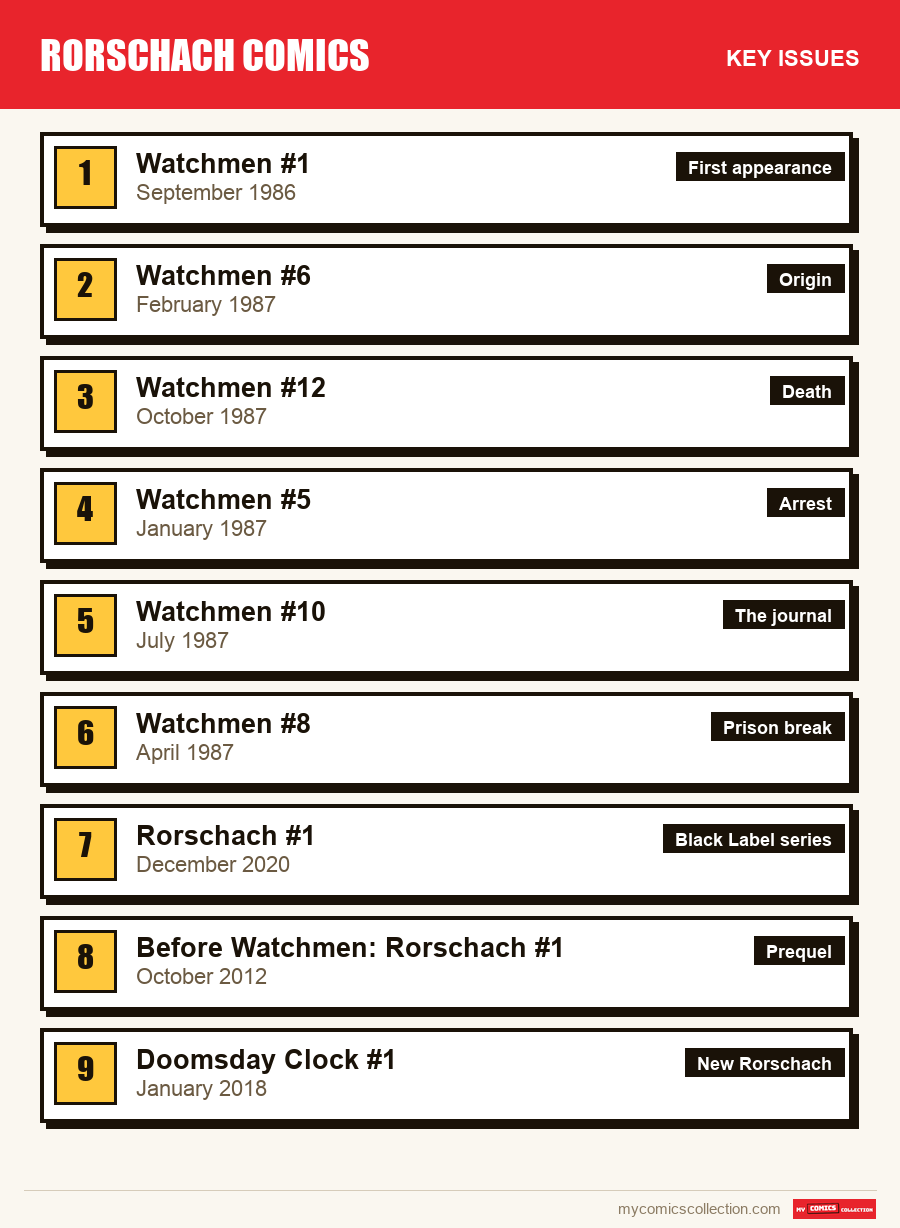
Watchmen #1
Alan Moore and Dave Gibbons open their twelve-issue maxi-series with Rorschach's journal as he investigates the murder of Edward Blake, the Comedian. It is the character's first appearance and the reference issue of the whole saga.
Watchmen #6
"The Abyss Gazes Also": in prison, Walter Kovacs opens up to psychologist Malcolm Long. The issue reveals his childhood, the origin of his mask cut from a fabric a customer turned down, and the case that turned Kovacs into Rorschach.
Watchmen #12
In the final issue, Rorschach refuses to keep quiet about Adrian Veidt's scheme and removes his mask before Doctor Manhattan disintegrates him. The last scene leaves his journal on top of a pile of submissions at the New Frontiersman.
Watchmen #5
"Fearful Symmetry": Rorschach walks into a trap at Moloch's home and is surrounded by the police. Arrested and unmasked, he turns out to be the sign-carrying doomsayer seen since the start of the series.
Watchmen #10
Before setting off to confront Adrian Veidt, Rorschach writes a last entry detailing Veidt's role, then mails his journal to the New Frontiersman newspaper. This act sets up the series' open ending.
Watchmen #8
"Old Ghosts": during a prison riot, Nite Owl and Silk Spectre break Rorschach out. The escape revives the investigation into the plot targeting the former masked heroes.
Rorschach #1
Tom King and Jorge Fornés open a twelve-issue series under the DC Black Label imprint: a man dressed as Rorschach attempts to assassinate a presidential candidate. A detective investigates the legacy left by the vigilante.
Before Watchmen: Rorschach #1
Brian Azzarello writes and Lee Bermejo draws a four-issue miniseries set in the seedy New York of 1977. It is the character's first return to comics since the original series.
Doomsday Clock #1
Geoff Johns and Gary Frank extend the Watchmen universe seven years after the events of the original series. A new Rorschach, Reggie Long, makes his first appearance and takes up the mask and the journal.