
Watchmen is arguably the most influential miniseries in American comic history. Published between 1986 and 1987 by DC Comics , written by Alan Moore and drawn by Dave Gibbons, the 12-issue series revolutionized the medium by proposing a realistic, psychologically complex and politically engaged vision of superheroes.
Watchmen is arguably the most influential miniseries in American comic history. Published between 1986 and 1987 by DC Comics , written by Alan Moore and drawn by Dave Gibbons, the 12-issue series revolutionized the medium by proposing a realistic, psychologically complex and politically engaged vision of superheroes. At the time of its Cold War-era publication, Watchmen broke all established codes: morally ambiguous characters, sophisticated nonlinear narrative, innovative layout using Dave Gibbons's signature 9-panel grid, and a shocking conclusion that still divides readers decades later.
For collectors, Watchmen has a unique peculiarity: it's a closed 12-issue miniseries. No infinite run to complete, no hundreds of issues to track. This paradoxically makes it one of the most accessible and coherent collections on the market. This guide lists the 10 essential Watchmen items, from original issues to deluxe editions, with their context and current value.
Watchmen: a 12-issue miniseries: why the whole collection is a key issue
Unlike franchises like Spider-Man or the X-Men with hundreds of issues of which only a few are considered "key", Watchmen is an exception: each issue is part of an indivisible whole, with a narrative conceived as a graphic novel from its inception. Alan Moore designed the series with an overall structure, each issue having its own theme and tone, contributing to the global narrative architecture.
- Watchmen #1-12 (1986-1987): the complete miniseries, published monthly
- Watchmen TPB (1987): first DC trade paperback, one of the first publications to bring comics into bookstores
- Absolute Watchmen (2005): large-format reference edition with restored colors
- Doomsday Clock (2017-2019): official sequel by Geoff Johns / Gary Frank
- Before Watchmen (2012): controversial prequels published without Alan Moore's consent
To organize your Watchmen collection, from original issues to special editions, the Collection tracking feature in My Comics Collection lets you catalogue each item with its condition and estimated value.
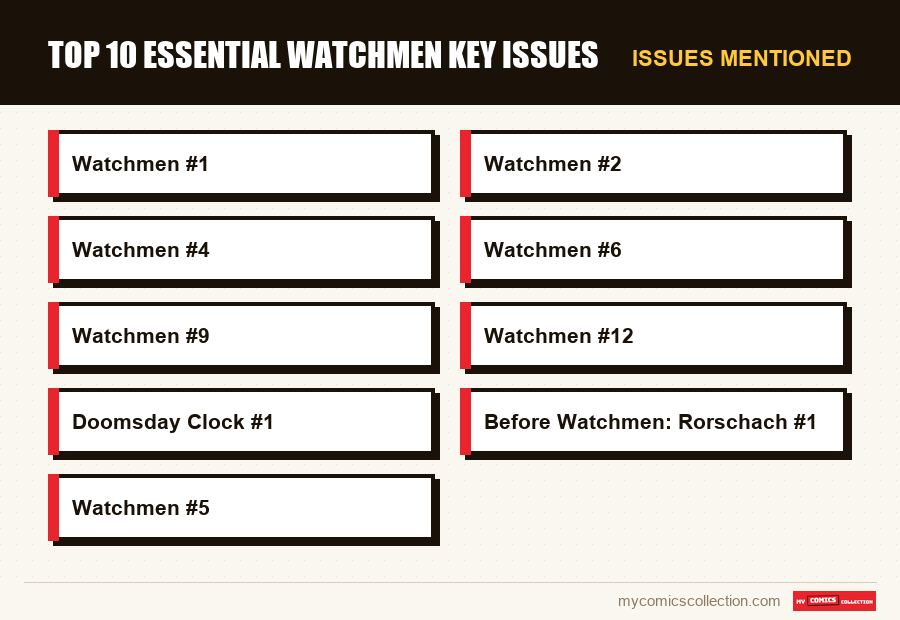
Top 10 Watchmen key issues and collectibles
Here are the ten absolutely essential items for any Watchmen collector.
Watchmen #1
Watchmen #1 is the series' founding issue, opening with Rorschach / Walter Kovacs inspecting the crime scene of The Comedian / Edward Blake. This first issue simultaneously introduces the entire cast: Dr Manhattan / Jon Osterman , Nite Owl / Dan Dreiberg , Silk Spectre / Laurie Jupiter and Ozymandias / Adrian Veidt. Its iconic cover, the blood puddle forming a smiley on the asphalt, is one of the most recognizable images in comic history. As the first issue of a revolutionary series unanimously praised as one of the best of all time, this issue is the absolute grail for any Watchmen collector.
Watchmen #2
Watchmen #2, titled "The Comedian", centers on Edward Blake's funeral and presents in flashbacks the character's moral complexity. It's in this issue that the phrase engraved on the prison wall that became emblematic first appears: "Who Watches the Watchmen?", adaptation of Juvenal's Latin formula Quis custodiet ipsos custodes. The issue also explores the links between The Comedian and Moloch, and deepens the relationship of each Watchmen member with their most troubled former teammate. An essential issue for understanding the series' moral structure.
Watchmen #4
Watchmen #4, "Watchmaker", is universally considered one of the most brilliantly constructed comic issues in medium history. Entirely dedicated to Dr Manhattan / Jon Osterman, it tells his origin, the accident that disintegrated and then reconstituted the physicist into a near-omniscient being, through a masterful nonlinear narrative that reflects the character's temporal perception. Dave Gibbons's layout reaches a peak of sophistication here, with parallel sequences and unique narrative time usage. This issue alone is often cited as a perfect example of what the comic medium can accomplish that no other support could.
Watchmen #6
Watchmen #6, "The Abyss Gazes Also", is the most in-depth psychological exploration of Rorschach, narrated from the prison cell where psychiatrist Dr Malcolm Long tries to understand Walter Kovacs's psyche. The revelations about Rorschach's traumatic childhood and the triggering event that forged his absolute moral code constitute one of the darkest and most fascinating psychological portraits in comics. The title references the famous Nietzsche quote: "When you gaze long into the abyss, the abyss gazes also into you." A fundamental issue for understanding the series' most complex character.
Watchmen #9
Watchmen #9, "The Darkness of Mere Being", takes place entirely on Mars , where Dr Manhattan confronts Laurie Jupiter / Silk Spectre about why humanity deserves to be saved. The central revelation of this issue, the truth about Laurie's paternity, is one of the most emotionally powerful moments in the entire series, retrospectively changing the reading of many earlier scenes. Dr Manhattan's construction of the Martian crystal palace offers some of the most visually spectacular pages by Dave Gibbons. A pivotal issue in the series' emotional arc.
Watchmen #12
Watchmen #12, "A Stronger Loving World", is the miniseries conclusion and one of the most discussed endings in comic history. The revelation of Ozymandias's plan, each character's reaction, Rorschach's death, and the final image leaving the question open: all combine to make this issue an unforgettable reading experience. The cover, which closes the bloodied smiley from the first issue in a radically different context, visually bookends the entire series with rare elegance. The last issue of a founding miniseries is always sought-after by collectors.
Watchmen TPB 1st edition
The first Watchmen trade paperback published by DC in 1987 is a historic object in its own right. It's among the first publications to have democratized comics in general bookstores, alongside The Dark Knight Returns by Frank Miller. This original edition is distinguished by its ISBN, printed cover price and certain specific print details. Savvy collectors differentiate first printings from later reprints. A top-condition copy of the 1st edition (1987) can reach $100 to $200, or more for sealed copies.
Absolute Watchmen
The Absolute Watchmen (2005) is the bible of any serious collector of the series. This large format offers restored pages and entirely reworked colors under the supervision of John Higgins, the original colorist, this time with high-resolution digital coloring that reveals details invisible in standard editions. The edition also includes supplementary material: scripts, preparatory sketches and correspondence between Moore and Gibbons. New or sealed, it's the ultimate edition to appreciate Dave Gibbons's graphic work in all its splendor.
Doomsday Clock #1
Doomsday Clock #1 (2017) launches the official Watchmen sequel, written by Geoff Johns and drawn by Gary Frank in a style deliberately close to Dave Gibbons's. The 12-issue series picks up directly where Watchmen (1987) ended and integrates Dr Manhattan and Rorschach II into the main DC universe, alongside Superman. Published between 2017 and 2019, the series generated very polarized reactions: adulated for its ambition and graphic quality, criticized for touching a work considered untouchable. First issue of a highly anticipated sequel, Doomsday Clock #1 is the most accessible key issue of this legacy.
Before Watchmen: Rorschach #1
Before Watchmen: Rorschach #1 is the first issue of the 4-part miniseries dedicated to Rorschach within the Before Watchmen project (2012), a series of prequels published by DC without Alan Moore's consent, who vigorously opposed them. Among the many Before Watchmen series (Comedian, Minutemen, Nite Owl, Silk Spectre, Dr Manhattan, Ozymandias…), it's the Rorschach written by J.M. DeMatteis and drawn by Lee Bermejo that enjoys the best critical reputation and the highest market value. Bermejo's art, with its dark and precise realism, is particularly acclaimed.
Collecting this series?
Track what you own, what you are missing and what your collection is worth. 7 day trial.
Start my trial →The three acts of Watchmen
The Watchmen miniseries is naturally structured in three acts, each with its own tone and progressive revelations:
Act 1: Setup (#1-4)
Introduction of characters and the Cold War context. Rorschach's investigation into The Comedian's death. Establishment of geopolitical stakes and nuclear threat. The masterful origin of Dr Manhattan in issue #4.
Act 2: Backstories and secrets (#5-8)
In-depth exploration of each character through thematic issues. Rorschach's psychology (#6), Nite Owl's history (#7), the Silk Spectre / Dr Manhattan relationship. The narrative threads tighten around a global conspiracy.
Act 3: Denouement and revelation (#9-12)
The final revelations unfold: the confrontation on Mars, Laurie's origins, the truth about Ozymandias's plan. The shocking conclusion of issue #12 and its moral implications, leaving the reader to judge the titan's ultimate act.
The prose texts: an additional reading level
Each Watchmen issue ends with a fictional prose text (police report, article, biography…) that enriches the worldbuilding. These "back-matters" are a unique feature of the series and contribute to making it a total, multi-layered work.
To organize your reading and collection of the 12 Watchmen issues and related publications, use the Story Arcs feature in My Comics Collection, ideal for tracking complete miniseries.
Manage your Watchmen collection with My Comics Collection
Collecting Watchmen in its various editions is both simple (only 12 base issues) and potentially very rich: original 1st printing issues, different TPB editions, Absolute Edition, international editions, Before Watchmen (8 series), Doomsday Clock… Collection possibilities are numerous.
My Comics Collection lets you manage it all:
- Catalogue each original Watchmen issue with its conservation condition and estimated value
- Identify missing issues in your run with the Missing comics feature
- Manage your CGC-graded copies with grade and individual value
- Create lists to distinguish your original Watchmen, Before Watchmen and Doomsday Clock
- Estimate the total value of your collection with daily-updated valuation
FAQ: Watchmen key issues
Manage your Watchmen collection with My Comics Collection
Track your 12 original issues, your special editions and estimate your Watchmen collection value. 7-day free trial.
Start free 7-day trialNo commitment · Cancel anytime · Instant access