
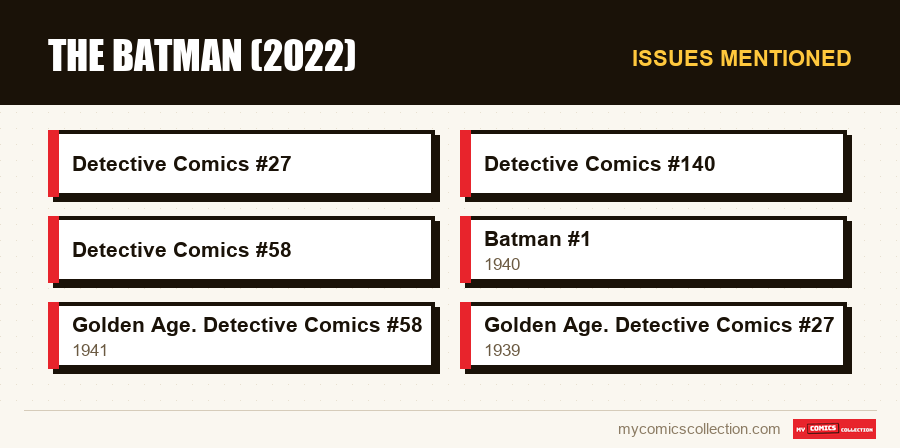
The Batman (2022) Matt Reeves , with Robert Pattinson, offers a dark police thriller centered on an early Batman (Detective Comics #27, 1939), confronted with Sphinx (Detective Comics #140, 1948), Penguin (Detective Comics #58, 1941) and Catwoman. The film is inspired by “The Long Halloween» and “Ego”, reconnecting with the Batman detective. Here is the detailed comparison, film versus comics.
New vision of the Dark Knight, The Batman emphasizes the detective side of the character in a dark thriller. It draws on several dark stories from the comics. Source-by-source decryption.
As in each article in this series, only verified information (creators, distribution, dates, comic numbers) is stated; the comparative analysis is ours, without reproducing dialogue or protected images.
Title : The Batman (2022)
Director: Matt Reeves
Actors: Robert Pattinson (Batman), Zoë Kravitz (Catwoman), Paul Dano (the Riddler), Colin Farrell (the Penguin)
Exit : March 2022
Studio: Warner Bros.
Detective Comics #140 (1948): 1st appearance of the Sphinx
Detective Comics #58 (1941): Penguin's first appearance
“The Long Halloween”(1996): Loeb & Dirty
“Ego” and “Year Two”: the early Batman
- Le Batman detective, “the greatest bloodhound in the world”.
- Le Sphinx and its macabre enigmas.
- Le Penguin and Gotham's organized crime.
- Catwoman, a thief with moral ambiguity.
- Le Corrupted Gotham and the alliance with Gordon.
- Le Sphinx becomes a masked, political serial killer.
- The plot is original (a long-term investigation).
- The tone borrows from crime thriller and film noir.
- Le secret of the Waynes is reinvented.
- A Batman beginner and unstable, in its beginnings.
The Batman detective, faithful to Detective Comics
The Batman reconnects with an essential dimension of the character, often neglected in cinema: that of the detective. Batman was born in Detective Comics #27 (1939), and his very title recalls that he is, in the comics, "the greatest bloodhound in the world". Matt Reeves' film makes this facet the heart of its story, constructing a police thriller where Batman leads a long-term investigation to unmask a serial killer. Robert Pattinson plays an early Dark Knight, dark, unstable and obsessive, still defining his mission. This approach, focused on investigation rather than pure action, is faithful to the origin of the character and his status as a detective.
The film brings to the screen a Batman from his beginnings, in his second year of activity, still haunted by revenge and seeking to become a symbol. This characterization is inspired by stories exploring the character's early years, such as "Year Two" and especially "Ego", which delves into his tormented psyche. By showing an imperfect Batman, under construction, the film deepens his psychological dimension. This fidelity to the Batman detective and his beginnings distinguishes the film from other adaptations, often centered on the accomplished vigilante. For the reader, it reminds us that Batman is above all an investigator, whose deductive genius is as important as his physical prowess.
The Sphinx, reinvented as a political killer
The film pits Batman against the Riddler, who appeared in Detective Comics #140 (1948). In the comics, the Riddler is a criminal obsessed with riddles, who can't help but leave clues that challenge Batman, embodying the clash of two intelligences. The film profoundly reinvents the character: the Sphinx becomes a masked serial killer, inspired by real figures of killers, who hunts down the corrupt elites of Gotham, leaving macabre enigmas. Paul Dano delivers a chilling interpretation, transforming the classic villain into a dark and political threat, denouncing the rottenness of the city.
This rereading, closer to a thriller than a classic comic, retains the essence of the Sphinx (the obsession with enigmas, the intellectual challenge thrown at Batman) while anchoring it in a realistic and frightening register. The film exploits the investigative dimension through these enigmas, making the Riddler the driving force behind Batman's investigation. This version, very far from the eccentric criminal of the comics, illustrates the film's desire to treat Gotham's villains with dark realism. For the reader, the Sphinx is an invitation to discover the character in the comics, where his intellectual confrontation with Batman has fueled numerous stories. The film offers a radical version, transforming the enigmist into a political killer, in the service of its point on corruption.
The Penguin, Catwoman and Corrupted Gotham
The film develops two other major figures in the Batman universe. THE Penguin (Oswald Cobblepot), who appeared in Detective Comics #58 (1941), is a Gotham organized crime boss, played unrecognizably by Colin Farrell. The film presents him as an ambitious underworld lieutenant, grounded in criminal realism. Catwoman (Selina Kyle), who appeared in Batman #1 (1940), is a morally ambiguous thief, Batman's ally and romantic interest, played by Zoë Kravitz. These characters, true to their spirit, populate a Gotham plagued by corruption, the central theme of the film, where organized crime and political power are intertwined.
This corrupt and rainy Gotham, filmed like a film noir city, is one of the film's great assets. He embodies the dark universe of Batman, where the line between law and crime is blurred, and where the vigilante must confront systemic rot. This atmosphere, faithful to the spirit of the great dark Batman stories like “The Long Halloween” from which the film is inspired, anchors the story in an oppressive realism. The Penguin and Catwoman, figures of this underworld, enrich the gallery of characters. For the reader, they are invitations to discover the criminal universe of Gotham in the comics, where Batman fights against sprawling corruption, a theme that the film brings to the screen with remarkable darkness.
Collecting this series?
Track what you own, what you are missing and what your collection is worth. 7 day trial.
Start my trial →The characters, from paper to screen
- Batman/Bruce Wayne: Early detective, dark and unstable, faithful to the Batman sleuth of the comics.
- The Sphinx: Reinvented as a political serial killer, true to his obsession with mysteries.
- The Penguin: Underworld Lieutenant, faithful to Detective Comics #58.
- Catwoman: Ambiguous thief, ally and romantic interest, loyal to Batman #1.
- Jim Gordon: The honest police officer, Batman's ally in the investigation.
The influence of “The Long Halloween”
The film is directly inspired by “The Long Halloween” (1996), by Jeph Loeb and Tim Sale, one of the most famous Batman stories. This dark thriller, centered on the beginnings of the Dark Knight and a long-term investigation to unmask a mysterious killer, had a profound impact on the modern vision of the character. The Batman takes up its structure (a criminal investigation spread over months, a corrupt Gotham, a Batman detective) and the atmosphere of film noir. This influence, claimed, anchors the film in the tradition of dark and detective stories of Batman, contrary to action blockbusters.
This inspiration illustrates the richness of Batman comics, whose diversity allows for varied approaches: Nolan's psychological drama, Burton's gothic, Reeves' police thriller. By drawing on “The Long Halloween” and the stories of the character’s beginnings, the film captures the detective and dark dimension of Batman, often eclipsed. For the reader, it is an invitation to discover these major stories (“The Long Halloween”, “Ego”, “Year Two”) which explore the Batman investigator and his early years. The Batman proves that the character, rich in eighty years of stories, can still reinvent himself, returning to his detective roots and the dark atmosphere of Gotham.
A dark thriller that renews the character
The Batman stands out for its resolutely detective and dark approach, renewing the vision of the character in cinema. By favoring investigation, atmosphere and psychology over spectacular action, the film offers an experience close to an adult thriller, in the tradition of black cinema. This direction, supported by the meticulous direction of Matt Reeves and the intense interpretation of Robert Pattinson, was praised by critics and the public. The film proves that after decades of adaptations, Batman can still surprise, by exploring less exploited facets of his myth, such as his detective dimension and his imperfect beginnings.
This success confirms the inexhaustible richness of the character, capable of carrying stories of great diversity. By returning to Batman's roots (the detective, the early vigilante, the corrupt Gotham) the film honors the essence of the myth while renewing it. For the reader, it is an invitation to rediscover Batman in the comics, beyond his most spectacular confrontations, in his dimension as an investigator and a dark figure. The Batman is part of the long tradition of great stories of the Dark Knight, proving that the character, eighty years after his creation, remains an inexhaustible source of inspiration for cinema, capable of constantly reinventing himself.
Where to start reading
To extend the film, “The Long Halloween” (1996) by Loeb and Sale is the major inspiration. Detective Comics #140 (1948) features the Riddler, and #58 (1941) features the Penguin. Darwyn Cooke's "Batman: Ego" (2000) explores the character's psyche. This journey covers the sources of a film which reconnects with the Batman detective.
Chronology of comics to know
- 1941: Detective Comics #58: The Penguin's first appearance.
- 1948: Detective Comics #140: The Sphinx's first appearance.
- 1996: “The Long Halloween”: the major inspiration for the film.
Collection side: what numbers to aim for after the film
The Batman points to keys to the Golden Age. Detective Comics #58 (1941, premiere of The Penguin) and Detective Comics #140 (1948, premiere of The Sphinx) are sought-after keys to the golden age. Detective Comics #27 (1939, Batman premiere) is an absolute grail. The collection “The Long Halloween” (1996) is essential reading and an accessible target. These numbers cover budgets ranging from inaccessible to reasonable. As always, condition and gradation determine value; relying on real recent sales is strongly recommended.
Its place in the saga and for the collector
The Batman renewed the character by reconnecting with his detective dimension, in an acclaimed dark thriller. For the collector, it reignited interest in Detective Comics #58, #140 and “The Long Halloween.” It illustrates the effect of adaptations on the market. Beyond speculation, the film invites us to discover the Batman investigator in the comics, often eclipsed by the action vigilante. By exploring his beginnings and the dark atmosphere of Gotham, he recalls the richness of a character capable of constantly reinventing himself, eighty years after his creation.
The Verdict: The Batman Detective Renewed
- Loyalty: the Batman detective, the Sphinx and his enigmas, the Penguin, Catwoman and the corrupt Gotham come from the comics.
- Freedoms: the Sphinx as a political killer, the original plot, the tone of a dark thriller, the secret of the Waynes reinvented, a beginner Batman.
- Collectible numbers: Detective Comics #58 (Penguin), Detective Comics #140 (Sphinx), “The Long Halloween”.
The Batman reconnects with the detective side of the Dark Knight in a dark detective thriller, drawing inspiration from “The Long Halloween” and the stories from his beginnings. Faithful to the Batman sleuth and his enemies (the Sphinx, the Penguin, Catwoman) the film reinvents them in a realistic and dark register. For both the reader and the collector, it is an invitation to discover Detective Comics #140 and “The Long Halloween”.
Frequently asked questions
Mainly from “The Long Halloween” (1996) by Loeb and Sale, a dark thriller about the beginnings of Batman and a long-term investigation. The film takes up its structure and atmosphere, as well as elements of “Ego” and “Year Two”.
Partly: Appearing in Detective Comics #140 (1948), the Sphinx is a criminal obsessed with puzzles. The film reinvents him as a masked and political serial killer, inspired by real killers, while retaining his obsession with mysteries and his challenge to Batman.
Because the film reconnects with an essential dimension of the character: born in Detective Comics #27 (1939), Batman is “the greatest bloodhound in the world”. The film makes it a police thriller focused on the investigation, faithful to the origin of the character.
Oswald Cobblepot, Gotham's organized crime boss, appeared in Detective Comics #58 (1941). The film presents him as an ambitious underworld lieutenant, played unrecognizably by Colin Farrell, in criminal realism.
Detective Comics #58 (1941, Penguin) and Detective Comics #140 (1948, Sphinx) are keys to the Golden Age. Detective Comics #27 (1939, Batman) is a holy grail. The collection “The Long Halloween” is an accessible target.
Does the film make you want to collect? Estimate the value for free of your issues (Detective Comics #58, #140…) with our tool based on current eBay listings.