Batman: The Challenge (1992) Tim Burton , with Michael Keaton, pits the Black Knight against Penguin (Detective Comics #58, 1941) and Catwoman (Batman #1, 1940). The film takes these iconic enemies while reinventing them in Burton's gothic universe. Here is the detailed comparison, film versus comics.
Sequel to the 1989 Batman, Batman Returns plunges the Dark Knight into a wintry, gothic Gotham facing two cult villains. He draws from the richest gallery of villains in comics. Source-by-source decryption.
As in each article in this series, only verified information (creators, distribution, dates, comic numbers) is stated; the comparative analysis is ours, without reproducing dialogue or protected images.
Title : Batman: The Challenge (1992)
Director: Tim Burton
Actors: Michael Keaton (Batman), Danny DeVito (Penguin), Michelle Pfeiffer (Catwoman), Christopher Walken (Max Shreck)
Exit : June 1992
Studio: Warner Bros.
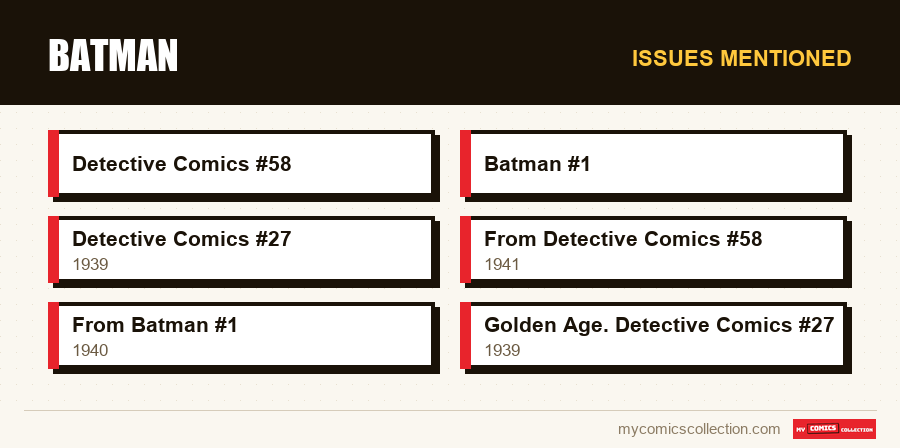
Detective Comics #58 (1941): Penguin's first appearance
Batman #1 (1940): Catwoman's first appearance
Detective Comics #27 (1939): Batman's first appearance
Gotham City: the city of the Black Knight
- Batman/Bruce Wayne, Gotham's vigilante.
- Le Penguin, criminal with umbrella and birds.
- Catwoman, the burglar with the whip and ambiguity.
- The atmosphere Gothic from Gotham City.
- La tension romantic between Batman and Catwoman.
- The Penguin becomes a deformed monster raised in the sewers.
- Catwoman is born from a quasi-supernatural resurrection.
- Max Shreck, the industrialist, is invented for the film.
- The plot is original, outside of comics.
- The aesthetics very Tim Burton, expressionist.
Detective Comics #58 (1941): the Penguin, gentleman of crime
Batman Returns pits the Dark Knight against the Penguin, who appeared in Detective Comics #58 (1941), created by Bob Kane and Bill Finger. Real name Oswald Cobblepot, the Penguin is one of Batman's oldest and most iconic enemies. An elegant and cunning criminal, he is distinguished by his appearance (small, portly, with a long nose) and by his iconic accessories: the top hat, the monocle and especially his doctored umbrellas, hiding weapons and gadgets. In the comics, the Penguin is a "gentleman of crime", handling illegal activities with calculation and refinement, seeing himself as an aristocrat of Gotham's underworld. His intelligence and his taste for birds make him an adversary as theatrical as he is dangerous.
The film uses the Penguin as an antagonist, played by Danny DeVito, while retaining certain traits: his association with birds, his umbrella gadgets and his criminal ambition. However, he reinvents it profoundly. The Penguin of the film is a deformed and monstrous being, abandoned as a baby by his parents and raised in the sewers by penguins, nourishing a thirst for revenge against Gotham. This tragic and grotesque origin, very far from the calculating gentleman of the comics, bears the mark of the gothic universe of Tim Burton. The film thus transforms a refined criminal into a pathetic and repulsive creature, a strong aesthetic choice but unfaithful to the classic version of the character.
Batman #1 (1940): Catwoman, feline ambiguity
The film also features Catwoman, Selina Kyle, who appeared in Batman #1 (1940), created by Bill Finger and Bob Kane. A genius burglar roaming the streets of Gotham, Selina is one of the most iconic figures in the Batman universe. Ambiguous by nature, she oscillates between antagonism and alliance, maintaining a complex relationship with the Black Knight made of romantic tension and rivalry. Without superpowers, she relies on her feline agility, her mastery of the whip and her intelligence. A major female character in DC, Catwoman embodies independence, seduction and freedom, refusing to side with either the heroes or the villains.
The film reprises Catwoman with Michelle Pfeiffer in an interpretation that has become cult. It retains faithful elements: Selina Kyle, her costume, her whip, her agility, her moral ambiguity and above all the romantic and rival tension with Batman, faithful to the spirit of the comics. The film, however, invents its origin: Selina, a secretary murdered by her crooked boss Max Shreck, is brought back to life in an almost supernatural way by cats, which triggers her transformation into Catwoman. This mystical origin differs from that of the comics, where Selina has no supernatural powers. Despite this freedom, the film captures the essence of the character (her duality, her seduction, her independence) making this Catwoman one of the most memorable in cinema.
The gothic universe of Tim Burton
Batman Returns bears the aesthetic mark of Tim Burton, which immerses Gotham City in a gothic, wintery and expressionist atmosphere. The city, crushed by snow and shadows, resembles the setting of a dark tale, populated by grotesque and tragic figures. This very personal vision moves away from the urban realism of modern comics to favor a dreamlike and nightmarish imagination. The characters are reinvented as deformed or injured creatures: the monstrous Penguin, resurrected Catwoman -, reflections of Burton's sensitivity for the marginalized and the broken. This aesthetic makes the film a work of art as much as an adaptation of Batman.
This gothic reinterpretation illustrates the freedom taken by the film vis-à-vis the comics. If Gotham has always been a dark and menacing city, Burton's vision pushes the styling to the extreme, to the point of transforming the villains into figures from a fantastic tale. This approach, striking and unique, has divided: hailed for its artistic audacity, criticized for its unfaithfulness to the tone of the comics. It nevertheless testifies to the richness of the Batman universe, capable of inspiring such varied visions. For the reader, the film is a separate object, an author's rereading which favors atmosphere and symbolism. It reminds us that Batman, a protean character, lends itself to multiple interpretations, from the dark realism of comics to the gothic expressionism of Burton, each illuminating a different facet of the myth of the Dark Knight.
The characters, from paper to screen
- Batman/Bruce Wayne: The Dark Knight, faithful to Detective Comics #27.
- The Penguin: The bird criminal, reinvented as a sewer monster.
- Catwoman / Selina Kyle: The ambiguous burglar, invented mystical origin.
- Max Shreck: The crooked industrialist, a character invented for the film.
- Gotham City: The Gothic city, reinterpreted by Burton.
Collecting this series?
Track what you own, what you are missing and what your collection is worth. 7 day trial.
Start my trial →Batman's gallery of villains
Batman Returns illustrates one of Batman's great strengths: his gallery of villains, the richest and most emblematic in comics. The Penguin and Catwoman are among the Dark Knight's oldest enemies, alongside the Joker, Two-Face, Scarecrow and Poison Ivy. Each embodies a facet of Gotham's crime and madness, often mirroring an aspect of Batman himself. This richness makes the Batman universe an inexhaustible breeding ground for adaptations, each villain offering a different dynamic and theme. The film exploits two of these major figures, confirming the enduring appeal of the Dark Knight's rogues gallery.
This gallery of villains is one of the assets that distinguishes Batman in the comic book universe. Where many heroes face one or two recurring enemies, Batman faces a multitude of iconic adversaries, each deeply characterized. The Penguin and Catwoman, with their strong personalities and aesthetics, are excellent examples. The film, by featuring them, draws from this exceptional reservoir. For the reader, this richness is an invitation to explore comics, where Batman's gallery of villains has nourished stories of remarkable variety and depth for decades. It reminds us that the greatness of a hero is also measured by that of his enemies, and that Batman, in this regard, has one of the richest mythologies in all of comics.
A Catwoman who has become a reference
Among the many incarnations of Catwoman on screen, that of Michelle Pfeiffer in Batman Returns is often cited as the most notable. His interpretation, combining fragility, madness, sensuality and dangerousness, has lastingly shaped the perception of the character in popular culture. This Catwoman, born from a traumatic transformation, embodies a complex and subversive femininity, both victim and predator, which makes her a fascinating and tragic figure. The stitched leather suit, the whip and the feline attitude have become iconic. Despite a mystical origin far from the comics, this version captured the ambiguous essence of Selina Kyle, to the point of influencing subsequent representations of the character, including in comics.
This influence illustrates the dialogue between cinema and comics. A significant adaptation can enrich the perception of a character and in return inspire comic book authors. Pfeiffer's Catwoman helped to affirm the complex and adult dimension of the character, far from the simple burglar of the beginning. For the reader, this cinematic version is an invitation to discover the richness of Selina Kyle in the comics, particularly in the modern runs which explore her psychology, her moral ambiguity and her relationship with Batman. She reminds us that Catwoman is one of DC's most fascinating female figures, capable of inspiring interpretations as varied as they are memorable, and that her fundamental ambiguity, neither heroine nor villain, remains the heart of her enduring appeal, on paper and on screen.
Where to start reading
To extend the film, Detective Comics #27 (1939) presents the first appearance of Batman, Batman #1 (1940) that of Catwoman, and Detective Comics #58 (1941) that of the Penguin. Frank Miller’s “Batman: The Long Halloween” and “Batman: Year One” (1987) are essential modern tales. Ed Brubaker's run on Catwoman develops the heroine. This tour covers the film's sources.
Chronology of comics to know
- 1939: Detective Comics #27: Batman's first appearance.
- 1940: Batman #1: the first appearance of Catwoman (and the Joker).
- 1941: Detective Comics #58: The Penguin's first appearance.
Collection side: what numbers to aim for after the film
Batman Returns points to major keys. Detective Comics #27 (1939, first appearance of Batman) is one of the most expensive and sought-after keys in history. Batman #1 (1940, first appearance of Catwoman and the Joker) and Detective Comics #58 (1941, first appearance of the Penguin) are key keys to the Golden Age. These numbers cover extreme budgets. As always, condition and gradation determine value; relying on real recent sales is strongly recommended.
Its place in the saga and for the collector
Batman Returns will remain as a daring author's rereading, plunging the Penguin and Catwoman into the gothic universe of Tim Burton. For the collector, it highlighted Detective Comics #58 and Batman #1, keys to these iconic villains. It illustrates the richness of Batman's gallery of villains and the freedom of adaptations. Beyond its reinventions, the film celebrates two of the Dark Knight's greatest enemies, to be discovered in the comics. By reimagining them, he reminds us that Batman lends itself to multiple visions, from realism to a gothic tale.
The Verdict: Iconic Villains Reinvented
- Loyalty: Batman, the Penguin and his birds, Catwoman and her whip, the gothic atmosphere of Gotham and the Batman-Catwoman tension come from the comics.
- Freedoms: the Penguin as a sewer monster, the mystical origin of Catwoman, the invented Max Shreck, an original plot, Burton's expressionist aesthetic.
- Collectible numbers: Detective Comics #58 (Penguin), Batman #1 (Catwoman), Detective Comics #27 (Batman).
Batman: The Challenge pits the Dark Knight against the Penguin and Catwoman, two iconic enemies reinvented in Tim Burton's gothic Gotham. Faithful to the characters and their ambiguity but reinventing their origins and favoring an author's aesthetic, the film illustrates the richness of Batman's gallery of villains. For both the reader and the collector, it is an invitation to discover Detective Comics #58 and Batman #1.
Frequently asked questions
From Detective Comics #58 (1941), created by Bob Kane and Bill Finger. Oswald Cobblepot is a stylish “gentleman of crime,” associated with birds and his umbrella gadgets. The film reinvents him as a deformed monster raised in the sewers, very far from the refined criminal of the comics.
From Batman #1 (1940), created by Bill Finger and Bob Kane. Selina Kyle is an ambiguous Gotham burglar, linked to Batman by romantic tension. The film retains its essence but invents a mystical origin (a resurrection by cats) absent from the comics.
Partially. It preserves Batman, the Penguin, Catwoman, their ambiguity and the gothic atmosphere of Gotham, but profoundly reinvents the origins of the villains and favors the expressionist aesthetic of Tim Burton, making it an author's rereading more than a faithful adaptation.
No. Crooked industrialist Max Shreck, played by Christopher Walken, is a character invented for the film. His name is a nod to the actor in the film “Nosferatu”. It serves as a link between the Penguin and Catwoman storylines.
Detective Comics #58 (1941, premiere of The Penguin) and Batman #1 (1940, premiere of Catwoman and The Joker) are key keys to the Golden Age. Detective Comics #27 (1939, Batman premiere) is one of the most sought-after comics in history.
Does the film make you want to collect? Estimate the value for free of your issues (Detective Comics #58, Batman #1…) with our tool based on current eBay listings.