Batman (1989) Tim Burton , with Michael Keaton, adapts the Dark Knight born in Detective Comics #27 (1939) by Bob Kane and Bill Finger, and opposes it to Joker (Batman #1, 1940). The film imposes a gothic and dark vision of Gotham, faithful to the spirit of the character after decades of lighter images. However, he reinvents the origin of the Joker. Here is the detailed comparison, film versus comics.
A film that redefined the image of Batman in cinema, Tim Burton's version brings the Gotham vigilante to the screen in a gothic register. It draws on a fifty-year-old myth. Source-by-source decryption.
As in each article in this series, only verified information (creators, distribution, dates, comic numbers) is stated; the comparative analysis is ours, without reproducing dialogue or protected images.
Title : Batman (1989)
Director: Tim Burton
Actors: Michael Keaton (Bruce Wayne / Batman), Jack Nicholson (the Joker), Kim Basinger (Vicki Vale)
Exit : June 1989
Studio: Warner Bros.
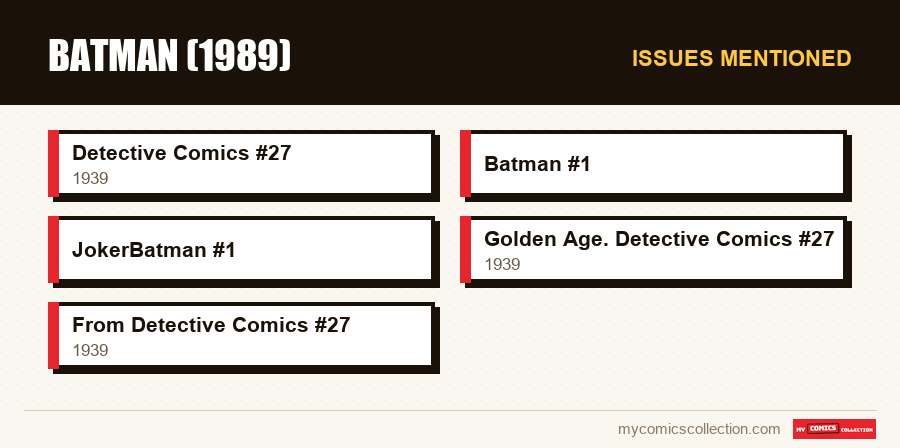
Detective Comics #27 (1939): Batman's first appearance (Kane & Finger)
Batman #1 (1940): 1st appearance of the Joker
The Murder of Wayne's Parents: the origin of the vigilante
Gothic Gotham: the atmosphere of the character
- Bruce Wayne, billionaire haunted by the murder of his parents.
- Le Black Knight, vigilante without powers.
- Le Joker, clown and chaotic enemy.
- Le Gotham Gothic and corrupt.
- Alfred, the trusty butler, and Wayne Manor.
- Le Joker becomes the murderer of Wayne's parents.
- Batman kill, going against his comic book code.
- The origin of the Joker (Jack Napier) is invented.
- Vicki Vale occupies a central place.
- The aesthetic Burton Gothic stylizes Gotham.
Detective Comics #27 (1939): the birth of the Dark Knight
Batman appears in Detective Comics #27 (1939), created by Bob Kane and Bill Finger. Bruce Wayne, young heir to a rich Gotham family, sees his parents murdered before his eyes by a criminal. Traumatized, he devotes his life to fighting crime, shaping himself into a masked vigilante inspiring terror: Batman, the Batman. Unlike Superman, Batman has no superpowers: he is a human being driven to physical and intellectual perfection, a detective, a fighter, a strategist, driven by an iron will and a founding trauma. A dark and tormented figure, he embodies a man's fight against darkness, in a corrupt and gothic Gotham.
Tim Burton's film brings this dark essence of the character to the screen. After decades of lighter images, notably a camp television series from the 1960s, the film reconnects with the original darkness of Batman: a gothic and menacing Gotham, a haunted vigilante, an oppressive atmosphere. Michael Keaton plays a mysterious and tormented Bruce Wayne, against the odds. This reinterpretation, faithful to the dark spirit of the character, redefined the image of Batman in popular culture. The film, however, takes significant liberties with the mythology, notably on the origin of the Joker and Batman's moral code, moving away from the letter of the comics while capturing their atmosphere.
The Joker, reinvented by the film
The film pits Batman against the Joker, his most emblematic enemy, who appeared in Batman #1 (1940). A criminal clown with a white face and a demented laugh, the Joker is, in the comics, the incarnation of chaos, the perfect antithesis of the order that Batman seeks to impose. Jack Nicholson delivers a flamboyant and memorable interpretation, capturing the madness and theatricality of the character. The film faithfully reproduces this chaotic and grotesque dimension. However, he profoundly reinvents his origin: the Joker is Jack Napier, a gangster disfigured by a fall into a vat of chemicals during a confrontation with Batman, which gives him his clown appearance.
This origin, if it is freely inspired by elements of the comics: the fall into chemicals evokes certain versions -, invents the details. The film's greatest freedom is to make the Joker (Jack Napier) the murderer of Bruce Wayne's parents, creating a direct link between the hero and his enemy. In the comics, the Wayne assassin is usually an anonymous criminal (sometimes named Joe Chill), unrelated to the Joker. This invention, which personalizes their rivalry, moves away from classic mythology where the Joker has no fixed origin: his mystery is part of his horror. For the reader, the Joker of the comics is a figure all the more terrifying as his origins remain unclear.
Batman who kills: a controversial freedom
One of the most notable liberties in the film concerns Batman's moral code. In the comics, the Dark Knight follows an absolute rule: he never kills, refusing to cross the line that would separate him from the criminals he fights. This principle is at the heart of his identity, which sets him apart from a vigilante like the Punisher. However, in Burton's film, Batman kills several times, notably the Joker during the final confrontation. This departure from the fundamental code of the character has divided purists, for whom the refusal to kill is an essential component of Batman.
This freedom illustrates the approach of the film, more concerned with the atmosphere and the spectacle than with strict fidelity to the moral code of the hero. It also reflects a time when the mythology of Batman in cinema was not yet established. Subsequent adaptations, notably Christopher Nolan's trilogy, will reaffirm this refusal to kill as central. For the reader, this moral dimension is fundamental: Batman embodies restraint, discipline, the refusal to give in to murderous vengeance despite his trauma. Burton's film, by freeing itself from this, takes a notable liberty, in the service of its vision, but moves away from what makes the moral greatness of the character in the comics.
Collecting this series?
Track what you own, what you are missing and what your collection is worth. 7 day trial.
Start my trial →The characters, from paper to screen
- Bruce Wayne / Batman: Haunted billionaire and powerless vigilante, faithful to Detective Comics #27.
- The Joker (Jack Napier): Chaotic clown, true to his spirit but originally reinvented.
- Vicki Vale: Journalist and love interest, central character in the film.
- Alfred: Bruce's loyal butler, true to his role.
- Gotham City: The gothic and corrupt city, magnified by Burton's aesthetic.
Tim Burton's Gothic Gotham
The film's great success lies in its vision of Gotham City. Tim Burton, filmmaker with a unique visual universe, creates a gothic, dark and timeless city, a mixture of art deco architecture and nightmarish atmosphere. This stylized Gotham, oppressive and theatrical, perfectly embodies the universe of Batman: a corrupt and threatening city, playground of the vigilante and his enemies. This aesthetic, faithful to the dark atmosphere of the comics while bearing Burton's personal mark, has had a lasting influence on the representation of Gotham in all subsequent adaptations. She makes the setting a character in its own right.
This gothic atmosphere reflects the spirit of Batman from the comics, particularly in his darkest versions. Gotham is no ordinary city but a reflection of the darkness Batman fights, a place where corruption and madness thrive. The film captures this dimension with rare visual force. For the reader, this Gotham is an invitation to discover the great dark stories of Batman in the comics, from “The Long Halloween” to “Batman: Year One”, where the city and its atmosphere play a central role. Burton's film, by imposing this gothic vision, recalled the fundamental darkness of the character and redefined his image for generations.
The film that revived Batman
Tim Burton's Batman marked a watershed moment for the character. Before him, the general public's image of Batman was largely associated with the camp and colorful television series of the 1960s, a far cry from the original darkness of the Dark Knight. Burton's film made a spectacular break, reaffirming the dark and gothic dimension of the character, in line with the great comic stories of the 1980s, such as “The Dark Knight Returns” by Frank Miller. This return to darkness redefined Batman's image in popular culture and launched a new era for the character in cinema.
The film's considerable success also proved the commercial viability of a dark, adult take on the superhero, paving the way for more ambitious adaptations. He demonstrated that a comic character could be treated with seriousness and style, without giving in to lightness. For the reader, this film is an invitation to discover the great dark stories of Batman in the comics, from “The Dark Knight Returns” to “Year One”, which inspired this gothic rereading. Burton's Batman reminded the world that the Dark Knight is above all a figure of darkness, a haunted vigilante operating in a corrupt Gotham, lastingly marking the perception of the character.
Where to start reading
To extend the film, Detective Comics #27 (1939) presents the first appearance of Batman, and Batman #1 (1940) that of the Joker. Frank Miller's "Batman: Year One" (1987) revisits the origins, and "The Killing Joke" (1988) explores the Joker. “The Dark Knight Returns” (1986) is a peak for the character. This journey covers the sources of a film faithful to the dark spirit of Batman.
Chronology of comics to know
- 1939: Detective Comics #27: Batman's first appearance.
- 1940: Batman #1: The Joker's first appearance.
- 1988: “The Killing Joke”: a major story about the Joker.
Collection side: what numbers to aim for after the film
Batman points to major keys to the Golden Age. Detective Comics #27 (1939, first appearance of Batman) is one of the most sought after and valuable keys to history, an absolute grail. Batman #1 (1940, Joker premiere) is another essential key. Modern stories like “The Killing Joke” and “The Dark Knight Returns” offer much more accessible targets. These numbers cover budgets ranging from inaccessible to reasonable. As always, condition and gradation determine value; relying on real recent sales is strongly recommended.
Its place in the saga and for the collector
Tim Burton's Batman redefined the image of the Dark Knight in cinema, reconnecting with his original darkness. For the collector, it magnified the aura of Detective Comics #27 and Batman #1, holy grails of the Golden Age. It illustrates the effect of adaptations on a character's mythology. Beyond speculation, the film invites you to discover the dark universe of Batman in the comics, from the founding story of 1939 to modern rereadings. By imposing a gothic Gotham and a tormented Batman, he left a lasting mark on popular culture and paved the way for subsequent adaptations of the vigilante.
The Verdict: A Founding Gothic Vision
- Loyalty: Bruce Wayne, the murder of his parents, the powerless Dark Knight, the Joker and the Gothic Gotham come from the comics.
- Freedoms: the murderous Joker of the Waynes, Batman who kills, the invented origin of Jack Napier, the place of Vicki Vale.
- Collectible numbers: Detective Comics #27 (Batman), Batman #1 (Joker), “The Killing Joke.”
Tim Burton's Batman imposes a gothic and dark vision of the Dark Knight, reconnecting with his original darkness after years of light images. Faithful to the spirit of the character and magnified by Burton's universe, the film however reinvents the origin of the Joker and has Batman killed. For both the reader and the collector, it is an invitation to discover Detective Comics #27 and Batman #1.
Frequently asked questions
From Detective Comics #27 (1939), created by Bob Kane and Bill Finger. Bruce Wayne, whose parents were murdered, becomes a masked vigilante with no superpowers. The film faithfully reproduces its origins and its dark spirit.
No: it's an invention of the film, which makes Jack Napier (the future Joker) their murderer to personalize the rivalry. In the comics, the Wayne assassin is generally an anonymous criminal, unrelated to the Joker.
No: the refusal to kill is an absolute principle of the character, which distinguishes him from criminals. Burton's film takes a controversial liberty by having Batman, particularly the Joker, killed. Subsequent adaptations will reaffirm this moral code.
The Joker is Jack Napier, a gangster disfigured by a fall into a vat of chemicals during a confrontation with Batman. This origin is freely inspired by comics, where the Joker however has no fixed origin, his mystery being part of his horror.
Detective Comics #27 (1939, Batman premiere) is an absolute grail. Batman #1 (1940, Joker premiere) is another major key. “The Killing Joke” and “The Dark Knight Returns” are accessible modern targets.
Does the film make you want to collect? Estimate the value for free of your issues (Detective Comics #27, Batman #1…) with our tool based on current eBay listings.