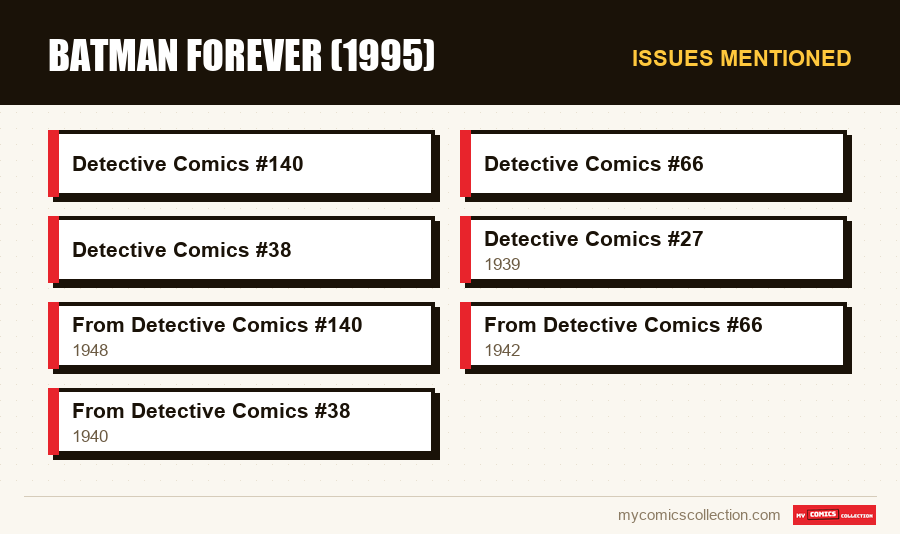
Batman Forever (1995) Joel Schumacher , with Val Kilmer, pits the Black Knight against Sphinx (Detective Comics #140, 1948) and Double-Face (Detective Comics #66, 1942), and introduced robin (Detective Comics #38, 1940). The film takes up these iconic figures in a more colorful tone. Here is the detailed comparison, film versus comics.
Third film in the modern Batman saga, Batman Forever abandons Burton's gothic style for a more flamboyant tone. It draws from the Dark Knight's rich gallery of characters. Source-by-source decryption.
As in each article in this series, only verified information (creators, distribution, dates, comic numbers) is stated; the comparative analysis is ours, without reproducing dialogue or protected images.
Title : Batman Forever (1995)
Director: Joel Schumacher
Actors: Val Kilmer (Batman), Jim Carrey (Sphinx), Tommy Lee Jones (Two-Face), Chris O'Donnell (Robin)
Exit : June 1995
Studio: Warner Bros.
Detective Comics #140 (1948): 1st appearance of the Sphinx
Detective Comics #66 (1942): 1st appearance of Two-Face
Detective Comics #38 (1940): Robin's first appearance
Detective Comics #27 (1939): Batman's first appearance
- Batman/Bruce Wayne, Gotham's vigilante.
- Le Sphinx, criminal obsessed with puzzles.
- Double-Face, the disfigured former prosecutor.
- robin (Dick Grayson) and his origin as an acrobat.
- Le trauma founder of Bruce Wayne.
- The tone becomes colorful and flamboyant, far from Gothic.
- Two-Face loses his tormented duality for the benefit of histrionics.
- The Sphinx is involved in an intrigue of wave machine.
- The plot is original, outside of comics.
- The origins of the villains are rewritten.
Detective Comics #140 (1948): the Sphinx, master of riddles
Batman Forever pits the Dark Knight against the Riddler, appearing in Detective Comics #140 (1948), created by Bill Finger and Dick Sprang. Real name Edward Nygma (or Nashton), the Riddler is a genius criminal obsessed with riddles, riddles and mind games. Unable to commit a crime without leaving clues in the form of charades, he compulsively challenges Batman, transforming each confrontation into an intellectual duel. Dressed in green and decorated with question marks, the Sphinx embodies pride and the morbid need to prove one's intellectual superiority. His compulsion to leave enigmas, paradoxically, often allows Batman to unmask him, making him an adversary as brilliant as he is self-destructive.
The film uses the Sphinx as an antagonist, played by Jim Carrey in an exuberant interpretation. It retains faithful elements: Edward Nygma, his obsession with puzzles, his green suit with question marks and his intellectual duel with Batman. The film, however, combines it with an original plot: Nygma, a former employee of Wayne Enterprises obsessed with Bruce Wayne, invents a machine capable of reading and manipulating minds. This technological framework, absent from the comics, serves as a vehicle for the character. The tone, carried by Jim Carrey's histrionics, favors comic eccentricity, moving away from the colder intellectual menace of the Sphinx of the comics, while capturing his theatrical egocentrism.
Detective Comics #66 (1942): Two-Face, tragic duality
The film also features Two-Face, who appeared in Detective Comics #66 (1942), created by Bob Kane and Bill Finger. Real name Harvey Dent, Two-Face is one of Batman's most tragic enemies. Former Gotham prosecutor, ally and friend of Bruce Wayne, Harvey Dent sees half of his face disfigured with acid, which shatters his psyche and pushes him into crime. Having become Two-Face, he is obsessed with duality and chance, making all his decisions by tossing a coin with the damaged side. This character embodies the fragility of justice and the fine line between good and evil, making his fall one of the most poignant in Batman mythology.
The film picks up Two-Face, played by Tommy Lee Jones, retaining his disfigured appearance, his coin and his obsession with duality. However, it betrays the essence of the character: where the comics make Harvey Dent a tragic figure, torn between his two natures, the film makes him an ugly and exuberant histrionic, close to the comic register. This interpretation loses the dramatic depth and inner heartbreak that make Two-Face so fascinating. Duality, meant to be a heartbreaking psychological struggle, becomes a mere gimmick. For the reader, this discrepancy illustrates the general tone of the film, which favors colorful spectacle over depth. It invites us to discover the real Two-Face in the comics, notably “The Long Halloween”, where his tragedy is explored with remarkable power.
Robin, the faithful sidekick
Batman Forever introduces Robin, Dick Grayson, who appeared in Detective Comics #38 (1940), created by Bob Kane, Bill Finger and Jerry Robinson. A young circus acrobat whose parents are murdered before his eyes, Dick Grayson is taken in by Bruce Wayne, who recognizes his own trauma in him. Having become Robin, he is Batman's first and most famous sidekick, bringing light and youth to the Dark Knight's dark universe. His presence humanizes Batman and illustrates the theme of transmission and chosen family. Robin embodies hope and loyalty, and his character has had a profound impact on Batman's history, becoming an essential figure in his universe.
The film faithfully reproduces the origin of Robin: Dick Grayson, a young acrobat whose family is killed by Two-Face during a show, is taken in by Bruce Wayne. Chris O'Donnell plays a fiery Robin, driven by revenge and the desire to team up with Batman. The film maintains the connection between Dick's trauma and that of Bruce, true to the spirit of the comics, as well as the dynamic of mentor and protégé. This introduction of Robin brings to the film the duo dimension that characterizes much of Batman's history. For the reader, it is an invitation to discover the rich history of Dick Grayson in the comics, from his beginnings as Robin to his evolution into Nightwing, a full-fledged character and major hero of the DC universe.
The characters, from paper to screen
- Batman/Bruce Wayne: The Dark Knight, faithful to Detective Comics #27.
- The Sphinx: The criminal of enigmas, faithful but involved in a technological intrigue.
- Double-Face: The disfigured former prosecutor, whose tragedy is lessened.
- Robin/Dick Grayson: The young sidekick, faithful to Detective Comics #38.
- Dr. Chase Meridian: Psychologist and love interest, original character.
Collecting this series?
Track what you own, what you are missing and what your collection is worth. 7 day trial.
Start my trial →A shift towards colorful spectacle
Batman Forever marks a major aesthetic turning point compared to Tim Burton's films. Joel Schumacher abandons the gothic and dark atmosphere in favor of a colorful, neon and flamboyant Gotham, looking like an amusement park. This shift, intended to make the franchise more accessible and family-friendly, transforms the tone of the saga. The villains become more exuberant and cartoonish, the action more spectacular and light, and the whole thing adopts an assumed pop aesthetic. This choice, which brings the film closer to the imagery of the 1960s television series, radically moves away from the darkness that characterizes Batman in modern comics.
This reorientation illustrates the malleability of Batman, capable of inspiring interpretations as opposed as Burton's gothic and Schumacher's pop. If the colorful tone of Batman Forever appealed to a wide audience upon its release, it also divided fans attached to the darkness of the character. This contrast testifies to the richness of the Batman universe, which has experienced very varied tones over the decades, from dark to light. For the reader, the film reminds us that Batman has been interpreted in multiple ways, each reflecting its times. It invites us to discover the deepest version of the character in the comics, while recognizing that the Dark Knight, a protean figure, lends itself as well to gothic drama as to flamboyant spectacle, depending on the visions of those who bring him to the screen.
The Sphinx and Two-Face, two mirrors of Batman
A wealth of Batman villains, which Batman Forever touches on, is that they often function as distorting mirrors of the hero. The Sphinx and Two-Face are excellent examples. The Riddler, with his obsessive intelligence and need to prove his superiority, embodies intellectual hubris-a dark reflection of the deductive genius of Batman, the world's greatest detective. Two-Face, for his part, represents duality and the fall: Harvey Dent was a virtuous ally before falling, illustrating the fragile border that Batman himself walks between justice and vengeance. These villains are not simple adversaries, but explorations of the themes that define the Dark Knight.
This mirror dimension gives Batman's enemies a depth rare in comics. Each villain illuminates a facet of the hero: the madness of the Joker in the face of Batman's rationality, the duality of Two-Face in the face of his double identity, the obsession of the Sphinx in the face of his intelligence. The film, by favoring the colorful spectacle, hardly exploits this thematic richness, reducing the villains to cartoonish figures. For the reader, it is in comics that this dimension takes on its full extent, particularly in stories like “The Long Halloween”, where the fall of Harvey Dent is explored with tragic depth. It reminds us that Batman's greatness is also due to his enemies, each of whom questions, in mirror image, what makes him a hero and what could have pushed him into darkness.
Where to start reading
To extend the film, Detective Comics #140 (1948) presents the first appearance of the Riddler, Detective Comics #66 (1942) that of Two-Face, and Detective Comics #38 (1940) that of Robin. “Batman: The Long Halloween” masterfully explores Two-Face. Frank Miller’s “Batman: Year One” is a must-see. This tour covers the film's sources.
Chronology of comics to know
- 1940: Detective Comics #38: Robin's first appearance.
- 1942: Detective Comics #66: the first appearance of Two-Face.
- 1948: Detective Comics #140: The Sphinx's first appearance.
Collection side: what numbers to aim for after the film
Batman Forever points to some major keys. Detective Comics #140 (1948, first appearance of the Sphinx), Detective Comics #66 (1942, first appearance of Two-Face) and Detective Comics #38 (1940, first appearance of Robin) are crucial keys to the Golden Age, sought after and rare. “Batman: The Long Halloween” is an accessible modern target. These numbers cover various budgets. As always, condition and gradation determine value; relying on real recent sales is strongly recommended.
Its place in the saga and for the collector
Batman Forever will remain as the film of the colorful turn of the Batman saga, introducing Robin and pitting the Dark Knight against the Riddler and Two-Face. For the collector, it highlighted Detective Comics #140, #66 and #38, keys to these iconic characters. It illustrates the variety of tones possible for Batman. Beyond its flamboyant aesthetic, the film celebrates major figures from the Dark Knight universe, to be discovered in the comics. By introducing Robin, he recalls the importance of the duo in Batman's history.
The verdict: iconic figures in a flamboyant tone
- Loyalty: Batman, the Sphinx and his enigmas, Two-Face and his play, Robin and his origin as an acrobat, Bruce's trauma come from the comics.
- Freedoms: the colorful and cartoonish tone, the tragedy of Two-Face toned down, the wave machine plot of the Sphinx, an original story, the origins rewritten.
- Collectible numbers: Detective Comics #140 (Sphinx), Detective Comics #66 (Two-Face), Detective Comics #38 (Robin).
Batman Forever pits the Dark Knight against the Sphinx and Two-Face and introduces Robin to a colorful and flamboyant Gotham. Faithful to the characters and their origins but attenuating their depth in favor of pop spectacle, the film illustrates the variety of tones of Batman. For the reader as well as the collector, it is an invitation to discover Detective Comics #140, #66 and #38.
Frequently asked questions
From Detective Comics #140 (1948), created by Bill Finger and Dick Sprang. Edward Nygma is a genius criminal obsessed with puzzles, incapable of committing a crime without leaving clues. The film takes up his obsession and his green suit, while mixing it with an original technological plot.
From Detective Comics #66 (1942), created by Bob Kane and Bill Finger. Harvey Dent, a prosecutor disfigured by acid, turns to crime and decides everything with the flip of a coin. The film maintains its appearance but attenuates its tragedy in favor of a more histrionic register.
From Detective Comics #38 (1940). Dick Grayson is a young circus acrobat whose parents are murdered, taken in by Bruce Wayne. The film faithfully reprises this origin and the connection between Dick's trauma and Bruce's, as well as the mentor-protege dynamic.
Joel Schumacher abandons the dark gothic of Tim Burton for a colorful, neon and flamboyant Gotham, more family-friendly and accessible. This pop turn, close to the 1960s series, transforms the villains into exuberant figures and distances the film from the darkness of modern comics.
Detective Comics #140 (1948, premiere of Sphinx), Detective Comics #66 (1942, premiere of Two-Face) and Detective Comics #38 (1940, premiere of Robin) are key keys to the Golden Age, sought after and rare.
Does the film make you want to collect? Estimate the value for free of your issues (Detective Comics #140, #66, #38…) with our tool based on current eBay listings.