Batman & robin (1997) Joel Schumacher , with George Clooney, pits the Black Knight against Mr Freeze (Batman #121, 1959), Poison Ivy (Batman #181, 1966) and Bane (Revenge of Bane #1, 1993). The film takes up these iconic villains but in a cartoonish tone. Here is the detailed comparison, film versus comics.
Fourth and final film in the Schumacher saga, Batman & Robin pushes the colorful and exuberant tone to the extreme. He draws from Batman's gallery of villains while caricaturing it. Source-by-source decryption.
As in each article in this series, only verified information (creators, distribution, dates, comic numbers) is stated; the comparative analysis is ours, without reproducing dialogue or protected images.
Title : Batman & Robin (1997)
Director: Joel Schumacher
Actors: George Clooney (Batman), Arnold Schwarzenegger (Mr Freeze), Uma Thurman (Poison Ivy), Chris O'Donnell (Robin)
Exit : June 1997
Studio: Warner Bros.
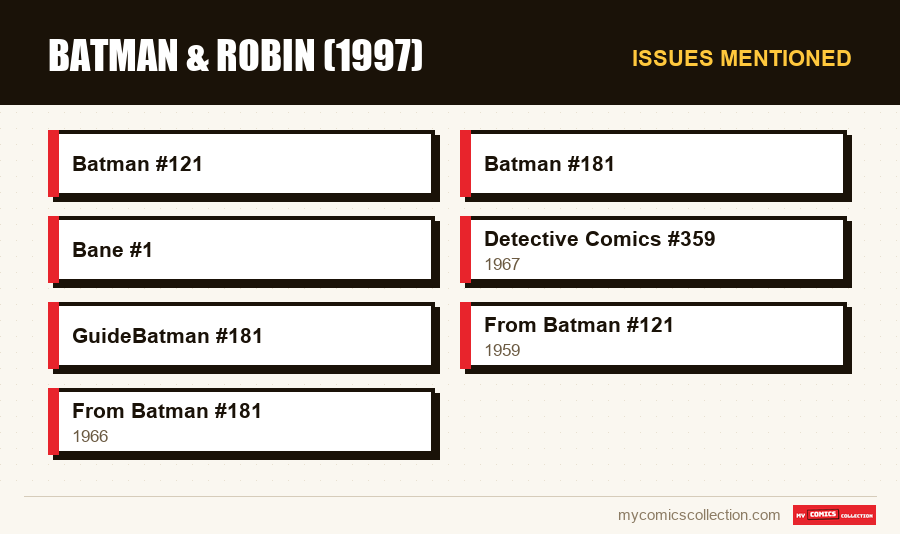
Batman #121 (1959): Mr. Freeze's first appearance
Batman #181 (1966): Poison Ivy's first appearance
Vengeance of Bane #1 (1993): Bane's first appearance
Detective Comics #359 (1967):Batgirl's first appearance
- Batman and robin, the dynamic duo.
- Mr Freeze, criminal with glacial technology.
- Poison Ivy, the eco-terrorist with plant powers.
- Bane, the brute doped with Venom.
- Batgirl, ally of the Black Knight.
- Bane reduced to one mute henchman, without his intelligence.
- Batgirl becomes the niece of Alfred, not Commissioner Gordon's daughter.
- The tone cartoonish pushes the caricature to the extreme.
- The plot is original, outside of comics.
- Mr Freeze's icy puns.
Batman #121 (1959): Mr. Freeze, the cold of vengeance
Batman & Robin pits the Dark Knight against Mr. Freeze, who appeared in Batman #121 (1959) under the name Mr. Zero, before being renamed Mr. Freeze. Real name Victor Fries, this criminal uses freezing technology and must live in a refrigerated suit, his body can no longer survive at normal temperature. In modern comics, notably thanks to the animated series of the 1990s, Mr. Freeze has become a profoundly tragic figure: a scientist whose wife Nora suffers from an incurable illness, he keeps her in cryogenics and turns to crime to finance her cure. This tragic dimension, born from the desperate love for his wife, makes Mr. Freeze one of Batman's most moving villains.
The film takes Mr. Freeze, played by Arnold Schwarzenegger, while retaining certain elements: Victor Fries, his refrigerated suit, his freezing technology and especially the illness of his wife Nora, whom he seeks to save: a direct continuation of the tragedy established by the animated series. This tragic motif is the only truly faithful aspect of the character. The film, however, drowns him in a deluge of cold puns and histrionics, transforming a poignant figure into a comical and exuberant villain. This caricature betrays the depth of Mr. Freeze, whose pain and despair are sacrificed for the sake of spectacle. For the reader, the contrast is striking with the moving character of modern comics.
Batman #181 (1966): Poison Ivy, the eco-terrorist
The film also features Poison Ivy, who appeared in Batman #181 (1966), created by Robert Kanigher and Sheldon Moldoff. Real name Pamela Isley, a botanist transformed by experiments, Poison Ivy has control over plants and immunity to poisons, as well as the ability to seduce and manipulate her victims using toxic pheromones. A fanatical eco-terrorist, she places plant life above humanity and leads a crusade to protect nature, even if it means killing. A complex character, both seductive and misguided idealist, Poison Ivy is one of the most striking enemies and female figures in the Batman universe.
The film takes Poison Ivy, played by Uma Thurman, while retaining her essential traits: Pamela Isley, her plant powers, her seductive pheromones and her eco-terrorist ideology placing plants above humans. These elements are faithful to the comics. The film, however, pushes the character towards an outrageous theatricality and a caricatured seduction, in line with the cartoonish tone of the whole. Poison Ivy's misguided idealism and complexity give way to an exuberant vamp. Despite this caricature, the film captures the essence of the character: his passion for nature, his seductive dangerousness. For the reader, Poison Ivy remains a much more nuanced figure in the comics, whose ecological ideology and moral ambiguity nourish stories of a depth that the film hardly explores.
Bane, the unnatural brute
The film also features Bane, who appeared in Batman: Vengeance of Bane #1 (1993), created by Chuck Dixon, Doug Moench and Graham Nolan. In the comics, Bane is one of Batman's most formidable enemies: a criminal of exceptional intelligence as well as colossal strength, increased tenfold by a drug called Venom. A brilliant strategist, he is famous for having “broken” Batman in the “Knightfall” saga, defeating him physically and mentally. Bane embodies the ultimate threat, that of an adversary capable of rivaling Batman in both brains and brawn. His unique combination of intellect and power makes him an exceptional antagonist.
The film deeply betrays this character. The Bane of the film is reduced to a mute and stupid henchman, a simple brute doped with Venom in the service of Poison Ivy, devoid of any intelligence or strategy. This reduction completely erases what makes Bane so rich in the comics: his tactical genius. The character becomes a mindless gorilla, light years away from the strategist who broke Batman. This betrayal is one of the most criticized in the film. For the reader, the contrast is brutal between the Bane of the comics, a leading intellectual enemy, and the caricature of the film. It illustrates the feature film's disregard for the depth of its characters, and invites us to discover the real Bane in “Knightfall”, one of Batman's major sagas.
The characters, from paper to screen
- Batman & robin: The dynamic duo, faithful to the spirit of the comics.
- Mr Freeze: The cold criminal, whose tragedy is drowned in histrionics.
- Poison Ivy: The seductive eco-terrorist, driven to caricature.
- Bane: The brute with Venom, deprived of his intelligence.
- Batgirl: The ally, transformed into Alfred's niece for the film.
Collecting this series?
Track what you own, what you are missing and what your collection is worth. 7 day trial.
Start my trial →Batgirl, a rewritten origin
The film introduces Batgirl, but changes her origin. In comics, the most famous Batgirl is Barbara Gordon, who appeared in Detective Comics #359 (1967), daughter of Commissioner James Gordon. A brilliant librarian and accomplished athlete, she becomes Batgirl on her own initiative, establishing herself as a heroine in her own right and a major ally of Batman. Barbara Gordon is an iconic DC female character, whose story, including her paralysis in "The Killing Joke" and her reinvention as Oracle, has shaped comics. His bond with Commissioner Gordon anchors the character in Gotham mythology.
The film rewrites this origin: Batgirl becomes Barbara Wilson, the niece of Alfred the butler, and not the daughter of Commissioner Gordon. This modification, which cuts the character from his iconic link with Gordon, illustrates the liberties taken by the film. Alicia Silverstone plays a Batgirl suited to the light tone of the ensemble. This rewriting, added to the caricature of the villains, contributes to the general distance of the film from the comics. For the reader, it is an invitation to discover the real Barbara Gordon in the comics, whose rich history and importance far exceed the role assigned to her on screen. Batgirl remains one of DC's most beloved heroes, whose journey, from Detective Comics #359 to her modern reinventions, illustrates the richness of female characters in the Batman universe.
The tragedy of Mr. Freeze, the film's missed peak
If there is one aspect where Batman & Robin could have shined, it's in the tragedy of Mr. Freeze. Since the animated series of the 1990s, notably the episode "Heart of Ice" by Paul Dini, Victor Fries has become one of Batman's most moving villains: a scientist whose only motivation is to save his wife Nora, suffering from an incurable illness and kept in cryogenics. His turn to crime is not motivated by greed or madness, but by desperate love. This dimension transformed a minor villain into a moving tragic figure, whose exterior coldness masks immense pain. Comics have since fully adopted this poignant version of the character.
The film takes up this motif (Nora's illness, Victor's quest to save her) but fails to exploit its dramatic potential. Drowned under the cold puns and the histrionics of Arnold Schwarzenegger, the tragedy of Mr. Freeze is reduced to a pretext, deprived of the emotion that makes it so powerful in the animated series and the comics. This is perhaps the biggest waste of the film: taking one of Batman's most moving villains and turning him into an exuberant clown. For the reader, this contrast illustrates the gap between the character's potential and his treatment on screen. It invites you to discover the real Mr Freeze in “Heart of Ice” and the comics which made him an unforgettable tragic figure, the incarnation of love and mourning at the heart of the Batman universe.
Where to start reading
To extend the film, Batman #121 (1959) presents the first appearance of Mr. Freeze, Batman #181 (1966) that of Poison Ivy, and Vengeance of Bane #1 (1993) that of Bane. “Batman: Knightfall” masterfully develops Bane. Paul Dini's "Batman: Mr. Freeze" (1997) reveals the tragedy of Victor Fries. This tour covers the film's sources.
Chronology of comics to know
- 1959: Batman #121: the first appearance of Mr. Freeze (Mr. Zero).
- 1966: Batman #181: Poison Ivy's first appearance.
- 1993: Vengeance of Bane #1: Bane's first appearance.
Collection side: what numbers to aim for after the film
Batman & Robin points to various keys. Batman #121 (1959, first appearance of Mr Freeze) and Batman #181 (1966, first appearance of Poison Ivy) are sought-after keys to the Silver Age. Vengeance of Bane #1 (1993, Bane's first appearance) is an accessible and popular modern key. Detective Comics #359 (1967, Batgirl premiere) is another target. These numbers cover various budgets. As always, condition and gradation determine value; relying on real recent sales is strongly recommended.
Its place in the saga and for the collector
Batman & Robin will remain as the controversial end point of the Schumacher saga, often cited among the most criticized adaptations, for its caricature of the villains. For the collector, it nevertheless highlighted Batman #121, #181 and Vengeance of Bane #1, keys to major characters. It illustrates the pitfalls of an overly cartoonish tone. Beyond this failure, Mr. Freeze, Poison Ivy and Bane remain fascinating enemies, to be discovered in the comics. The film implicitly reminds us of the importance of respecting the depth of the characters in order to succeed in an adaptation.
The verdict: iconic villains caricatured
- Loyalty: Batman and Robin, Mr. Freeze and his suit, Nora's tragedy, Poison Ivy and her plant powers, Bane and Venom, Batgirl come from the comics.
- Freedoms: Bane reduced to a mute brute, Batgirl become Alfred's niece, the outrageous cartoonish tone, an original plot, the tragedy of Freeze drowned in comedy.
- Collectible numbers: Batman #121 (Mr. Freeze), Batman #181 (Poison Ivy), Vengeance of Bane #1 (Bane).
Batman & Robin pits the Dark Knight against Mr. Freeze, Poison Ivy and Bane, in a cartoonish Gotham taken to the extreme. Faithful to the characters on paper but caricaturing their depth (especially Bane, reduced to a mute brute) the film illustrates the pitfalls in a tone that is too light. For both the reader and the collector, it is an invitation to discover Batman #121, #181 and Vengeance of Bane #1.
Frequently asked questions
From Batman #121 (1959), first as Mr. Zero. Victor Fries must live in a refrigerated suit. Modern comics have made him a tragic figure, a scientist seeking to save his sick wife Nora. The film takes up this tragedy but drowns it in histrionics.
From Batman #181 (1966), created by Robert Kanigher and Sheldon Moldoff. Pamela Isley, botanist, controls plants and manipulates with pheromones. An eco-terrorist placing nature above humans, she is faithfully reproduced in the film, although pushed towards caricature.
In the comics (Vengeance of Bane #1, 1993), Bane is a brilliant strategist as well as a brute, famous for having broken Batman in "Knightfall". The film reduces him to a mute, mindless henchman serving Poison Ivy, erasing his intelligence. It is one of the most criticized betrayals.
No. In the comics (Detective Comics #359, 1967), Barbara Gordon is the daughter of the commissioner. The film transforms her into Barbara Wilson, the niece of Alfred the butler, severing the character from her iconic connection to Gordon and the mythology of Gotham.
Batman #121 (1959, Mr. Freeze) and Batman #181 (1966, Poison Ivy) are keys to the Silver Age. Vengeance of Bane #1 (1993, Bane) is an accessible and popular modern key. Detective Comics #359 (1967, Batgirl) is another target.
Does the film make you want to collect? Estimate the value for free of your issues (Batman #121, Batman #181, Vengeance of Bane #1…) with our tool based on current eBay listings.