The Dark Knight Rises (2012) Christopher Nolan concludes his trilogy by pitting Batman against Bane (Batman: Vengeance of Bane #1, 1993), which breaks his back like in the saga “Knightfall”(Batman #497, 1993). The film also features Selina Kyle / Catwoman (Batman #1, 1940) and Talia al Ghul. Faithful to the spirit of several stories, he reinvents the plot. Here is the detailed comparison, film versus comics.
The epic conclusion to Nolan's trilogy, The Dark Knight Rises brings to the screen the fall and resurrection of Batman. It draws from several major comic book sagas. Source-by-source decryption.
As in each article in this series, only verified information (creators, distribution, dates, comic numbers) is stated; the comparative analysis is ours, without reproducing dialogue or protected images.
Title : The Dark Knight Rises (2012)
Director: Christopher Nolan
Actors: Christian Bale (Batman), Tom Hardy (Bane), Anne Hathaway (Selina Kyle), Marion Cotillard (Talia)
Exit : July 2012
Studio: Warner Bros.
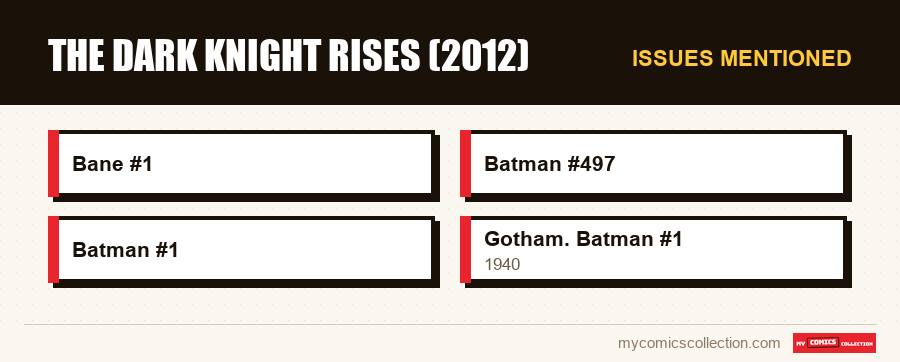
Batman: Vengeance of Bane #1 (1993): Bane's first appearance
“Knightfall”(Batman #497, 1993): Bane breaks Batman's back
Batman #1 (1940): Catwoman's first appearance
Talia al Ghul: the daughter of Ra's al Ghul
- Bane, intelligent colossus who breaks Batman's back.
- La fall and resurrection of the hero (“Knightfall”).
- Selina Kyle / Catwoman, ambiguous thief.
- Talia al Ghul, daughter of Ra's al Ghul.
- Taking Gotham held hostage (echo of “No Man’s Land”).
- L'origin of Bane is reorganized (the prison, the League).
- The plot is largely original.
- Catwoman is never named "Catwoman".
- The movie definitively concludes Bruce's arc.
- The tone remains realistic and grounded.
Bane and “Knightfall” (1993)
The film pits Batman against Bane, one of the few enemies to physically defeat him. Bane appears in Batman: Vengeance of Bane #1 (1993), created by Chuck Dixon, Doug Moench and Graham Nolan. A colossus born and raised in a prison, endowed with strength increased by a drug, Venom, but also with a formidable intelligence, he is conceived as “the man who broke the Black Knight”. In the "Knightfall" saga (from Batman #497, 1993), Bane wears Batman down and then breaks his back, forcing him to abandon his role. This event, one of the most traumatic in the character's history, left its mark on readers. The film faithfully reproduces this iconic moment: Bane breaks Batman's back, plunging him into a decline from which he will have to recover.
The film respects the essence of Bane: strength and intelligence, the physical victory over Batman, the decline of the hero. Tom Hardy plays a massive and charismatic Bane, whose voice and presence are striking. The film, however, rearranges its origin and mythology: in the film, Bane is linked to Ra's al Ghul's League of Shadows and an underground prison, a largely original story. The Venom drug from the comics disappears in favor of a mask diffusing painkiller. These liberties serve the coherence of Nolan's trilogy, while retaining the heart of the character: the adversary who pushes Batman to his limits, before his resurrection.
The Fall and Resurrection of Batman
The heart of the film is the arc of Batman's fall and resurrection, directly inspired by "Knightfall." After being broken by Bane, Bruce Wayne, imprisoned and deprived of everything, must draw from himself the strength to get back up, both physically and morally. This trajectory, the decline then the return of the hero, is one of the great themes of comics, that of resilience in the face of the most extreme adversity. The film develops this arc with breadth, showing a Bruce Wayne at his lowest who finds, at the end of an initiatory ordeal, the desire to save Gotham. This redemptive dimension gives the film its emotional significance.
This structure of fall and rebirth is faithful to the spirit of “Knightfall”, even if the film reinvents the details. In the comics, Batman's recovery and temporary replacement follow a different path, but the central idea, the broken hero who must be reborn, is common. The film adds a conclusive dimension, making this resurrection the culmination of Bruce Wayne's arc over the entire trilogy. For the reader, this arc is an invitation to discover “Knightfall” in the comics, a major saga where Batman faces his own limit. The film captures the power of this story of resilience, one of the character's most striking, by scaling it to an epic conclusion.
Catwoman and Talia al Ghul
The film features two major female characters. Selina Kyle, aka Catwoman, appeared as early as Batman #1 (1940), is a skilled thief with moral ambiguity, oscillating between crime and alliance with Batman. The film faithfully takes up this dimension, with Selina Kyle (never named “Catwoman” on screen) torn between her personal interest and her conscience. Anne Hathaway embodies this fascinating character, true to her feline and independent spirit. Talia al Ghul, daughter of Ra's al Ghul, who appeared in the comics in the 1970s, plays a key role in the plot, continuing her father's legacy against Gotham.
These two characters enrich the story and connect it to the Batman mythology. Catwoman, emblematic figure of the Dark Knight's gallery, embodies the moral ambivalence and romantic tension dear to the character. Talia, for her part, completes the arc started in Batman Begins with Ra's al Ghul, making the League of Shadows the recurring threat of the trilogy. The film thus weaves continuity between its parts, anchored in the comics. For the reader, Catwoman and Talia are invitations to discover the richness of the characters revolving around Batman, whose complex relationships (romantic, family, conflictual) nourish stories of great depth. The film aptly incorporates them at its conclusion.
Collecting this series?
Track what you own, what you are missing and what your collection is worth. 7 day trial.
Start my trial →The characters, from paper to screen
- Batman/Bruce Wayne: Broken hero then reborn, faithful to the spirit of “Knightfall”.
- Bane: Intelligent colossus that breaks Batman's back, originally retooled.
- Selina Kyle / Catwoman: Ambiguous thief, loyal to Batman #1.
- Talia al Ghul: Daughter of Ra's al Ghul, heir to his crusade.
- Jim Gordon: Batman's allied commissioner, present until the end.
An epic and grounded conclusion
The Dark Knight Rises concludes Nolan's trilogy with epic scope, while retaining the realistic anchoring that characterizes it. The film pushes the saga's themes (fear, sacrifice, legacy, resilience) to their climax in a Gotham hostage story that evokes the "No Man's Land" saga of the comics. By making Bruce Wayne a hero who must be reborn after having lost everything, the film offers a conclusion that lives up to the dramatic stakes established in the previous parts. This conclusive dimension, which closes the character's arc, is one of the great successes of the trilogy.
This conclusion illustrates the coherence of Nolan's vision, who treated Batman as a dramatic character evolving over three films. En s'inspirant de plusieurs sagas majeures (« Knightfall », « No Man's Land ») le film capte l'essence du Chevalier Noir : un homme brisé qui trouve, dans le sacrifice et la résilience, la force de sauver sa ville. For the reader, it is an invitation to discover these great comic book sagas, where Batman confronts his most extreme limits. The Dark Knight Rises referme une trilogie qui aura redéfini le film de super-héros, en prouvant que le genre pouvait porter des récits d'une profondeur et d'une ambition dignes du grand cinéma.
The end of a legendary trilogy
The Dark Knight Rises concludes one of the most acclaimed trilogies in superhero cinema history. By completing the arc of Bruce Wayne begun with Batman Begins and continued in The Dark Knight, the film offers a conclusion to a story of nearly seven hours, of rare coherence and ambition for the genre. This trilogy by Christopher Nolan redefined what a superhero film could be, by treating Batman as a dramatic character evolving over three parts, in a realistic and psychologically in-depth universe. Its conclusion, despite some debate, honors this overall vision.
This ending illustrates the strength of a serial and coherent approach, where each film deepens the character and his universe. Drawing on the great stories of comics, from "Year One" to "Knightfall", Nolan's trilogy captured the essence of the Dark Knight: a broken man who transforms his trauma into a mission, before finding, in sacrifice, a form of peace. For the reader, this conclusion is an invitation to discover the sagas that inspired it, where Batman confronts his most extreme limits. The Dark Knight Rises will remain as the end of a benchmark trilogy, which elevated the superhero film to the rank of great cinema and lastingly marked the perception of the character.
Where to start reading
To extend the film, Batman: Vengeance of Bane #1 (1993) introduces Bane, and the "Knightfall" saga (from Batman #497, 1993) tells how he breaks Batman's back. “No Man's Land” (1999) inspires the takeover of Gotham. Batman #1 (1940) introduced Catwoman. This journey covers the sources of a film which synthesizes several major sagas.
Chronology of comics to know
- 1940: Batman #1: The first appearance of Catwoman.
- 1993: Batman: Vengeance of Bane #1: Bane's first appearance.
- 1993: “Knightfall” (Batman #497): Bane breaks Batman’s back.
Collection side: what numbers to aim for after the film
The Dark Knight Rises points to varied keys. Batman: Vengeance of Bane #1 (1993, first appearance of Bane) is a sought-after issue, whose popularity is driven by the popularity of the character. Batman #497 (1993, “Knightfall”, Bane breaks Batman's back) is an emblematic key to the saga. Batman #1 (1940, Catwoman) is a holy grail of the Golden Age. These numbers cover various budgets. As always, condition and gradation determine value; relying on real recent sales is strongly recommended.
Its place in the saga and for the collector
The Dark Knight Rises concludes Nolan's trilogy by bringing to the screen the fall and resurrection of Batman, inspired by “Knightfall”. For the collector, it reignited interest in Vengeance of Bane #1 and Batman #497. It illustrates the effect of adaptations on the market. Beyond speculation, the film invites you to discover the great sagas of Batman in the comics, from “Knightfall” to “No Man's Land”. By offering an epic and grounded conclusion, it closes a trilogy that redefined the superhero film and left a lasting mark on popular culture.
The Verdict: A “Knightfall”-Inspired Conclusion
- Loyalty: Bane breaking Batman's back, the fall and resurrection, Catwoman and Talia al Ghul come from the comics.
- Freedoms: Bane's origin rearranged, the original plot, Catwoman never named, the final conclusion of the arc.
- Collectible numbers: Batman: Vengeance of Bane #1 (Bane), Batman #497 (“Knightfall”), Batman #1 (Catwoman).
The Dark Knight Rises concludes the trilogy by pitting Batman against Bane, who breaks his back like in “Knightfall”, before his resurrection. Faithful to the spirit of several major sagas but reinventing their plot, the film offers an epic and grounded conclusion. For both the reader and the collector, it is an invitation to discover “Knightfall” and Vengeance of Bane #1.
Frequently asked questions
From Batman: Vengeance of Bane #1 (1993), created by Chuck Dixon, Doug Moench and Graham Nolan. Intelligent colossus, he breaks Batman's back in the “Knightfall” saga (Batman #497, 1993). The film faithfully reproduces this iconic moment.
A cult saga from 1993 (from Batman #497) where Bane exhausts and then breaks Batman's back, forcing him to abandon his role. The film is directly inspired by this for the fall and resurrection of the hero.
No: the character of Selina Kyle, faithful to Batman #1 (1940), is never explicitly called "Catwoman" on screen, in the realistic logic of the trilogy. Anne Hathaway nevertheless faithfully embodies his moral ambiguity.
In part: the film keeps the intelligent colossus that breaks Batman, but rearranges his origin, linking him to the League of Shadows and an underground prison. The drug Venom from the comics is replaced by a pain mask.
Batman: Vengeance of Bane #1 (1993, Bane's premiere) and Batman #497 (1993, "Knightfall") are hot targets. Batman #1 (1940, Catwoman) is a holy grail of the Golden Age.
Does the film make you want to collect? Estimate the value for free of your issues (Vengeance of Bane #1, Batman #497…) with our tool based on current eBay listings.