The Dark Knight (2008) Christopher Nolan , with Christian Bale and Heath Ledger , pits Batman against Joker (Batman #1, 1940) and depicts the fall of Harvey Dent / Two-Face (Detective Comics #66, 1942). The film is inspired by “The Long Halloween» and “The Killing Joke”, in a dark thriller about chaos and morality. Here is the detailed comparison, film versus comics.
The culmination of Nolan's trilogy and a benchmark of the genre, The Dark Knight brings to the screen the legendary confrontation between Batman and the Joker. It draws on the greatest tales of the Dark Knight. Source-by-source decryption.
As in each article in this series, only verified information (creators, distribution, dates, comic numbers) is stated; the comparative analysis is ours, without reproducing dialogue or protected images.
Title : The Dark Knight (2008)
Director: Christopher Nolan
Actors: Christian Bale (Batman), Heath Ledger (The Joker), Aaron Eckhart (Harvey Dent), Gary Oldman (Gordon)
Exit : July 2008
Studio: Warner Bros.
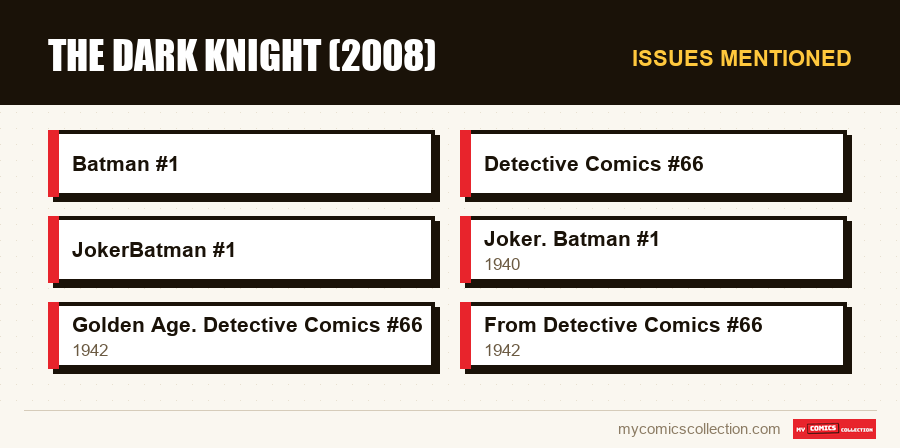
Batman #1 (1940): 1st appearance of the Joker
Detective Comics #66 (1942): 1st appearance of Two-Face
“The Long Halloween”(1996): Loeb & Dirty
“The Killing Joke”(1988): the philosophy of the Joker
- Le Joker, agent of chaos, ultimate enemy of Batman.
- La fall of Harvey Dent in Double-Face.
- Le moral duel between order and chaos.
- Le refusal to kill of Batman, put to the test.
- The alliance Batman-Gordon-Tooth against crime.
- Le Joker without fixed origin, assumed choice of the film.
- The plot is largely original.
- Double-Face dies from this film.
- The tone, realistic, anchors Gotham in the thriller.
- Elements of several stories are merged.
The Joker, agent of chaos born in Batman #1 (1940)
The Joker appears in Batman #1 (1940), created by Bob Kane, Bill Finger and Jerry Robinson. A criminal clown with a white face and a demented laugh, he is, in the comics, the incarnation of pure chaos, the absolute antithesis of Batman. Where the Dark Knight seeks to impose order and justice, the Joker sows disorder and madness, with no other motivation than chaos itself. This fundamental opposition, order versus chaos, is at the heart of their rivalry, one of the richest in all of fiction. The Joker has no fixed origin in the comics: his mystery, his lack of a coherent past, are part of his horror and his dramatic power.
The film masterfully captures this dimension. Heath Ledger delivers a legendary interpretation of the Joker, playing a terrifying, unpredictable and philosophical agent of chaos. Faithful to the spirit of the character, the film assumes his lack of a fixed origin: the Joker tells several contradictory versions of his past, never letting the viewer know the truth. This choice, deeply faithful to the comics, reinforces the mystery and horror of the character. The film also explores his nihilistic philosophy, his desire to prove that anyone can fall into chaos, in a moral duel with Batman which constitutes the heart of the story.
Harvey Dent and the fall into Two-Face
The film depicts the tragedy of Harvey Dent, Gotham's honest prosecutor who turns into Two-Face after being disfigured and broken by the Joker. Two-Face appears in Detective Comics #66 (1942): a former district attorney with a half-ravaged face, he bases his decisions on the toss of a coin, embodying the duality between good and evil, chance and justice. The film faithfully takes up this character and its symbolism, making Dent the “white knight” of Gotham whose fall illustrates the fragility of hope. Aaron Eckhart embodies this tragic trajectory, from hero to monster.
The fall of Harvey Dent is at the heart of the film's purpose: the Joker seeks to prove that even the best of men can be corrupted, and Dent becomes the demonstration. This tragedy, faithful to the spirit of the character from the comics, serves the moral duel between Batman and the Joker. The film, however, takes a liberty by having Two-Face die in this part, where the character has a long career in comics. This condensation serves the closed narrative of the film. For the reader, Double-Face is an invitation to discover “The Long Halloween” (1996), a major story which explores his transformation in depth and whose influence on the film is obvious. Harvey Dent embodies the tragedy of a man broken by the crime he fought.
The influence of “The Long Halloween” and “The Killing Joke”
The film draws on two major stories from the comics. “The Long Halloween” (1996) by Jeph Loeb and Tim Sale, a dark thriller about the beginnings of Batman and the fall of Harvey Dent, directly influences the structure and themes of the film, notably the alliance between Batman, Gordon and Dent against organized crime, and the tragic shift of the prosecutor. “The Killing Joke” (1988) by Alan Moore and Brian Bolland, a seminal story about the Joker, inspires the character's philosophy: the idea that a single bad day can send anyone into madness. These two works, peaks of comics, nourish the depth of the film.
This inspiration illustrates the richness of the sources from which the film draws. Rather than adapting a specific story, The Dark Knight merges elements from several major comics to compose an original plot, while respecting the spirit and themes of its sources. This approach, which captures the essence of Batman's great stories without copying them, demonstrates a deep understanding of the character. For the reader, the film is an invitation to discover “The Long Halloween” and “The Killing Joke”, two masterpieces that explore the duality, morality and chaos at the heart of the Batman universe. The film offers a masterful cinematographic synthesis, driven by universal themes.
Collecting this series?
Track what you own, what you are missing and what your collection is worth. 7 day trial.
Start my trial →The characters, from paper to screen
- Batman/Bruce Wayne: The vigilante whose refusal to kill is tested by the Joker.
- The Joker: Agent of chaos without a fixed origin, faithful to the spirit of Batman #1 and “The Killing Joke”.
- Harvey Dent / Two-Face: The Broken “White Knight,” faithful to Detective Comics #66 and “The Long Halloween.”
- Jim Gordon: The honest police officer, pillar of the alliance against crime.
- Alfred and Lucius Fox: Bruce Wayne's allies, guarantors of his balance.
A pinnacle of superhero cinema
The Dark Knight is unanimously considered one of the pinnacles of superhero cinema, or even cinema in general. By treating the confrontation between Batman and the Joker as a philosophical thriller about order, chaos and morality, Christopher Nolan has elevated the genre to a new level of depth and ambition. Heath Ledger's posthumously awarded performance will go down as one of the greatest incarnations of a villain on screen. The film explores serious themes (justice, sacrifice, corruption, human nature) with rare intelligence and intensity, transcending the simple superhero film.
This success is due to the film's fidelity to the essence of Batman and the Joker, as it was forged in the greatest comic book stories. The duel between order and chaos, the fragility of morality, the refusal to kill put to the test: these themes, at the heart of the Batman universe, are explored with a depth that honors its sources. For the reader, the film is the culmination of decades of stories that have made Batman and the Joker two of the richest characters in fiction. The Dark Knight proves that the superhero film can achieve dramatic excellence, and pays homage to the comics that inspired it, from "The Long Halloween" to "The Killing Joke." It is an absolute reference of the genre.
Heath Ledger's Joker, a legendary incarnation
It's impossible to talk about The Dark Knight without returning to Heath Ledger's interpretation of the Joker, unanimously considered one of the greatest villain performances in the history of cinema. Winner of a posthumous Oscar, she redefined the character on screen, capturing his madness, unpredictability and philosophical dimension with disturbing intensity. Ledger played a terrifying Joker precisely because he escapes all logic: without understandable motivation, without a fixed past, he is chaos made man. This incarnation left a lasting mark on popular culture and elevated the film to the rank of reference.
This performance illustrates the film's fidelity to the essence of the Joker as forged in the comics, particularly in "The Killing Joke." The Joker is not a simple criminal but an idea: that order and reason hang by a thread, that a single bad day can tip anyone into madness. Ledger and Nolan translate this philosophy with rare acuity. For the reader, this incarnation is an invitation to discover the great stories of the Joker in the comics, where the character explores the limits of morality and mental health. Heath Ledger's Joker will remain as the most accomplished transposition of this figure of chaos, inseparable from the mythical duel which pits him against Batman.
Where to start reading
To extend the film, “The Long Halloween” (1996) by Loeb and Sale explores the fall of Harvey Dent, and “The Killing Joke” (1988) by Moore and Bolland the philosophy of the Joker. Batman #1 (1940) features the Joker, and Detective Comics #66 (1942) features Two-Face. This journey covers the source material for a film that synthesizes the greatest Batman stories.
Chronology of comics to know
- 1940: Batman #1: The Joker's first appearance.
- 1942: Detective Comics #66: the first appearance of Two-Face.
- 1988-1996: “The Killing Joke” and “The Long Halloween”: the stories that inspire the film.
Collection side: what numbers to aim for after the film
The Dark Knight points to major keys. Batman #1 (1940, first appearance of the Joker) is a highly sought-after key to the Golden Age. Detective Comics #66 (1942, premiere of Two-Face) is another Golden Age target. The collections “The Long Halloween” and “The Killing Joke” are essential reading and accessible targets. These numbers cover budgets ranging from inaccessible to reasonable. As always, condition and gradation determine value; relying on real recent sales is strongly recommended.
Its place in the saga and for the collector
The Dark Knight is the pinnacle of Nolan's trilogy and a reference in superhero cinema, carried by Heath Ledger's legendary Joker. For the collector, it reignited interest in Batman #1, Detective Comics #66, and stories like “The Long Halloween.” It illustrates the effect of adaptations on the market. Beyond speculation, the film invites you to discover the greatest stories of Batman and the Joker in the comics. By treating their clash as a philosophical thriller, he elevated the genre and paid homage to the masterpieces that inspired it.
The verdict: the Batman-Joker duel sublimated
- Loyalty: the Joker, agent of chaos, the fall of Harvey Dent, the moral duel and the refusal to kill come from the comics.
- Freedoms: the Joker without a fixed origin (faithful but assumed choice), the original plot, the death of Two-Face, the fusion of several stories.
- Collectible numbers: Batman #1 (Joker), Detective Comics #66 (Two-Face), “The Long Halloween”, “The Killing Joke”.
The Dark Knight sublimates the confrontation between Batman and the Joker into a philosophical thriller about order and chaos, carried by the legendary interpretation of Heath Ledger. Faithful to the spirit of the greatest stories (“The Long Halloween”, “The Killing Joke”) the film masterfully synthesizes its sources. For both the reader and the collector, it is an invitation to discover Batman #1 and Detective Comics #66.
Frequently asked questions
No, and it's a choice faithful to the comics: the Joker tells several contradictory versions of his past, without ever revealing the truth. This lack of a fixed origin, which reinforces his mystery and horror, is at the heart of the character.
From Detective Comics #66 (1942). A disfigured former prosecutor, Harvey Dent bases his decisions on the toss of a coin, embodying the duality of good/evil. The film resumes its fall, strongly inspired by “The Long Halloween” (1996).
“The Long Halloween” (1996) by Loeb and Sale, for the fall of Harvey Dent and the Batman-Gordon-Dent alliance, and “The Killing Joke” (1988) by Moore and Bolland, for the philosophy of the Joker. The film merges these sources into an original plot.
For its treatment of the Batman-Joker duel as a philosophical thriller about order, chaos and morality, and for Heath Ledger's legendary performance. The film elevates the genre to a rare level of dramatic depth.
Batman #1 (1940, premiere of Joker) and Detective Comics #66 (1942, premiere of Two-Face) are two keys to the Golden Age. The collections “The Long Halloween” and “The Killing Joke” are accessible and essential targets.
Does the film make you want to collect? Estimate the value for free of your issues (Batman #1, Detective Comics #66…) with our tool based on current eBay listings.