Joker (2019) Todd Phillips , with Joaquin Phoenix, offers an autonomous and realistic origin of Batman's famous enemy (Batman #1, 1940). The film is inspired by the spirit of “The Killing Joke» (1988), a single bad day sends a man into madness, without adapting a precise story. Awarded and acclaimed, he radically reinvents the character. Here is the detailed comparison, film versus comics.
A singular cinematic object, Joker frees itself from the superhero film to deliver a social drama about the birth of a monster. It draws on the spirit of the character without tracing a story. Source-by-source decryption.
As in each article in this series, only verified information (creators, distribution, dates, comic numbers) is stated; the comparative analysis is ours, without reproducing dialogue or protected images.
Title : Joker (2019)
Director: Todd Phillips
Actors: Joaquin Phoenix (Arthur Fleck / Joker), Robert De Niro, Frances Conroy, Zazie Beetz
Exit : October 2019
Studio: Warner Bros.
Batman #1 (1940): 1st appearance of the Joker
“The Killing Joke”(1988): Moore & Bolland
“just one bad day”: the philosophy of changeover
Thomas and Bruce Wayne: Gotham and its social divide
- Le Joker, figure of chaos and madness.
- The idea of a bad day» (“The Killing Joke”).
- Gotham and its social divide.
- THE Wayne (Thomas, young Bruce).
- Le pathological laughter of the character.
- A fixed and realistic origin (Arthur Fleck), unpublished.
- No Batman nor superpowers: a social drama.
- The story is autonomous, out of continuity.
- The influence of Scorsese set the tone.
- La mental illness is at the center of the story.
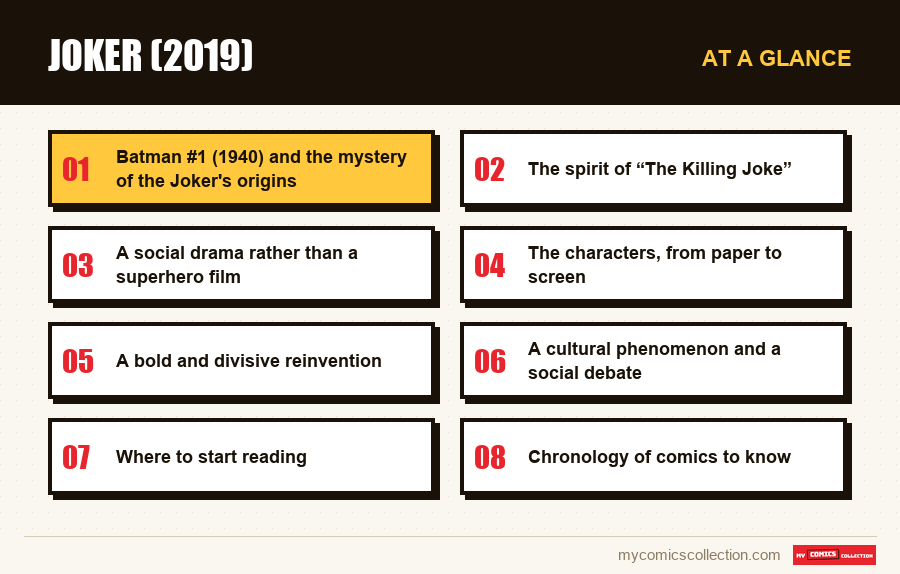
Batman #1 (1940) and the mystery of the Joker's origins
The Joker appears in Batman #1 (1940), created by Bob Kane, Bill Finger and Jerry Robinson. Since then, he has been Batman's most iconic enemy, the embodiment of chaos in the face of order. One of the most striking characteristics of the character in the comics is the absence of a fixed origin: his past remains a mystery, and the rare stories which evoke him, such as "The Killing Joke" (1988), present their versions as uncertain. The Joker himself says he prefers his past to be "multiple". This lack of coherent origin is part of his horror: he is chaos incarnate, without rational explanation, a pure force which escapes all logic.
Todd Phillips' film takes the radical opposite of this tradition by giving the Joker a fixed, detailed and realistic origin. Arthur Fleck, a failed clown and failed comedian, suffering from mental illness and rejected by a merciless society, gradually descends into madness and violence, until he becomes the Joker. This unique psychological and social origin moves away from the enigma maintained by comics. The film accepts this choice, delivering not an adaptation of a specific story, but a reinvention of the character from the angle of social drama. Joaquin Phoenix embodies this descent into hell with an intensity that earned him an Oscar.
The spirit of “The Killing Joke”
If the film does not adapt any specific story, it draws on the spirit of “The Killing Joke” (1988), by Alan Moore and Brian Bolland, one of the most famous stories about the Joker. This comic develops a central idea: it only takes “one bad day” to tip anyone, even the healthiest man, into madness. The Joker seeks to prove this thesis, by attempting to break minds through trauma. Phillips' film illustrates this philosophy through the journey of Arthur Fleck: an accumulation of misfortunes, rejections and humiliations which push him, inexorably, towards murderous madness. It’s the epitome of “bad day” stretched out over an entire film.
This inspiration gives the film its thematic coherence with the character. The Joker of “The Killing Joke” is a man broken by society and chance, who has become chaos incarnate; Arthur Fleck follows a similar trajectory, shaped by a cruel and indifferent Gotham. The film thus explores the social roots of violence, making the Joker the product of a sick society. This dimension, if it takes the risk of rationalizing a character whose strength lies in mystery, nevertheless relies on an authentic idea of comics. For the reader, the film is an invitation to discover “The Killing Joke”, a major story which questions, with disturbing depth, the tenuous border between reason and madness.
A social drama rather than a superhero film
The uniqueness of Joker lies in its genre: it is not a superhero film, but a social and psychological drama. Without Batman, without superpowers, without spectacular action, the film follows the slow disintegration of a marginalized man in a Gotham of the 1980s, plagued by inequality and indifference. This approach, radically different from the usual adaptations, is openly inspired by the cinema of Martin Scorsese, in particular his portraits of solitary and unstable men. The film explores mental illness, social exclusion, violence, with a seriousness and realism that moves it away from entertainment and towards auteur cinema.
This bold move earned the film resounding critical and commercial success, as well as numerous awards, making it one of the most acclaimed superhero films, or rather comic book films. It has also sparked debate over its depiction of violence and mental illness. By treating the Joker as a character in a social drama, the film proves that comic book figures can inspire ambitious and disturbing works. For the reader, Joker is a radical rereading of a cult character, which questions our society as much as the mythology of the Joker. It illustrates the richness of a figure whose absence of fixed origin allows, paradoxically, all reinventions, including the most realistic and the most disturbing.
Collecting this series?
Track what you own, what you are missing and what your collection is worth. 7 day trial.
Start my trial →The characters, from paper to screen
- Arthur Fleck / Joker: Failed clown who descends into madness, original fixed and realistic origin.
- Thomas Wayne: Notable rich person from Gotham, figure of the social divide.
- Young Bruce Wayne: Child crossed by Arthur, a nod to the future Batman.
- Murray Franklin: Television host, played by Robert De Niro.
- Gotham City: City of the 1980s, plagued by inequalities.
A bold and divisive reinvention
Joker is one of the boldest and most discussed adaptations of a comic book. By giving the character a fixed and realistic origin, the film takes the risk of demystifying a figure whose strength lies precisely in his mystery. This reinvention, which rationalizes the Joker as a product of a sick society, divided purists, attached to the enigma of the character in the comics. But it also seduced with its ambition, its depth and the inhabited interpretation of Joaquin Phoenix. The film fully embraces its bias, delivering a singular work that transcends genre.
This reinvention illustrates the richness of a character as malleable as the Joker. Precisely because he has no canonical origin, he lends himself to all interpretations, from the chaotic clown of “The Killing Joke” to Christopher Nolan's agent of chaos, to Todd Phillips' Arthur Fleck. Each version sheds light on a facet of the character. For the reader, Joker is an invitation to discover the multiple faces of the Joker in the comics, where the mystery of his origins nourishes his legend. The film, by daring a realistic origin, reminds us that the Joker is perhaps the most fascinating character in fiction, a mirror held up to our fears and our societies, capable of reinventing himself infinitely.
A cultural phenomenon and a social debate
Joker has gone beyond being a simple film to become a true cultural phenomenon. Its immense commercial success, one of the largest for a film rated adult, and its harvest of awards surprised the industry, proving that a dark and ambitious work based on a comic book could reach a massive audience. The film has sparked countless analyses, on its social significance, its depiction of mental illness and violence, and its message. This cultural resonance testifies to the strength of the Joker's character and the relevance of the themes addressed: exclusion, indifference, social divide.
This debate also focused on the risks of a work showing the genesis of a killer, with some fearing that it would glorify violence. This controversy, revealing the impact of the film, illustrates its ability to question our society beyond simple entertainment. By treating the Joker as a symptom of a sick world, the film touches on deep and disturbing questions. For the reader, this resonance recalls the power of the character, whose figure of chaos has always been a mirror held up to our collective fears. Joker will have proven that comics can inspire works capable of sparking a real social debate, confirming the richness and topicality of their most emblematic figures.
Where to start reading
To extend the film, “The Killing Joke” (1988) by Alan Moore and Brian Bolland is the major reference on the Joker and his philosophical inspiration. Batman #1 (1940) features his first appearance. Brian Azzarello's "The Man Who Laughs" (2005) and "Joker" (2008) explore the character. This journey covers the source material for a film that radically reinvents the Joker.
Chronology of comics to know
- 1940: Batman #1: The Joker's first appearance.
- 1988: “The Killing Joke”: the story that inspires the philosophy of the film.
- 2008: “Joker” (Brian Azzarello): a dark exploration of the character.
Collection side: what numbers to aim for after the film
Joker points to major keys. Batman #1 (1940, first appearance of the Joker) is a grail of the Golden Age, highly sought after and valuable. The collection “The Killing Joke” (1988) is essential reading and an accessible target, available in numerous editions. Modern stories like Azzarello’s “Joker” offer other avenues. These numbers cover budgets ranging from inaccessible to reasonable. As always, condition and gradation determine value; relying on real recent sales is strongly recommended.
Its place in the saga and for the collector
Joker radically reinvented Batman's famous foe into an acclaimed and award-winning social drama. For the collector, it reignited interest in Batman #1 and “The Killing Joke.” It illustrates the effect of adaptations on the market. Beyond speculation, the film invites us to discover the multiple faces of the Joker in the comics, where the absence of a fixed origin nourishes his legend. By daring a realistic origin and an unexpected genre, he proved that comic book figures can inspire ambitious works, while recalling the lasting fascination exercised by DC's most enigmatic character.
The verdict: a radical and acclaimed origin
- Loyalty: the Joker represents chaos, the idea of the “bad day” (“The Killing Joke”), Gotham and the Waynes come from the comics.
- Freedoms: a fixed and realistic origin (Arthur Fleck), the absence of Batman, the genre of social drama, the influence of Scorsese.
- Collectible numbers: Batman #1 (Joker), “The Killing Joke” (1988).
Joker offers an autonomous and realistic origin of Batman's famous enemy, drawing inspiration from the spirit of "The Killing Joke" without adapting a specific story. An acclaimed and award-winning social drama, led by Joaquin Phoenix, the film radically reinvents the character. For both the reader and the collector, it is an invitation to discover “The Killing Joke” and Batman #1.
Frequently asked questions
No in a fixed way: the absence of a coherent origin is part of its mystery. The rare stories that mention it, such as “The Killing Joke” (1988), present their versions as uncertain. The film takes the opposite view by giving him a detailed and realistic origin.
It doesn't adapt any specific story, but draws on the spirit of Alan Moore's "The Killing Joke" (1988): the idea that "one bad day" can drive a man into madness. Arthur Fleck's journey illustrates this philosophy.
No, as Batman: the film takes place before, and we only meet young Bruce Wayne as a child and his father Thomas. Without superheroes or superpowers, Joker is an autonomous social drama, outside classic continuity.
For his audacity: treating the Joker as a character in a social and psychological drama, in a film inspired by Scorsese, carried by the inhabited interpretation of Joaquin Phoenix (Oscar). It transcends genre, despite debates over its depiction of violence.
Batman #1 (1940, Joker premiere) is a holy grail of the Golden Age. The collection “The Killing Joke” (1988), which inspires the philosophy of the film, is essential reading and an accessible target.
Does the film make you want to collect? Estimate the value for free of your issues (Batman #1, The Killing Joke…) with our tool based on current eBay listings.