Catwoman (2004) Pitof , with Halle Berry, radically moves away from comics: he invents a new heroine, Patience Phillips , instead of Selina Kyle, the real Catwoman who appeared in Batman #1 (1940). The film retains only the name and feline imagery. Here is the detailed comparison, film versus comics.
The most controversial adaptation of the Batman universe, Catwoman abandons the heroine of the comics in favor of an original creation. It illustrates the pitfalls of an unfaithful adaptation. Source-by-source decryption.
As in each article in this series, only verified information (creators, distribution, dates, comic numbers) is stated; the comparative analysis is ours, without reproducing dialogue or protected images.
Title : Catwoman (2004)
Director: Pitof
Actors: Halle Berry (Patience Phillips), Sharon Stone (Laurel Hedare), Benjamin Bratt (Tom Lone)
Exit : July 2004
Studio: Warner Bros.
Batman #1 (1940): 1st appearance of Selina Kyle (Catwoman)
Selina Kyle: Gotham's burglar
“Catwoman: When in Rome”: a key character narrative
Batman: the universe to which it belongs
- Le name of Catwoman and feline identity.
- L'agility and cat-inspired reflexes.
- Le whip as an emblematic weapon.
- L'moral ambiguity, between heroine and outlaw.
- The leather suit and the sensual imagery.
- Patience Phillips replaces Selina Kyle: invented character.
- Of the supernatural powers given by a cat goddess.
- No connection with Gotham nor with Batman.
- An intrigue around a cosmetic cream toxic.
- Completely rewritten origin and personality.
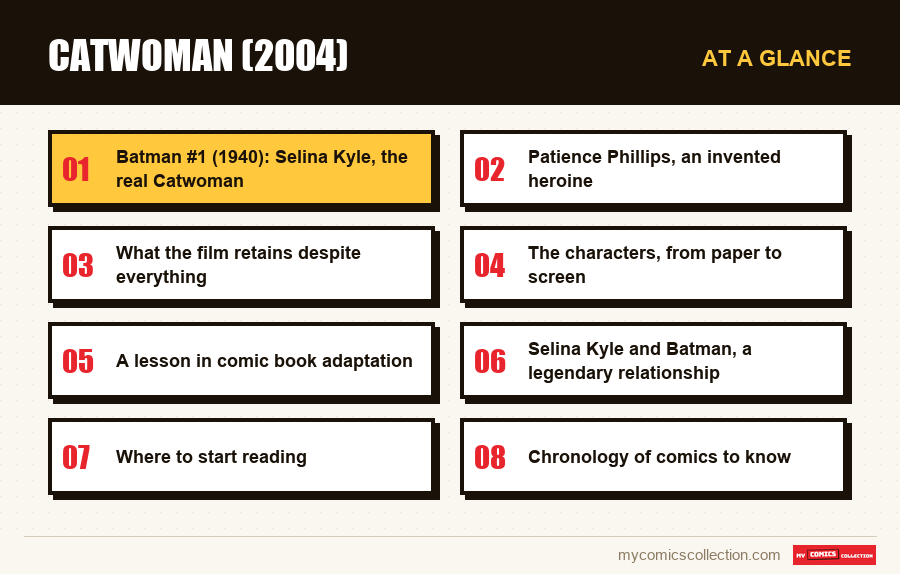
Batman #1 (1940): Selina Kyle, the real Catwoman
The real Catwoman of the comics is Selina Kyle, who appeared in Batman #1 (1940), created by Bill Finger and Bob Kane. A genius burglar roaming the streets of Gotham City, Selina is one of the most iconic figures in the Batman universe. Ambiguous by nature, she oscillates between antagonism and alliance, between crime and redemption, maintaining a complex relationship with the Black Knight made of romantic tension and rivalry. Without superpowers, she relies on her feline agility, her mastery of the whip and her formidable intelligence. A major female character in DC, Catwoman embodies independence, seduction and freedom, refusing to side with either the heroes or the villains.
The 2004 film almost completely ignores this character. It retains only the Catwoman name, feline imagery, agility, whip, and moral ambiguity, but abandons Selina Kyle in favor of an entirely new heroine, Patience Phillips. This decision, one of the most controversial in the history of comic book adaptations, deprives the film of the character's entire heritage: her roots in Gotham, her relationship with Batman, her status as an iconic burglar. Halle Berry plays a Catwoman with no connection to the comics, which deeply disappointed readers. The film illustrates the risks of an adaptation that frees itself from the original material to the point of betraying its essence.
Patience Phillips, an invented heroine
Instead of Selina Kyle, the film stars Patience Phillips, a shy graphic designer working for a cosmetics company. After discovering a compromising secret about a toxic product, she is murdered, then resurrected by a mystical cat, the Egyptian goddess Bastet, who gives her supernatural powers: superhuman agility, feline reflexes and cat instincts. This mystical origin has no connection with the comics, where Selina Kyle is a simple human, without the slightest supernatural power. The film thus radically transforms the nature of the character, making Catwoman a heroine with quasi-magical abilities rather than a skilled and determined burglar.
This total reinvention explains the massive rejection of the film by readers and critics. By abandoning Selina Kyle, her story, her universe and her psychology, the film deprives itself of what makes Catwoman so rich. Patience Phillips, with her mystical powers and her cosmetic cream plot, appears as a generic character with no connection to Gotham's mythology. This approach has lastingly marked the history of adaptations as a counter-example: that of a film which borrows an iconic name without respecting its essence. For the reader, the contrast is striking between the depth of Selina Kyle in the comics and the superficiality of the character on screen. The film implicitly reminds us of the importance of fidelity to the original material in order to succeed in an adaptation.
What the film retains despite everything
The film still retains some superficial elements of the character. Feline imagery is present: Patience adopts cat-like gestures, climbs with agility, has superhuman reflexes and wields a whip, Catwoman's emblematic weapon. The leather suit and sensual aesthetic are visually reminiscent of the character, as is the moral ambiguity: Patience acts outside the law while pursuing a goal of justice. These elements, purely aesthetic, constitute the only tangible link with the comics. They demonstrate a desire to capture the visual aura of Catwoman without taking up its narrative substance.
These surface borrowings paradoxically underline the gap with comics. Where Selina Kyle draws her identity from her history, her environment and her relationships, the film is content with imagery disconnected from any context. Agility and the whip, without the anchor in Gotham or the relationship with Batman, lose their meaning. This approach illustrates the difference between taking on the appearance of a character and capturing their soul. For the reader, the film is an invitation, by contrast, to (re)discover the real Catwoman in the comics, where Selina Kyle displays a dramatic richness that imagery alone cannot replace. The character from the comics, with her complexity and her history, remains incomparably more captivating than the mystical heroine invented for the big screen.
Collecting this series?
Track what you own, what you are missing and what your collection is worth. 7 day trial.
Start my trial →The characters, from paper to screen
- Patience Phillips / Catwoman: Heroine invented for the film, with no connection to the comics.
- Selina Kyle: The real Catwoman from the comics, absent from the film.
- Laurel Hedare: Antagonist created for the film, linked to the cosmetics industry.
- Tom Lone: Police officer and love interest, original character.
- Bastet: The cat goddess who resurrects Patience, an invented mystical element.
A lesson in comic book adaptation
Catwoman has become a textbook case of how not to adapt a comic book character. By abandoning Selina Kyle and her entire world, the film alienated readers and failed to appeal to a wider audience. Its critical and commercial failure permanently associated the title with a failed adaptation. This experience showed studios the importance of respecting the essence of a character, its history and mythology, rather than just keeping the name. The successful adaptations that followed, faithful to the original material, confirmed this lesson a contrario.
This reflection on fidelity resonates with all comic book adaptations. The success of a superhero film relies largely on its ability to honor the characters that readers know and love. Catwoman, by completely freeing itself from its sources, illustrates the failure of an approach which ignores this requirement. The character of Selina Kyle, rich in decades of stories, deserved an adaptation worthy of her complexity. For the reader, the film is a reminder of the value of the source material and an invitation to discover the real Catwoman in the comics, where she remains one of the most fascinating and enduring female figures in the entire DC Universe, a far cry from the mystical heroine of the big screen.
Selina Kyle and Batman, a legendary relationship
One of the richest aspects of Catwoman, completely absent from the film, is her relationship with Batman. Since their first meeting in the 1940s, Selina Kyle and the Dark Knight have maintained one of the most fascinating dynamics in the DC universe: a permanent tension between attraction and opposition, between the vigilante and the burglar. In turn adversaries, allies and lovers, they embody the attraction of opposites, the ordered hero facing the free thief. This ambiguous relationship, developed over decades, has fueled some of Batman's most memorable stories, exploring the blurred lines between good and evil, law and desire.
By cutting Catwoman from Batman and Gotham, the 2004 film deprives itself of this essential dimension. Patience Phillips evolves in a disconnected universe, without the Dark Knight or the mythology that gives meaning to the character. However, it is largely through her relationship with Batman that Selina Kyle reveals her complexity: her quest for freedom, her refusal of labels, her moral ambiguity. For the reader, this absence highlights how much the film missed the essence of the character. The real Catwoman of the comics draws her richness from her anchoring in the Batman universe, where she remains one of the most complex and enduring female figures, a thousand miles from the mystical and solitary heroine imagined for the big screen.
Where to start reading
To discover the real Catwoman, Batman #1 (1940) features the first appearance of Selina Kyle. The Catwoman series by Ed Brubaker (2002) offers a modern and acclaimed reinterpretation of the character. “Catwoman: When in Rome” (2004) by Jeph Loeb and Tim Sale is a key story. “Batman: The Long Halloween” develops his relationship with Batman. This journey reveals the character that the film ignored.
Chronology of comics to know
- 1940: Batman #1: the first appearance of Selina Kyle (Catwoman).
- 2002: Catwoman (series by Ed Brubaker): a major modern rereading.
- 2004: “Catwoman: When in Rome”: a key story from Loeb and Sale.
Collection side: what numbers to aim for after the film
The real Catwoman points to major keys. Batman #1 (1940, first appearance of Selina Kyle and the Joker) is a crucial key to the Golden Age, one of the most sought after and most expensive, very rare. Modern runs like that of Ed Brubaker (2002) are accessible and acclaimed targets. “Catwoman: When in Rome” is an affordable collection. These numbers cover extreme budgets. As always, condition and gradation determine value; relying on real recent sales is strongly recommended.
Its place in the saga and for the collector
Catwoman will remain as one of the most criticized adaptations of the DC universe, for having abandoned Selina Kyle in favor of an invented heroine. For the collector, it paradoxically recalls the importance of Batman #1, the key to the real Catwoman. It illustrates the pitfalls of an unfaithful adaptation. Beyond this failure, the character of Selina Kyle remains one of the richest in DC, to be discovered in the comics. In contrast to the film, the Catwoman of the comics embodies ambiguity, independence and depth, far from the mystical heroine of the big screen.
The verdict: an adaptation that betrays its source
- Loyalty: only Catwoman's name, feline imagery, agility, whip and moral ambiguity come from the comics.
- Freedoms: Patience Phillips replaces Selina Kyle, invented mystical powers, no connection to Gotham or Batman, original cosmetic plot, origin completely rewritten.
- Collectible numbers: Batman #1 (Selina Kyle), the run by Ed Brubaker (2002).
Catwoman (2004) retains only the name and feline imagery from the comics, replacing the real Selina Kyle with an invented heroine with mystical powers. An unfaithful and criticized adaptation, the film illustrates the pitfalls of a film that betrays its source. For both the reader and the collector, it is an invitation to discover the real Catwoman in Batman #1 and the modern runs.
Frequently asked questions
No. The real Catwoman from the comics, Selina Kyle (appeared in Batman #1, 1940), is absent from the film. This invents a new heroine, Patience Phillips, a graphic designer with no connection to Gotham or Batman. This is one of the major criticisms of the film.
From Batman #1 (1940), created by Bill Finger and Bob Kane. Selina Kyle is a Gotham burglar, without superpowers, ambiguous between crime and redemption, linked to Batman by a complex relationship. The film only uses the name and feline imagery.
No. In the comics, Selina Kyle is a simple human, relying on her agility, whip skills, and intelligence. The film invents supernatural powers bestowed by a cat goddess, which betrays the nature of the original character.
Because he abandons Selina Kyle, his universe, his history and his psychology, in favor of an invented heroine with mystical powers. This disregard for the original material, coupled with a weak storyline, made it a textbook case of failed adaptation.
Batman #1 (1940, first appearance of Selina Kyle and the Joker) is a highly sought-after key to the Golden Age. Ed Brubaker's Run (2002) and "Catwoman: When in Rome" (2004) are accessible and acclaimed modern targets.
Does the film make you want to collect? Estimate the value for free of your issues (Batman #1, Catwoman, etc.) with our tool based on current eBay listings.