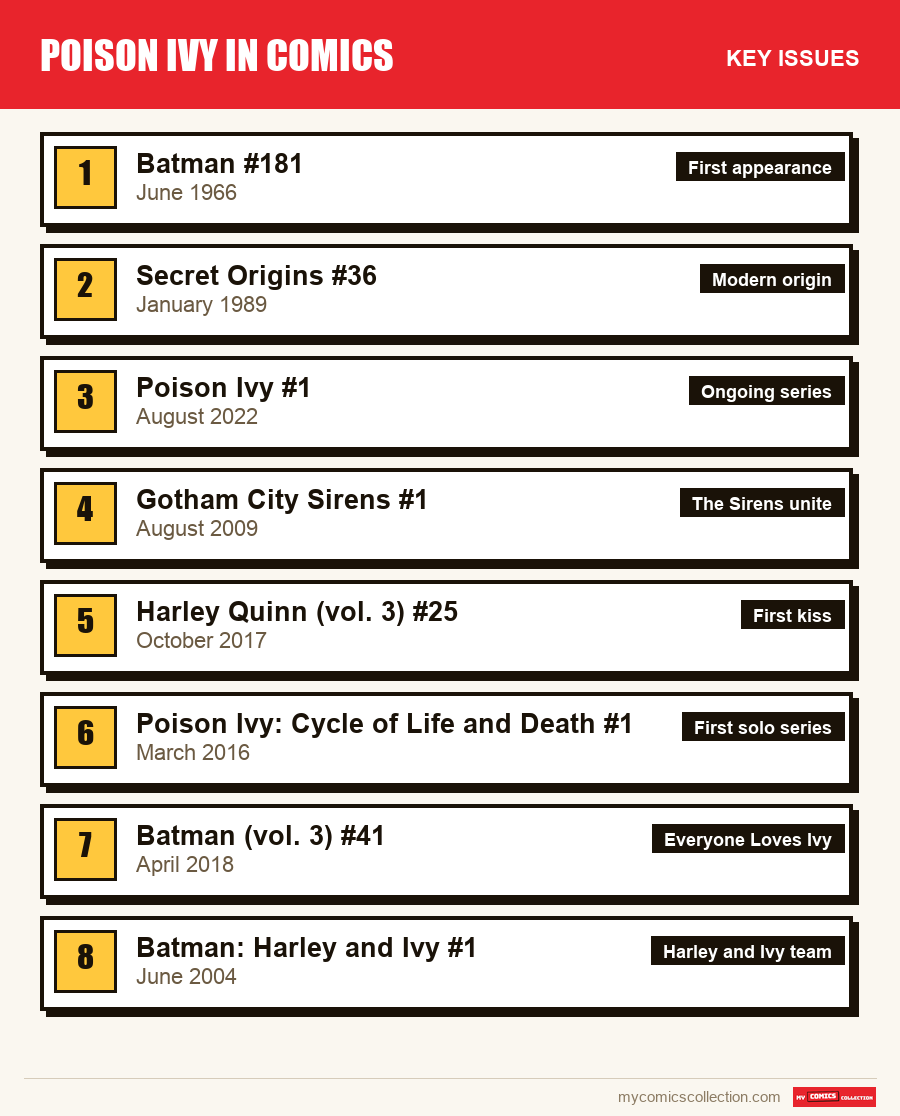
Poison Ivy debuts in Batman #181 (cover date June 1966, on newsstands April 19, 1966), under the pen of Robert Kanigher and the pencil of Sheldon Moldoff, with Carmine Infantino credited as co-creator of the character. Its modern origin: botanist Pamela Isley transformed by the toxins of Dr. Jason Woodrue: is set in 1989 in Secret Origins #36 by Neil Gaiman. Batman #181 remains the key issue reference: the CGC listed 3,540 copies graded in summer 2023, with only four 9.8s and no copies above, and one 9.8 sold for $96,000 in August 2023.
Few villains from Batman's Rogues Gallery have had such a unique trajectory as Poison Ivy. Born in a somewhat forgotten story from the Silver Age, the toxic botanist first lived in the shadow of more flashy figures like the Joker or the Penguin, before becoming, fifty years later, one of the most discussed characters in the entire DC catalog: driven by an original rewrite by Neil Gaiman, a romance with Harley Quinn that became canonical, and a critically acclaimed solo series in 2022.
For a French collector interested in the Batman universe, Poison Ivy occupies a special place: its first appearance comic is an accessible Silver Age compared to juggernauts like Batman #1 or Detective Comics #27, while remaining a real marker of rarity with a limited-period print run and a rating that climbs significantly from the higher grade. This article traces the complete editorial history of the character, from its creation in 1966 to its most recent adaptations, and gives concrete points of reference for those who want to get started in the collection around it.
What is especially striking, in retracing the character's journey, is the gap between his original editorial status and his current place in pop culture. At its creation, Poison Ivy was only one occasional threat among others in a Batman that multiplied new villains to accompany the television craze of the 1966s. Fifty-eight years later, she became a central figure in several media (comics, animation, cinema, video games, live-action series) to the point that her founding key issue, long considered a secondary Silver Age, is now traded at levels comparable to some much more famous keys upon its release.
Poison Ivy: from creation in 1966 to the icon of the Rogues Gallery
The story begins in a Silver Age Batman who was looking for new adversaries to renew a gallery of villains then dominated by the Joker, the Penguin, the Riddler or Two-Face. Robert Kanigher, prolific screenwriter at DC (already father of Wonder Woman during the Golden Age era and creator of Sgt. Rock), imagines a toxic femme fatale whose body secretes plant poisons and whose kisses can kill. The drawing was entrusted to Sheldon Moldoff, then Batman's official ghost-artist: signing contractually under the name Bob Kane, as was the custom at the time for most of the Dark Knight's stories. Carmine Infantino, who oversaw the artistic direction of the title, is today credited as visual co-creator of the character.
The story, entitled “Beware of-Poison Ivy!”, appeared in Batman #181, cover date June 1966 and went on sale April 19, 1966. In terms of design, Poison Ivy borrows her haircut and appearance from the pin-up Bettie Page, very popular in the imagery of the 1950s-60s, while the narrative concept of a woman poisoned by her own beauty owes a lot to the short story "Rappaccini's Daughter" by Nathaniel Hawthorne, a classic of 19th century American literature featuring a young woman made toxic by her botanist father. This double filiation, pin-up culture and Gothic literature, gives the character an unusual texture for the time, halfway between the femme fatale of film noir and the almost mythological figure.
It should be noted that Batman #181 is also memorable for another reason, purely contextual: its publication coincided with the explosion of the Batman television series with Adam West, launched in January 1966, which temporarily increased the sales of Batman comics and pushed the screenwriters to produce visually strong adversaries, capable of functioning as well on paper as on the screen. Poison Ivy was therefore born in this context of editorial overheating, without however being adapted by the Adam West series itself: she remained a strictly comic book character for more than twenty-five years before her first audiovisual incarnation.
The Bronze Age and the recasting of the origin by Neil Gaiman
After her creation, Poison Ivy remained for a time a relatively generic second knife in the Batman stories of the 1960s and 70s, summoned occasionally as an exotic threat without much psychological depth. The real turning point came in 1989, in Secret Origins #36, a story entitled "Pavane" and signed by a young Neil Gaiman, then still far from the notoriety that Sandman or American Gods would earn him.
Gaiman established what would become the enduring canon of the character: Pamela Isley, a gifted botanist raised in a wealthy but emotionally distant family, pursued advanced studies in plant biochemistry alongside a certain Alec Holland, the future Swamp Thing, under the direction of Professor Jason Woodrue, who himself would become the villainous Floronic Man. Seduced and then manipulated by Woodrue, Isley is forcibly injected with a series of experimental poisons and toxins; she survives, but her body undergoes lasting transformation, making her immune to all known poisons and capable of secreting her own deadly toxins on contact. Later developments would link her powers to an elemental force called "the Green", the same energy that animates Swamp Thing, placing Poison Ivy within a broader plant mythology of the DC Universe.
This rewriting changes the nature of the character: from a femme fatale with a simple concept, she becomes a tragic figure, victim of an academic abuse of power before turning into an eco-terrorist convinced that humanity is a threat to nature. This complexity will fuel all subsequent incarnations of the character, from comics to cartoons.
From the 90s to Gotham City Sirens: the rise of the character
The real boost to Poison Ivy's notoriety paradoxically comes from television rather than comics: the episode "Pretty Poison", broadcast on September 14, 1992 in Batman: The Animated Series, introduced the character to the general public with the voice of Diane Pershing. The episode permanently establishes the image of an eco-terrorist obsessed with plant preservation, ready to poison a prosecutor to save a threatened plant species: a characterization directly inherited from the Gaiman version. The success of the animated series, today considered one of the best superhero adaptations ever produced, anchors Poison Ivy in the collective imagination well beyond the comic book readership.
In the comics themselves, the 2000s marked a new stage with the editorial rapprochement between Poison Ivy, Harley Quinn and Catwoman. Screenwriter Paul Dini, who co-wrote "Pretty Poison" for the animated series and created Harley Quinn for the screen before she joined the comics, launched the series in 2009 Gotham City Sirens, which brings together the three characters as an anti-heroic trio sharing an apartment in Gotham. This series lastingly consolidates the friendship between Ivy and Harley, until then treated in a more episodical manner, and prepares the ground for the romantic evolution of the duo a decade later.
Over the decades, Poison Ivy has also circulated between several narrative statuses even within the DC universe: sometimes a solitary threat acting alone against Batman, sometimes an occasional member of collectives of villains like the Legion of Doom or the Suicide Squad depending on the editorial era, sometimes an occasional ally of plant heroes like Swamp Thing, with whom she shares the same source of powers. This script flexibility, rare among secondary villains of the Silver Age, partly explains its longevity: unlike characters who remained fixed in a single register, Ivy could be rewritten as a pure threat, as an anti-heroine, as a romantic figure or as spokesperson for an environmentalist discourse, according to the needs of each run. The New 52 relaunch of 2011 thus reintroduced her in a more radical vein and more connected to Green, while the Rebirth era (from 2016) brought her closer to Harley Quinn again in short stories which prepared the ground for subsequent romantic developments.
Harley and Ivy: the romance that redefined the character
No recent development has had as much impact on Poison Ivy as her relationship with Harley Quinn. The emotional subtext between the two characters has existed since the 1990s, but it was not until 2015 that screenwriters Jimmy Palmiotti and Amanda Conner, then at the helm of the Harley Quinn series, publicly described the duo as "girlfriends without the jealousy of monogamy". The first kiss explicitly shown in the continuity occurs in Harley Quinn Vol. 3 #25 (2017), drawn by Chad Hardin: the original scene showed a kiss on the lips, but DC Comics had the panel modified for a kiss on the cheek before publication: an editorial anecdote that the artist himself would later reveal, when sharing the original, unedited drawing.
The true canonical and unambiguous kiss, integrated into the main continuity of the Batman universe, arrives with Batman: Urban Legends #1 (2021), by Stephanie Phillips and Laura Braga, which shows in flashback the beginning of the romance between the two women: a story that will directly influence the following Batman series as well as Phillips' own Harley Quinn series. The duo will even go as far as marriage in the mini-series Injustice: Year Zero, where Harley and Ivy get married in Las Vegas.
This romantic dimension directly irrigates the solo series Poison Ivy launched on June 7, 2022 by screenwriter G. Willow Wilson (known for Ms. Marvel) and designer Marcio Takara. Initially designed as a mini-series as part of DC's Pride Month, it follows an Ivy stripped of her powers and dying after the events of "Fear State", who undertakes a final journey across the United States to complete a radical mission: save the planet by erasing humanity. Wilson described the project as "a love story from a villainess' point of view", largely constructed in the form of letters Ivy writes to Harley. The critical success - 8.9/10 on the first fifteen aggregate reviews, then an average of 8.2/10 on the complete series according to Comic Book Roundup: led DC to extend the initial six-issue project into a complete ongoing series, with artist Atagun Ilhan joining Takara on the second arc.
Collecting this series?
Track what you own, what you are missing and what your collection is worth. 7 day trial.
Start my trial →The impact of adaptations on the rating
Poison Ivy has experienced a proliferation of audiovisual adaptations which, cumulatively, have largely fueled the demand for its founding comic and its editorial keys. After Batman: The Animated Series in 1992, she appeared in the cinema in 1997 in Batman & Robin, played by Uma Thurman opposite George Clooney: a film that was commercially disappointing upon its release but which, with hindsight and the nostalgic reevaluation of the years 2010-2020, helped to maintain the character's notoriety among a general public unfamiliar with comics.
The Fox series Gotham (2014-2019) integrated the character from its first season in the form of a young teenage Ivy Pepper (Clare Foley), before a transformation into an adult version entrusted successively to Maggie Geha in season 3 then to Peyton List from season 4 - a recasting choice which itself caused discussion within the fanbase. More recently, the animated series Harley Quinn (HBO Max, since 2019), with Lake Bell in the role of Ivy, played a determining role in the general public popularization of the "Harlivy" couple, by formalizing their romantic relationship in season 2 (2020): well before the comics did so explicitly in their main continuity. This streaming success has generated a direct resurgence of interest in the comics on which this relationship is based, notably the Palmiotti/Conner run and the Gotham City Sirens series.
On the video game side, Poison Ivy is present in Rocksteady's Batman: Arkham trilogy, with a different treatment in each episode: direct threat to Batman in Arkham Asylum (2009), antagonist more oriented towards Catwoman in Arkham City (2011), then quasi-ally of the hero in Arkham Knight (2015): an evolution which reflects, in the game, the same shift towards moral complexity that the character has experienced in the comics since Gaiman.
On the paper market, this accumulation of adaptations benefits above all Batman #181, the original key. According to the CGC census stopped in mid-August 2023, 3,540 copies of the issue were then graded, with only four copies at 9.8 and none above: a very low quality ceiling for a Silver Age comic in such high demand, which explains the premium paid for the very best grades. A CGC 9.8 White Pages copy sold for $96,000 on August 10, 2023, while the best sale recorded for a 9.6 grade reached $17,000. A clean example in grade 9.0 generally trades between $3,000 and $3,600, and grades around 4.0 remain accessible, in the low hundreds of dollars range. These very marked differences between intermediate grades and top grades are typical of Silver Age key issues with low populations at the top of the census.
Buying guide: collect Poison Ivy without making a mistake
Building a coherent collection around Poison Ivy requires clearly distinguishing the founding piece, the secondary keys linked to its original rewritings, and the modern issues driven by its current popularity. Here are the essential points before buying:
- Check the restoration on Batman #181. Like many highly sought-after Silver Ages, this issue has been subject to restorations which are not always declared. Systematically favor a CGC or CBCS graded copy with a blue label (unrestored) rather than a "purple label" copy (restored), whose rating clearly drops even at an equivalent grade.
- Understand the census structure before bidding on a high grade. With only four 9.8s and no 9.6+ above that ceiling, each grade jump to the top comes at a high price; a more reasonable budget is fully justified on an 8.0-9.0, which remains a very fine reading and exhibition copy.
- Use the Facsimile Edition as your entry point. DC published in 2019 an almost identical reprint of Batman #181 (release September 4, 2019, cover date November 2019), with foil variant and sketch variant. This is an affordable option to own the cover and the original story without the budget of a vintage copy.
- Don't forget Secret Origins #36 (1989). This issue, which establishes the modern origin of Pamela Isley under the pen of Neil Gaiman, is a major narrative key often underestimated in relation to its real importance in the continuity of the character.
- Spot the milestones in the Harley/Ivy romance if you're interested in this sub-story. Harley Quinn Vol. 3 #25 (2017) and Batman: Urban Legends #1 (2021) are the two reference numbers for the “Harlivy” relationship, highly sought after by a very active fan base since the success of the HBO Max animated series.
- Follow the first draws of the 2022 series. Poison Ivy #1 (G. Willow Wilson / Marcio Takara, June 2022) benefits from a very favorable critical reception and a loyal readership; First impressions and launch variants make for an interesting modern key to watch.
- Always compare several recent sales before setting your budget. The rating of Silver Age key issues evolves quickly according to the latest adaptations (series, films, video games); an estimation tool based on current listings is more reliable than a fixed price guide.
To go further in tracking your own collection, whether it's Batman #181 or your other Batman keys, the collection management application allows you to centralize your numbers, grades and estimates in the same place, and to follow the evolution of their rating over time.
Key issues to know
Batman #181
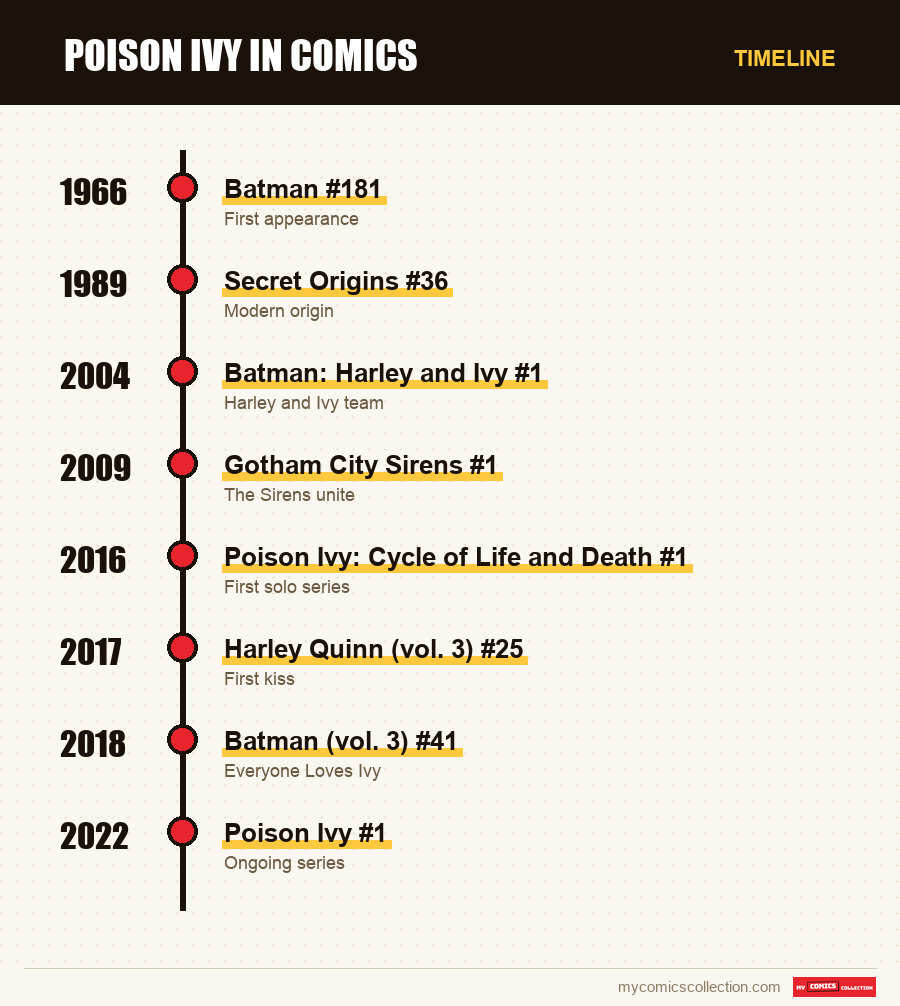
Robert Kanigher (script) and Sheldon Moldoff (art) deliver "Beware of Poison Ivy!". To prove she is Gotham's top female criminal, Poison Ivy challenges Dragon Fly, Silken Spider and Tiger Moth. This is the character's first appearance and the essential key of any Ivy collection.
Secret Origins #36
In "Pavane", Neil Gaiman and Mark Buckingham have Pamela Isley recount, from her cell, her lonely childhood and her botany studies under Jason Woodrue, who seduces her and then injects her with experimental toxins. This origin turns her into a tragic figure and underpins every later version.
Poison Ivy #1
G. Willow Wilson (script) and Marcio Takara (art) launch Ivy's own series, first announced as six issues and then extended. Weakened, Ivy sets off on a journey across the United States, told largely through letters to Harley Quinn. It is the character's modern key.
Gotham City Sirens #1
Paul Dini (script) and Guillem March (art) bring together Poison Ivy, Catwoman and Harley Quinn. Ivy rescues a weakened Catwoman, and the three women decide to team up and move in together. The series firmly establishes the friendship between Ivy and Harley.
Harley Quinn (vol. 3) #25
Written by Amanda Conner and Jimmy Palmiotti and drawn by Chad Hardin, this issue is regarded as the first canonical kiss between Harley Quinn and Poison Ivy. The creators had already described the two women as girlfriends. A milestone for collectors of the couple.
Poison Ivy: Cycle of Life and Death #1
The character's first solo series, written by Amy Chu and drawn by Clay Mann. As Dr. Pamela Isley, Ivy joins the Gotham Botanical Gardens, but her friend and mentor Luisa Cruz is poisoned. Her investigation leads her to create two plant-human hybrid children, Rose and Hazel.
Batman (vol. 3) #41
The first chapter of "Everyone Loves Ivy", written by Tom King and drawn by Mikel Janín. Consumed by guilt, Poison Ivy takes control of everyone on Earth except Batman and Catwoman. With Harley Quinn's help, they convince her to release the world.
Batman: Harley and Ivy #1
Paul Dini and Bruce Timm, the creators of Harley Quinn, devote a miniseries to the pairing of Harley and Poison Ivy. The issue carries over into comics the bond first built in the world of the animated series. An important step on the road to Gotham City Sirens.